
The global Medical Elastomers Market Study analyzes and forecasts the market size across 6 regions and 24 countries for diverse segments -By Type (Thermoplastic Elastomer, Thermoset Elastomer), By Application (Medical Tubes, Medical Bags, Catheters, Syringes, Implants, Gloves, Others).
Medical elastomers are versatile materials used in the production of medical devices, implants, seals, and components requiring flexibility, resilience, and biocompatibility. In 2024, the demand for medical elastomers s to grow as the medical industry relies on these materials for a wide range of applications in healthcare settings. Medical elastomers exhibit properties such as elasticity, tear resistance, chemical inertness, and compatibility with sterilization methods, making them suitable for use in surgical instruments, catheters, tubing, seals, and prosthetic devices. These elastomers are typically based on materials such as silicone, thermoplastic elastomers (TPE), and thermoset rubbers, each offering specific performance characteristics and processing advantages. Silicone elastomers, for example, are widely used in medical applications due to their biocompatibility, temperature resistance, and inertness to body fluids. Thermoplastic elastomers offer advantages such as ease of processing, recyclability, and customizable mechanical properties, making them suitable for injection molding and extrusion processes. With advancements in elastomer chemistry and manufacturing technologies, there is ongoing research into developing novel medical-grade elastomers with enhanced properties such as self-healing, antimicrobial activity, and tissue integration. Further, the adoption of biodegradable and bioresorbable elastomers supports innovations in implantable medical devices and regenerative medicine. As the medical industry s to innovate and introduce new materials and technologies, the demand for medical elastomers is expected to remain strong, driven by their critical role in advancing healthcare delivery and patient care.
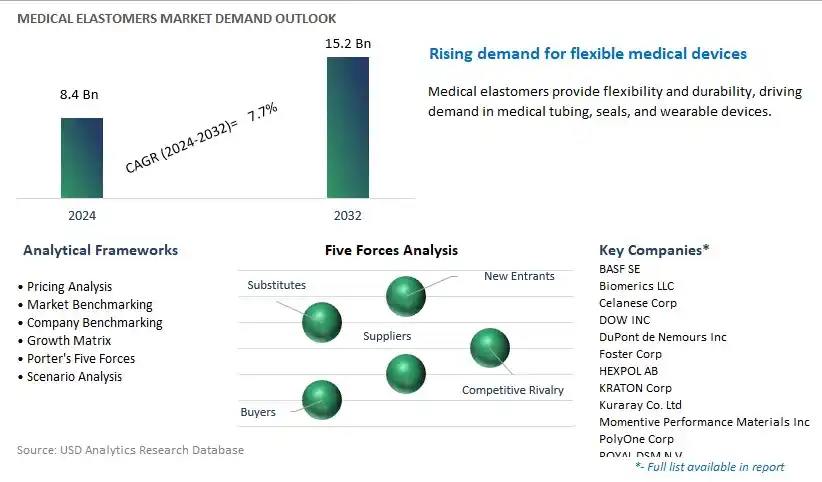
The market report analyses the leading companies in the industry including BASF SE, Biomerics LLC, Celanese Corp, DOW INC, DuPont de Nemours Inc, Foster Corp, HEXPOL AB, KRATON Corp, Kuraray Co. Ltd, Momentive Performance Materials Inc, PolyOne Corp, ROYAL DSM N.V., Solvay SA, Teknor Apex, Trelleborg AB, and others.
A prominent market trend for medical elastomers is the increased demand driven by the growing need for biocompatible materials in medical devices and implants. With advancements in medical technology and an emphasis on patient safety, there's a rising preference for elastomeric materials that are compatible with the human body and minimize the risk of adverse reactions. Medical elastomers offer properties such as flexibility, durability, and resistance to bodily fluids, making them suitable for a wide range of applications including catheters, seals, gaskets, and prosthetic components. This trend is fueled by regulatory requirements, patient preferences, and the desire to enhance the performance and longevity of medical devices, driving the adoption of medical elastomers in the healthcare industry.
A key market driver for medical elastomers is the expansion in medical device manufacturing driven by demographic shifts and technological advancements. As the global population ages and the prevalence of chronic diseases increases, there's a growing demand for medical devices and implants to address healthcare needs. Medical elastomers play a critical role in the fabrication of medical devices due to their versatility, biocompatibility, and ability to withstand sterilization processes. The growing market for medical devices, coupled with innovations in materials science and manufacturing techniques, drives the demand for medical elastomers as essential components in medical device production, supporting the growth of the medical elastomers market.
A potential opportunity for medical elastomers lies in the development of advanced formulations tailored to specific healthcare applications. Opportunities exist for the customization of elastomeric materials to meet the unique requirements of medical devices and implants in terms of mechanical properties, biocompatibility, and performance characteristics. For example, there's a demand for elastomers with antimicrobial properties for use in catheters and implants to reduce the risk of infections. Additionally, bioresorbable elastomers offer opportunities for temporary implants that gradually degrade in the body, eliminating the need for additional surgeries for removal. By focusing on innovation and collaboration with healthcare professionals, manufacturers can capitalize on this opportunity to develop advanced medical elastomers that address unmet needs and improve patient outcomes in the medical device industry.
Among the types of elastomers in the Medical Elastomers market, thermoplastic elastomers (TPEs) are the largest segment. Thermoplastic elastomers offer a unique combination of rubber-like elasticity and thermoplastic processing capabilities, making them highly versatile and suitable for a wide range of medical applications. TPEs are extensively used in medical device manufacturing due to their flexibility, durability, biocompatibility, and ease of processing. They can be molded, extruded, and formed into intricate shapes with precision, allowing for the production of complex medical components and devices. Moreover, TPEs exhibit excellent chemical resistance, sterilization compatibility, and low extractable levels, ensuring safety and reliability in medical applications. Additionally, the growing demand for lightweight, cost-effective, and recyclable materials in the medical industry further drives the adoption of TPEs. As the medical sector continues to evolve and innovate, thermoplastic elastomers are expected to maintain their dominance as the preferred material choice in the Medical Elastomers market.
Among the various applications in the Medical Elastomers market, the segment related to implants is experiencing rapid growth. In particular, there is an increasing demand for medical implants due to the growing prevalence of chronic diseases, aging populations, and advancements in medical technology. Elastomers offer unique advantages for implant applications, including biocompatibility, flexibility, and durability, making them suitable for a wide range of implantable medical devices such as joint replacements, cardiac implants, and soft tissue implants. Moreover, elastomers can mimic the mechanical properties of natural tissues, providing comfort and functionality for patients. Additionally, the development of innovative elastomer formulations with enhanced properties such as antimicrobial capabilities, tissue integration, and controlled drug release further drives the adoption of elastomers in implantable medical devices. As the demand for implants continues to rise and medical technology advances, the implants segment is expected to maintain its rapid growth trajectory in the Medical Elastomers market.
By Type
Thermoplastic Elastomer
Thermoset Elastomer
By Application
Medical Tubes
Medical Bags
Catheters
Syringes
Implants
Gloves
Others
Countries Analyzed
North America (US, Canada, Mexico)
Europe (Germany, UK, France, Spain, Italy, Russia, Rest of Europe)
Asia Pacific (China, India, Japan, South Korea, Australia, South East Asia, Rest of Asia)
South America (Brazil, Argentina, Rest of South America)
Middle East and Africa (Saudi Arabia, UAE, Rest of Middle East, South Africa, Egypt, Rest of Africa)
BASF SE
Biomerics LLC
Celanese Corp
DOW INC
DuPont de Nemours Inc
Foster Corp
HEXPOL AB
KRATON Corp
Kuraray Co. Ltd
Momentive Performance Materials Inc
PolyOne Corp
ROYAL DSM N.V.
Solvay SA
Teknor Apex
Trelleborg AB
*- List Not Exhaustive
TABLE OF CONTENTS
1 Introduction to 2024 Medical Elastomers Market
1.1 Market Overview
1.2 Quick Facts
1.3 Scope/Objective of the Study
1.4 Market Definition
1.5 Countries and Regions Covered
1.6 Units, Currency, and Conversions
1.7 Industry Value Chain
2 Research Methodology
2.1 Market Size Estimation
2.2 Sources and Research Methodology
2.3 Data Triangulation
2.4 Assumptions and Limitations
3 Executive Summary
3.1 Global Medical Elastomers Market Size Outlook, $ Million, 2021 to 2032
3.2 Medical Elastomers Market Outlook by Type, $ Million, 2021 to 2032
3.3 Medical Elastomers Market Outlook by Product, $ Million, 2021 to 2032
3.4 Medical Elastomers Market Outlook by Application, $ Million, 2021 to 2032
3.5 Medical Elastomers Market Outlook by Key Countries, $ Million, 2021 to 2032
4 Market Dynamics
4.1 Key Driving Forces of Medical Elastomers Industry
4.2 Key Market Trends in Medical Elastomers Industry
4.3 Potential Opportunities in Medical Elastomers Industry
4.4 Key Challenges in Medical Elastomers Industry
5 Market Factor Analysis
5.1 Value Chain Analysis
5.2 Competitive Landscape
5.2.1 Global Medical Elastomers Market Share by Company (%), 2023
5.2.2 Product Offerings by Company
5.3 Porter’s Five Forces Analysis
5.4 Pricing Analysis and Outlook
6 Growth Outlook Across Scenarios
6.1 Growth Analysis-Case Scenario Definitions
6.2 Low Growth Scenario Forecasts
6.3 Reference Growth Scenario Forecasts
6.4 High Growth Scenario Forecasts
7 Global Medical Elastomers Market Outlook by Segments
7.1 Medical Elastomers Market Outlook by Segments, $ Million, 2021- 2032
By Type
Thermoplastic Elastomer
Thermoset Elastomer
By Application
Medical Tubes
Medical Bags
Catheters
Syringes
Implants
Gloves
Others
8 North America Medical Elastomers Market Analysis and Outlook To 2032
8.1 Introduction to North America Medical Elastomers Markets in 2024
8.2 North America Medical Elastomers Market Size Outlook by Country, 2021-2032
8.2.1 United States
8.2.2 Canada
8.2.3 Mexico
8.3 North America Medical Elastomers Market size Outlook by Segments, 2021-2032
By Type
Thermoplastic Elastomer
Thermoset Elastomer
By Application
Medical Tubes
Medical Bags
Catheters
Syringes
Implants
Gloves
Others
9 Europe Medical Elastomers Market Analysis and Outlook To 2032
9.1 Introduction to Europe Medical Elastomers Markets in 2024
9.2 Europe Medical Elastomers Market Size Outlook by Country, 2021-2032
9.2.1 Germany
9.2.2 France
9.2.3 Spain
9.2.4 United Kingdom
9.2.4 Italy
9.2.5 Russia
9.2.6 Norway
9.2.7 Rest of Europe
9.3 Europe Medical Elastomers Market Size Outlook by Segments, 2021-2032
By Type
Thermoplastic Elastomer
Thermoset Elastomer
By Application
Medical Tubes
Medical Bags
Catheters
Syringes
Implants
Gloves
Others
10 Asia Pacific Medical Elastomers Market Analysis and Outlook To 2032
10.1 Introduction to Asia Pacific Medical Elastomers Markets in 2024
10.2 Asia Pacific Medical Elastomers Market Size Outlook by Country, 2021-2032
10.2.1 China
10.2.2 India
10.2.3 Japan
10.2.4 South Korea
10.2.5 Indonesia
10.2.6 Malaysia
10.2.7 Australia
10.2.8 Rest of Asia Pacific
10.3 Asia Pacific Medical Elastomers Market size Outlook by Segments, 2021-2032
By Type
Thermoplastic Elastomer
Thermoset Elastomer
By Application
Medical Tubes
Medical Bags
Catheters
Syringes
Implants
Gloves
Others
11 South America Medical Elastomers Market Analysis and Outlook To 2032
11.1 Introduction to South America Medical Elastomers Markets in 2024
11.2 South America Medical Elastomers Market Size Outlook by Country, 2021-2032
11.2.1 Brazil
11.2.2 Argentina
11.2.3 Rest of South America
11.3 South America Medical Elastomers Market size Outlook by Segments, 2021-2032
By Type
Thermoplastic Elastomer
Thermoset Elastomer
By Application
Medical Tubes
Medical Bags
Catheters
Syringes
Implants
Gloves
Others
12 Middle East and Africa Medical Elastomers Market Analysis and Outlook To 2032
12.1 Introduction to Middle East and Africa Medical Elastomers Markets in 2024
12.2 Middle East and Africa Medical Elastomers Market Size Outlook by Country, 2021-2032
12.2.1 Saudi Arabia
12.2.2 UAE
12.2.3 Oman
12.2.4 Rest of Middle East
12.2.5 Egypt
12.2.6 Nigeria
12.2.7 South Africa
12.2.8 Rest of Africa
12.3 Middle East and Africa Medical Elastomers Market size Outlook by Segments, 2021-2032
By Type
Thermoplastic Elastomer
Thermoset Elastomer
By Application
Medical Tubes
Medical Bags
Catheters
Syringes
Implants
Gloves
Others
13 Company Profiles
13.1 Company Snapshot
13.2 SWOT Profiles
13.3 Products and Services
13.4 Recent Developments
13.5 Financial Profile
BASF SE
Biomerics LLC
Celanese Corp
DOW INC
DuPont de Nemours Inc
Foster Corp
HEXPOL AB
KRATON Corp
Kuraray Co. Ltd
Momentive Performance Materials Inc
PolyOne Corp
ROYAL DSM N.V.
Solvay SA
Teknor Apex
Trelleborg AB
14 Appendix
14.1 Customization Offerings
14.2 Subscription Services
14.3 Related Reports
14.4 Publisher Expertise
By Type
Thermoplastic Elastomer
Thermoset Elastomer
By Application
Medical Tubes
Medical Bags
Catheters
Syringes
Implants
Gloves
Others
Countries Analyzed
North America (US, Canada, Mexico)
Europe (Germany, UK, France, Spain, Italy, Russia, Rest of Europe)
Asia Pacific (China, India, Japan, South Korea, Australia, South East Asia, Rest of Asia)
South America (Brazil, Argentina, Rest of South America)
Middle East and Africa (Saudi Arabia, UAE, Rest of Middle East, South Africa, Egypt, Rest of Africa)
Global Medical Elastomers Market Size is valued at $8.4 Billion in 2024 and is forecast to register a growth rate (CAGR) of 7.7% to reach $15.2 Billion by 2032.
Emerging Markets across Asia Pacific, Europe, and Americas present robust growth prospects.
BASF SE, Biomerics LLC, Celanese Corp, DOW INC, DuPont de Nemours Inc, Foster Corp, HEXPOL AB, KRATON Corp, Kuraray Co. Ltd, Momentive Performance Materials Inc, PolyOne Corp, ROYAL DSM N.V., Solvay SA, Teknor Apex, Trelleborg AB
Base Year- 2023; Estimated Year- 2024; Historic Period- 2018-2023; Forecast period- 2024 to 2032; Currency: Revenue (USD); Volume