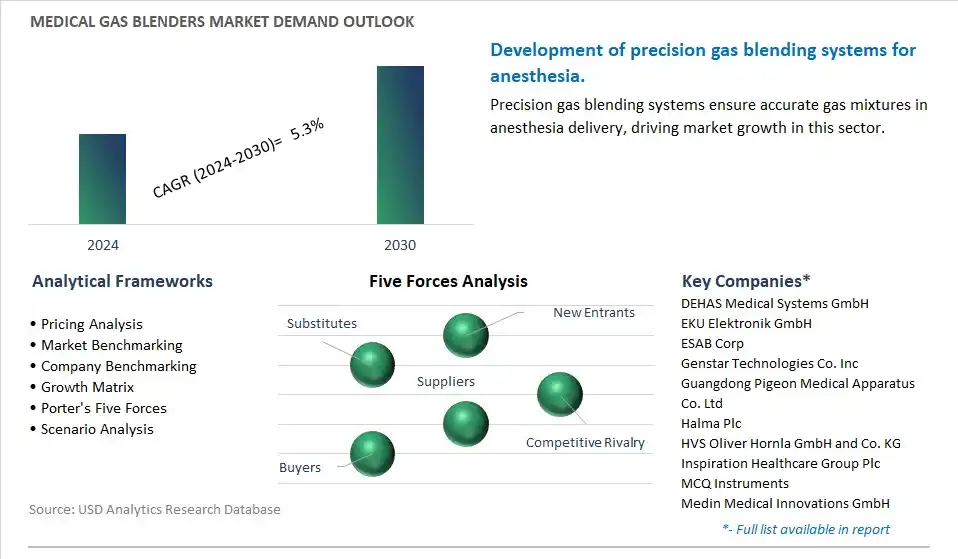
Medical Gas Blenders Market is estimated to increase at a growth rate of 5.3% CAGR over the forecast period from 2024 to 2030.
The global Medical Gas Blenders Market Study analyzes and forecasts the market size across 6 regions and 24 countries for diverse segments including By Product (Dual flow, Tube flow), By End-User (Hospitals, Ambulatory surgical centers, Pharmaceuticals, Homecare settings, Academic and research institutions, Others).
An Introduction to Medical Gas Blenders Market in 2024
The Medical Gas Blenders Market in 2024 addresses the critical need for precise gas mixture delivery in respiratory therapy, anesthesia delivery systems, and hyperbaric oxygen therapy, offering advanced blending solutions for customized oxygen concentrations and flow rates. Medical gas blenders utilize precision flow control valves, sensors, and microprocessor algorithms to accurately mix medical gases such as oxygen, air, and nitrous oxide according to prescribed therapy parameters, ensuring patient safety and treatment efficacy. The market witnesses robust growth driven by increasing prevalence of respiratory disorders, surgical procedures, and critical care interventions requiring precise gas delivery systems. Moreover, technological advancements in blender design, gas monitoring capabilities, and integration with medical devices further propel market expansion, fostering innovation and standardization in respiratory care delivery.
Medical Gas Blenders Market Competitive Landscape
The global Medical Gas Blenders Industry is highly competitive with a large number of companies focusing on niche market segments. Amidst intense competitive conditions, Medical Gas Blenders Companies are investing in new product launches and strengthening distribution channels. Key companies operating in the Medical Gas Blenders Industry include- DEHAS Medical Systems GmbH, EKU Elektronik GmbH, ESAB Corp, Genstar Technologies Co. Inc, Guangdong Pigeon Medical Apparatus Co. Ltd, Halma Plc, HVS Oliver Hornla GmbH and Co. KG , Inspiration Healthcare Group Plc, MCQ Instruments, Medin Medical Innovations GmbH, Ningbo David Medical Device Co. Ltd, Precision Medical Inc, S S Technomed P Ltd, Scanatron Technics AG, Shanghai Amcaremed Technology Co. Ltd, TG Eakin Ltd, Weyer GmbH, WITT Gasetechnik GmbH and Co KG, Zhengzhou Dison Instrument Meter Co. Ltd.
Medical Gas Blenders Market Trend: Integration of Advanced Gas Mixing Technologies
A prominent trend in the medical gas blenders market is the integration of advanced gas mixing technologies, driven by the demand for precise gas concentration control, improved patient safety, and enhanced clinical outcomes in respiratory care settings. Traditional gas blenders utilized manual flow meters and mechanical valves to mix medical gases, which often resulted in inaccuracies, fluctuations, and inconsistencies in gas delivery. However, advancements in sensor technology, microprocessor control, and closed-loop feedback systems have revolutionized gas blending, enabling the development of smart gas blenders equipped with electronic flow sensors, proportional solenoid valves, and real-time monitoring capabilities. These intelligent gas blenders can precisely regulate gas flow rates, adjust gas concentrations, and maintain desired FiO2 levels, ensuring optimal oxygen therapy and ventilation management for patients with respiratory disorders such as chronic obstructive pulmonary disease (COPD), asthma, and respiratory failure. Moreover, integrated safety features such as alarms, pressure sensors, and automatic shut-off mechanisms enhance device reliability, mitigate risks of gas delivery errors, and improve overall patient care quality. As healthcare facilities prioritize respiratory therapy, critical care, and emergency medicine, the demand for advanced gas blenders is expected to rise, driving innovation and market growth in the medical gas blender sector.
Medical Gas Blenders Market Driver: Increasing Incidence of Respiratory Diseases and Critical Care Needs
The increasing incidence of respiratory diseases, critical care admissions, and surgical interventions represents a significant driver for the medical gas blenders market, fueled by demographic changes, environmental factors, and advancements in medical technology. Respiratory disorders such as COPD, pneumonia, and acute respiratory distress syndrome (ARDS) are leading causes of morbidity and mortality worldwide, contributing to significant healthcare burden and resource utilization. Effective management of respiratory conditions often requires supplemental oxygen therapy, mechanical ventilation, or anesthesia administration, necessitating precise control of gas concentrations and flow rates to optimize gas exchange, minimize ventilator-associated complications, and support patient recovery. Medical gas blenders play a critical role in delivering oxygen-enriched air, nitrous oxide, or medical air to patients undergoing respiratory support, anesthesia induction, or procedural sedation in various healthcare settings, including hospitals, intensive care units (ICUs), and operating rooms. Additionally, the COVID-19 pandemic has underscored the importance of respiratory care and ventilator support in managing severe respiratory illness, driving demand for respiratory therapy equipment and gas delivery systems. As healthcare systems invest in respiratory care infrastructure, critical care capacity, and infection control measures, the market for medical gas blenders is poised for growth, driven by the need for reliable, efficient, and adaptable gas delivery solutions in diverse clinical scenarios.
Medical Gas Blenders Market Opportunity: Expansion of Home Respiratory Therapy and Telehealth Services
A Market Opportunity in the medical gas blenders market lies in the expansion of home respiratory therapy and telehealth services, catering to the growing demand for remote monitoring, virtual consultations, and decentralized care delivery models in respiratory medicine. Traditionally, respiratory therapy and oxygen supplementation were primarily administered in hospital settings, requiring specialized equipment, trained personnel, and in-person consultations. However, the shift towards patient-centered care, aging-in-place initiatives, and healthcare cost containment has led to increased adoption of home-based respiratory therapy solutions, including portable oxygen concentrators, home mechanical ventilators, and oxygen delivery systems. Medical gas blenders designed for home use offer compact, lightweight, and user-friendly options that enable patients to receive oxygen therapy, nebulized medications, or positive airway pressure (PAP) therapy in the comfort of their own homes, under the supervision of healthcare professionals or through telehealth platforms. By partnering with home healthcare agencies, durable medical equipment (DME) suppliers, and telemedicine providers, companies can offer comprehensive respiratory therapy packages that include gas blenders, oxygen delivery devices, remote monitoring devices, and virtual support services. Moreover, integrating gas blender data with electronic health records (EHRs) and telehealth platforms enables seamless communication, data sharing, and care coordination between patients, caregivers, and healthcare providers, promoting continuity of care and optimizing treatment outcomes. By embracing the shift towards home-based care and digital health solutions, companies can capitalize on the expanding market opportunities in home respiratory therapy and telehealth, driving innovation and market growth in the medical gas blender sector.
Medical Gas Blenders Market Share Analysis: Dual Flow Medical Gas Blenders is the fastest growing market segment over the forecast period to 2030
Among medical gas blenders, the segment experiencing the fastest growth is Dual Flow Medical Gas Blenders. These devices are designed to precisely mix and regulate the flow of medical gases, ensuring accurate concentrations for patient therapy or anesthesia delivery. The increasing demand for dual flow medical gas blenders can be attributed to their versatility and efficiency in healthcare settings. These blenders offer the capability to deliver two different gases simultaneously, allowing healthcare providers to administer tailored treatments to patients with diverse respiratory needs. Their widespread adoption in hospitals, ambulatory surgical centers, pharmaceutical facilities, homecare settings, and academic and research institutions underscores their importance in enhancing patient care and safety. With advancements in medical technology and growing emphasis on patient-centric care, the market for dual flow medical gas blenders is expected to witness continued expansion in the coming years.
Medical Gas Blenders Market Segmentation
By Product
Dual flow
Tube flow
By End-User
Hospitals
Ambulatory surgical centers
Pharmaceuticals
Homecare settings
Academic and research institutions
Others
Geographical Analysis
North America (United States, Canada, Mexico)
Europe (Germany, France, United Kingdom, Spain, Italy, Rest of Europe)
Asia Pacific (China, India, Japan, South Korea, Rest of Asia Pacific)
South America (Brazil, Argentina, Rest of South America)
Middle East and Africa (Saudi Arabia, UAE, Rest of Middle East, South Africa, Egypt, Rest of Africa)
Medical Gas Blenders Companies
DEHAS Medical Systems GmbH
EKU Elektronik GmbH
ESAB Corp
Genstar Technologies Co. Inc
Guangdong Pigeon Medical Apparatus Co. Ltd
Halma Plc
HVS Oliver Hornla GmbH and Co. KG
Inspiration Healthcare Group Plc
MCQ Instruments
Medin Medical Innovations GmbH
Ningbo David Medical Device Co. Ltd
Precision Medical Inc
S S Technomed P Ltd
Scanatron Technics AG
Shanghai Amcaremed Technology Co. Ltd
TG Eakin Ltd
Weyer GmbH
WITT Gasetechnik GmbH and Co KG
Zhengzhou Dison Instrument Meter Co. Ltd
* List not Exhaustive
Reasons to Buy the Medical Gas Blenders Market Market Study
• Deepen your industry insights and navigate uncertainties for strategy formulation, CAPEX, and Operational decisions
• Gain access to detailed insights on the Medical Gas Blenders Market Market, encompassing current market size, growth trends, and forecasts till 2030.
• Access detailed competitor analysis, enabling competitive advantage through a thorough understanding of market players, strategies, and potential differentiation opportunities
• Stay ahead of the curve with insights on technological advancements, innovations, and upcoming trends
• Identify lucrative investment avenues and expansion opportunities within the Medical Gas Blenders Market Industry, guided by robust, data-backed analysis.
• Understand regional and global markets through country-wise analysis, regional market potential, regulatory nuances, and dynamics
• Execute strategies with confidence and speed through information, analytics, and insights on the industry value chain
• Corporate leaders, strategists, financial experts, shareholders, asset managers, and governmental representatives can make long-term planning scenarios and build an integrated and timely understanding of market dynamics
• Benefit from tailored solutions and expert consultation based on report insights, providing personalized strategies aligned with specific business needs.
TABLE OF CONTENTS
1 Introduction to 2024 Medical Gas Blenders Market
1.1 Market Overview
1.2 Quick Facts
1.3 Scope/Objective of the Study
1.4 Market Definition
1.5 Countries and Regions Analyzed
1.6 Units, Currency, and Conversions
1.7 Industry Value Chain
2 Research Methodology
2.1 Market Size Estimation
2.2 Sources and Research Methodology
2.3 Data Triangulation
2.4 Assumptions and Limitations
3 Executive Summary
3.1 Global Medical Gas Blenders Market Size Outlook, $ Million, 2021 to 2030
3.2 Medical Gas Blenders Market Outlook by Type, $ Million, 2021 to 2030
3.3 Medical Gas Blenders Market Outlook by Product, $ Million, 2021 to 2030
3.4 Medical Gas Blenders Market Outlook by Application, $ Million, 2021 to 2030
3.5 Medical Gas Blenders Market Outlook by Key Countries, $ Million, 2021 to 2030
4 Market Dynamics
4.1 Key Driving Forces of Medical Gas Blenders Industry
4.2 Key Market Trends in Medical Gas Blenders Industry
4.3 Potential Opportunities in Medical Gas Blenders Industry
4.4 Key Challenges in Medical Gas Blenders Industry
5 Market Factor Analysis
5.1 Value Chain Analysis
5.2 Competitive Landscape
5.2.1 Global Medical Gas Blenders Market Share by Company (%), 2023
5.2.2 Product Offerings by Company
5.3 Porter’s Five Forces Analysis
5.4 Pricing Analysis and Outlook
6 Growth Outlook Across Scenarios
6.1 Growth Analysis-Case Scenario Definitions
6.2 Low Growth Scenario Forecasts
6.3 Reference Growth Scenario Forecasts
6.4 High Growth Scenario Forecasts
7 Global Medical Gas Blenders Market Outlook by Segments
7.1 Medical Gas Blenders Market Outlook by Segments, $ Million, 2021- 2030
By Product
Dual flow
Tube flow
By End-User
Hospitals
Ambulatory surgical centers
Pharmaceuticals
Homecare settings
Academic and research institutions
Others
8 North America Medical Gas Blenders Market Analysis and Outlook To 2030
8.1 Introduction to North America Medical Gas Blenders Markets in 2024
8.2 North America Medical Gas Blenders Market Size Outlook by Country, 2021-2030
8.2.1 United States
8.2.2 Canada
8.2.3 Mexico
8.3 North America Medical Gas Blenders Market size Outlook by Segments, 2021-2030
By Product
Dual flow
Tube flow
By End-User
Hospitals
Ambulatory surgical centers
Pharmaceuticals
Homecare settings
Academic and research institutions
Others
9 Europe Medical Gas Blenders Market Analysis and Outlook To 2030
9.1 Introduction to Europe Medical Gas Blenders Markets in 2024
9.2 Europe Medical Gas Blenders Market Size Outlook by Country, 2021-2030
9.2.1 Germany
9.2.2 France
9.2.3 Spain
9.2.4 United Kingdom
9.2.4 Italy
9.2.5 Russia
9.2.6 Norway
9.2.7 Rest of Europe
9.3 Europe Medical Gas Blenders Market Size Outlook by Segments, 2021-2030
By Product
Dual flow
Tube flow
By End-User
Hospitals
Ambulatory surgical centers
Pharmaceuticals
Homecare settings
Academic and research institutions
Others
10 Asia Pacific Medical Gas Blenders Market Analysis and Outlook To 2030
10.1 Introduction to Asia Pacific Medical Gas Blenders Markets in 2024
10.2 Asia Pacific Medical Gas Blenders Market Size Outlook by Country, 2021-2030
10.2.1 China
10.2.2 India
10.2.3 Japan
10.2.4 South Korea
10.2.5 Indonesia
10.2.6 Malaysia
10.2.7 Australia
10.2.8 Rest of Asia Pacific
10.3 Asia Pacific Medical Gas Blenders Market size Outlook by Segments, 2021-2030
By Product
Dual flow
Tube flow
By End-User
Hospitals
Ambulatory surgical centers
Pharmaceuticals
Homecare settings
Academic and research institutions
Others
11 South America Medical Gas Blenders Market Analysis and Outlook To 2030
11.1 Introduction to South America Medical Gas Blenders Markets in 2024
11.2 South America Medical Gas Blenders Market Size Outlook by Country, 2021-2030
11.2.1 Brazil
11.2.2 Argentina
11.2.3 Rest of South America
11.3 South America Medical Gas Blenders Market size Outlook by Segments, 2021-2030
By Product
Dual flow
Tube flow
By End-User
Hospitals
Ambulatory surgical centers
Pharmaceuticals
Homecare settings
Academic and research institutions
Others
12 Middle East and Africa Medical Gas Blenders Market Analysis and Outlook To 2030
12.1 Introduction to Middle East and Africa Medical Gas Blenders Markets in 2024
12.2 Middle East and Africa Medical Gas Blenders Market Size Outlook by Country, 2021-2030
12.2.1 Saudi Arabia
12.2.2 UAE
12.2.3 Oman
12.2.4 Rest of Middle East
12.2.5 Egypt
12.2.6 Nigeria
12.2.7 South Africa
12.2.8 Rest of Africa
12.3 Middle East and Africa Medical Gas Blenders Market size Outlook by Segments, 2021-2030
By Product
Dual flow
Tube flow
By End-User
Hospitals
Ambulatory surgical centers
Pharmaceuticals
Homecare settings
Academic and research institutions
Others
13 Company Profiles
13.1 Company Snapshot
13.2 SWOT Profiles
13.3 Products and Services
13.4 Recent Developments
13.5 Financial Profile
List of Companies
DEHAS Medical Systems GmbH
EKU Elektronik GmbH
ESAB Corp
Genstar Technologies Co. Inc
Guangdong Pigeon Medical Apparatus Co. Ltd
Halma Plc
HVS Oliver Hornla GmbH and Co. KG
Inspiration Healthcare Group Plc
MCQ Instruments
Medin Medical Innovations GmbH
Ningbo David Medical Device Co. Ltd
Precision Medical Inc
S S Technomed P Ltd
Scanatron Technics AG
Shanghai Amcaremed Technology Co. Ltd
TG Eakin Ltd
Weyer GmbH
WITT Gasetechnik GmbH and Co KG
Zhengzhou Dison Instrument Meter Co. Ltd
14 Appendix
14.1 Customization Offerings
14.2 Subscription Services
14.3 Related Reports
14.4 Publisher Expertise
