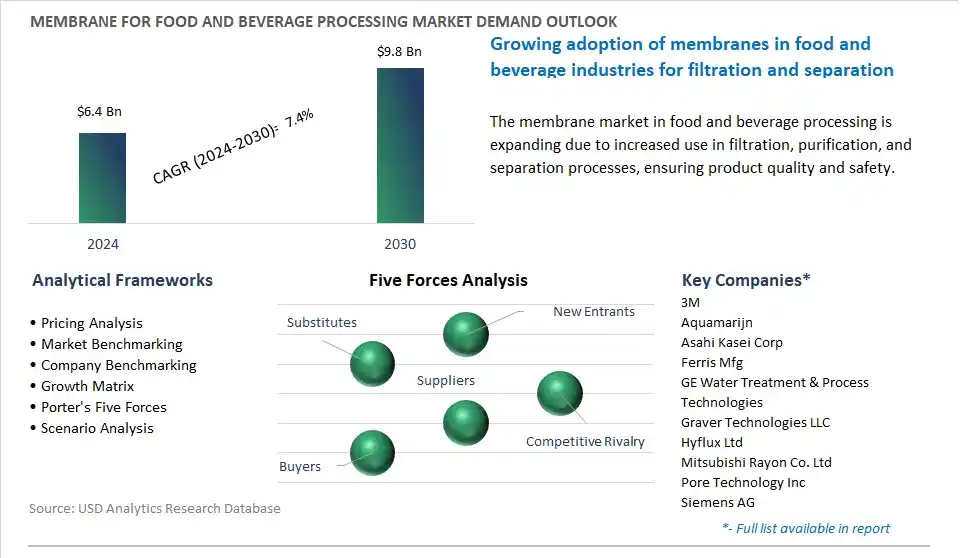
The global Membrane for Food and Beverage Processing Market is poised to register a 7.4% CAGR from $6.4 Billion in 2024 to $9.8 Billion in 2030.
The global Membrane for Food and Beverage Processing Market Study analyzes and forecasts the market size across 6 regions and 24 countries for diverse segments -By Type (Polymeric Membranes, Ceramic Membranes), By Technology (Ultrafiltration, Microfiltration, Nanofiltration, Reverse Osmosis, Pervaporation, Gas Separation), By Application (Dairy Processing, Beverage Processing, Food & Starch Processing).
An Introduction to Global Membrane for Food and Beverage Processing Market in 2024
The future of membranes for food and beverage processing is influenced by several key trends, including increasing demand for efficient and sustainable food processing technologies, advancements in membrane materials and filtration techniques, and growing emphasis on food safety, quality, and shelf-life extension. Membranes are thin barriers used in various food and beverage processing applications such as filtration, separation, and concentration, offering properties such as size exclusion, molecular selectivity, and fouling resistance. With the rise of global food production, changing consumer preferences, and stringent regulations, there's a growing need for membranes that offer high performance, hygiene, and product integrity while minimizing energy consumption, waste generation, and chemical usage in food processing operations. Moreover, advancements in membrane technology, such as nanofiltration, reverse osmosis, and membrane distillation, are driving the development of innovative solutions for removing contaminants, reducing water usage, and preserving nutritional value and flavor in food and beverage products. Additionally, the integration of membranes into food processing systems such as dairy processing, juice clarification, and wastewater treatment is enhancing process efficiency, product quality, and sustainability across the food supply chain. Collaboration between membrane manufacturers, food processors, research institutions, and regulatory agencies is essential to drive innovation, ensure membrane performance, and address market demands in the membrane for food and beverage processing industry.
Membrane for Food and Beverage Processing Market Competitive Landscape
The market report analyses the leading companies in the industry including 3M, Aquamarijn, Asahi Kasei Corp, Ferris Mfg, GE Water Treatment & Process Technologies, Graver Technologies LLC, Hyflux Ltd, Mitsubishi Rayon Co. Ltd, Pore Technology Inc, Siemens AG.
Membrane for Food and Beverage Processing Market Dynamics
Membrane for Food and Beverage Processing Market Trend: Adoption of Membrane Technology for Enhanced Food Safety and Quality Assurance
A significant trend in the membrane for food and beverage processing market is the widespread adoption of membrane technology to enhance food safety and quality assurance. With increasing consumer demand for safe and high-quality food products, there's a growing reliance on membrane filtration and separation techniques to remove contaminants, pathogens, and undesirable components from food and beverage streams. Membrane processes such as microfiltration, ultrafiltration, nanofiltration, and reverse osmosis offer precise and efficient filtration, allowing manufacturers to achieve desired product specifications while maintaining nutritional value and flavor profiles. Additionally, membrane technology enables the production of shelf-stable and minimally processed foods without the need for heat or chemical additives, aligning with consumer preferences for clean label and minimally processed products. As food safety regulations become more stringent globally, the adoption of membrane technology for food and beverage processing is expected to continue rising, driving market growth.
Membrane for Food and Beverage Processing Market Driver: Increasing Demand for Sustainable and Cost-Effective Food Processing Solutions
A major driver of the membrane for food and beverage processing market is the increasing demand for sustainable and cost-effective food processing solutions. As the global population grows and urbanizes, there's a rising need for efficient and environmentally friendly methods to produce, process, and preserve food and beverages. Membrane technology offers several advantages, including reduced water usage, energy efficiency, and minimal waste generation compared to traditional processing methods such as thermal pasteurization and chemical treatments. Furthermore, membrane processes enable the recovery and reuse of valuable ingredients and by-products, enhancing resource efficiency and reducing production costs for food manufacturers. With sustainability becoming a key focus for the food and beverage industry, the demand for membrane solutions that enable eco-friendly and economically viable food processing continues to drive market expansion.
Membrane for Food and Beverage Processing Market Opportunity: Expansion into Emerging Applications and Geographies
An opportunity within the membrane for food and beverage processing market lies in the expansion into emerging applications and geographies. While membrane technology is well-established in applications such as dairy processing, fruit juice clarification, and water purification, there's untapped potential in emerging segments such as plant-based protein extraction, alcoholic beverage clarification, and functional ingredient recovery. These segments present opportunities for membrane manufacturers to develop specialized membranes and process solutions tailored to the unique requirements of each application. Additionally, there's growing demand for membrane technology in emerging markets, particularly in Asia-Pacific and Latin America, where rapid urbanization and changing dietary preferences are driving the growth of the food and beverage industry. By investing in research and development and establishing partnerships with local distributors and food processors, companies can capitalize on the expanding opportunities in emerging applications and geographies, driving further growth and market penetration in the membrane for food and beverage processing market.
Membrane for Food and Beverage Processing Market Share Analysis: The Polymeric Membranes segment generated the highest revenue in 2024
The largest segment in the Membrane for Food and Beverage Processing Market is Polymeric Membranes. Polymeric membranes have witnessed significant growth in recent years due to their widespread applications and Diverse inherent advantages over ceramic membranes. One of the key reasons for their dominance is their versatility and flexibility in terms of design and functionality, allowing for customization to suit various food and beverage processing requirements. Polymeric membranes offer excellent performance in separating and purifying liquids and gases, making them indispensable in processes such as microfiltration, ultrafiltration, nanofiltration, and reverse osmosis, which are vital in the food and beverage industry for tasks like clarification, concentration, and sterilization. Further, polymeric membranes are generally more cost-effective than ceramic membranes, making them a preferred choice for many food and beverage manufacturers, particularly those operating on a larger scale. Additionally, ongoing advancements in polymer chemistry and membrane technology are further driving the growth of this segment, as manufacturers continue to innovate and develop new materials and configurations to enhance performance and efficiency in food and beverage processing applications.
Membrane for Food and Beverage Processing Market Share Analysis: The Nanofiltration segment is poised to register the fastest growth rate (CAGR) over the forecast period to 2030
The fastest-growing segment in the Membrane for Food and Beverage Processing Market is Nanofiltration. Nanofiltration technology has been experiencing rapid growth due to its unique ability to selectively separate and concentrate components in food and beverage processing streams with precision and efficiency. One of the primary reasons for this accelerated growth is the increasing demand for higher-quality products and the need for advanced separation technologies to meet stringent industry standards. Nanofiltration membranes operate on a smaller scale than reverse osmosis membranes, allowing for the retention of certain ions and molecules while selectively permeating others, which is particularly advantageous in applications such as flavor and color removal, desalination, and concentration of valuable components like proteins and vitamins. Additionally, nanofiltration offers benefits such as lower energy consumption and reduced fouling compared to other membrane technologies, making it an attractive option for food and beverage manufacturers seeking to enhance process efficiency and product quality while reducing operational costs. Further, ongoing research and development efforts aimed at improving nanofiltration membrane performance and expanding its applicability across various food and beverage processing operations are further driving the growth of this segment in the market.
Membrane for Food and Beverage Processing Market Share Analysis: The Beverage Processing segment is poised to register the fastest growth rate (CAGR) over the forecast period to 2030
The fastest-growing segment in the Membrane for Food and Beverage Processing Market is Beverage Processing. There has been a significant increase in consumer demand for a diverse range of beverages, including fruit juices, soft drinks, sports drinks, and functional beverages, driven by shifting consumer preferences towards healthier options and convenient ready-to-drink products. Additionally, beverage manufacturers are increasingly adopting membrane technology to enhance product quality, extend shelf life, and meet regulatory requirements regarding food safety and hygiene. Membrane processes such as microfiltration and ultrafiltration are particularly valuable in beverage processing for tasks like clarification, sterilization, and concentration, allowing manufacturers to achieve desired product characteristics while preserving flavor and nutritional integrity. Further, the versatility of membrane technology enables its application across various beverage categories, from traditional carbonated drinks to emerging segments like plant-based beverages and nutraceuticals, further fueling its rapid growth in the beverage processing industry.
Membrane for Food and Beverage Processing Market Report Segmentation
By Type
Polymeric Membranes
Ceramic Membranes
By Technology
Ultrafiltration
Microfiltration
Nanofiltration
Reverse Osmosis
Pervaporation
Gas Separation
By Application
Dairy Processing
Beverage Processing
Food & Starch Processing
Regions Included
North America (US, Canada, Mexico)
Europe (Germany, UK, France, Spain, Italy, Russia, Rest of Europe)
Asia Pacific (China, India, Japan, South Korea, Australia, South East Asia, Rest of Asia)
South America (Brazil, Argentina, Rest of South America)
Middle East and Africa (Saudi Arabia, UAE, Rest of Middle East, South Africa, Egypt, Rest of Africa)
Membrane for Food and Beverage Processing Companies Profiled in the Market Study
3M
Aquamarijn
Asahi Kasei Corp
Ferris Mfg
GE Water Treatment & Process Technologies
Graver Technologies LLC
Hyflux Ltd
Mitsubishi Rayon Co. Ltd
Pore Technology Inc
Siemens AG
*- List Not Exhaustive
TABLE OF CONTENTS
1 Introduction to 2024 Membrane for Food and Beverage Processing Market
1.1 Market Overview
1.2 Quick Facts
1.3 Scope/Objective of the Study
1.4 Market Definition
1.5 Countries and Regions Covered
1.6 Units, Currency, and Conversions
1.7 Industry Value Chain
2 Research Methodology
2.1 Market Size Estimation
2.2 Sources and Research Methodology
2.3 Data Triangulation
2.4 Assumptions and Limitations
3 Executive Summary
3.1 Global Membrane for Food and Beverage Processing Market Size Outlook, $ Million, 2021 to 2030
3.2 Membrane for Food and Beverage Processing Market Outlook by Type, $ Million, 2021 to 2030
3.3 Membrane for Food and Beverage Processing Market Outlook by Product, $ Million, 2021 to 2030
3.4 Membrane for Food and Beverage Processing Market Outlook by Application, $ Million, 2021 to 2030
3.5 Membrane for Food and Beverage Processing Market Outlook by Key Countries, $ Million, 2021 to 2030
4 Market Dynamics
4.1 Key Driving Forces of Membrane for Food and Beverage Processing Industry
4.2 Key Market Trends in Membrane for Food and Beverage Processing Industry
4.3 Potential Opportunities in Membrane for Food and Beverage Processing Industry
4.4 Key Challenges in Membrane for Food and Beverage Processing Industry
5 Market Factor Analysis
5.1 Value Chain Analysis
5.2 Competitive Landscape
5.2.1 Global Membrane for Food and Beverage Processing Market Share by Company (%), 2023
5.2.2 Product Offerings by Company
5.3 Porter’s Five Forces Analysis
5.4 Pricing Analysis and Outlook
6 Growth Outlook Across Scenarios
6.1 Growth Analysis-Case Scenario Definitions
6.2 Low Growth Scenario Forecasts
6.3 Reference Growth Scenario Forecasts
6.4 High Growth Scenario Forecasts
7 Global Membrane for Food and Beverage Processing Market Outlook by Segments
7.1 Membrane for Food and Beverage Processing Market Outlook by Segments, $ Million, 2021- 2030
By Type
Polymeric Membranes
Ceramic Membranes
By Technology
Ultrafiltration
Microfiltration
Nanofiltration
Reverse Osmosis
Pervaporation
Gas Separation
By Application
Dairy Processing
Beverage Processing
Food & Starch Processing
8 North America Membrane for Food and Beverage Processing Market Analysis and Outlook To 2030
8.1 Introduction to North America Membrane for Food and Beverage Processing Markets in 2024
8.2 North America Membrane for Food and Beverage Processing Market Size Outlook by Country, 2021-2030
8.2.1 United States
8.2.2 Canada
8.2.3 Mexico
8.3 North America Membrane for Food and Beverage Processing Market size Outlook by Segments, 2021-2030
By Type
Polymeric Membranes
Ceramic Membranes
By Technology
Ultrafiltration
Microfiltration
Nanofiltration
Reverse Osmosis
Pervaporation
Gas Separation
By Application
Dairy Processing
Beverage Processing
Food & Starch Processing
9 Europe Membrane for Food and Beverage Processing Market Analysis and Outlook To 2030
9.1 Introduction to Europe Membrane for Food and Beverage Processing Markets in 2024
9.2 Europe Membrane for Food and Beverage Processing Market Size Outlook by Country, 2021-2030
9.2.1 Germany
9.2.2 France
9.2.3 Spain
9.2.4 United Kingdom
9.2.4 Italy
9.2.5 Russia
9.2.6 Norway
9.2.7 Rest of Europe
9.3 Europe Membrane for Food and Beverage Processing Market Size Outlook by Segments, 2021-2030
By Type
Polymeric Membranes
Ceramic Membranes
By Technology
Ultrafiltration
Microfiltration
Nanofiltration
Reverse Osmosis
Pervaporation
Gas Separation
By Application
Dairy Processing
Beverage Processing
Food & Starch Processing
10 Asia Pacific Membrane for Food and Beverage Processing Market Analysis and Outlook To 2030
10.1 Introduction to Asia Pacific Membrane for Food and Beverage Processing Markets in 2024
10.2 Asia Pacific Membrane for Food and Beverage Processing Market Size Outlook by Country, 2021-2030
10.2.1 China
10.2.2 India
10.2.3 Japan
10.2.4 South Korea
10.2.5 Indonesia
10.2.6 Malaysia
10.2.7 Australia
10.2.8 Rest of Asia Pacific
10.3 Asia Pacific Membrane for Food and Beverage Processing Market size Outlook by Segments, 2021-2030
By Type
Polymeric Membranes
Ceramic Membranes
By Technology
Ultrafiltration
Microfiltration
Nanofiltration
Reverse Osmosis
Pervaporation
Gas Separation
By Application
Dairy Processing
Beverage Processing
Food & Starch Processing
11 South America Membrane for Food and Beverage Processing Market Analysis and Outlook To 2030
11.1 Introduction to South America Membrane for Food and Beverage Processing Markets in 2024
11.2 South America Membrane for Food and Beverage Processing Market Size Outlook by Country, 2021-2030
11.2.1 Brazil
11.2.2 Argentina
11.2.3 Rest of South America
11.3 South America Membrane for Food and Beverage Processing Market size Outlook by Segments, 2021-2030
By Type
Polymeric Membranes
Ceramic Membranes
By Technology
Ultrafiltration
Microfiltration
Nanofiltration
Reverse Osmosis
Pervaporation
Gas Separation
By Application
Dairy Processing
Beverage Processing
Food & Starch Processing
12 Middle East and Africa Membrane for Food and Beverage Processing Market Analysis and Outlook To 2030
12.1 Introduction to Middle East and Africa Membrane for Food and Beverage Processing Markets in 2024
12.2 Middle East and Africa Membrane for Food and Beverage Processing Market Size Outlook by Country, 2021-2030
12.2.1 Saudi Arabia
12.2.2 UAE
12.2.3 Oman
12.2.4 Rest of Middle East
12.2.5 Egypt
12.2.6 Nigeria
12.2.7 South Africa
12.2.8 Rest of Africa
12.3 Middle East and Africa Membrane for Food and Beverage Processing Market size Outlook by Segments, 2021-2030
By Type
Polymeric Membranes
Ceramic Membranes
By Technology
Ultrafiltration
Microfiltration
Nanofiltration
Reverse Osmosis
Pervaporation
Gas Separation
By Application
Dairy Processing
Beverage Processing
Food & Starch Processing
13 Company Profiles
13.1 Company Snapshot
13.2 SWOT Profiles
13.3 Products and Services
13.4 Recent Developments
13.5 Financial Profile
3M
Aquamarijn
Asahi Kasei Corp
Ferris Mfg
GE Water Treatment & Process Technologies
Graver Technologies LLC
Hyflux Ltd
Mitsubishi Rayon Co. Ltd
Pore Technology Inc
Siemens AG
14 Appendix
14.1 Customization Offerings
14.2 Subscription Services
14.3 Related Reports
14.4 Publisher Expertise
By Type
Polymeric Membranes
Ceramic Membranes
By Technology
Ultrafiltration
Microfiltration
Nanofiltration
Reverse Osmosis
Pervaporation
Gas Separation
By Application
Dairy Processing
Beverage Processing
Food & Starch Processing
Countries Analyzed
North America (US, Canada, Mexico)
Europe (Germany, UK, France, Spain, Italy, Russia, Rest of Europe)
Asia Pacific (China, India, Japan, South Korea, Australia, South East Asia, Rest of Asia)
South America (Brazil, Argentina, Rest of South America)
Middle East and Africa (Saudi Arabia, UAE, Rest of Middle East, South Africa, Egypt, Rest of Africa)
