The global Mesifurane Market is poised to register a 4.2% CAGR from $146.5 Million in 2024 to $187.5 Million in 2030.
The global Mesifurane Market Study analyzes and forecasts the market size across 6 regions and 24 countries for diverse segments -By Type (Natural, Synthetic), By Application (Food and Beverages, Pharmaceuticals, Animal Feed, Cosmetics, Others).
An Introduction to Global Mesifurane Market in 2024
The market for mesifurane is witnessing growth driven by its potential applications as a renewable platform chemical in the production of bio-based polymers, solvents, and fine chemicals. One key trend shaping the future of the industry is the increasing demand for sustainable alternatives to petroleum-derived chemicals, driven by environmental concerns, resource scarcity, and regulatory pressures. Mesifurane, derived from renewable feedstocks such as biomass and agricultural residues, is gaining attention as a versatile building block for the synthesis of various value-added products, including biofuels, bioplastics, and flavoring agents. This trend is driving investments in mesifurane production technologies, including biomass conversion processes such as dehydration and hydrogenation, as well as catalyst development and process optimization to improve yield, selectivity, and cost-effectiveness. Moreover, the growing interest in bio-based materials and green chemistry solutions is driving collaborations and partnerships among industry players, research institutions, and government agencies to accelerate the commercialization of mesifurane-based products and technologies. Additionally, the expansion of bioeconomy initiatives and bio-refining infrastructure is creating opportunities for market players to develop integrated biorefinery systems that valorize biomass feedstocks into high-value chemicals and materials, positioning mesifurane as a key enabler of sustainable development and circular economy principles. Furthermore, the versatility of mesifurane as a platform chemical for synthesizing various derivatives and downstream products is driving innovation and market diversification in areas such as specialty chemicals, pharmaceutical intermediates, and agricultural additives, fostering growth and competitiveness in the bio-based chemicals industry.
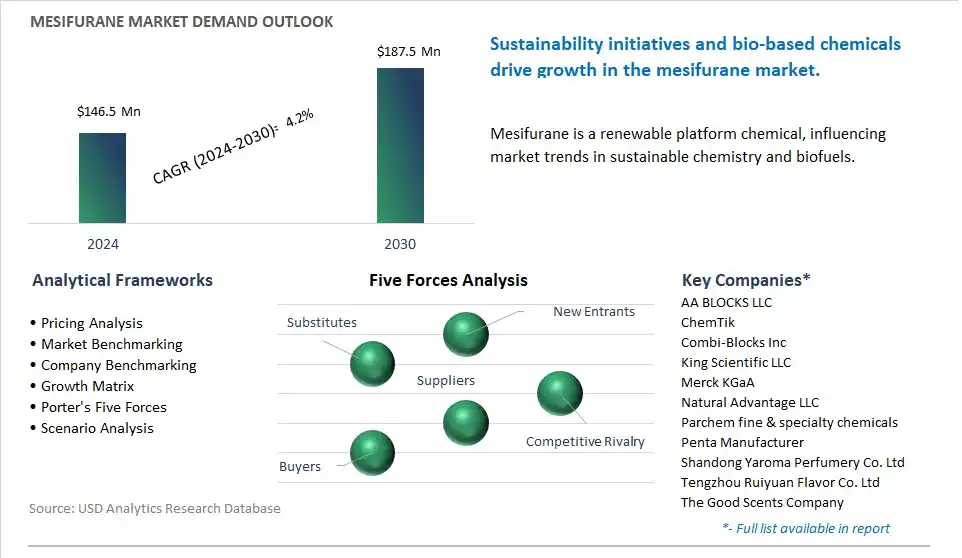
Mesifurane Market Competitive Landscape
The market report analyses the leading companies in the industry including AA BLOCKS LLC, ChemTik, Combi-Blocks Inc, King Scientific LLC, Merck KGaA, Natural Advantage LLC, Parchem fine & specialty chemicals, Penta Manufacturer, Shandong Yaroma Perfumery Co. Ltd, Tengzhou Ruiyuan Flavor Co. Ltd, The Good Scents Company, Tokyo Chemical Industry Co. Ltd, United International Co. LTD, Vesino Industrial Co. Ltd, VladaChem GmbH.
Mesifurane Market Dynamics
Mesifurane Market Trend: Shift Towards Sustainable and Renewable Chemicals
A significant trend in the mesifurane market is the shift towards sustainable and renewable chemicals driven by increasing environmental awareness, regulatory pressure, and consumer demand for eco-friendly products. Mesifurane, a furan derivative obtained from renewable biomass sources such as furfural or lignocellulosic feedstocks, offers a sustainable alternative to petrochemical-based compounds for various applications in the chemical industry. With growing concerns about climate change, carbon emissions, and finite fossil fuel resources, there is a growing emphasis on transitioning towards bio-based chemicals that reduce environmental impact, promote circular economy principles, and contribute to a more sustainable future. Mesifurane's potential as a versatile platform chemical for producing polymers, solvents, and specialty chemicals aligns with sustainability goals and offers opportunities for companies to innovate and differentiate in the market by offering greener alternatives to conventional products.
Mesifurane Market Driver: Demand for Green Solvents and Bio-based Materials
A key driver propelling the mesifurane market is the increasing demand for green solvents and bio-based materials across various industries such as coatings, adhesives, sealants, and polymers driven by regulatory mandates, consumer preferences, and corporate sustainability initiatives. As companies seek to reduce their environmental footprint and comply with regulations restricting the use of volatile organic compounds (VOCs) and hazardous chemicals, there is a growing need for environmentally friendly solvents and raw materials derived from renewable sources. Mesifurane's low toxicity, high solvent power, and biodegradability make it an attractive option for formulating eco-friendly coatings, adhesives, and polymers that meet performance requirements while minimizing environmental impact. Additionally, mesifurane's potential as a bio-based building block for synthesizing specialty chemicals and pharmaceutical intermediates further expands its market opportunities and drives demand for sustainable alternatives to petroleum-derived compounds. The demand for green solvents and bio-based materials presents opportunities for mesifurane producers to collaborate with downstream industries, develop innovative formulations, and capture market share in the growing bioeconomy.
Mesifurane Market Opportunity: Expansion into Renewable Energy and Energy Storage
An opportunity for market expansion lies in the expansion into renewable energy and energy storage applications where mesifurane can serve as a platform chemical for producing high-value intermediates and additives. With the global transition towards renewable energy sources such as solar and wind power, there is a growing need for energy storage solutions to address intermittency issues and ensure grid stability. Mesifurane's potential as a precursor for synthesizing furan-based electrolytes and redox-active materials offers opportunities for developing sustainable energy storage systems such as flow batteries and supercapacitors that store and release energy efficiently. Additionally, mesifurane-derived chemicals can be utilized in the production of biofuels, bio-based lubricants, and renewable chemicals used in the manufacture of photovoltaic panels, wind turbine blades, and other renewable energy infrastructure components. By leveraging mesifurane's unique properties and versatility, companies can capitalize on the growing demand for renewable energy solutions, enhance energy storage technologies, and contribute to the transition towards a more sustainable energy future.
Mesifurane Market Share Analysis: Natural Mesifurane segment generated the highest revenue in the industry
The natural mesifurane segment is the largest segment in the mesifurane market, primarily due to diverse key factors. The natural mesifurane, derived from renewable biomass sources such as lignocellulosic materials and agricultural residues, aligns with the growing consumer preference for sustainable and eco-friendly products. As environmental awareness and concerns about climate change continue to rise, there is increasing demand for bio-based alternatives to petroleum-derived chemicals and additives. Natural mesifurane offers a renewable and biodegradable alternative to synthetic counterparts, reducing reliance on fossil fuels and minimizing environmental impact throughout its lifecycle. Secondly, natural mesifurane exhibits favorable properties and functionalities that make it suitable for a wide range of applications in industries such as food and beverages, pharmaceuticals, cosmetics, and fine chemicals. Its pleasant odor, low volatility, and high solubility in water and organic solvents enhance its utility as a flavoring agent, fragrance ingredient, solvent, and chemical intermediate in various formulations. Natural mesifurane's versatility and compatibility with diverse matrices and formulations contribute to its widespread adoption across multiple end-use sectors. Thirdly, the growing trend towards clean label and natural products drives the demand for natural ingredients and additives in food, beverage, and personal care products. Natural mesifurane, obtained from renewable biomass sources using environmentally friendly processes, meets the criteria for clean label and natural product claims, appealing to health-conscious consumers seeking safer and more sustainable alternatives to synthetic additives and flavors. In addition, the regulatory approvals and safety assessments for natural mesifurane as a food additive and flavoring agent further bolster its market position and acceptance in the food and beverage industry. Additionally, the increasing availability and commercialization of natural mesifurane from biomass conversion technologies, such as furan production from hemicellulose and furfural upgrading processes, contribute to its market dominance. Advances in biorefinery technologies and sustainable biomass feedstock sourcing enable efficient and cost-effective production of natural mesifurane on a commercial scale, ensuring a reliable and consistent supply for industrial applications. Over the forecast period, the combination of consumer preferences, functional properties, regulatory approvals, and sustainable production methods positions natural mesifurane as the largest segment in the mesifurane market, preferred for its natural origin, versatility, and eco-friendly attributes.
Mesifurane Market Share Analysis: Pharmaceuticals Segment is poised to register the fastest growth rate (CAGR) over the forecast period to 2030
The pharmaceuticals segment is the fastest-growing segment in the mesifurane market, propelled by diverse key factors. The mesifurane exhibits promising pharmacological properties and therapeutic potential, making it an attractive candidate for pharmaceutical applications. Research indicates that mesifurane possesses antioxidant, anti-inflammatory, antimicrobial, and antitumor properties, suggesting its utility in the development of novel drug formulations for various medical conditions. Pharmaceutical companies and researchers are exploring therapeutic benefits of mesifurane in areas such as oncology, neurology, cardiovascular health, and metabolic disorders, driving the demand for mesifurane as an active pharmaceutical ingredient (API) or pharmaceutical intermediate. Secondly, mesifurane's natural origin and favorable safety profile make it a preferred choice for pharmaceutical formulations, particularly in the development of natural and herbal medicines, nutraceuticals, and dietary supplements. As consumers increasingly seek natural and plant-derived remedies for health and wellness, pharmaceutical manufacturers incorporate mesifurane into formulations targeting specific health conditions, such as antioxidant supplements, anti-inflammatory drugs, and herbal remedies for stress and anxiety. Mesifurane's bioavailability, solubility, and compatibility with pharmaceutical excipients enhance its suitability for oral, topical, and parenteral drug delivery systems, facilitating drug formulation and development processes. Thirdly, the rising prevalence of chronic diseases, aging population, and lifestyle-related health conditions drive the demand for innovative pharmaceutical solutions and treatment modalities. Pharmaceutical companies invest in research and development (R&D) efforts to discover and commercialize new drugs and therapies that address unmet medical needs and improve patient outcomes. Mesifurane's potential therapeutic benefits and versatile pharmacological properties position it as a promising candidate for drug discovery and development programs focused on novel therapies for cancer, inflammation, infectious diseases, and metabolic disorders. In addition, mesifurane's application in combination therapies, drug delivery systems, and personalized medicine approaches further expands its opportunities in the pharmaceutical market, catering to the diverse needs and preferences of healthcare professionals and patients. Additionally, the regulatory approvals and clinical validation of mesifurane-based pharmaceutical products drive market growth and adoption, instilling confidence in its safety, efficacy, and therapeutic value. Over the forecast period, the combination of mesifurane's pharmacological properties, natural origin, therapeutic potential, and market demand positions the pharmaceuticals segment as the fastest-growing segment in the mesifurane market, driving innovation and expansion in drug discovery and development pipelines.
Mesifurane Market Report Segmentation
By Type
Natural
Synthetic
By Application
Food and Beverages
Pharmaceuticals
Animal Feed
Cosmetics
Others
Regions Included
North America (US, Canada, Mexico)
Europe (Germany, UK, France, Spain, Italy, Russia, Rest of Europe)
Asia Pacific (China, India, Japan, South Korea, Australia, South East Asia, Rest of Asia)
South America (Brazil, Argentina, Rest of South America)
Middle East and Africa (Saudi Arabia, UAE, Rest of Middle East, South Africa, Egypt, Rest of Africa)
Mesifurane Companies Profiled in the Market Study
AA BLOCKS LLC
ChemTik
Combi-Blocks Inc
King Scientific LLC
Merck KGaA
Natural Advantage LLC
Parchem fine & specialty chemicals
Penta Manufacturer
Shandong Yaroma Perfumery Co. Ltd
Tengzhou Ruiyuan Flavor Co. Ltd
The Good Scents Company
Tokyo Chemical Industry Co. Ltd
United International Co. LTD
Vesino Industrial Co. Ltd
VladaChem GmbH
*- List Not Exhaustive
TABLE OF CONTENTS
1 Introduction to 2024 Mesifurane Market
1.1 Market Overview
1.2 Quick Facts
1.3 Scope/Objective of the Study
1.4 Market Definition
1.5 Countries and Regions Covered
1.6 Units, Currency, and Conversions
1.7 Industry Value Chain
2 Research Methodology
2.1 Market Size Estimation
2.2 Sources and Research Methodology
2.3 Data Triangulation
2.4 Assumptions and Limitations
3 Executive Summary
3.1 Global Mesifurane Market Size Outlook, $ Million, 2021 to 2030
3.2 Mesifurane Market Outlook by Type, $ Million, 2021 to 2030
3.3 Mesifurane Market Outlook by Product, $ Million, 2021 to 2030
3.4 Mesifurane Market Outlook by Application, $ Million, 2021 to 2030
3.5 Mesifurane Market Outlook by Key Countries, $ Million, 2021 to 2030
4 Market Dynamics
4.1 Key Driving Forces of Mesifurane Industry
4.2 Key Market Trends in Mesifurane Industry
4.3 Potential Opportunities in Mesifurane Industry
4.4 Key Challenges in Mesifurane Industry
5 Market Factor Analysis
5.1 Value Chain Analysis
5.2 Competitive Landscape
5.2.1 Global Mesifurane Market Share by Company (%), 2023
5.2.2 Product Offerings by Company
5.3 Porter’s Five Forces Analysis
5.4 Pricing Analysis and Outlook
6 Growth Outlook Across Scenarios
6.1 Growth Analysis-Case Scenario Definitions
6.2 Low Growth Scenario Forecasts
6.3 Reference Growth Scenario Forecasts
6.4 High Growth Scenario Forecasts
7 Global Mesifurane Market Outlook by Segments
7.1 Mesifurane Market Outlook by Segments, $ Million, 2021- 2030
By Type
Natural
Synthetic
By Application
Food and Beverages
Pharmaceuticals
Animal Feed
Cosmetics
Others
8 North America Mesifurane Market Analysis and Outlook To 2030
8.1 Introduction to North America Mesifurane Markets in 2024
8.2 North America Mesifurane Market Size Outlook by Country, 2021-2030
8.2.1 United States
8.2.2 Canada
8.2.3 Mexico
8.3 North America Mesifurane Market size Outlook by Segments, 2021-2030
By Type
Natural
Synthetic
By Application
Food and Beverages
Pharmaceuticals
Animal Feed
Cosmetics
Others
9 Europe Mesifurane Market Analysis and Outlook To 2030
9.1 Introduction to Europe Mesifurane Markets in 2024
9.2 Europe Mesifurane Market Size Outlook by Country, 2021-2030
9.2.1 Germany
9.2.2 France
9.2.3 Spain
9.2.4 United Kingdom
9.2.4 Italy
9.2.5 Russia
9.2.6 Norway
9.2.7 Rest of Europe
9.3 Europe Mesifurane Market Size Outlook by Segments, 2021-2030
By Type
Natural
Synthetic
By Application
Food and Beverages
Pharmaceuticals
Animal Feed
Cosmetics
Others
10 Asia Pacific Mesifurane Market Analysis and Outlook To 2030
10.1 Introduction to Asia Pacific Mesifurane Markets in 2024
10.2 Asia Pacific Mesifurane Market Size Outlook by Country, 2021-2030
10.2.1 China
10.2.2 India
10.2.3 Japan
10.2.4 South Korea
10.2.5 Indonesia
10.2.6 Malaysia
10.2.7 Australia
10.2.8 Rest of Asia Pacific
10.3 Asia Pacific Mesifurane Market size Outlook by Segments, 2021-2030
By Type
Natural
Synthetic
By Application
Food and Beverages
Pharmaceuticals
Animal Feed
Cosmetics
Others
11 South America Mesifurane Market Analysis and Outlook To 2030
11.1 Introduction to South America Mesifurane Markets in 2024
11.2 South America Mesifurane Market Size Outlook by Country, 2021-2030
11.2.1 Brazil
11.2.2 Argentina
11.2.3 Rest of South America
11.3 South America Mesifurane Market size Outlook by Segments, 2021-2030
By Type
Natural
Synthetic
By Application
Food and Beverages
Pharmaceuticals
Animal Feed
Cosmetics
Others
12 Middle East and Africa Mesifurane Market Analysis and Outlook To 2030
12.1 Introduction to Middle East and Africa Mesifurane Markets in 2024
12.2 Middle East and Africa Mesifurane Market Size Outlook by Country, 2021-2030
12.2.1 Saudi Arabia
12.2.2 UAE
12.2.3 Oman
12.2.4 Rest of Middle East
12.2.5 Egypt
12.2.6 Nigeria
12.2.7 South Africa
12.2.8 Rest of Africa
12.3 Middle East and Africa Mesifurane Market size Outlook by Segments, 2021-2030
By Type
Natural
Synthetic
By Application
Food and Beverages
Pharmaceuticals
Animal Feed
Cosmetics
Others
13 Company Profiles
13.1 Company Snapshot
13.2 SWOT Profiles
13.3 Products and Services
13.4 Recent Developments
13.5 Financial Profile
AA BLOCKS LLC
ChemTik
Combi-Blocks Inc
King Scientific LLC
Merck KGaA
Natural Advantage LLC
Parchem fine & specialty chemicals
Penta Manufacturer
Shandong Yaroma Perfumery Co. Ltd
Tengzhou Ruiyuan Flavor Co. Ltd
The Good Scents Company
Tokyo Chemical Industry Co. Ltd
United International Co. LTD
Vesino Industrial Co. Ltd
VladaChem GmbH
14 Appendix
14.1 Customization Offerings
14.2 Subscription Services
14.3 Related Reports
14.4 Publisher Expertise
By Type
Natural
Synthetic
By Application
Food and Beverages
Pharmaceuticals
Animal Feed
Cosmetics
Others
Countries Analyzed
North America (US, Canada, Mexico)
Europe (Germany, UK, France, Spain, Italy, Russia, Rest of Europe)
Asia Pacific (China, India, Japan, South Korea, Australia, South East Asia, Rest of Asia)
South America (Brazil, Argentina, Rest of South America)
Middle East and Africa (Saudi Arabia, UAE, Rest of Middle East, South Africa, Egypt, Rest of Africa)
