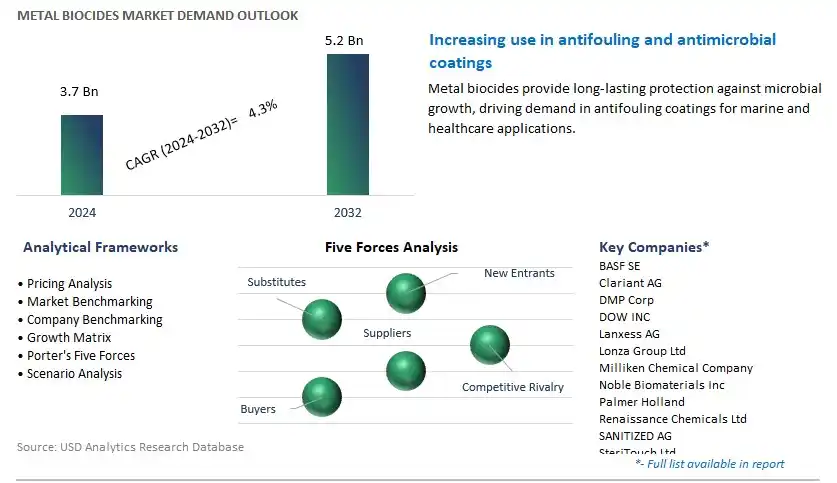
Global Metal Biocides Market Size is valued at $3.7 Billion in 2024 and is forecast to register a growth rate (CAGR) of 4.3% to reach $5.2 Billion by 2032.
The global Metal Biocides Market Study analyzes and forecasts the market size across 6 regions and 24 countries for diverse segments -By Type (Silver, Copper & Alloys, Zinc, Others), By End-User (Paints & Coatings, Medical, Textile, Pesticides, Wood Preservation, Foods & Beverages, Others).
An Introduction to Metal Biocides Market in 2024
Metal biocides are chemical compounds containing metal ions that exhibit antimicrobial properties, used to control the growth of bacteria, fungi, algae, and other microorganisms in various industrial and consumer applications. In 2024, the demand for metal biocides s to rise as industries such as water treatment, paints and coatings, textiles, and healthcare seek effective solutions for microbial control. Metal biocides work by disrupting cellular processes in microorganisms, leading to cell death or inhibition of growth. Commonly used metal biocides include silver, copper, zinc, and mercury compounds, each with specific antimicrobial mechanisms and applications. Silver ions, for example, are effective against a broad spectrum of microorganisms and are commonly used in water purification systems, medical devices, and wound dressings. Copper-based biocides are utilized in antifouling coatings for marine applications, preventing the growth of algae and barnacles on ship hulls. Zinc pyrithione is another widely used metal biocide in anti-dandruff shampoos and paints for its ability to control fungal growth. With increasing concerns about microbial contamination, antimicrobial resistance, and biofilm formation, there is ongoing research into developing novel metal biocides with enhanced efficacy, stability, and environmental safety. Further, the adoption of metal biocides in sustainable and eco-friendly formulations supports efforts to reduce reliance on traditional biocidal chemicals with potential environmental and health risks. As industries to prioritize hygiene, product quality, and regulatory compliance, the demand for effective metal biocides is expected to remain strong, driving innovation and growth in the metal biocides market.
Metal Biocides Market Competitive Landscape
The market report analyses the leading companies in the industry including BASF SE, Clariant AG, DMP Corp, DOW INC, Lanxess AG, Lonza Group Ltd, Milliken Chemical Company, Noble Biomaterials Inc, Palmer Holland, Renaissance Chemicals Ltd, SANITIZED AG, SteriTouch Ltd, Troy Corp, and others.
Metal Biocides Market Dynamics
Market Trend: Rising Demand for Antimicrobial Products
A prominent market trend for metal biocides is the rising demand for antimicrobial products across various industries. With increasing awareness of infectious diseases, healthcare-associated infections, and foodborne illnesses, there's a growing emphasis on hygiene, sanitation, and antimicrobial protection in public spaces, healthcare facilities, food processing plants, and consumer products. Metal biocides, such as silver, copper, and zinc-based compounds, are widely used for their antimicrobial properties, which inhibit the growth of bacteria, fungi, and viruses on surfaces and materials. This trend is driven by regulatory requirements, consumer preferences, and the need to mitigate the risk of microbial contamination in healthcare, food, and industrial settings, leading to the widespread adoption of metal biocides in various applications.
Market Driver: Regulatory Compliance and Safety Standards
A key market driver for metal biocides is the need for regulatory compliance with safety standards and antimicrobial efficacy requirements imposed by government agencies and industry associations. As concerns about antimicrobial resistance, infection control, and product safety continue to escalate, authorities are implementing stricter regulations and guidelines governing the use of biocidal products in healthcare, food processing, water treatment, and consumer goods. Metal biocides play a vital role in meeting these regulatory requirements by providing effective and safe antimicrobial protection against a wide range of pathogens and microorganisms. The need to ensure compliance with regulatory mandates drives the demand for metal biocides as essential components in antimicrobial formulations and surface treatments across various industries.
Market Opportunity: Development of Next-Generation Antimicrobial Technologies
A potential opportunity for metal biocides lies in the development of next-generation antimicrobial technologies with improved efficacy, safety, and sustainability. Opportunities exist for innovation in metal biocide formulations, delivery systems, and application methods to address evolving market needs and challenges. For example, there's potential for the development of nanostructured metal biocides with enhanced antimicrobial activity and prolonged efficacy, capable of targeting specific pathogens or biofilms. Additionally, advancements in surface modification techniques can lead to the creation of self-disinfecting materials and coatings embedded with metal biocides for continuous antimicrobial protection in healthcare facilities, public spaces, and high-touch surfaces. By investing in research and development, metal biocide manufacturers can capitalize on this opportunity to introduce innovative solutions that offer superior antimicrobial performance, reduce environmental impact, and meet the growing demand for safe and sustainable antimicrobial products in diverse applications.
Metal Biocides Market Share Analysis: Silver segment generated the highest revenue in 2024
Within the Metal Biocides market segmented by type, silver is the largest and most significant segment. Silver has long been recognized for its potent antimicrobial properties, making it an effective biocide against a wide range of bacteria, fungi, and viruses. Silver biocides are extensively used in various industries, including healthcare, water treatment, textiles, and consumer products, to inhibit the growth of microbes and prevent contamination and infection. Moreover, silver biocides offer potential advantages, including broad-spectrum antimicrobial activity, low toxicity to humans and animals, and long-lasting efficacy. These properties make silver biocides highly versatile and suitable for use in diverse applications, ranging from medical devices and wound dressings to water purification systems and household products. Additionally, advancements in nanotechnology have led to the development of silver nanoparticles, which further enhance the antimicrobial properties and stability of silver biocides. As industries continue to prioritize hygiene, safety, and infection control, the silver segment is expected to maintain its dominance in the Metal Biocides market.
Metal Biocides Market Share Analysis: Medical is poised to register the fastest CAGR over the forecast period
Among the listed end-users in the Metal Biocides market, the fastest-growing segment is the Medical sector. In the medical industry, controlling and preventing the spread of infections is paramount, especially in healthcare facilities where patients are vulnerable to microbial contamination. Metal biocides, particularly silver-based biocides, are widely used in medical devices, wound dressings, surgical instruments, and healthcare surfaces to inhibit the growth of bacteria, fungi, and viruses, thereby reducing the risk of healthcare-associated infections (HAIs). With the increasing prevalence of HAIs and the emergence of antibiotic-resistant pathogens, there is a growing demand for effective antimicrobial solutions in the medical sector. Additionally, the COVID-19 pandemic has further emphasized the importance of infection control measures, leading to increased adoption of antimicrobial coatings and materials in healthcare settings. Moreover, advancements in metal biocide formulations and technologies, such as controlled release systems and nanotechnology, enhance their efficacy and safety for medical applications. As healthcare facilities continue to prioritize patient safety and infection prevention, the Medical sector is expected to experience rapid growth in the Metal Biocides market.
Metal Biocides Market
By Type
Silver
Copper & Alloys
Zinc
Others
By End-User
Paints & Coatings
Medical
Textile
Pesticides
Wood Preservation
Foods & Beverages
Others
Countries Analyzed
North America (US, Canada, Mexico)
Europe (Germany, UK, France, Spain, Italy, Russia, Rest of Europe)
Asia Pacific (China, India, Japan, South Korea, Australia, South East Asia, Rest of Asia)
South America (Brazil, Argentina, Rest of South America)
Middle East and Africa (Saudi Arabia, UAE, Rest of Middle East, South Africa, Egypt, Rest of Africa)
Metal Biocides Companies Profiled in the Study
BASF SE
Clariant AG
DMP Corp
DOW INC
Lanxess AG
Lonza Group Ltd
Milliken Chemical Company
Noble Biomaterials Inc
Palmer Holland
Renaissance Chemicals Ltd
SANITIZED AG
SteriTouch Ltd
Troy Corp
*- List Not Exhaustive
TABLE OF CONTENTS
1 Introduction to 2024 Metal Biocides Market
1.1 Market Overview
1.2 Quick Facts
1.3 Scope/Objective of the Study
1.4 Market Definition
1.5 Countries and Regions Covered
1.6 Units, Currency, and Conversions
1.7 Industry Value Chain
2 Research Methodology
2.1 Market Size Estimation
2.2 Sources and Research Methodology
2.3 Data Triangulation
2.4 Assumptions and Limitations
3 Executive Summary
3.1 Global Metal Biocides Market Size Outlook, $ Million, 2021 to 2032
3.2 Metal Biocides Market Outlook by Type, $ Million, 2021 to 2032
3.3 Metal Biocides Market Outlook by Product, $ Million, 2021 to 2032
3.4 Metal Biocides Market Outlook by Application, $ Million, 2021 to 2032
3.5 Metal Biocides Market Outlook by Key Countries, $ Million, 2021 to 2032
4 Market Dynamics
4.1 Key Driving Forces of Metal Biocides Industry
4.2 Key Market Trends in Metal Biocides Industry
4.3 Potential Opportunities in Metal Biocides Industry
4.4 Key Challenges in Metal Biocides Industry
5 Market Factor Analysis
5.1 Value Chain Analysis
5.2 Competitive Landscape
5.2.1 Global Metal Biocides Market Share by Company (%), 2023
5.2.2 Product Offerings by Company
5.3 Porter’s Five Forces Analysis
5.4 Pricing Analysis and Outlook
6 Growth Outlook Across Scenarios
6.1 Growth Analysis-Case Scenario Definitions
6.2 Low Growth Scenario Forecasts
6.3 Reference Growth Scenario Forecasts
6.4 High Growth Scenario Forecasts
7 Global Metal Biocides Market Outlook by Segments
7.1 Metal Biocides Market Outlook by Segments, $ Million, 2021- 2032
By Type
Silver
Copper & Alloys
Zinc
Others
By End-User
Paints & Coatings
Medical
Textile
Pesticides
Wood Preservation
Foods & Beverages
Others
8 North America Metal Biocides Market Analysis and Outlook To 2032
8.1 Introduction to North America Metal Biocides Markets in 2024
8.2 North America Metal Biocides Market Size Outlook by Country, 2021-2032
8.2.1 United States
8.2.2 Canada
8.2.3 Mexico
8.3 North America Metal Biocides Market size Outlook by Segments, 2021-2032
By Type
Silver
Copper & Alloys
Zinc
Others
By End-User
Paints & Coatings
Medical
Textile
Pesticides
Wood Preservation
Foods & Beverages
Others
9 Europe Metal Biocides Market Analysis and Outlook To 2032
9.1 Introduction to Europe Metal Biocides Markets in 2024
9.2 Europe Metal Biocides Market Size Outlook by Country, 2021-2032
9.2.1 Germany
9.2.2 France
9.2.3 Spain
9.2.4 United Kingdom
9.2.4 Italy
9.2.5 Russia
9.2.6 Norway
9.2.7 Rest of Europe
9.3 Europe Metal Biocides Market Size Outlook by Segments, 2021-2032
By Type
Silver
Copper & Alloys
Zinc
Others
By End-User
Paints & Coatings
Medical
Textile
Pesticides
Wood Preservation
Foods & Beverages
Others
10 Asia Pacific Metal Biocides Market Analysis and Outlook To 2032
10.1 Introduction to Asia Pacific Metal Biocides Markets in 2024
10.2 Asia Pacific Metal Biocides Market Size Outlook by Country, 2021-2032
10.2.1 China
10.2.2 India
10.2.3 Japan
10.2.4 South Korea
10.2.5 Indonesia
10.2.6 Malaysia
10.2.7 Australia
10.2.8 Rest of Asia Pacific
10.3 Asia Pacific Metal Biocides Market size Outlook by Segments, 2021-2032
By Type
Silver
Copper & Alloys
Zinc
Others
By End-User
Paints & Coatings
Medical
Textile
Pesticides
Wood Preservation
Foods & Beverages
Others
11 South America Metal Biocides Market Analysis and Outlook To 2032
11.1 Introduction to South America Metal Biocides Markets in 2024
11.2 South America Metal Biocides Market Size Outlook by Country, 2021-2032
11.2.1 Brazil
11.2.2 Argentina
11.2.3 Rest of South America
11.3 South America Metal Biocides Market size Outlook by Segments, 2021-2032
By Type
Silver
Copper & Alloys
Zinc
Others
By End-User
Paints & Coatings
Medical
Textile
Pesticides
Wood Preservation
Foods & Beverages
Others
12 Middle East and Africa Metal Biocides Market Analysis and Outlook To 2032
12.1 Introduction to Middle East and Africa Metal Biocides Markets in 2024
12.2 Middle East and Africa Metal Biocides Market Size Outlook by Country, 2021-2032
12.2.1 Saudi Arabia
12.2.2 UAE
12.2.3 Oman
12.2.4 Rest of Middle East
12.2.5 Egypt
12.2.6 Nigeria
12.2.7 South Africa
12.2.8 Rest of Africa
12.3 Middle East and Africa Metal Biocides Market size Outlook by Segments, 2021-2032
By Type
Silver
Copper & Alloys
Zinc
Others
By End-User
Paints & Coatings
Medical
Textile
Pesticides
Wood Preservation
Foods & Beverages
Others
13 Company Profiles
13.1 Company Snapshot
13.2 SWOT Profiles
13.3 Products and Services
13.4 Recent Developments
13.5 Financial Profile
BASF SE
Clariant AG
DMP Corp
DOW INC
Lanxess AG
Lonza Group Ltd
Milliken Chemical Company
Noble Biomaterials Inc
Palmer Holland
Renaissance Chemicals Ltd
SANITIZED AG
SteriTouch Ltd
Troy Corp
14 Appendix
14.1 Customization Offerings
14.2 Subscription Services
14.3 Related Reports
14.4 Publisher Expertise
By Type
Silver
Copper & Alloys
Zinc
Others
By End-User
Paints & Coatings
Medical
Textile
Pesticides
Wood Preservation
Foods & Beverages
Others
Countries Analyzed
North America (US, Canada, Mexico)
Europe (Germany, UK, France, Spain, Italy, Russia, Rest of Europe)
Asia Pacific (China, India, Japan, South Korea, Australia, South East Asia, Rest of Asia)
South America (Brazil, Argentina, Rest of South America)
Middle East and Africa (Saudi Arabia, UAE, Rest of Middle East, South Africa, Egypt, Rest of Africa)
