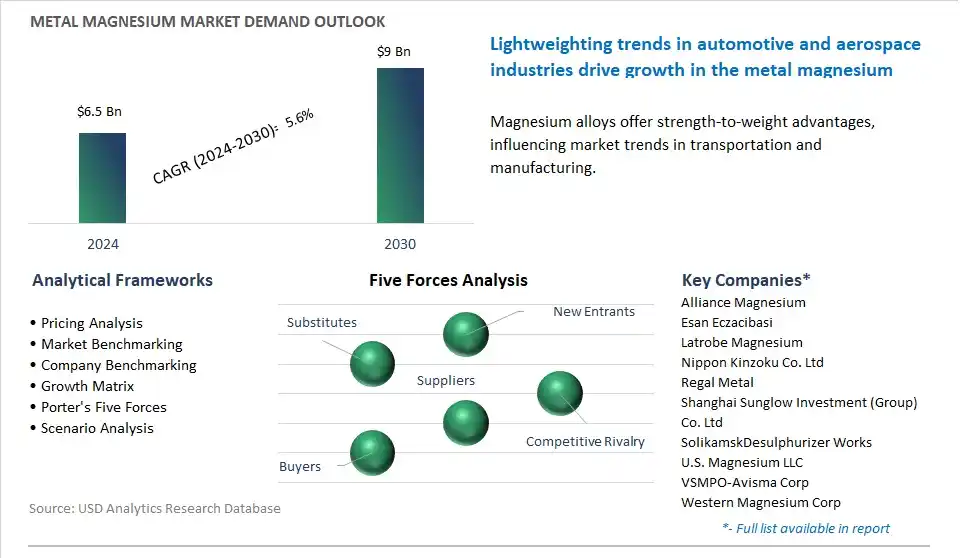
The global Metal Magnesium Market is poised to register a 5.6% CAGR from $6.5 Billion in 2024 to $9 Billion in 2030.
The global Metal Magnesium Market Study analyzes and forecasts the market size across 6 regions and 24 countries for diverse segments -By Application (Die Casting, Aluminum Alloys, Titanium Reduction, Iron & Steel Making, Others), By Product (Pure Magnesium, Magnesium Compounds, Magnesium Alloys), By Manufacturing Process (Thermal Reduction Process, Electrolyte Process, Recycling).
An Introduction to Global Metal Magnesium Market in 2024
The market for metal magnesium is undergoing significant transformation driven by its diverse applications in industries such as automotive, aerospace, electronics, and healthcare. One key trend shaping the future of the industry is the increasing demand for lightweight and high-strength materials to meet the stringent requirements of fuel efficiency, emissions reduction, and performance optimization in transportation and aerospace applications. Metal magnesium, known for its exceptional strength-to-weight ratio, corrosion resistance, and machinability, is gaining traction as a preferred material for lightweight components and structural alloys in automotive body panels, aircraft fuselages, electronic enclosures, and medical implants. This trend is driving investments in magnesium production technologies, alloy development, and surface treatment techniques to enhance the mechanical properties, formability, and surface finish of magnesium-based materials, enabling their widespread adoption in critical applications. Moreover, the growing focus on sustainability and environmental responsibility is driving research and innovation in magnesium recycling technologies, waste valorization, and life cycle assessment methodologies, fostering the development of closed-loop supply chains and circular economy initiatives in the magnesium industry. Additionally, the expansion of emerging markets and the rapid urbanization of developing economies are driving demand for magnesium-based products in construction, infrastructure, consumer electronics, and renewable energy sectors, creating opportunities for market players to diversify their product offerings and expand their global footprint. Furthermore, advancements in additive manufacturing and 3D printing technologies are enabling the production of complex magnesium components with intricate geometries and customized properties, unlocking new possibilities for innovation and product design in industries such as healthcare, aerospace, and automotive engineering.
Metal Magnesium Market Competitive Landscape
The market report analyses the leading companies in the industry including Alliance Magnesium, Esan Eczacibasi, Latrobe Magnesium, Nippon Kinzoku Co. Ltd, Regal Metal, Shanghai Sunglow Investment (Group) Co. Ltd, SolikamskDesulphurizer Works, U.S. Magnesium LLC, VSMPO-Avisma Corp, Western Magnesium Corp.
Metal Magnesium Market Dynamics
Metal Magnesium Market Trend: Growing Demand for Lightweight Materials in Automotive and Aerospace Industries
A significant trend in the metal magnesium market is the growing demand for lightweight materials driven by the automotive and aerospace industries' emphasis on fuel efficiency, emissions reduction, and performance optimization. Magnesium, known for its high strength-to-weight ratio and excellent machinability, is increasingly sought after as a lightweight alternative to traditional materials such as steel and aluminum in vehicle and aircraft manufacturing. With stringent fuel economy regulations, increasing consumer preferences for electric vehicles, and the aerospace sector's focus on reducing emissions and enhancing aircraft efficiency, there is a rising need for lightweight structural materials that can help achieve weight savings without compromising strength or safety. This trend is reshaping the metal magnesium market towards increased adoption in automotive and aerospace applications, driving demand for magnesium alloys and advanced manufacturing processes to meet industry requirements for lightweighting solutions.
Metal Magnesium Market Driver: Advancements in Magnesium Alloy Development and Processing Technologies
A key driver propelling the metal magnesium market is the advancements in magnesium alloy development and processing technologies aimed at improving material properties, alloy performance, and manufacturing efficiency. Magnesium alloys offer versatility in terms of alloy composition, mechanical properties, and processing methods, enabling customization for specific applications and performance requirements. With ongoing research and development efforts focused on alloy design, microstructure control, and processing optimization, manufacturers can enhance magnesium's mechanical strength, corrosion resistance, and formability while reducing production costs and environmental impacts. Additionally, advancements in casting, extrusion, and forming technologies facilitate the production of complex magnesium components with tight tolerances and superior surface finishes, expanding the potential applications of magnesium alloys in automotive body structures, engine components, aircraft fuselages, and structural components. The continuous innovation in magnesium alloy development and processing technologies drives market growth and competitiveness, positioning magnesium as a preferred material choice for lightweighting solutions across various industries.
Metal Magnesium Market Opportunity: Expansion into Emerging Markets and Applications
An opportunity for market expansion lies in the expansion into emerging markets and applications where metal magnesium can offer unique advantages and address evolving industry needs. Beyond traditional automotive and aerospace sectors, magnesium alloys hold potential for applications in consumer electronics, medical devices, sporting goods, and renewable energy technologies. In consumer electronics, for instance, magnesium's lightweight and durable properties make it ideal for manufacturing portable devices such as laptops, tablets, and smartphones, where weight reduction and structural integrity are critical. Similarly, in the medical industry, magnesium implants and surgical instruments benefit from the material's biocompatibility, bioabsorbability, and mechanical properties, offering potential solutions for orthopedic implants, cardiovascular stents, and surgical tools. Furthermore, in renewable energy applications such as wind turbines and solar panels, magnesium's lightweight characteristics can contribute to reducing material and transportation costs, improving installation efficiency, and enhancing overall system performance. By expanding into emerging markets and applications, metal magnesium suppliers can diversify their product portfolios, capture new customer segments, and unlock opportunities for growth and innovation in the global magnesium industry.
Metal Magnesium Market Share Analysis: Die Casting segment generated the highest revenue in the industry
The Die Casting segment is the largest segment in the Metal Magnesium Market due to its extensive applications across various industries, particularly in automotive and aerospace manufacturing. Die casting with magnesium offers numerous advantages, including lightweight properties, excellent dimensional stability, and high strength-to-weight ratio, making it an ideal choice for producing complex and lightweight components. In the automotive sector, magnesium die castings are widely used to manufacture engine parts, transmission housings, steering components, and structural elements, contributing to fuel efficiency and Over the forecast period vehicle performance. Similarly, in the aerospace industry, magnesium die castings are favored for their lightweight characteristics, enabling aircraft manufacturers to reduce fuel consumption and enhance aircraft efficiency while maintaining structural integrity and durability. Additionally, advancements in die casting technologies have facilitated the production of intricate and high-precision magnesium components, further expanding the applications of magnesium die casting in various industries. As industries increasingly prioritize lightweight materials for enhancing product performance and efficiency, the Die Casting segment remains the largest and most prominent segment in the Metal Magnesium Market.
Metal Magnesium Market Share Analysis: Magnesium Alloys Segment is poised to register the fastest growth rate (CAGR) over the forecast period to 2030
The Magnesium Alloys segment is the fastest growing segment in the Metal Magnesium Market owing to its wide-ranging applications and superior mechanical properties. Magnesium alloys are engineered to enhance the inherent properties of pure magnesium, offering improved strength, stiffness, and corrosion resistance while maintaining its lightweight characteristics. These alloys find extensive use across diverse industries, including automotive, aerospace, electronics, and healthcare, where lightweight and high-performance materials are in high demand. In the automotive sector, magnesium alloys are increasingly utilized to manufacture lightweight components such as engine blocks, transmission cases, and structural parts, enabling vehicle manufacturers to meet stringent fuel efficiency and emissions standards. Similarly, in the aerospace industry, magnesium alloys play a vital role in the production of lightweight aircraft components, contributing to fuel savings and environmental sustainability. In addition, the growing focus on sustainability and eco-friendly materials further drives the adoption of magnesium alloys, as they are recyclable and offer a reduced environmental footprint compared to other metals. With ongoing research and development efforts aimed at enhancing the properties and processing capabilities of magnesium alloys, coupled with their expanding applications across industries, the Magnesium Alloys segment is poised for significant growth in the Metal Magnesium Market.
Metal Magnesium Market Share Analysis: Recycling Segment is poised to register the fastest growth rate (CAGR) over the forecast period to 2030
The Recycling segment is the fastest growing segment in the Metal Magnesium Market due to diverse key factors driving its expansion. Recycling of magnesium offers significant environmental benefits, including reduced energy consumption, greenhouse gas emissions, and the conservation of natural resources. As sustainability becomes increasingly important across industries, manufacturers are actively seeking ways to minimize their environmental impact and integrate circular economy principles into their operations. Recycling of magnesium presents an opportunity to recover and reuse valuable magnesium resources from scrap materials, manufacturing waste, and end-of-life products. Further, advancements in recycling technologies have made it more cost-effective and efficient to extract magnesium from recycled sources, thereby reducing reliance on primary magnesium production methods such as thermal reduction and electrolysis. Additionally, stringent regulations and sustainability initiatives are encouraging industries to prioritize recycling and adopt sustainable practices, further driving the demand for recycled magnesium. With the growing emphasis on sustainability and circularity, coupled with technological advancements in recycling processes, the Recycling segment is poised for rapid growth in the Metal Magnesium Market.
Metal Magnesium Market Report Segmentation
By Application
Die Casting
Aluminum Alloys
Titanium Reduction
Iron & Steel Making
Others
By Product
Pure Magnesium
Magnesium Compounds
Magnesium Alloys
By Manufacturing Process
Thermal Reduction Process
Electrolyte Process
Recycling
Regions Included
North America (US, Canada, Mexico)
Europe (Germany, UK, France, Spain, Italy, Russia, Rest of Europe)
Asia Pacific (China, India, Japan, South Korea, Australia, South East Asia, Rest of Asia)
South America (Brazil, Argentina, Rest of South America)
Middle East and Africa (Saudi Arabia, UAE, Rest of Middle East, South Africa, Egypt, Rest of Africa)
Metal Magnesium Companies Profiled in the Market Study
Alliance Magnesium
Esan Eczacibasi
Latrobe Magnesium
Nippon Kinzoku Co. Ltd
Regal Metal
Shanghai Sunglow Investment (Group) Co. Ltd
SolikamskDesulphurizer Works
U.S. Magnesium LLC
VSMPO-Avisma Corp
Western Magnesium Corp
*- List Not Exhaustive
TABLE OF CONTENTS
1 Introduction to 2024 Metal Magnesium Market
1.1 Market Overview
1.2 Quick Facts
1.3 Scope/Objective of the Study
1.4 Market Definition
1.5 Countries and Regions Covered
1.6 Units, Currency, and Conversions
1.7 Industry Value Chain
2 Research Methodology
2.1 Market Size Estimation
2.2 Sources and Research Methodology
2.3 Data Triangulation
2.4 Assumptions and Limitations
3 Executive Summary
3.1 Global Metal Magnesium Market Size Outlook, $ Million, 2021 to 2030
3.2 Metal Magnesium Market Outlook by Type, $ Million, 2021 to 2030
3.3 Metal Magnesium Market Outlook by Product, $ Million, 2021 to 2030
3.4 Metal Magnesium Market Outlook by Application, $ Million, 2021 to 2030
3.5 Metal Magnesium Market Outlook by Key Countries, $ Million, 2021 to 2030
4 Market Dynamics
4.1 Key Driving Forces of Metal Magnesium Industry
4.2 Key Market Trends in Metal Magnesium Industry
4.3 Potential Opportunities in Metal Magnesium Industry
4.4 Key Challenges in Metal Magnesium Industry
5 Market Factor Analysis
5.1 Value Chain Analysis
5.2 Competitive Landscape
5.2.1 Global Metal Magnesium Market Share by Company (%), 2023
5.2.2 Product Offerings by Company
5.3 Porter’s Five Forces Analysis
5.4 Pricing Analysis and Outlook
6 Growth Outlook Across Scenarios
6.1 Growth Analysis-Case Scenario Definitions
6.2 Low Growth Scenario Forecasts
6.3 Reference Growth Scenario Forecasts
6.4 High Growth Scenario Forecasts
7 Global Metal Magnesium Market Outlook by Segments
7.1 Metal Magnesium Market Outlook by Segments, $ Million, 2021- 2030
By Application
Die Casting
Aluminum Alloys
Titanium Reduction
Iron & Steel Making
Others
By Product
Pure Magnesium
Magnesium Compounds
Magnesium Alloys
By Manufacturing Process
Thermal Reduction Process
Electrolyte Process
Recycling
8 North America Metal Magnesium Market Analysis and Outlook To 2030
8.1 Introduction to North America Metal Magnesium Markets in 2024
8.2 North America Metal Magnesium Market Size Outlook by Country, 2021-2030
8.2.1 United States
8.2.2 Canada
8.2.3 Mexico
8.3 North America Metal Magnesium Market size Outlook by Segments, 2021-2030
By Application
Die Casting
Aluminum Alloys
Titanium Reduction
Iron & Steel Making
Others
By Product
Pure Magnesium
Magnesium Compounds
Magnesium Alloys
By Manufacturing Process
Thermal Reduction Process
Electrolyte Process
Recycling
9 Europe Metal Magnesium Market Analysis and Outlook To 2030
9.1 Introduction to Europe Metal Magnesium Markets in 2024
9.2 Europe Metal Magnesium Market Size Outlook by Country, 2021-2030
9.2.1 Germany
9.2.2 France
9.2.3 Spain
9.2.4 United Kingdom
9.2.4 Italy
9.2.5 Russia
9.2.6 Norway
9.2.7 Rest of Europe
9.3 Europe Metal Magnesium Market Size Outlook by Segments, 2021-2030
By Application
Die Casting
Aluminum Alloys
Titanium Reduction
Iron & Steel Making
Others
By Product
Pure Magnesium
Magnesium Compounds
Magnesium Alloys
By Manufacturing Process
Thermal Reduction Process
Electrolyte Process
Recycling
10 Asia Pacific Metal Magnesium Market Analysis and Outlook To 2030
10.1 Introduction to Asia Pacific Metal Magnesium Markets in 2024
10.2 Asia Pacific Metal Magnesium Market Size Outlook by Country, 2021-2030
10.2.1 China
10.2.2 India
10.2.3 Japan
10.2.4 South Korea
10.2.5 Indonesia
10.2.6 Malaysia
10.2.7 Australia
10.2.8 Rest of Asia Pacific
10.3 Asia Pacific Metal Magnesium Market size Outlook by Segments, 2021-2030
By Application
Die Casting
Aluminum Alloys
Titanium Reduction
Iron & Steel Making
Others
By Product
Pure Magnesium
Magnesium Compounds
Magnesium Alloys
By Manufacturing Process
Thermal Reduction Process
Electrolyte Process
Recycling
11 South America Metal Magnesium Market Analysis and Outlook To 2030
11.1 Introduction to South America Metal Magnesium Markets in 2024
11.2 South America Metal Magnesium Market Size Outlook by Country, 2021-2030
11.2.1 Brazil
11.2.2 Argentina
11.2.3 Rest of South America
11.3 South America Metal Magnesium Market size Outlook by Segments, 2021-2030
By Application
Die Casting
Aluminum Alloys
Titanium Reduction
Iron & Steel Making
Others
By Product
Pure Magnesium
Magnesium Compounds
Magnesium Alloys
By Manufacturing Process
Thermal Reduction Process
Electrolyte Process
Recycling
12 Middle East and Africa Metal Magnesium Market Analysis and Outlook To 2030
12.1 Introduction to Middle East and Africa Metal Magnesium Markets in 2024
12.2 Middle East and Africa Metal Magnesium Market Size Outlook by Country, 2021-2030
12.2.1 Saudi Arabia
12.2.2 UAE
12.2.3 Oman
12.2.4 Rest of Middle East
12.2.5 Egypt
12.2.6 Nigeria
12.2.7 South Africa
12.2.8 Rest of Africa
12.3 Middle East and Africa Metal Magnesium Market size Outlook by Segments, 2021-2030
By Application
Die Casting
Aluminum Alloys
Titanium Reduction
Iron & Steel Making
Others
By Product
Pure Magnesium
Magnesium Compounds
Magnesium Alloys
By Manufacturing Process
Thermal Reduction Process
Electrolyte Process
Recycling
13 Company Profiles
13.1 Company Snapshot
13.2 SWOT Profiles
13.3 Products and Services
13.4 Recent Developments
13.5 Financial Profile
Alliance Magnesium
Esan Eczacibasi
Latrobe Magnesium
Nippon Kinzoku Co. Ltd
Regal Metal
Shanghai Sunglow Investment (Group) Co. Ltd
SolikamskDesulphurizer Works
U.S. Magnesium LLC
VSMPO-Avisma Corp
Western Magnesium Corp
14 Appendix
14.1 Customization Offerings
14.2 Subscription Services
14.3 Related Reports
14.4 Publisher Expertise
By Application
Die Casting
Aluminum Alloys
Titanium Reduction
Iron & Steel Making
Others
By Product
Pure Magnesium
Magnesium Compounds
Magnesium Alloys
By Manufacturing Process
Thermal Reduction Process
Electrolyte Process
Recycling
Countries Analyzed
North America (US, Canada, Mexico)
Europe (Germany, UK, France, Spain, Italy, Russia, Rest of Europe)
Asia Pacific (China, India, Japan, South Korea, Australia, South East Asia, Rest of Asia)
South America (Brazil, Argentina, Rest of South America)
Middle East and Africa (Saudi Arabia, UAE, Rest of Middle East, South Africa, Egypt, Rest of Africa)
