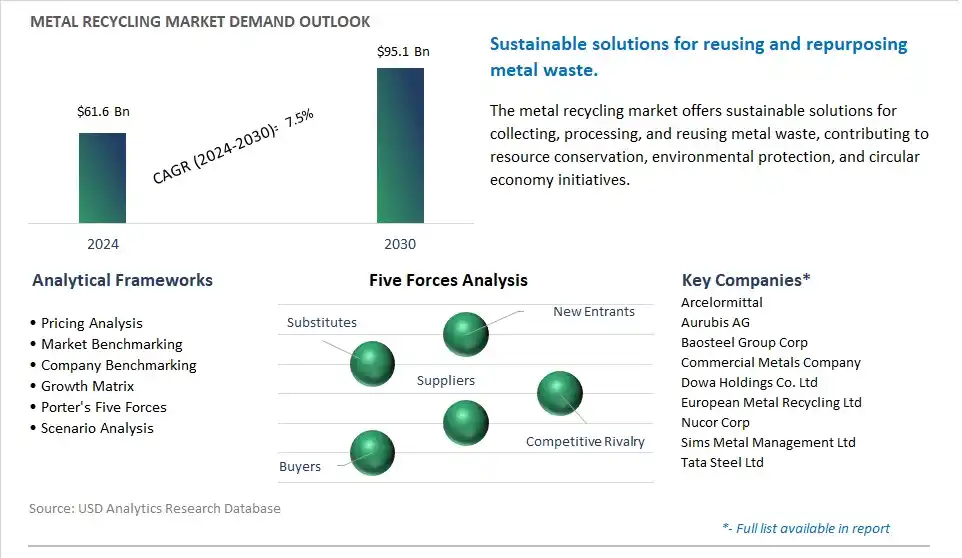
The global Metal Recycling Market is poised to register a 7.5% CAGR from $61.6 Billion in 2024 to $95.1 Billion in 2030.
The global Metal Recycling Market Study analyzes and forecasts the market size across 6 regions and 24 countries for diverse segments -By Scrap (Old Scrap, New Scrap), By Type (Ferrous, Non-Ferrous), By Equipment (Shredders, Shears, Granulating Machines, Briquetting Machines), By End-User (Building & Construction, Automotive, Equipment Manufacturing, Shipbuilding, Packaging, Consumer Appliances, Others).
An Introduction to Global Metal Recycling Market in 2024
The future of metal recycling is influenced by several key trends reflecting advancements in technology, circular economy initiatives, and environmental sustainability goals across industries. One significant trend is the increasing emphasis on closed-loop recycling systems that promote the collection, processing, and reuse of scrap metal to reduce reliance on virgin materials, conserve natural resources, and minimize environmental impact. Metal recycling involves processes such as sorting, shredding, melting, and purification to transform scrap metal into high-quality secondary raw materials for manufacturing new products. Additionally, advancements in recycling technologies, such as sensor-based sorting, pyrolysis, and electrolysis, are improving efficiency, yield, and purity while reducing energy consumption and emissions. Moreover, there is growing interest in the development of innovative business models and collaborations to enhance recycling infrastructure, increase collection rates, and promote responsible end-of-life management of metal-containing products. As governments, industries, and consumers increasingly prioritize sustainability and resource conservation, the demand for metal recycling is expected to grow, driving opportunities for recyclers, technology providers, and manufacturers to invest in and expand recycling capabilities to meet the evolving needs of the market.
Metal Recycling Market Competitive Landscape
The market report analyses the leading companies in the industry including Arcelormittal, Aurubis AG, Baosteel Group Corp, Commercial Metals Company, Dowa Holdings Co. Ltd, European Metal Recycling Ltd, Nucor Corp, Sims Metal Management Ltd, Tata Steel Ltd.
Metal Recycling Market Dynamics
Metal Recycling Market Trend: Increasing Focus on Circular Economy and Sustainability
A significant trend in the Metal Recycling market is the increasing focus on the circular economy and sustainability. With growing concerns about resource depletion, environmental pollution, and climate change, there's a rising demand for sustainable practices, including metal recycling. Governments, industries, and consumers are recognizing the importance of conserving natural resources and reducing carbon emissions by promoting the recycling and reuse of metals. The trend towards a circular economy drives market growth for metal recycling as businesses seek to meet sustainability goals, comply with regulations, and minimize environmental impact through responsible waste management practices.
Metal Recycling Market Driver: Rising Demand for Raw Materials and Environmental Regulations
A key driver propelling the Metal Recycling market is the rising demand for raw materials and environmental regulations. As global population and industrialization continue to increase, there's a growing demand for metals such as steel, aluminum, copper, and zinc in various industries including construction, automotive, electronics, and packaging. Metal recycling provides a sustainable and cost-effective alternative to primary metal production, conserving energy, reducing greenhouse gas emissions, and minimizing waste. Additionally, stringent environmental regulations aimed at reducing landfill waste, promoting resource efficiency, and mitigating climate change further drive market demand for metal recycling services and technologies.
Metal Recycling Market Opportunity: Technological Innovation and Infrastructure Development
An opportunity in the Metal Recycling market lies in technological innovation and infrastructure development. While metal recycling is well-established, there's potential for growth through advancements in recycling technologies, automation, and material recovery processes. Manufacturers aim to capitalize on this opportunity by investing in state-of-the-art equipment such as shredders, sorting systems, and metal recovery units that improve efficiency, purity, and yield in metal recycling operations. Additionally, there's an opportunity to develop partnerships and collaborations to expand recycling infrastructure, such as collection networks, processing facilities, and end-market distribution channels. By leveraging technological innovation and infrastructure development, businesses can enhance their competitiveness, increase recycling rates, and contribute to the sustainable management of metal resources.
Metal Recycling Market Share Analysis: Old Scrap generated the highest revenue in 2024
The Old Scrap segment stands as the largest segment in the Metal Recycling Market. This dominance is driven by to the abundant availability of old scrap from end-of-life products, industrial waste, and demolished structures. Old scrap refers to metal materials that have reached the end of their useful life and are recycled for their metal content. Examples of old scrap include scrapped vehicles, dismantled machinery and equipment, demolished buildings, and discarded appliances. The recycling of old scrap plays a crucial role in the circular economy by recovering valuable metals, reducing the need for virgin materials extraction, and minimizing environmental impact. Additionally, old scrap recycling contributes to energy conservation, greenhouse gas emissions reduction, and resource conservation by diverting metal waste from landfills and incineration. Further, the recycling infrastructure for old scrap, including collection networks, processing facilities, and smelters, is well-established and widely accessible, further supporting the dominance of the Old Scrap segment in the Metal Recycling Market.
Metal Recycling Market Share Analysis: Non-Ferrous segment is poised to register the fastest growth rate (CAGR) over the forecast period to 2030
The Non-Ferrous segment is the fastest-growing segment in the Metal Recycling Market. This growth is propelled by the increasing demand for non-ferrous metals such as aluminum, copper, lead, and zinc in various industries such as automotive, construction, electronics, and renewable energy. Non-ferrous metals exhibit properties such as lightweight, corrosion resistance, electrical conductivity, and recyclability, making them essential materials for a wide range of applications. Additionally, the shift towards lightweight materials in automotive and aerospace manufacturing to improve fuel efficiency and reduce emissions drives the demand for non-ferrous metals like aluminum and magnesium. Furthermore, the growing adoption of renewable energy technologies such as solar panels and wind turbines requires significant quantities of non-ferrous metals for their construction and electrical components. The recyclability of non-ferrous metals also plays a crucial role in meeting sustainability goals, reducing reliance on primary metal production, and conserving natural resources. As industries increasingly prioritize environmental sustainability and resource efficiency, the demand for non-ferrous metal recycling is expected to surge, positioning the Non-Ferrous segment as the fastest-growing segment in the Metal Recycling Market.
Metal Recycling Market Share Analysis: The Granulating Machines segment is poised to register the fastest growth rate (CAGR) over the forecast period to 2030
The Granulating Machines segment is the fastest-growing segment in the Metal Recycling Market. This growth is propelled by the increasing demand for efficient and versatile equipment capable of processing various types of metal scrap into granules or pellets for further processing and recycling. Granulating machines offer potential advantages over traditional metal recycling equipment, including the ability to handle diverse feedstock materials, such as metal chips, turnings, and swarf, as well as scrap from end-of-life products and manufacturing processes. Additionally, granulating machines facilitate the production of uniform and compacted metal granules or pellets, which are easier to handle, transport, and store compared to bulkier scrap materials. Further, granulating machines contribute to waste reduction and resource conservation by efficiently recovering valuable metals from scrap materials while minimizing material loss and environmental impact. As industries increasingly prioritize sustainability and resource efficiency, the demand for granulating machines in the Metal Recycling Market is expected to surge, positioning this segment as the fastest-growing segment in the industry.
Metal Recycling Market Report Segmentation
By Scrap
Old Scrap
New Scrap
By Type
Ferrous
Non-Ferrous
By Equipment
Shredders
Shears
Granulating Machines
Briquetting Machines
By End-User
Building & Construction
Automotive
Equipment Manufacturing
Shipbuilding
Packaging
Consumer Appliances
Others
Regions Included
North America (US, Canada, Mexico)
Europe (Germany, UK, France, Spain, Italy, Russia, Rest of Europe)
Asia Pacific (China, India, Japan, South Korea, Australia, South East Asia, Rest of Asia)
South America (Brazil, Argentina, Rest of South America)
Middle East and Africa (Saudi Arabia, UAE, Rest of Middle East, South Africa, Egypt, Rest of Africa)
Metal Recycling Companies Profiled in the Market Study
Arcelormittal
Aurubis AG
Baosteel Group Corp
Commercial Metals Company
Dowa Holdings Co. Ltd
European Metal Recycling Ltd
Nucor Corp
Sims Metal Management Ltd
Tata Steel Ltd
*- List Not Exhaustive
TABLE OF CONTENTS
1 Introduction to 2024 Metal Recycling Market
1.1 Market Overview
1.2 Quick Facts
1.3 Scope/Objective of the Study
1.4 Market Definition
1.5 Countries and Regions Covered
1.6 Units, Currency, and Conversions
1.7 Industry Value Chain
2 Research Methodology
2.1 Market Size Estimation
2.2 Sources and Research Methodology
2.3 Data Triangulation
2.4 Assumptions and Limitations
3 Executive Summary
3.1 Global Metal Recycling Market Size Outlook, $ Million, 2021 to 2030
3.2 Metal Recycling Market Outlook by Type, $ Million, 2021 to 2030
3.3 Metal Recycling Market Outlook by Product, $ Million, 2021 to 2030
3.4 Metal Recycling Market Outlook by Application, $ Million, 2021 to 2030
3.5 Metal Recycling Market Outlook by Key Countries, $ Million, 2021 to 2030
4 Market Dynamics
4.1 Key Driving Forces of Metal Recycling Industry
4.2 Key Market Trends in Metal Recycling Industry
4.3 Potential Opportunities in Metal Recycling Industry
4.4 Key Challenges in Metal Recycling Industry
5 Market Factor Analysis
5.1 Value Chain Analysis
5.2 Competitive Landscape
5.2.1 Global Metal Recycling Market Share by Company (%), 2023
5.2.2 Product Offerings by Company
5.3 Porter’s Five Forces Analysis
5.4 Pricing Analysis and Outlook
6 Growth Outlook Across Scenarios
6.1 Growth Analysis-Case Scenario Definitions
6.2 Low Growth Scenario Forecasts
6.3 Reference Growth Scenario Forecasts
6.4 High Growth Scenario Forecasts
7 Global Metal Recycling Market Outlook by Segments
7.1 Metal Recycling Market Outlook by Segments, $ Million, 2021- 2030
By Scrap
Old Scrap
New Scrap
By Type
Ferrous
Non-Ferrous
By Equipment
Shredders
Shears
Granulating Machines
Briquetting Machines
By End-User
Building & Construction
Automotive
Equipment Manufacturing
Shipbuilding
Packaging
Consumer Appliances
Others
8 North America Metal Recycling Market Analysis and Outlook To 2030
8.1 Introduction to North America Metal Recycling Markets in 2024
8.2 North America Metal Recycling Market Size Outlook by Country, 2021-2030
8.2.1 United States
8.2.2 Canada
8.2.3 Mexico
8.3 North America Metal Recycling Market size Outlook by Segments, 2021-2030
By Scrap
Old Scrap
New Scrap
By Type
Ferrous
Non-Ferrous
By Equipment
Shredders
Shears
Granulating Machines
Briquetting Machines
By End-User
Building & Construction
Automotive
Equipment Manufacturing
Shipbuilding
Packaging
Consumer Appliances
Others
9 Europe Metal Recycling Market Analysis and Outlook To 2030
9.1 Introduction to Europe Metal Recycling Markets in 2024
9.2 Europe Metal Recycling Market Size Outlook by Country, 2021-2030
9.2.1 Germany
9.2.2 France
9.2.3 Spain
9.2.4 United Kingdom
9.2.4 Italy
9.2.5 Russia
9.2.6 Norway
9.2.7 Rest of Europe
9.3 Europe Metal Recycling Market Size Outlook by Segments, 2021-2030
By Scrap
Old Scrap
New Scrap
By Type
Ferrous
Non-Ferrous
By Equipment
Shredders
Shears
Granulating Machines
Briquetting Machines
By End-User
Building & Construction
Automotive
Equipment Manufacturing
Shipbuilding
Packaging
Consumer Appliances
Others
10 Asia Pacific Metal Recycling Market Analysis and Outlook To 2030
10.1 Introduction to Asia Pacific Metal Recycling Markets in 2024
10.2 Asia Pacific Metal Recycling Market Size Outlook by Country, 2021-2030
10.2.1 China
10.2.2 India
10.2.3 Japan
10.2.4 South Korea
10.2.5 Indonesia
10.2.6 Malaysia
10.2.7 Australia
10.2.8 Rest of Asia Pacific
10.3 Asia Pacific Metal Recycling Market size Outlook by Segments, 2021-2030
By Scrap
Old Scrap
New Scrap
By Type
Ferrous
Non-Ferrous
By Equipment
Shredders
Shears
Granulating Machines
Briquetting Machines
By End-User
Building & Construction
Automotive
Equipment Manufacturing
Shipbuilding
Packaging
Consumer Appliances
Others
11 South America Metal Recycling Market Analysis and Outlook To 2030
11.1 Introduction to South America Metal Recycling Markets in 2024
11.2 South America Metal Recycling Market Size Outlook by Country, 2021-2030
11.2.1 Brazil
11.2.2 Argentina
11.2.3 Rest of South America
11.3 South America Metal Recycling Market size Outlook by Segments, 2021-2030
By Scrap
Old Scrap
New Scrap
By Type
Ferrous
Non-Ferrous
By Equipment
Shredders
Shears
Granulating Machines
Briquetting Machines
By End-User
Building & Construction
Automotive
Equipment Manufacturing
Shipbuilding
Packaging
Consumer Appliances
Others
12 Middle East and Africa Metal Recycling Market Analysis and Outlook To 2030
12.1 Introduction to Middle East and Africa Metal Recycling Markets in 2024
12.2 Middle East and Africa Metal Recycling Market Size Outlook by Country, 2021-2030
12.2.1 Saudi Arabia
12.2.2 UAE
12.2.3 Oman
12.2.4 Rest of Middle East
12.2.5 Egypt
12.2.6 Nigeria
12.2.7 South Africa
12.2.8 Rest of Africa
12.3 Middle East and Africa Metal Recycling Market size Outlook by Segments, 2021-2030
By Scrap
Old Scrap
New Scrap
By Type
Ferrous
Non-Ferrous
By Equipment
Shredders
Shears
Granulating Machines
Briquetting Machines
By End-User
Building & Construction
Automotive
Equipment Manufacturing
Shipbuilding
Packaging
Consumer Appliances
Others
13 Company Profiles
13.1 Company Snapshot
13.2 SWOT Profiles
13.3 Products and Services
13.4 Recent Developments
13.5 Financial Profile
Arcelormittal
Aurubis AG
Baosteel Group Corp
Commercial Metals Company
Dowa Holdings Co. Ltd
European Metal Recycling Ltd
Nucor Corp
Sims Metal Management Ltd
Tata Steel Ltd
14 Appendix
14.1 Customization Offerings
14.2 Subscription Services
14.3 Related Reports
14.4 Publisher Expertise
By Scrap
Old Scrap
New Scrap
By Type
Ferrous
Non-Ferrous
By Equipment
Shredders
Shears
Granulating Machines
Briquetting Machines
By End-User
Building & Construction
Automotive
Equipment Manufacturing
Shipbuilding
Packaging
Consumer Appliances
Others
Countries Analyzed
North America (US, Canada, Mexico)
Europe (Germany, UK, France, Spain, Italy, Russia, Rest of Europe)
Asia Pacific (China, India, Japan, South Korea, Australia, South East Asia, Rest of Asia)
South America (Brazil, Argentina, Rest of South America)
Middle East and Africa (Saudi Arabia, UAE, Rest of Middle East, South Africa, Egypt, Rest of Africa)
