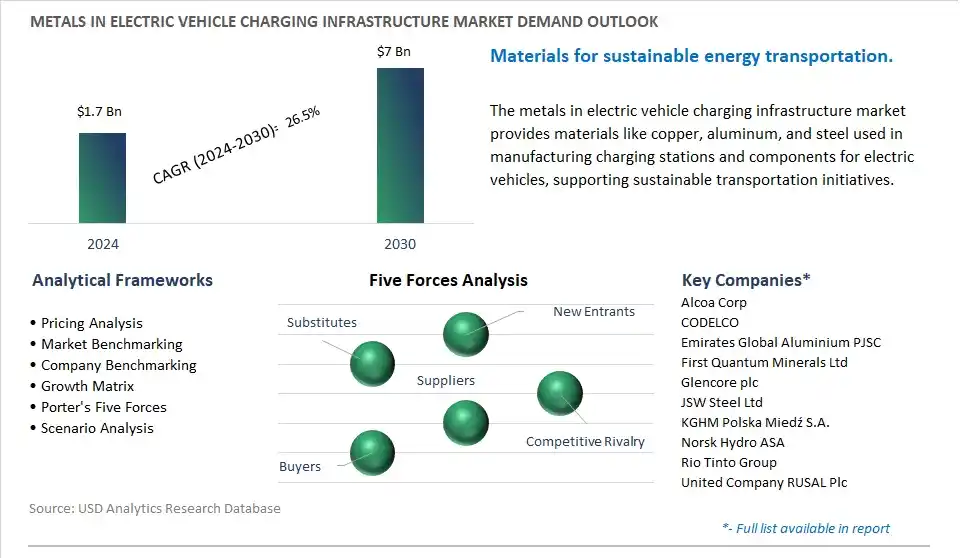
The global Metals In Electric Vehicle Charging Infrastructure Market is poised to register a 26.5% CAGR from $1.7 Billion in 2024 to $7 Billion in 2030.
The global Metals In Electric Vehicle Charging Infrastructure Market Study analyzes and forecasts the market size across 6 regions and 24 countries for diverse segments -By Metal (Copper, Steel, Aluminum, Others), By Charging Ports (Level 1, Level 2, DC Fast Charger (Level 3)), By End-User (Commercial, Private).
An Introduction to Global Metals In Electric Vehicle Charging Infrastructure Market in 2024
The future of metals in electric vehicle (EV) charging infrastructure is influenced by several key trends reflecting advancements in transportation technology, urban planning, and sustainability initiatives. One significant trend is the increasing demand for robust and efficient metal components and materials to support the expansion of EV charging infrastructure, driven by the global transition towards electric mobility and the need to reduce greenhouse gas emissions. Metals play a critical role in various aspects of EV charging infrastructure, including charging stations, connectors, cables, and support structures, due to their strength, conductivity, and durability. Additionally, advancements in materials science and engineering are enabling the development of innovative metal alloys and composites with enhanced properties such as corrosion resistance, thermal conductivity, and lightweighting, to optimize the performance and longevity of charging infrastructure components. Moreover, there is growing interest in the integration of smart technologies and energy management systems into charging infrastructure, which relies on metal components for structural integrity and electrical conductivity. As governments, cities, and private enterprises invest in expanding EV charging networks to support the adoption of electric vehicles, the demand for metals in charging infrastructure is expected to grow, driving opportunities for metal producers, manufacturers, and technology providers to innovate and deliver solutions that meet the evolving needs of the market while contributing to a sustainable and electrified transportation future.
Metals In Electric Vehicle Charging Infrastructure Market Competitive Landscape
The market report analyses the leading companies in the industry including Alcoa Corp, CODELCO, Emirates Global Aluminium PJSC, First Quantum Minerals Ltd, Glencore plc, JSW Steel Ltd, KGHM Polska Miedź S.A., Norsk Hydro ASA, Rio Tinto Group, United Company RUSAL Plc.
Metals In Electric Vehicle Charging Infrastructure Market Dynamics
Metals In Electric Vehicle Charging Infrastructure Market Trend: Rapid Expansion of Electric Vehicle Charging Infrastructure
A significant trend in the Metals in Electric Vehicle Charging Infrastructure market is the rapid expansion of electric vehicle (EV) charging infrastructure globally. With the growing adoption of electric vehicles driven by environmental concerns and government regulations, there's a pressing need to develop a robust and extensive charging network to support EV growth. Metals such as aluminum, copper, and steel play crucial roles in the construction of EV charging stations, including charging poles, connectors, wiring, and support structures. As governments and private enterprises invest heavily in expanding charging infrastructure to meet the increasing demand for EVs, the demand for metals in this sector is expected to surge, driving market growth and innovation in charging station design and technology.
Metals In Electric Vehicle Charging Infrastructure Market Driver: Government Initiatives and Incentives for Electric Vehicle Adoption
A key driver propelling the Metals in Electric Vehicle Charging Infrastructure market is government initiatives and incentives aimed at promoting electric vehicle adoption. Governments worldwide are implementing policies such as subsidies, tax incentives, and regulatory mandates to accelerate the transition towards electric mobility and reduce greenhouse gas emissions. As part of these initiatives, governments are investing in the development of public charging infrastructure to alleviate range anxiety and increase EV adoption rates. Metals are essential components of EV charging infrastructure, and the increased government support for electric vehicle deployment translates to higher demand for metals in charging station construction. This driver incentivizes manufacturers to invest in the production of charging infrastructure components, contributing to market growth and expansion.
Metals In Electric Vehicle Charging Infrastructure Market Opportunity: Integration of Renewable Energy and Smart Grid Technologies
An opportunity in the Metals in Electric Vehicle Charging Infrastructure market lies in the integration of renewable energy and smart grid technologies into charging infrastructure. With the shift towards sustainable energy sources and the increasing adoption of renewable energy generation such as solar and wind power, there's an opportunity to integrate renewable energy sources into EV charging stations. Metals such as copper and aluminum are essential for the construction of solar panels, wind turbines, and energy storage systems, which can be combined with charging infrastructure to create eco-friendly and energy-efficient charging solutions. Additionally, smart grid technologies enable dynamic load management, demand response, and grid-balancing capabilities, optimizing the use of energy and enhancing the reliability of charging infrastructure. By embracing renewable energy and smart grid technologies, manufacturers can create innovative and sustainable charging solutions that cater to the evolving needs of electric vehicle users and contribute to the decarbonization of transportation.
Metals in Electric Vehicle Charging Infrastructure Market Share Analysis: Copper generated the highest revenue in 2024
The Copper segment dominates the Metals in the Electric Vehicle (EV) Charging Infrastructure Market due to its essential role in electrical conductivity and reliability. Copper is widely utilized in various components of EV charging infrastructure, including charging cables, connectors, busbars, and conductive materials within charging stations. Its excellent electrical conductivity, corrosion resistance, and thermal properties make copper the preferred choice for transmitting electricity efficiently and safely in EV charging systems. Additionally, the increasing adoption of fast-charging technologies and high-power charging stations in the EV market further drives the demand for copper-based infrastructure components capable of handling higher electrical currents and power levels. Furthermore, the transition towards renewable energy sources and the integration of energy storage systems in EV charging infrastructure necessitate robust and reliable electrical connections, where copper plays a vital role. As governments worldwide incentivize the adoption of electric vehicles and invest in EV charging infrastructure expansion, the demand for copper in this sector is expected to continue growing, reinforcing its dominance in the Metals in EV Charging Infrastructure Market.
Metals in Electric Vehicle Charging Infrastructure Market Share Analysis: DC Fast Charger (Level 3) segment is poised to register the fastest growth rate (CAGR) over the forecast period to 2030
The DC Fast Charger (Level 3) segment is experiencing rapid growth in the Metals in Electric Vehicle (EV) Charging Infrastructure Market. Level 3 chargers, also known as DC fast chargers, offer significantly faster charging speeds compared to Level 1 and Level 2 chargers, making them essential for addressing range anxiety and enabling long-distance travel for electric vehicle owners. DC fast chargers utilize direct current (DC) to deliver high power levels directly to the vehicle's battery, allowing for quick replenishment of battery charge in a fraction of the time required by Level 1 and Level 2 chargers. As electric vehicle technology advances and battery capacities increase, there is a growing demand for faster and more efficient charging solutions to meet the needs of EV drivers. Additionally, the deployment of Level 3 chargers along highways, major travel routes, and urban centers is essential for building out the EV charging infrastructure and supporting the widespread adoption of electric vehicles. Furthermore, government initiatives, incentives, and investments aimed at expanding EV charging networks and promoting electric mobility contribute to the accelerated growth of the DC Fast Charger (Level 3) segment in the Metals in EV Charging Infrastructure Market. As the EV market continues to mature and EV adoption rates rise, the demand for Level 3 chargers is expected to surge, driving further growth in this segment.
Metals in Electric Vehicle Charging Infrastructure Market Share Analysis: Commercial segment is poised to register the fastest growth rate (CAGR) over the forecast period to 2030
The Commercial segment is experiencing rapid growth in the Metals in the Electric Vehicle (EV) Charging Infrastructure Market. As businesses, fleet operators, and municipalities increasingly transition their vehicles to electric power, there is a growing demand for robust and scalable charging solutions to support large-scale charging operations. Commercial entities such as shopping centers, office complexes, airports, and parking facilities are installing EV charging infrastructure to attract customers, employees, and tenants while demonstrating their commitment to sustainability and environmental stewardship. Further, the rise of electric delivery vehicles, buses, and commercial fleets further drives the need for dedicated charging infrastructure in commercial settings. Additionally, government incentives, grants, and mandates aimed at accelerating the adoption of electric vehicles in commercial fleets contribute to the growth of this segment. Furthermore, advancements in charging technology, including smart charging systems, payment integration, and network connectivity, enhance the convenience and accessibility of EV charging for commercial users, driving further adoption and growth in the Commercial segment of the Metals in EV Charging Infrastructure Market.
Metals In Electric Vehicle Charging Infrastructure Market Report Segmentation
By Metal
Copper
Steel
Aluminum
Others
By Charging Ports
Level 1
Level 2
DC Fast Charger (Level 3)
By End-User
Commercial
Private
Regions Included
North America (US, Canada, Mexico)
Europe (Germany, UK, France, Spain, Italy, Russia, Rest of Europe)
Asia Pacific (China, India, Japan, South Korea, Australia, South East Asia, Rest of Asia)
South America (Brazil, Argentina, Rest of South America)
Middle East and Africa (Saudi Arabia, UAE, Rest of Middle East, South Africa, Egypt, Rest of Africa)
Metals In Electric Vehicle Charging Infrastructure Companies Profiled in the Market Study
Alcoa Corp
CODELCO
Emirates Global Aluminium PJSC
First Quantum Minerals Ltd
Glencore plc
JSW Steel Ltd
KGHM Polska Miedź S.A.
Norsk Hydro ASA
Rio Tinto Group
United Company RUSAL Plc
*- List Not Exhaustive
TABLE OF CONTENTS
1 Introduction to 2024 Metals In Electric Vehicle Charging Infrastructure Market
1.1 Market Overview
1.2 Quick Facts
1.3 Scope/Objective of the Study
1.4 Market Definition
1.5 Countries and Regions Covered
1.6 Units, Currency, and Conversions
1.7 Industry Value Chain
2 Research Methodology
2.1 Market Size Estimation
2.2 Sources and Research Methodology
2.3 Data Triangulation
2.4 Assumptions and Limitations
3 Executive Summary
3.1 Global Metals In Electric Vehicle Charging Infrastructure Market Size Outlook, $ Million, 2021 to 2030
3.2 Metals In Electric Vehicle Charging Infrastructure Market Outlook by Type, $ Million, 2021 to 2030
3.3 Metals In Electric Vehicle Charging Infrastructure Market Outlook by Product, $ Million, 2021 to 2030
3.4 Metals In Electric Vehicle Charging Infrastructure Market Outlook by Application, $ Million, 2021 to 2030
3.5 Metals In Electric Vehicle Charging Infrastructure Market Outlook by Key Countries, $ Million, 2021 to 2030
4 Market Dynamics
4.1 Key Driving Forces of Metals In Electric Vehicle Charging Infrastructure Industry
4.2 Key Market Trends in Metals In Electric Vehicle Charging Infrastructure Industry
4.3 Potential Opportunities in Metals In Electric Vehicle Charging Infrastructure Industry
4.4 Key Challenges in Metals In Electric Vehicle Charging Infrastructure Industry
5 Market Factor Analysis
5.1 Value Chain Analysis
5.2 Competitive Landscape
5.2.1 Global Metals In Electric Vehicle Charging Infrastructure Market Share by Company (%), 2023
5.2.2 Product Offerings by Company
5.3 Porter’s Five Forces Analysis
5.4 Pricing Analysis and Outlook
6 Growth Outlook Across Scenarios
6.1 Growth Analysis-Case Scenario Definitions
6.2 Low Growth Scenario Forecasts
6.3 Reference Growth Scenario Forecasts
6.4 High Growth Scenario Forecasts
7 Global Metals In Electric Vehicle Charging Infrastructure Market Outlook by Segments
7.1 Metals In Electric Vehicle Charging Infrastructure Market Outlook by Segments, $ Million, 2021- 2030
By Metal
Copper
Steel
Aluminum
Others
By Charging Ports
Level 1
Level 2
DC Fast Charger (Level 3)
By End-User
Commercial
Private
8 North America Metals In Electric Vehicle Charging Infrastructure Market Analysis and Outlook To 2030
8.1 Introduction to North America Metals In Electric Vehicle Charging Infrastructure Markets in 2024
8.2 North America Metals In Electric Vehicle Charging Infrastructure Market Size Outlook by Country, 2021-2030
8.2.1 United States
8.2.2 Canada
8.2.3 Mexico
8.3 North America Metals In Electric Vehicle Charging Infrastructure Market size Outlook by Segments, 2021-2030
By Metal
Copper
Steel
Aluminum
Others
By Charging Ports
Level 1
Level 2
DC Fast Charger (Level 3)
By End-User
Commercial
Private
9 Europe Metals In Electric Vehicle Charging Infrastructure Market Analysis and Outlook To 2030
9.1 Introduction to Europe Metals In Electric Vehicle Charging Infrastructure Markets in 2024
9.2 Europe Metals In Electric Vehicle Charging Infrastructure Market Size Outlook by Country, 2021-2030
9.2.1 Germany
9.2.2 France
9.2.3 Spain
9.2.4 United Kingdom
9.2.4 Italy
9.2.5 Russia
9.2.6 Norway
9.2.7 Rest of Europe
9.3 Europe Metals In Electric Vehicle Charging Infrastructure Market Size Outlook by Segments, 2021-2030
By Metal
Copper
Steel
Aluminum
Others
By Charging Ports
Level 1
Level 2
DC Fast Charger (Level 3)
By End-User
Commercial
Private
10 Asia Pacific Metals In Electric Vehicle Charging Infrastructure Market Analysis and Outlook To 2030
10.1 Introduction to Asia Pacific Metals In Electric Vehicle Charging Infrastructure Markets in 2024
10.2 Asia Pacific Metals In Electric Vehicle Charging Infrastructure Market Size Outlook by Country, 2021-2030
10.2.1 China
10.2.2 India
10.2.3 Japan
10.2.4 South Korea
10.2.5 Indonesia
10.2.6 Malaysia
10.2.7 Australia
10.2.8 Rest of Asia Pacific
10.3 Asia Pacific Metals In Electric Vehicle Charging Infrastructure Market size Outlook by Segments, 2021-2030
By Metal
Copper
Steel
Aluminum
Others
By Charging Ports
Level 1
Level 2
DC Fast Charger (Level 3)
By End-User
Commercial
Private
11 South America Metals In Electric Vehicle Charging Infrastructure Market Analysis and Outlook To 2030
11.1 Introduction to South America Metals In Electric Vehicle Charging Infrastructure Markets in 2024
11.2 South America Metals In Electric Vehicle Charging Infrastructure Market Size Outlook by Country, 2021-2030
11.2.1 Brazil
11.2.2 Argentina
11.2.3 Rest of South America
11.3 South America Metals In Electric Vehicle Charging Infrastructure Market size Outlook by Segments, 2021-2030
By Metal
Copper
Steel
Aluminum
Others
By Charging Ports
Level 1
Level 2
DC Fast Charger (Level 3)
By End-User
Commercial
Private
12 Middle East and Africa Metals In Electric Vehicle Charging Infrastructure Market Analysis and Outlook To 2030
12.1 Introduction to Middle East and Africa Metals In Electric Vehicle Charging Infrastructure Markets in 2024
12.2 Middle East and Africa Metals In Electric Vehicle Charging Infrastructure Market Size Outlook by Country, 2021-2030
12.2.1 Saudi Arabia
12.2.2 UAE
12.2.3 Oman
12.2.4 Rest of Middle East
12.2.5 Egypt
12.2.6 Nigeria
12.2.7 South Africa
12.2.8 Rest of Africa
12.3 Middle East and Africa Metals In Electric Vehicle Charging Infrastructure Market size Outlook by Segments, 2021-2030
By Metal
Copper
Steel
Aluminum
Others
By Charging Ports
Level 1
Level 2
DC Fast Charger (Level 3)
By End-User
Commercial
Private
13 Company Profiles
13.1 Company Snapshot
13.2 SWOT Profiles
13.3 Products and Services
13.4 Recent Developments
13.5 Financial Profile
Alcoa Corp
CODELCO
Emirates Global Aluminium PJSC
First Quantum Minerals Ltd
Glencore plc
JSW Steel Ltd
KGHM Polska Miedź S.A.
Norsk Hydro ASA
Rio Tinto Group
United Company RUSAL Plc
14 Appendix
14.1 Customization Offerings
14.2 Subscription Services
14.3 Related Reports
14.4 Publisher Expertise
By Metal
Copper
Steel
Aluminum
Others
By Charging Ports
Level 1
Level 2
DC Fast Charger (Level 3)
By End-User
Commercial
Private
Countries Analyzed
North America (US, Canada, Mexico)
Europe (Germany, UK, France, Spain, Italy, Russia, Rest of Europe)
Asia Pacific (China, India, Japan, South Korea, Australia, South East Asia, Rest of Asia)
South America (Brazil, Argentina, Rest of South America)
Middle East and Africa (Saudi Arabia, UAE, Rest of Middle East, South Africa, Egypt, Rest of Africa)
