The global Metalworking Fluids Market is poised to register a 4.6% CAGR from $12.6 Billion in 2024 to $16.5 Billion in 2030.
The global Metalworking Fluids Market Study analyzes and forecasts the market size across 6 regions and 24 countries for diverse segments -By Type (Mineral, Synthetic, Bio-based), By Application (Removal Fluids, Forming Fluids, Protecting Fluids, Treating Fluids, Neat Cutting Oils, Water Cutting Oils, Corrosion Preventive Oils, Others), By End-User (Automotive, Aerospace, Construction, Electrical & power, Agriculture, Marine, Others).
An Introduction to Global Metalworking Fluids Market in 2024
The future of metalworking fluids (MWFs) is influenced by several key trends, including increasing demand for machining and metal fabrication in automotive, aerospace, and machinery industries, advancements in MWF formulation and application technologies, and growing emphasis on performance, safety, and environmental sustainability. MWFs are liquids used in metalworking operations such as cutting, grinding, and forming to lubricate, cool, and protect metal surfaces from tool wear, heat buildup, and corrosion, offering properties such as viscosity, thermal stability, and bioresistance. With the rise of high-speed machining, advanced materials, and stringent quality requirements, there's a growing need for MWFs that offer enhanced lubrication, chip removal, and surface finish while minimizing health hazards, waste generation, and environmental pollution. Moreover, advancements in MWF chemistry, such as bio-based additives, microemulsions, and nanoparticle dispersions, are driving the development of next-generation formulations with improved performance, stability, and eco-compatibility for various metalworking processes and materials. Additionally, the integration of MWF management systems, such as recycling, filtration, and monitoring technologies, is enhancing process efficiency, waste reduction, and regulatory compliance in metalworking operations. Collaboration between MWF manufacturers, machine tool suppliers, occupational health experts, and environmental agencies is essential to drive innovation, ensure fluid performance, and address market demands in the metalworking fluids industry.
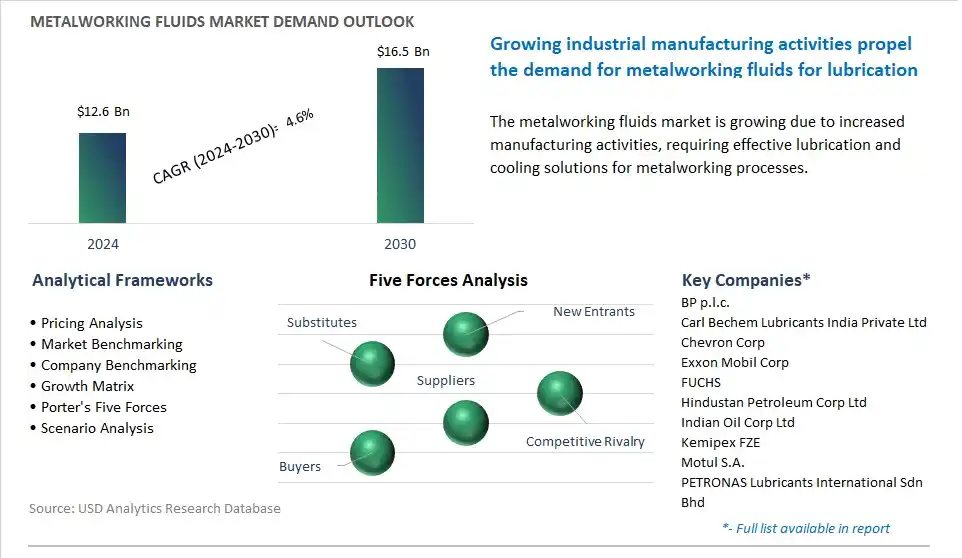
Metalworking Fluids Market Competitive Landscape
The market report analyses the leading companies in the industry including BP p.l.c., Carl Bechem Lubricants India Private Ltd, Chevron Corp, Exxon Mobil Corp, FUCHS, Hindustan Petroleum Corp Ltd, Indian Oil Corp Ltd, Kemipex FZE, Motul S.A., PETRONAS Lubricants International Sdn Bhd, Saudi Arabian Oil Co., SKF AB, TotalEnergies SE.
Metalworking Fluids Market Dynamics
Metal Working Fluids Market Trend: Shift Towards Environmentally Friendly and Sustainable Formulations
A significant trend in the metal working fluids market is the shift towards environmentally friendly and sustainable formulations. With increasing regulatory scrutiny and growing awareness of environmental issues, there's a notable demand for metal working fluids that minimize environmental impact, reduce worker exposure to hazardous chemicals, and improve workplace safety. Manufacturers are developing innovative formulations that incorporate biodegradable, renewable, and non-toxic ingredients, such as vegetable oils, esters, and bio-based additives, to meet sustainability objectives while maintaining performance and efficiency in metal machining, cutting, and forming processes. This trend is driven by industry initiatives to adopt green manufacturing practices, as well as customer preferences for eco-friendly products that align with corporate sustainability goals. As environmental regulations become more stringent and sustainability becomes a key differentiator in the marketplace, the demand for environmentally friendly metal working fluids is expected to continue rising.
Metal Working Fluids Market Driver: Growth in Manufacturing Activities and Industrialization
A major driver of the metal working fluids market is the growth in manufacturing activities and industrialization globally. As economies develop and urbanize, there's an increasing demand for metal products across various industries such as automotive, aerospace, machinery, and construction. Metal working fluids play a crucial role in metal fabrication processes by lubricating, cooling, and protecting metal surfaces from corrosion and wear during machining, cutting, and forming operations. The expansion of manufacturing infrastructure, the rise of industrial automation, and the pursuit of technological advancements in metal processing techniques are driving the demand for high-performance metal working fluids that can improve machining efficiency, prolong tool life, and enhance product quality. With the growing demand for metal components in consumer goods, infrastructure projects, and industrial applications, the need for effective metal working fluids to support manufacturing processes is expected to fuel market growth.
Metal Working Fluids Market Opportunity: Development of Specialty Formulations for Advanced Manufacturing Processes
An opportunity within the metal working fluids market lies in the development of specialty formulations tailored for advanced manufacturing processes. With the increasing adoption of high-speed machining, hard metal machining, and exotic material processing techniques such as titanium and composites, there's a demand for metal working fluids that can meet the unique challenges of these applications. Specialty formulations with advanced lubrication, cooling, and anti-wear properties are required to optimize cutting performance, prevent tool wear, and ensure dimensional accuracy in precision machining operations. Additionally, there's an opportunity to develop metal working fluids specifically designed for additive manufacturing processes such as 3D printing of metal components, where unique lubrication and cooling requirements exist. By investing in research and development to address the evolving needs of advanced manufacturing technologies, companies can capitalize on the demand for specialty metal working fluids and differentiate themselves in the market, thereby unlocking new growth opportunities.
Metal Working Fluids Market Share Analysis: The Mineral-based fluids segment generated the highest revenue in 2024
The largest segment in the Metal Working Fluids Market is Mineral-based fluids. This dominance is primarily due to their long history of use and established presence in various metalworking applications. Mineral-based fluids are derived from petroleum or mineral oil distillation processes and are known for their excellent cooling and lubricating properties, making them suitable for a wide range of metalworking operations, including cutting, grinding, milling, and forming. Additionally, mineral-based fluids are cost-effective compared to synthetic and bio-based alternatives, making them a preferred choice for many manufacturers, especially in industries with high-volume production requirements. Further, mineral-based fluids offer good stability, compatibility with metals, and resistance to microbial growth, further contributing to their widespread adoption in the Metal Working Fluids Market. While synthetic and bio-based fluids are gaining traction due to environmental and health concerns, the mineral-based segment continues to dominate the market due to its established market presence, performance, and cost-effectiveness.
Metal Working Fluids Market Share Analysis: The Removal Fluids segment is poised to register the fastest growth rate (CAGR) over the forecast period to 2030
The fastest-growing segment in the Metal Working Fluids Market is Removal Fluids. Removal fluids, also known as cutting fluids or machining fluids, are extensively used in metalworking operations such as cutting, drilling, milling, and grinding to lubricate and cool the cutting tool and workpiece, reduce friction, and remove metal chips or swarf. As manufacturing processes become more advanced and demanding, there is a growing need for efficient and high-performance removal fluids that can improve machining efficiency, tool life, and surface finish quality. Additionally, the increasing adoption of advanced machining techniques such as high-speed machining, hard machining, and dry machining has led to greater demand for removal fluids with enhanced lubricity, thermal stability, and anti-wear properties to withstand the rigors of modern machining operations. Further, stringent environmental regulations and growing concerns over worker safety and health have fueled the demand for removal fluids that are biodegradable, low in volatile organic compounds (VOCs), and free from hazardous chemicals, driving the growth of eco-friendly and bio-based removal fluid formulations in the Metal Working Fluids Market. Additionally, advancements in formulation technologies and the development of tailor-made solutions for specific machining applications are further accelerating the growth of the Removal Fluids segment.
Metal Working Fluids Market Share Analysis: The Aerospace segment is poised to register the fastest growth rate (CAGR) over the forecast period to 2030
The fastest-growing segment in the Metal Working Fluids Market is the Aerospace industry. The aerospace industry operates under strict regulations and standards to ensure the safety, reliability, and performance of aircraft components and systems. Metal working fluids play a crucial role in aerospace manufacturing processes such as machining, milling, and forming, where precision, quality, and consistency are paramount. The aerospace sector requires specialized metal working fluids that can meet stringent performance requirements, including high lubricity, thermal stability, and corrosion resistance, to ensure the integrity of critical components such as turbine blades, engine components, and structural parts. Additionally, the aerospace industry is experiencing robust growth driven by increasing air travel demand, expansion of commercial aviation fleets, and advancements in aerospace technology. This growth translates into higher demand for metal working fluids to support aerospace manufacturing and maintenance operations. Further, aerospace manufacturers are increasingly investing in advanced machining technologies and materials to improve efficiency, reduce costs, and enhance product quality, driving the need for innovative metal working fluid formulations tailored to meet the evolving needs of the aerospace industry. Over the forecast period, these factors contribute to the aerospace segment emerging as the fastest-growing segment in the Metal Working Fluids Market.
Metalworking Fluids Market Report Segmentation
By Type
Mineral
Synthetic
Bio-based
By Application
Removal Fluids
Forming Fluids
Protecting Fluids
Treating Fluids
Neat Cutting Oils
Water Cutting Oils
Corrosion Preventive Oils
Others
By End-User
Automotive
Aerospace
Construction
Electrical & power
Agriculture
Marine
Others
Regions Included
North America (US, Canada, Mexico)
Europe (Germany, UK, France, Spain, Italy, Russia, Rest of Europe)
Asia Pacific (China, India, Japan, South Korea, Australia, South East Asia, Rest of Asia)
South America (Brazil, Argentina, Rest of South America)
Middle East and Africa (Saudi Arabia, UAE, Rest of Middle East, South Africa, Egypt, Rest of Africa)
Metalworking Fluids Companies Profiled in the Market Study
BP p.l.c.
Carl Bechem Lubricants India Private Ltd
Chevron Corp
Exxon Mobil Corp
FUCHS
Hindustan Petroleum Corp Ltd
Indian Oil Corp Ltd
Kemipex FZE
Motul S.A.
PETRONAS Lubricants International Sdn Bhd
Saudi Arabian Oil Co.
SKF AB
TotalEnergies SE
*- List Not Exhaustive
TABLE OF CONTENTS
1 Introduction to 2024 Metalworking Fluids Market
1.1 Market Overview
1.2 Quick Facts
1.3 Scope/Objective of the Study
1.4 Market Definition
1.5 Countries and Regions Covered
1.6 Units, Currency, and Conversions
1.7 Industry Value Chain
2 Research Methodology
2.1 Market Size Estimation
2.2 Sources and Research Methodology
2.3 Data Triangulation
2.4 Assumptions and Limitations
3 Executive Summary
3.1 Global Metalworking Fluids Market Size Outlook, $ Million, 2021 to 2030
3.2 Metalworking Fluids Market Outlook by Type, $ Million, 2021 to 2030
3.3 Metalworking Fluids Market Outlook by Product, $ Million, 2021 to 2030
3.4 Metalworking Fluids Market Outlook by Application, $ Million, 2021 to 2030
3.5 Metalworking Fluids Market Outlook by Key Countries, $ Million, 2021 to 2030
4 Market Dynamics
4.1 Key Driving Forces of Metalworking Fluids Industry
4.2 Key Market Trends in Metalworking Fluids Industry
4.3 Potential Opportunities in Metalworking Fluids Industry
4.4 Key Challenges in Metalworking Fluids Industry
5 Market Factor Analysis
5.1 Value Chain Analysis
5.2 Competitive Landscape
5.2.1 Global Metalworking Fluids Market Share by Company (%), 2023
5.2.2 Product Offerings by Company
5.3 Porter’s Five Forces Analysis
5.4 Pricing Analysis and Outlook
6 Growth Outlook Across Scenarios
6.1 Growth Analysis-Case Scenario Definitions
6.2 Low Growth Scenario Forecasts
6.3 Reference Growth Scenario Forecasts
6.4 High Growth Scenario Forecasts
7 Global Metalworking Fluids Market Outlook by Segments
7.1 Metalworking Fluids Market Outlook by Segments, $ Million, 2021- 2030
By Type
Mineral
Synthetic
Bio-based
By Application
Removal Fluids
Forming Fluids
Protecting Fluids
Treating Fluids
Neat Cutting Oils
Water Cutting Oils
Corrosion Preventive Oils
Others
By End-User
Automotive
Aerospace
Construction
Electrical & power
Agriculture
Marine
Others
8 North America Metalworking Fluids Market Analysis and Outlook To 2030
8.1 Introduction to North America Metalworking Fluids Markets in 2024
8.2 North America Metalworking Fluids Market Size Outlook by Country, 2021-2030
8.2.1 United States
8.2.2 Canada
8.2.3 Mexico
8.3 North America Metalworking Fluids Market size Outlook by Segments, 2021-2030
By Type
Mineral
Synthetic
Bio-based
By Application
Removal Fluids
Forming Fluids
Protecting Fluids
Treating Fluids
Neat Cutting Oils
Water Cutting Oils
Corrosion Preventive Oils
Others
By End-User
Automotive
Aerospace
Construction
Electrical & power
Agriculture
Marine
Others
9 Europe Metalworking Fluids Market Analysis and Outlook To 2030
9.1 Introduction to Europe Metalworking Fluids Markets in 2024
9.2 Europe Metalworking Fluids Market Size Outlook by Country, 2021-2030
9.2.1 Germany
9.2.2 France
9.2.3 Spain
9.2.4 United Kingdom
9.2.4 Italy
9.2.5 Russia
9.2.6 Norway
9.2.7 Rest of Europe
9.3 Europe Metalworking Fluids Market Size Outlook by Segments, 2021-2030
By Type
Mineral
Synthetic
Bio-based
By Application
Removal Fluids
Forming Fluids
Protecting Fluids
Treating Fluids
Neat Cutting Oils
Water Cutting Oils
Corrosion Preventive Oils
Others
By End-User
Automotive
Aerospace
Construction
Electrical & power
Agriculture
Marine
Others
10 Asia Pacific Metalworking Fluids Market Analysis and Outlook To 2030
10.1 Introduction to Asia Pacific Metalworking Fluids Markets in 2024
10.2 Asia Pacific Metalworking Fluids Market Size Outlook by Country, 2021-2030
10.2.1 China
10.2.2 India
10.2.3 Japan
10.2.4 South Korea
10.2.5 Indonesia
10.2.6 Malaysia
10.2.7 Australia
10.2.8 Rest of Asia Pacific
10.3 Asia Pacific Metalworking Fluids Market size Outlook by Segments, 2021-2030
By Type
Mineral
Synthetic
Bio-based
By Application
Removal Fluids
Forming Fluids
Protecting Fluids
Treating Fluids
Neat Cutting Oils
Water Cutting Oils
Corrosion Preventive Oils
Others
By End-User
Automotive
Aerospace
Construction
Electrical & power
Agriculture
Marine
Others
11 South America Metalworking Fluids Market Analysis and Outlook To 2030
11.1 Introduction to South America Metalworking Fluids Markets in 2024
11.2 South America Metalworking Fluids Market Size Outlook by Country, 2021-2030
11.2.1 Brazil
11.2.2 Argentina
11.2.3 Rest of South America
11.3 South America Metalworking Fluids Market size Outlook by Segments, 2021-2030
By Type
Mineral
Synthetic
Bio-based
By Application
Removal Fluids
Forming Fluids
Protecting Fluids
Treating Fluids
Neat Cutting Oils
Water Cutting Oils
Corrosion Preventive Oils
Others
By End-User
Automotive
Aerospace
Construction
Electrical & power
Agriculture
Marine
Others
12 Middle East and Africa Metalworking Fluids Market Analysis and Outlook To 2030
12.1 Introduction to Middle East and Africa Metalworking Fluids Markets in 2024
12.2 Middle East and Africa Metalworking Fluids Market Size Outlook by Country, 2021-2030
12.2.1 Saudi Arabia
12.2.2 UAE
12.2.3 Oman
12.2.4 Rest of Middle East
12.2.5 Egypt
12.2.6 Nigeria
12.2.7 South Africa
12.2.8 Rest of Africa
12.3 Middle East and Africa Metalworking Fluids Market size Outlook by Segments, 2021-2030
By Type
Mineral
Synthetic
Bio-based
By Application
Removal Fluids
Forming Fluids
Protecting Fluids
Treating Fluids
Neat Cutting Oils
Water Cutting Oils
Corrosion Preventive Oils
Others
By End-User
Automotive
Aerospace
Construction
Electrical & power
Agriculture
Marine
Others
13 Company Profiles
13.1 Company Snapshot
13.2 SWOT Profiles
13.3 Products and Services
13.4 Recent Developments
13.5 Financial Profile
BP p.l.c.
Carl Bechem Lubricants India Private Ltd
Chevron Corp
Exxon Mobil Corp
FUCHS
Hindustan Petroleum Corp Ltd
Indian Oil Corp Ltd
Kemipex FZE
Motul S.A.
PETRONAS Lubricants International Sdn Bhd
Saudi Arabian Oil Co.
SKF AB
TotalEnergies SE
14 Appendix
14.1 Customization Offerings
14.2 Subscription Services
14.3 Related Reports
14.4 Publisher Expertise
By Type
Mineral
Synthetic
Bio-based
By Application
Removal Fluids
Forming Fluids
Protecting Fluids
Treating Fluids
Neat Cutting Oils
Water Cutting Oils
Corrosion Preventive Oils
Others
By End-User
Automotive
Aerospace
Construction
Electrical & power
Agriculture
Marine
Others
Countries Analyzed
North America (US, Canada, Mexico)
Europe (Germany, UK, France, Spain, Italy, Russia, Rest of Europe)
Asia Pacific (China, India, Japan, South Korea, Australia, South East Asia, Rest of Asia)
South America (Brazil, Argentina, Rest of South America)
Middle East and Africa (Saudi Arabia, UAE, Rest of Middle East, South Africa, Egypt, Rest of Africa)
