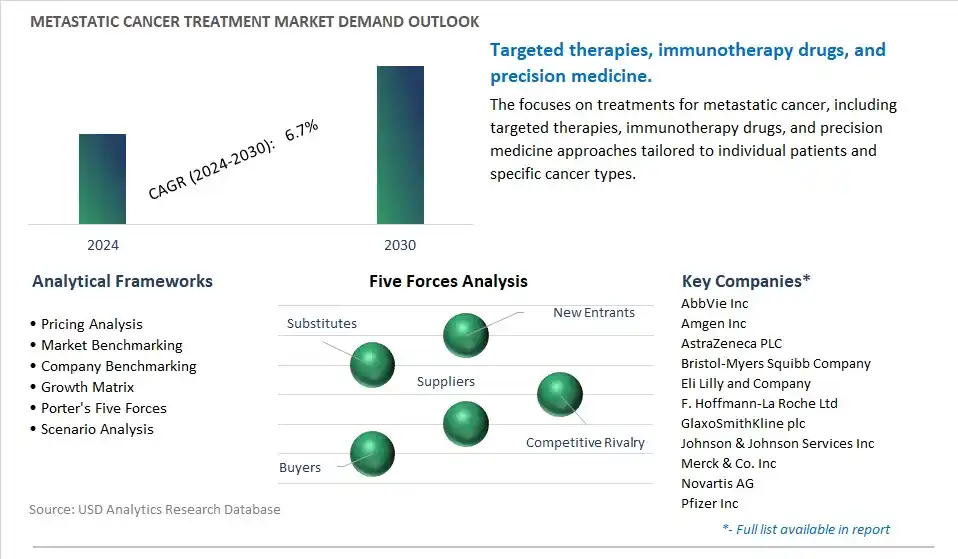
Metastatic Cancer Treatment Market is estimated to increase at a Compounded Annual Growth Rate of 6.7% CAGR over the forecast period from 2024 to 2030
The Metastatic Cancer Treatment Market study analyzes and forecasts the market size across 6 regions and 24 countries for diverse segments- By Treatment (Chemotherapy, Immunotherapy, Hormone Therapy, Others), By Cancer (Breast Cancer, Lung Cancer, Prostate Cancer, Melanoma, Colorectal Cancer, Others), By End-User (Hospitals, Clinics, Others).
An Introduction to Metastatic Cancer Treatment Market in 2024
In 2024, the market for metastatic cancer treatment continues to advance, offering innovative therapies and personalized approaches to combat cancer that has spread from its original site to other parts of the body. Metastatic cancer poses significant challenges due to its aggressive nature and potential for widespread dissemination, requiring comprehensive treatment strategies that target primary and metastatic tumors while minimizing systemic toxicity and preserving quality of life. Treatment options for metastatic cancer may include surgery, chemotherapy, radiation therapy, targeted therapy, immunotherapy, and palliative care, depending on the cancer type, stage, and individual patient factors. Technological advancements in cancer diagnostics, molecular profiling, and treatment modalities, such as precision medicine, immune checkpoint inhibitors, and adoptive cell therapies, have revolutionized the management of metastatic cancer, offering patients improved survival outcomes and enhanced therapeutic options. With the growing understanding of cancer biology, the emergence of novel therapeutic targets, and the increasing availability of advanced cancer care services, the market for metastatic cancer treatment is poised for continued growth and innovation, providing hope to patients and healthcare providers in the fight against advanced-stage malignancies.
Market Trend: Precision Oncology and Targeted Therapies
A prominent trend in the metastatic cancer treatment market is the increasing adoption of precision oncology approaches and targeted therapies. As our understanding of cancer biology and genetics advances, there is a growing emphasis on identifying specific molecular alterations and biomarkers that drive metastatic cancer progression. This trend is driven by the recognition that metastatic cancers are heterogeneous diseases with distinct molecular profiles and treatment responses. Healthcare providers are increasingly utilizing genomic profiling and molecular diagnostic tests to tailor treatment regimens based on individual tumor characteristics, enabling the selection of targeted therapies that inhibit key oncogenic pathways and improve treatment outcomes. Additionally, advancements in precision medicine technologies, such as next-generation sequencing and liquid biopsies, are facilitating real-time monitoring of tumor evolution and treatment response, enabling personalized adjustments to therapy and optimizing patient care. As precision oncology continues to reshape cancer treatment paradigms, the demand for targeted therapies in metastatic cancer treatment is expected to grow, driving market expansion and innovation in therapeutic interventions.
Market Driver: Rising Incidence of Metastatic Cancer and Unmet Medical Needs
The primary driver propelling the metastatic cancer treatment market is the rising incidence of metastatic cancer and the associated unmet medical needs. Metastatic cancer, characterized by the spread of cancer cells from the primary tumor to distant organs or tissues, remains a significant clinical challenge and a leading cause of cancer-related mortality worldwide. Despite advancements in cancer treatment modalities, including surgery, chemotherapy, radiation therapy, and immunotherapy, metastatic cancers often develop resistance to standard therapies and are associated with poor prognosis and limited treatment options. Consequently, there is a critical need for innovative therapeutic approaches that effectively target metastatic disease, inhibit tumor progression, and prolong survival while minimizing treatment-related toxicity and adverse effects. This unmet medical need drives research and development efforts to discover and develop novel targeted therapies, immunotherapies, and combination regimens that address the complex biology and heterogeneity of metastatic tumors, offering hope for improved outcomes and quality of life for patients with advanced cancer.
Market Opportunity: Development of Immunotherapy Combinations and Biomarker-driven Treatments
An opportunity within the metastatic cancer treatment market lies in the development of immunotherapy combinations and biomarker-driven treatments that enhance treatment efficacy and patient outcomes. Immunotherapy, particularly immune checkpoint inhibitors, has revolutionized the treatment landscape for metastatic cancers by harnessing the body's immune system to recognize and eliminate cancer cells. However, not all patients respond to immunotherapy, and resistance mechanisms can limit treatment effectiveness. There is an opportunity to explore combination therapies that synergistically enhance immune responses, overcome resistance, and improve response rates in metastatic cancer patients. Additionally, biomarker-driven approaches, such as tumor mutational burden, microsatellite instability, and programmed death-ligand 1 (PD-L1) expression, can help identify patients who are most to benefit from immunotherapy and guide treatment selection. By leveraging biomarkers and predictive analytics, pharmaceutical companies and researchers can develop personalized treatment strategies that optimize the use of immunotherapy in metastatic cancer patients, maximizing therapeutic benefit and improving clinical outcomes. This opportunity represents a promising avenue for innovation and advancement in metastatic cancer treatment, offering potential breakthroughs in patient care and survival.
Metastatic Cancer Treatment Market Share Analysis: Immunotherapy for Metastatic Cancer Treatment
The fast-growing segment within the metastatic cancer treatment market is immunotherapy. This growth is propelled by several factors. Firstly, immunotherapy has revolutionized the treatment landscape for metastatic cancer by harnessing the body's immune system to target and destroy cancer cells. Immune checkpoint inhibitors, adoptive cell therapies, cancer vaccines, and other immunotherapeutic approaches have demonstrated significant clinical benefits in patients with metastatic cancer, including improved survival outcomes and durable responses. Secondly, immunotherapy offers several advantages over traditional cancer treatments such as chemotherapy and radiation therapy. It can provide long-term remission and survival benefits with fewer severe side effects, offering a better quality of life for patients. Additionally, immunotherapy has shown efficacy across a wide range of metastatic cancer types, including melanoma, lung cancer, kidney cancer, and certain types of breast and colorectal cancer, providing hope for patients with advanced or treatment-resistant disease. Furthermore, ongoing research and development efforts are focused on advancing immunotherapy techniques, identifying predictive biomarkers, and developing combination strategies to enhance treatment outcomes and overcome resistance mechanisms. Moreover, the expanding indications and approvals for immunotherapy agents by regulatory agencies worldwide further contribute to market growth and adoption. Additionally, the increasing investment in precision medicine and personalized cancer therapies drives the demand for immunotherapy-based treatments tailored to individual patient profiles and tumor characteristics. Overall, the combination of clinical efficacy, safety profile, broad applicability, and ongoing research advancements positions immunotherapy as the fast-growing segment within the metastatic cancer treatment market.
Metastatic Cancer Treatment Competitive Analysis
The market research study provides in-depth insights into leading companies including the SWOT analyses, product profile, financial details, and recent developments acrossAbbVie Inc, Amgen Inc, AstraZeneca PLC, Bristol-Myers Squibb Company, Eli Lilly and Company, F. Hoffmann-La Roche Ltd, GlaxoSmithKline plc, Johnson & Johnson Services Inc, Merck & Co. Inc, Novartis AG, Pfizer Inc
Metastatic Cancer Treatment Market Segmentation
By Treatment
Chemotherapy
Immunotherapy
Hormone Therapy
Others
By Cancer
Breast Cancer
Lung Cancer
Prostate Cancer
Melanoma
Colorectal Cancer
Others
By End-User
Hospitals
Clinics
Others
Geographical Analysis
North America (United States, Canada, Mexico)
Europe (Germany, France, United Kingdom, Spain, Italy, Rest of Europe)
Asia Pacific (China, India, Japan, South Korea, Rest of Asia Pacific)
South America (Brazil, Argentina, Rest of South America)
Middle East and Africa (Saudi Arabia, UAE, Rest of Middle East, South Africa, Egypt, Rest of Africa)
Metastatic Cancer Treatment Market Companies
AbbVie Inc
Amgen Inc
AstraZeneca PLC
Bristol-Myers Squibb Company
Eli Lilly and Company
F. Hoffmann-La Roche Ltd
GlaxoSmithKline plc
Johnson & Johnson Services Inc
Merck & Co. Inc
Novartis AG
Pfizer Inc
Reasons to Buy the Metastatic Cancer Treatment Market Study
• Deepen your industry insights and navigate uncertainties for strategy formulation, CAPEX, and Operational decisions
• Gain access to detailed insights on the Metastatic Cancer Treatment Market, encompassing current market size, growth trends, and forecasts till 2030.
• Access detailed competitor analysis, enabling competitive advantage through a thorough understanding of market players, strategies, and potential differentiation opportunities
• Stay ahead of the curve with insights on technological advancements, innovations, and upcoming trends
• Identify lucrative investment avenues and expansion opportunities within the Metastatic Cancer Treatment Market industry, guided by robust, data-backed analysis.
• Understand regional and global markets through country-wise analysis, regional market potential, regulatory nuances, and dynamics
• Execute strategies with confidence and speed through information, analytics, and insights on the industry value chain
• Corporate leaders, strategists, financial experts, shareholders, asset managers, and governmental representatives can make long-term planning scenarios and build an integrated and timely understanding of market dynamics
• Benefit from tailored solutions and expert consultation based on report insights, providing personalized strategies aligned with specific business needs.
TABLE OF CONTENTS
1 Introduction to 2024 Metastatic Cancer Treatment Market
1.1 Market Overview
1.2 Quick Facts
1.3 Scope/Objective of the Study
1.4 Market Definition
1.5 Countries and Regions Covered
1.6 Units, Currency, and Conversions
1.7 Industry Value Chain
2 Research Methodology
2.1 Market Size Estimation
2.2 Sources and Research Methodology
2.3 Data Triangulation
2.4 Assumptions and Limitations
3 Executive Summary
3.1 Global Metastatic Cancer Treatment Market Size Outlook, $ Million, 2021 to 2030
3.2 Metastatic Cancer Treatment Market Outlook by Type, $ Million, 2021 to 2030
3.3 Metastatic Cancer Treatment Market Outlook by Product, $ Million, 2021 to 2030
3.4 Metastatic Cancer Treatment Market Outlook by Application, $ Million, 2021 to 2030
3.5 Metastatic Cancer Treatment Market Outlook by Key Countries, $ Million, 2021 to 2030
4 Market Dynamics
4.1 Key Driving Forces of Metastatic Cancer Treatment Industry
4.2 Key Market Trends in Metastatic Cancer Treatment Industry
4.3 Potential Opportunities in Metastatic Cancer Treatment Industry
4.4 Key Challenges in Metastatic Cancer Treatment Industry
5 Market Factor Analysis
5.1 Value Chain Analysis
5.2 Competitive Landscape
5.2.1 Global Metastatic Cancer Treatment Market Share by Company (%), 2023
5.2.2 Product Offerings by Company
5.3 Porter’s Five Forces Analysis
5.4 Pricing Analysis and Outlook
6 Growth Outlook Across Scenarios
6.1 Growth Analysis-Case Scenario Definitions
6.2 Low Growth Scenario Forecasts
6.3 Reference Growth Scenario Forecasts
6.4 High Growth Scenario Forecasts
7 Global Metastatic Cancer Treatment Market Outlook by Segments
7.1 Metastatic Cancer Treatment Market Outlook by Segments, $ Million, 2021- 2030
By Treatment
Chemotherapy
Immunotherapy
Hormone Therapy
Others
By Cancer
Breast Cancer
Lung Cancer
Prostate Cancer
Melanoma
Colorectal Cancer
Others
By End-User
Hospitals
Clinics
Others
8 North America Metastatic Cancer Treatment Market Analysis and Outlook To 2030
8.1 Introduction to North America Metastatic Cancer Treatment Markets in 2024
8.2 North America Metastatic Cancer Treatment Market Size Outlook by Country, 2021-2030
8.2.1 United States
8.2.2 Canada
8.2.3 Mexico
8.3 North America Metastatic Cancer Treatment Market size Outlook by Segments, 2021-2030
By Treatment
Chemotherapy
Immunotherapy
Hormone Therapy
Others
By Cancer
Breast Cancer
Lung Cancer
Prostate Cancer
Melanoma
Colorectal Cancer
Others
By End-User
Hospitals
Clinics
Others
9 Europe Metastatic Cancer Treatment Market Analysis and Outlook To 2030
9.1 Introduction to Europe Metastatic Cancer Treatment Markets in 2024
9.2 Europe Metastatic Cancer Treatment Market Size Outlook by Country, 2021-2030
9.2.1 Germany
9.2.2 France
9.2.3 Spain
9.2.4 United Kingdom
9.2.4 Italy
9.2.5 Russia
9.2.6 Norway
9.2.7 Rest of Europe
9.3 Europe Metastatic Cancer Treatment Market Size Outlook by Segments, 2021-2030
By Treatment
Chemotherapy
Immunotherapy
Hormone Therapy
Others
By Cancer
Breast Cancer
Lung Cancer
Prostate Cancer
Melanoma
Colorectal Cancer
Others
By End-User
Hospitals
Clinics
Others
10 Asia Pacific Metastatic Cancer Treatment Market Analysis and Outlook To 2030
10.1 Introduction to Asia Pacific Metastatic Cancer Treatment Markets in 2024
10.2 Asia Pacific Metastatic Cancer Treatment Market Size Outlook by Country, 2021-2030
10.2.1 China
10.2.2 India
10.2.3 Japan
10.2.4 South Korea
10.2.5 Indonesia
10.2.6 Malaysia
10.2.7 Australia
10.2.8 Rest of Asia Pacific
10.3 Asia Pacific Metastatic Cancer Treatment Market size Outlook by Segments, 2021-2030
By Treatment
Chemotherapy
Immunotherapy
Hormone Therapy
Others
By Cancer
Breast Cancer
Lung Cancer
Prostate Cancer
Melanoma
Colorectal Cancer
Others
By End-User
Hospitals
Clinics
Others
11 South America Metastatic Cancer Treatment Market Analysis and Outlook To 2030
11.1 Introduction to South America Metastatic Cancer Treatment Markets in 2024
11.2 South America Metastatic Cancer Treatment Market Size Outlook by Country, 2021-2030
11.2.1 Brazil
11.2.2 Argentina
11.2.3 Rest of South America
11.3 South America Metastatic Cancer Treatment Market size Outlook by Segments, 2021-2030
By Treatment
Chemotherapy
Immunotherapy
Hormone Therapy
Others
By Cancer
Breast Cancer
Lung Cancer
Prostate Cancer
Melanoma
Colorectal Cancer
Others
By End-User
Hospitals
Clinics
Others
12 Middle East and Africa Metastatic Cancer Treatment Market Analysis and Outlook To 2030
12.1 Introduction to Middle East and Africa Metastatic Cancer Treatment Markets in 2024
12.2 Middle East and Africa Metastatic Cancer Treatment Market Size Outlook by Country, 2021-2030
12.2.1 Saudi Arabia
12.2.2 UAE
12.2.3 Oman
12.2.4 Rest of Middle East
12.2.5 Egypt
12.2.6 Nigeria
12.2.7 South Africa
12.2.8 Rest of Africa
12.3 Middle East and Africa Metastatic Cancer Treatment Market size Outlook by Segments, 2021-2030
By Treatment
Chemotherapy
Immunotherapy
Hormone Therapy
Others
By Cancer
Breast Cancer
Lung Cancer
Prostate Cancer
Melanoma
Colorectal Cancer
Others
By End-User
Hospitals
Clinics
Others
13 Company Profiles
13.1 Company Snapshot
13.2 SWOT Profiles
13.3 Products and Services
13.4 Recent Developments
13.5 Financial Profile
List of Companies
AbbVie Inc
Amgen Inc
AstraZeneca PLC
Bristol-Myers Squibb Company
Eli Lilly and Company
F. Hoffmann-La Roche Ltd
GlaxoSmithKline plc
Johnson & Johnson Services Inc
Merck & Co. Inc
Novartis AG
Pfizer Inc
14 Appendix
14.1 Customization Offerings
14.2 Subscription Services
14.3 Related Reports
14.4 Publisher Expertise
By Treatment
Chemotherapy
Immunotherapy
Hormone Therapy
Others
By Cancer
Breast Cancer
Lung Cancer
Prostate Cancer
Melanoma
Colorectal Cancer
Others
By End-User
Hospitals
Clinics
Others
Countries Analyzed
North America (United States, Canada, Mexico)
Europe (Germany, France, United Kingdom, Spain, Italy, Rest of Europe)
Asia Pacific (China, India, Japan, South Korea, Rest of Asia Pacific)
South America (Brazil, Argentina, Rest of South America)
Middle East and Africa (Saudi Arabia, UAE, Rest of Middle East, South Africa, Egypt, Rest of Africa)
