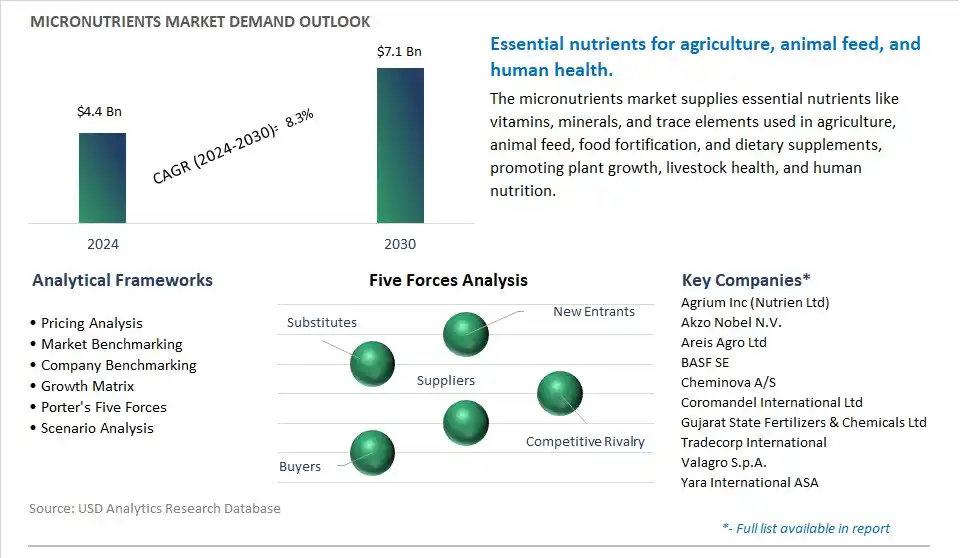
The global Micronutrients Market is poised to register a 8.3% CAGR from $4.4 Billion in 2024 to $7.1 Billion in 2030.
The global Micronutrients Market Study analyzes and forecasts the market size across 6 regions and 24 countries for diverse segments -By Type (Vitamins, Copper, Zinc, Molybdenum, Cobalt, Others), By Application (Fertilizer, Health Supplements, Others), By End-User (Agriculture, Food & Beverages, Pharmaceutical, Healthcare, Others).
An Introduction to Global Micronutrients Market in 2024
The future of micronutrients is influenced by several key trends reflecting advancements in agriculture technology, soil management practices, and nutritional science. One significant trend is the increasing recognition of micronutrients, including essential elements such as zinc, iron, manganese, and boron, as critical components for optimizing plant growth, health, and productivity in agriculture. Micronutrients play a vital role in various physiological processes within plants, including enzyme activation, photosynthesis, and nutrient uptake, contributing to improved crop yield, quality, and resilience to biotic and abiotic stresses. Additionally, advancements in soil testing methods, nutrient management practices, and precision agriculture technologies are enabling farmers to assess and address micronutrient deficiencies more effectively, optimizing fertilizer applications and nutrient utilization efficiency. Moreover, there is growing interest in sustainable and environmentally friendly micronutrient formulations, such as chelated and slow-release products, to minimize nutrient leaching, runoff, and environmental impact while maximizing nutrient availability to plants. As agriculture faces increasing pressure to produce more food with limited resources and environmental constraints, the demand for micronutrients is expected to grow, driving opportunities for nutrient manufacturers, distributors, and agricultural stakeholders to innovate and develop solutions that improve crop nutrition, resilience, and sustainability in farming practices.
Micronutrients Market Competitive Landscape
The market report analyses the leading companies in the industry including Agrium Inc (Nutrien Ltd), Akzo Nobel N.V., Areis Agro Ltd, BASF SE, Cheminova A/S, Coromandel International Ltd, Gujarat State Fertilizers & Chemicals Ltd, Tradecorp International, Valagro S.p.A., Yara International ASA.
Micronutrients Market Dynamics
Micronutrients Market Trend: Rising Demand for Fortified and Functional Foods
A significant trend in the Micronutrients market is the rising demand for fortified and functional foods. As consumers become more health-conscious and aware of nutritional deficiencies, there's a growing interest in food products enriched with essential vitamins, minerals, and other micronutrients. Micronutrients play a crucial role in maintaining overall health and well-being, supporting various bodily functions such as metabolism, immunity, and cognitive function. With increasing concerns about nutrient imbalances and deficiencies, food manufacturers are incorporating micronutrients into a wide range of products, including breakfast cereals, dairy products, beverages, snacks, and dietary supplements. The trend towards fortification and functionalization of foods drives market growth for micronutrients and stimulates innovation in product development and formulation technologies.
Micronutrients Market Driver: Growing Awareness of Health and Wellness
A key driver propelling the Micronutrients market is the growing awareness of health and wellness among consumers. In today's fast-paced lifestyle, maintaining a balanced diet that provides all essential nutrients can be challenging. Micronutrient deficiencies, such as vitamin D, vitamin B12, iron, and zinc, are common worldwide and can lead to various health issues, including anemia, osteoporosis, and impaired immune function. As consumers prioritize preventive healthcare and seek ways to optimize their nutritional intake, there's a heightened demand for micronutrient-rich foods and dietary supplements. Additionally, healthcare professionals, nutritionists, and government agencies are advocating for increased awareness of the importance of micronutrients in preventing chronic diseases and promoting overall health, further driving market growth for micronutrients.
Micronutrients Market Opportunity: Expansion into Functional Beverages and Personalized Nutrition
An opportunity in the Micronutrients market lies in the expansion into functional beverages and personalized nutrition solutions. While micronutrients are commonly added to foods and dietary supplements, there's potential for growth by targeting emerging segments such as functional beverages and personalized nutrition products. Functional beverages, including sports drinks, energy drinks, and wellness beverages, are gaining popularity among health-conscious consumers seeking convenient and functional hydration options. By formulating beverages with added vitamins, minerals, antioxidants, and other micronutrients, manufacturers can offer functional beverages that cater to specific health needs and lifestyle preferences. Additionally, there's an opportunity to capitalize on the trend towards personalized nutrition by developing customized micronutrient blends tailored to individual health profiles, dietary habits, and genetic factors. By leveraging innovation in beverage formulations and personalized nutrition technologies, micronutrient suppliers can tap into new market segments and drive growth in the Micronutrients market.
Micronutrients Market Share Analysis: Zinc generated the highest revenue in 2024
The largest segment in the micronutrient market is the Zinc segment. The market growth is driven by zinc is an essential micronutrient required for the growth and development of plants, animals, and humans. In agriculture, zinc plays a crucial role in various physiological processes, including photosynthesis, enzyme activation, protein synthesis, and hormone regulation, making it indispensable for plant health and productivity. Zinc deficiency in soils is a widespread problem globally, particularly in regions with alkaline or acidic soils, which limits crop yields and quality. Consequently, the demand for zinc micronutrient fertilizers and supplements is significant among farmers to address nutrient deficiencies and improve crop performance. Further, zinc is also essential for animal nutrition, where it contributes to growth, immunity, reproduction, and overall health. Livestock producers supplement animal diets with zinc to prevent deficiencies and promote optimal growth and productivity. In addition, zinc is utilized in various industrial applications, including galvanizing, alloy production, battery manufacturing, and pharmaceuticals, further driving its demand. Additionally, advancements in micronutrient formulations, application techniques, and awareness about the benefits of zinc supplementation contribute to its dominance in the micronutrient market. Over the forecast period, the combination of its essentiality, wide-ranging applications, and significant demand positions the Zinc segment as the largest in the micronutrient market.
Micronutrients Market Share Analysis: Health Supplements segment is poised to register the fastest growth rate (CAGR) over the forecast period to 2030
The fastest-growing segment in the Micronutrients Market is the Health Supplements application. There is a growing awareness of the importance of micronutrients in maintaining overall health and well-being among consumers worldwide. Micronutrients, including vitamins, minerals, and trace elements, play essential roles in various physiological functions, such as metabolism, immune function, cognitive health, and cellular repair. Accordingly, there is an increasing demand for health supplements enriched with micronutrients to address nutritional deficiencies and support optimal health outcomes. Further, lifestyle factors such as poor dietary habits, stress, pollution, and aging contribute to micronutrient deficiencies in populations, driving the need for supplementation. Consumers are turning to health supplements as convenient and effective ways to meet their daily nutrient requirements and support their immune systems. In addition, advancements in research and technology have led to the development of innovative micronutrient formulations and delivery systems, such as micronized powders, liquid concentrates, and gummies, which enhance bioavailability and consumer acceptability. Additionally, the growing focus on preventive healthcare and personalized nutrition further fuels the demand for micronutrient-rich supplements tailored to specific health needs and preferences. Over the forecast period, the combination of increasing consumer awareness, lifestyle factors, technological innovations, and preventive healthcare trends positions the Health Supplements application as the fastest-growing segment in the micronutrient market.
Micronutrients Market Share Analysis: Agriculture segment is poised to register the fastest growth rate (CAGR) over the forecast period to 2030
The fastest-growing segment in the Micronutrients Market is the Agriculture sector. The global population is increasing rapidly, leading to rising demand for food and agricultural products. Micronutrients play a crucial role in crop nutrition, as they are essential for plant growth, development, and productivity. Micronutrient deficiencies in soils can significantly impact crop yields and quality, leading to reduced agricultural output and economic losses for farmers. Consequently, there is a growing recognition of the importance of micronutrient fertilizers in addressing soil deficiencies and optimizing crop performance. Further, increasing environmental concerns and climate change-related challenges, such as soil degradation, nutrient depletion, and changing weather patterns, underscore the need for sustainable agricultural practices, including micronutrient management. Micronutrient fertilizers help improve soil health, enhance nutrient uptake efficiency, and mitigate the adverse effects of environmental stressors on crop production. In addition, advancements in micronutrient formulation technologies, precision agriculture techniques, and agronomic practices contribute to the growth of the agriculture sector in the micronutrient market. Additionally, government initiatives, subsidies, and incentives aimed at promoting micronutrient use in agriculture drive market expansion. Over the forecast period, the combination of increasing food demand, environmental concerns, technological advancements, and government support positions the Agriculture sector as the fastest-growing segment in the micronutrient market.
Micronutrients Market Report Segmentation
By Type
Vitamins
Copper
Zinc
Molybdenum
Cobalt
Others
By Application
Fertilizer
Health Supplements
Others
By End-User
Agriculture
Food & Beverages
Pharmaceutical
Healthcare
Others
Regions Included
North America (US, Canada, Mexico)
Europe (Germany, UK, France, Spain, Italy, Russia, Rest of Europe)
Asia Pacific (China, India, Japan, South Korea, Australia, South East Asia, Rest of Asia)
South America (Brazil, Argentina, Rest of South America)
Middle East and Africa (Saudi Arabia, UAE, Rest of Middle East, South Africa, Egypt, Rest of Africa)
Micronutrients Companies Profiled in the Market Study
Agrium Inc (Nutrien Ltd)
Akzo Nobel N.V.
Areis Agro Ltd
BASF SE
Cheminova A/S
Coromandel International Ltd
Gujarat State Fertilizers & Chemicals Ltd
Tradecorp International
Valagro S.p.A.
Yara International ASA
*- List Not Exhaustive
TABLE OF CONTENTS
1 Introduction to 2024 Micronutrients Market
1.1 Market Overview
1.2 Quick Facts
1.3 Scope/Objective of the Study
1.4 Market Definition
1.5 Countries and Regions Covered
1.6 Units, Currency, and Conversions
1.7 Industry Value Chain
2 Research Methodology
2.1 Market Size Estimation
2.2 Sources and Research Methodology
2.3 Data Triangulation
2.4 Assumptions and Limitations
3 Executive Summary
3.1 Global Micronutrients Market Size Outlook, $ Million, 2021 to 2030
3.2 Micronutrients Market Outlook by Type, $ Million, 2021 to 2030
3.3 Micronutrients Market Outlook by Product, $ Million, 2021 to 2030
3.4 Micronutrients Market Outlook by Application, $ Million, 2021 to 2030
3.5 Micronutrients Market Outlook by Key Countries, $ Million, 2021 to 2030
4 Market Dynamics
4.1 Key Driving Forces of Micronutrients Industry
4.2 Key Market Trends in Micronutrients Industry
4.3 Potential Opportunities in Micronutrients Industry
4.4 Key Challenges in Micronutrients Industry
5 Market Factor Analysis
5.1 Value Chain Analysis
5.2 Competitive Landscape
5.2.1 Global Micronutrients Market Share by Company (%), 2023
5.2.2 Product Offerings by Company
5.3 Porter’s Five Forces Analysis
5.4 Pricing Analysis and Outlook
6 Growth Outlook Across Scenarios
6.1 Growth Analysis-Case Scenario Definitions
6.2 Low Growth Scenario Forecasts
6.3 Reference Growth Scenario Forecasts
6.4 High Growth Scenario Forecasts
7 Global Micronutrients Market Outlook by Segments
7.1 Micronutrients Market Outlook by Segments, $ Million, 2021- 2030
By Type
Vitamins
Copper
Zinc
Molybdenum
Cobalt
Others
By Application
Fertilizer
Health Supplements
Others
By End-User
Agriculture
Food & Beverages
Pharmaceutical
Healthcare
Others
8 North America Micronutrients Market Analysis and Outlook To 2030
8.1 Introduction to North America Micronutrients Markets in 2024
8.2 North America Micronutrients Market Size Outlook by Country, 2021-2030
8.2.1 United States
8.2.2 Canada
8.2.3 Mexico
8.3 North America Micronutrients Market size Outlook by Segments, 2021-2030
By Type
Vitamins
Copper
Zinc
Molybdenum
Cobalt
Others
By Application
Fertilizer
Health Supplements
Others
By End-User
Agriculture
Food & Beverages
Pharmaceutical
Healthcare
Others
9 Europe Micronutrients Market Analysis and Outlook To 2030
9.1 Introduction to Europe Micronutrients Markets in 2024
9.2 Europe Micronutrients Market Size Outlook by Country, 2021-2030
9.2.1 Germany
9.2.2 France
9.2.3 Spain
9.2.4 United Kingdom
9.2.4 Italy
9.2.5 Russia
9.2.6 Norway
9.2.7 Rest of Europe
9.3 Europe Micronutrients Market Size Outlook by Segments, 2021-2030
By Type
Vitamins
Copper
Zinc
Molybdenum
Cobalt
Others
By Application
Fertilizer
Health Supplements
Others
By End-User
Agriculture
Food & Beverages
Pharmaceutical
Healthcare
Others
10 Asia Pacific Micronutrients Market Analysis and Outlook To 2030
10.1 Introduction to Asia Pacific Micronutrients Markets in 2024
10.2 Asia Pacific Micronutrients Market Size Outlook by Country, 2021-2030
10.2.1 China
10.2.2 India
10.2.3 Japan
10.2.4 South Korea
10.2.5 Indonesia
10.2.6 Malaysia
10.2.7 Australia
10.2.8 Rest of Asia Pacific
10.3 Asia Pacific Micronutrients Market size Outlook by Segments, 2021-2030
By Type
Vitamins
Copper
Zinc
Molybdenum
Cobalt
Others
By Application
Fertilizer
Health Supplements
Others
By End-User
Agriculture
Food & Beverages
Pharmaceutical
Healthcare
Others
11 South America Micronutrients Market Analysis and Outlook To 2030
11.1 Introduction to South America Micronutrients Markets in 2024
11.2 South America Micronutrients Market Size Outlook by Country, 2021-2030
11.2.1 Brazil
11.2.2 Argentina
11.2.3 Rest of South America
11.3 South America Micronutrients Market size Outlook by Segments, 2021-2030
By Type
Vitamins
Copper
Zinc
Molybdenum
Cobalt
Others
By Application
Fertilizer
Health Supplements
Others
By End-User
Agriculture
Food & Beverages
Pharmaceutical
Healthcare
Others
12 Middle East and Africa Micronutrients Market Analysis and Outlook To 2030
12.1 Introduction to Middle East and Africa Micronutrients Markets in 2024
12.2 Middle East and Africa Micronutrients Market Size Outlook by Country, 2021-2030
12.2.1 Saudi Arabia
12.2.2 UAE
12.2.3 Oman
12.2.4 Rest of Middle East
12.2.5 Egypt
12.2.6 Nigeria
12.2.7 South Africa
12.2.8 Rest of Africa
12.3 Middle East and Africa Micronutrients Market size Outlook by Segments, 2021-2030
By Type
Vitamins
Copper
Zinc
Molybdenum
Cobalt
Others
By Application
Fertilizer
Health Supplements
Others
By End-User
Agriculture
Food & Beverages
Pharmaceutical
Healthcare
Others
13 Company Profiles
13.1 Company Snapshot
13.2 SWOT Profiles
13.3 Products and Services
13.4 Recent Developments
13.5 Financial Profile
Agrium Inc (Nutrien Ltd)
Akzo Nobel N.V.
Areis Agro Ltd
BASF SE
Cheminova A/S
Coromandel International Ltd
Gujarat State Fertilizers & Chemicals Ltd
Tradecorp International
Valagro S.p.A.
Yara International ASA
14 Appendix
14.1 Customization Offerings
14.2 Subscription Services
14.3 Related Reports
14.4 Publisher Expertise
By Type
Vitamins
Copper
Zinc
Molybdenum
Cobalt
Others
By Application
Fertilizer
Health Supplements
Others
By End-User
Agriculture
Food & Beverages
Pharmaceutical
Healthcare
Others
Countries Analyzed
North America (US, Canada, Mexico)
Europe (Germany, UK, France, Spain, Italy, Russia, Rest of Europe)
Asia Pacific (China, India, Japan, South Korea, Australia, South East Asia, Rest of Asia)
South America (Brazil, Argentina, Rest of South America)
Middle East and Africa (Saudi Arabia, UAE, Rest of Middle East, South Africa, Egypt, Rest of Africa)
