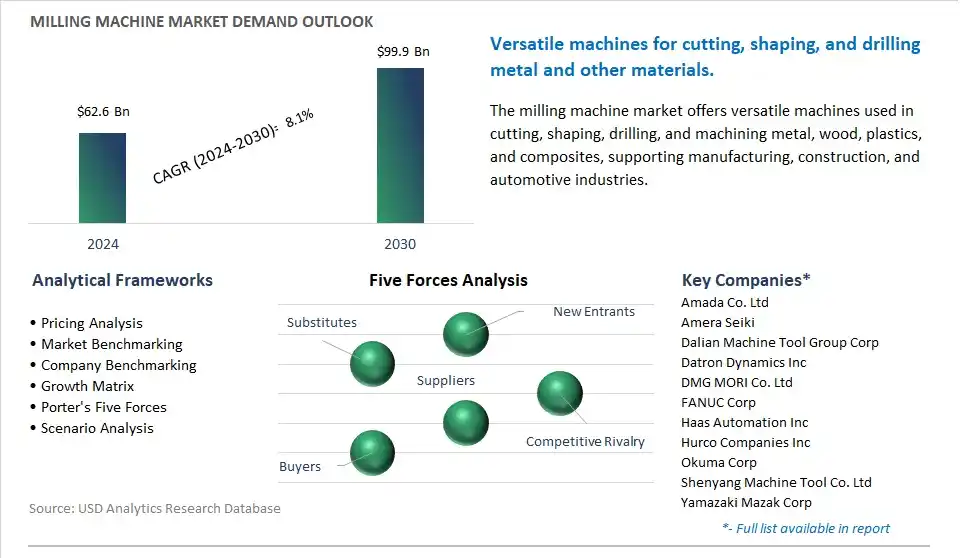
The global Milling Machine Market is poised to register a 8.1% CAGR from $62.6 Billion in 2024 to $99.9 Billion in 2030.
The global Milling Machine Market Study analyzes and forecasts the market size across 6 regions and 24 countries for diverse segments -By Type (Horizontal, Vertical), By End-User (Automotive, Aerospace & Defense, Construction Equipment, Power & Energy, Industrial, Others).
An Introduction to Global Milling Machine Market in 2024
The future of milling machines is influenced by several key trends reflecting advancements in manufacturing technology, automation, and digitalization in various industries such as aerospace, automotive, electronics, and medical devices. One significant trend is the increasing adoption of high-speed and precision milling machines capable of producing complex geometries, tight tolerances, and superior surface finishes in a wide range of materials, including metals, plastics, and composites. As industries demand faster production cycles, higher part quality, and greater flexibility in manufacturing operations, there is a growing need for milling machines that offer advanced features such as multi-axis machining, dynamic toolpath optimization, and real-time monitoring and control. Additionally, advancements in machine tool design, cutting tool technology, and software integration are driving improvements in productivity, efficiency, and cost-effectiveness in milling operations. Moreover, there is a rising interest in hybrid manufacturing solutions that combine milling with additive manufacturing techniques to leverage the benefits of both subtractive and additive processes, enabling rapid prototyping, tooling, and low-volume production of complex components. As manufacturing processes evolve to meet the demands of Industry 4.0 and digital transformation, the demand for advanced milling machines is expected to grow, driving opportunities for machine tool manufacturers, technology providers, and end-users to innovate and develop solutions that meet the evolving needs of the market while enhancing productivity, quality, and competitiveness in manufacturing.
Milling Machine Market Competitive Landscape
The market report analyses the leading companies in the industry including Amada Co. Ltd, Amera Seiki, Dalian Machine Tool Group Corp, Datron Dynamics Inc, DMG MORI Co. Ltd, FANUC Corp, Haas Automation Inc, Hurco Companies Inc, Okuma Corp, Shenyang Machine Tool Co. Ltd, Yamazaki Mazak Corp.
Milling Machine Market Dynamics
Milling Machine Market Trend: Adoption of CNC and Automation Technologies
A significant trend in the Milling Machine market is the increasing adoption of computer numerical control (CNC) and automation technologies. As manufacturing processes evolve towards greater precision, efficiency, and flexibility, there's a growing demand for milling machines equipped with CNC capabilities and automated features. CNC milling machines offer advantages such as higher accuracy, repeatability, and productivity compared to conventional manual or semi-automatic machines. Additionally, automation technologies, such as robotic loading and unloading systems, tool changers, and adaptive machining software, enable unmanned operation, shorter setup times, and increased throughput. Manufacturers are investing in CNC and automation solutions to streamline production processes, optimize resource utilization, and meet the demands of modern manufacturing industries.
Milling Machine Market Driver: Demand for High-Precision Machining Solutions
A key driver propelling the Milling Machine market is the demand for high-precision machining solutions across various industries, including aerospace, automotive, medical, and electronics. Precision machining plays a critical role in the production of complex components with tight tolerances and intricate geometries, such as aircraft engine parts, automotive components, medical implants, and electronic devices. Milling machines equipped with advanced control systems, high-speed spindles, and precision tooling enable manufacturers to achieve superior surface finishes, dimensional accuracy, and part quality, meeting the stringent requirements of demanding applications. With increasing customer expectations for product quality and performance, there's a continuous need for milling machines that can deliver precise and reliable machining results, driving market demand for high-precision solutions.
Milling Machine Market Opportunity: Integration of Additive Manufacturing Technologies
An opportunity in the Milling Machine market lies in the integration of additive manufacturing (AM) technologies, such as 3D printing, with traditional subtractive machining processes. While milling machines are traditionally associated with subtractive manufacturing, there's a growing trend towards hybrid manufacturing systems that combine both additive and subtractive techniques to leverage the strengths of each approach. By integrating AM capabilities into milling machines, manufacturers can create hybrid manufacturing platforms capable of producing complex parts with optimized geometries, improved material utilization, and reduced lead times. Hybrid machines offer flexibility in material selection and processing techniques, enabling the production of customized or low-volume parts that are difficult or uneconomical to manufacture using traditional methods alone. By embracing hybrid manufacturing, companies can expand their market reach, unlock new application opportunities, and offer innovative solutions to meet the evolving needs of their customers.
Milling Machine Market Share Analysis: Vertical generated the highest revenue in 2024
The largest segment in the Milling Machine Market is the Vertical type segment. The market growth is driven by vertical milling machines are widely used in various industries, including automotive, aerospace, construction, and manufacturing, due to their versatility, efficiency, and suitability for a wide range of machining applications. Vertical milling machines feature a vertically oriented spindle that allows for the cutting tool to be positioned vertically, facilitating precise and efficient machining of workpieces from multiple angles. This vertical orientation enables operators to easily access and maneuver workpieces, resulting in faster setup times, increased productivity, and improved accuracy compared to horizontal milling machines. Further, vertical milling machines offer greater flexibility and capability for performing complex machining operations, such as drilling, tapping, boring, and contouring, on a wide variety of materials, including metals, plastics, and composites. The vertical spindle configuration allows for the use of various cutting tools, attachments, and accessories, enabling operators to achieve a diverse range of machining tasks with a single-machine setup. In addition, advancements in vertical milling machine technology, including computer numerical control (CNC) systems, digital readouts (DROs), and automated tool changers, further enhance their efficiency, precision, and productivity. These technological advancements enable operators to program and execute complex machining operations with ease, reducing manual intervention and minimizing errors. Additionally, the compact footprint and space-saving design of vertical milling machines make them ideal for use in workshops, job shops, and manufacturing facilities with limited space availability. Over the forecast period, the combination of versatility, efficiency, technological advancements, and widespread application across industries positions the Vertical type segment as the largest in the Milling Machine Market.
Milling Machine Market Share Analysis: Aerospace & Defense segment is poised to register the fastest growth rate (CAGR) over the forecast period to 2030
The fastest-growing segment in the Milling Machine Market is the Aerospace & Defense sector. The aerospace and defense industries have seen significant expansion in recent years, driven by increased global demand for commercial air travel, rising defense expenditures, and advancements in aerospace technology. Aerospace and defense manufacturers require milling machines for the precision machining of critical components such as aircraft structures, engine parts, landing gear, and defense systems. The complex geometries and stringent quality requirements of aerospace components demand high-precision milling machines capable of producing tight tolerances, fine surface finishes, and intricate features. Further, advancements in aerospace materials, such as composites, titanium alloys, and high-strength steels, present unique machining challenges that require specialized milling solutions. Aerospace manufacturers increasingly rely on advanced milling machines equipped with high-speed spindles, multi-axis capabilities, and adaptive machining technologies to optimize productivity and maintain competitiveness. In addition, the aerospace and defense sectors prioritize innovation, efficiency, and reliability in manufacturing processes to meet the demands of modern aviation and defense applications. Accordingly, there is a growing adoption of automated milling solutions, digital manufacturing technologies, and integrated machining systems that enhance productivity, flexibility, and process control. Additionally, government investments in aerospace research, development, and defense modernization programs drive the demand for milling machines in these sectors. Over the forecast period, the combination of increasing demand for aerospace and defense products, technological advancements, and industry innovation positions the Aerospace & Defense segment as the fastest-growing in the Milling Machine Market.
Milling Machine Market Report Segmentation
By Type
Horizontal
Vertical
By End-User
Automotive
Aerospace & Defense
Construction Equipment
Power & Energy
Industrial
Others
Regions Included
North America (US, Canada, Mexico)
Europe (Germany, UK, France, Spain, Italy, Russia, Rest of Europe)
Asia Pacific (China, India, Japan, South Korea, Australia, South East Asia, Rest of Asia)
South America (Brazil, Argentina, Rest of South America)
Middle East and Africa (Saudi Arabia, UAE, Rest of Middle East, South Africa, Egypt, Rest of Africa)
Milling Machine Companies Profiled in the Market Study
Amada Co. Ltd
Amera Seiki
Dalian Machine Tool Group Corp
Datron Dynamics Inc
DMG MORI Co. Ltd
FANUC Corp
Haas Automation Inc
Hurco Companies Inc
Okuma Corp
Shenyang Machine Tool Co. Ltd
Yamazaki Mazak Corp
*- List Not Exhaustive
TABLE OF CONTENTS
1 Introduction to 2024 Milling Machine Market
1.1 Market Overview
1.2 Quick Facts
1.3 Scope/Objective of the Study
1.4 Market Definition
1.5 Countries and Regions Covered
1.6 Units, Currency, and Conversions
1.7 Industry Value Chain
2 Research Methodology
2.1 Market Size Estimation
2.2 Sources and Research Methodology
2.3 Data Triangulation
2.4 Assumptions and Limitations
3 Executive Summary
3.1 Global Milling Machine Market Size Outlook, $ Million, 2021 to 2030
3.2 Milling Machine Market Outlook by Type, $ Million, 2021 to 2030
3.3 Milling Machine Market Outlook by Product, $ Million, 2021 to 2030
3.4 Milling Machine Market Outlook by Application, $ Million, 2021 to 2030
3.5 Milling Machine Market Outlook by Key Countries, $ Million, 2021 to 2030
4 Market Dynamics
4.1 Key Driving Forces of Milling Machine Industry
4.2 Key Market Trends in Milling Machine Industry
4.3 Potential Opportunities in Milling Machine Industry
4.4 Key Challenges in Milling Machine Industry
5 Market Factor Analysis
5.1 Value Chain Analysis
5.2 Competitive Landscape
5.2.1 Global Milling Machine Market Share by Company (%), 2023
5.2.2 Product Offerings by Company
5.3 Porter’s Five Forces Analysis
5.4 Pricing Analysis and Outlook
6 Growth Outlook Across Scenarios
6.1 Growth Analysis-Case Scenario Definitions
6.2 Low Growth Scenario Forecasts
6.3 Reference Growth Scenario Forecasts
6.4 High Growth Scenario Forecasts
7 Global Milling Machine Market Outlook by Segments
7.1 Milling Machine Market Outlook by Segments, $ Million, 2021- 2030
By Type
Horizontal
Vertical
By End-User
Automotive
Aerospace & Defense
Construction Equipment
Power & Energy
Industrial
Others
8 North America Milling Machine Market Analysis and Outlook To 2030
8.1 Introduction to North America Milling Machine Markets in 2024
8.2 North America Milling Machine Market Size Outlook by Country, 2021-2030
8.2.1 United States
8.2.2 Canada
8.2.3 Mexico
8.3 North America Milling Machine Market size Outlook by Segments, 2021-2030
By Type
Horizontal
Vertical
By End-User
Automotive
Aerospace & Defense
Construction Equipment
Power & Energy
Industrial
Others
9 Europe Milling Machine Market Analysis and Outlook To 2030
9.1 Introduction to Europe Milling Machine Markets in 2024
9.2 Europe Milling Machine Market Size Outlook by Country, 2021-2030
9.2.1 Germany
9.2.2 France
9.2.3 Spain
9.2.4 United Kingdom
9.2.4 Italy
9.2.5 Russia
9.2.6 Norway
9.2.7 Rest of Europe
9.3 Europe Milling Machine Market Size Outlook by Segments, 2021-2030
By Type
Horizontal
Vertical
By End-User
Automotive
Aerospace & Defense
Construction Equipment
Power & Energy
Industrial
Others
10 Asia Pacific Milling Machine Market Analysis and Outlook To 2030
10.1 Introduction to Asia Pacific Milling Machine Markets in 2024
10.2 Asia Pacific Milling Machine Market Size Outlook by Country, 2021-2030
10.2.1 China
10.2.2 India
10.2.3 Japan
10.2.4 South Korea
10.2.5 Indonesia
10.2.6 Malaysia
10.2.7 Australia
10.2.8 Rest of Asia Pacific
10.3 Asia Pacific Milling Machine Market size Outlook by Segments, 2021-2030
By Type
Horizontal
Vertical
By End-User
Automotive
Aerospace & Defense
Construction Equipment
Power & Energy
Industrial
Others
11 South America Milling Machine Market Analysis and Outlook To 2030
11.1 Introduction to South America Milling Machine Markets in 2024
11.2 South America Milling Machine Market Size Outlook by Country, 2021-2030
11.2.1 Brazil
11.2.2 Argentina
11.2.3 Rest of South America
11.3 South America Milling Machine Market size Outlook by Segments, 2021-2030
By Type
Horizontal
Vertical
By End-User
Automotive
Aerospace & Defense
Construction Equipment
Power & Energy
Industrial
Others
12 Middle East and Africa Milling Machine Market Analysis and Outlook To 2030
12.1 Introduction to Middle East and Africa Milling Machine Markets in 2024
12.2 Middle East and Africa Milling Machine Market Size Outlook by Country, 2021-2030
12.2.1 Saudi Arabia
12.2.2 UAE
12.2.3 Oman
12.2.4 Rest of Middle East
12.2.5 Egypt
12.2.6 Nigeria
12.2.7 South Africa
12.2.8 Rest of Africa
12.3 Middle East and Africa Milling Machine Market size Outlook by Segments, 2021-2030
By Type
Horizontal
Vertical
By End-User
Automotive
Aerospace & Defense
Construction Equipment
Power & Energy
Industrial
Others
13 Company Profiles
13.1 Company Snapshot
13.2 SWOT Profiles
13.3 Products and Services
13.4 Recent Developments
13.5 Financial Profile
Amada Co. Ltd
Amera Seiki
Dalian Machine Tool Group Corp
Datron Dynamics Inc
DMG MORI Co. Ltd
FANUC Corp
Haas Automation Inc
Hurco Companies Inc
Okuma Corp
Shenyang Machine Tool Co. Ltd
Yamazaki Mazak Corp
14 Appendix
14.1 Customization Offerings
14.2 Subscription Services
14.3 Related Reports
14.4 Publisher Expertise
By Type
Horizontal
Vertical
By End-User
Automotive
Aerospace & Defense
Construction Equipment
Power & Energy
Industrial
Others
Countries Analyzed
North America (US, Canada, Mexico)
Europe (Germany, UK, France, Spain, Italy, Russia, Rest of Europe)
Asia Pacific (China, India, Japan, South Korea, Australia, South East Asia, Rest of Asia)
South America (Brazil, Argentina, Rest of South America)
Middle East and Africa (Saudi Arabia, UAE, Rest of Middle East, South Africa, Egypt, Rest of Africa)
