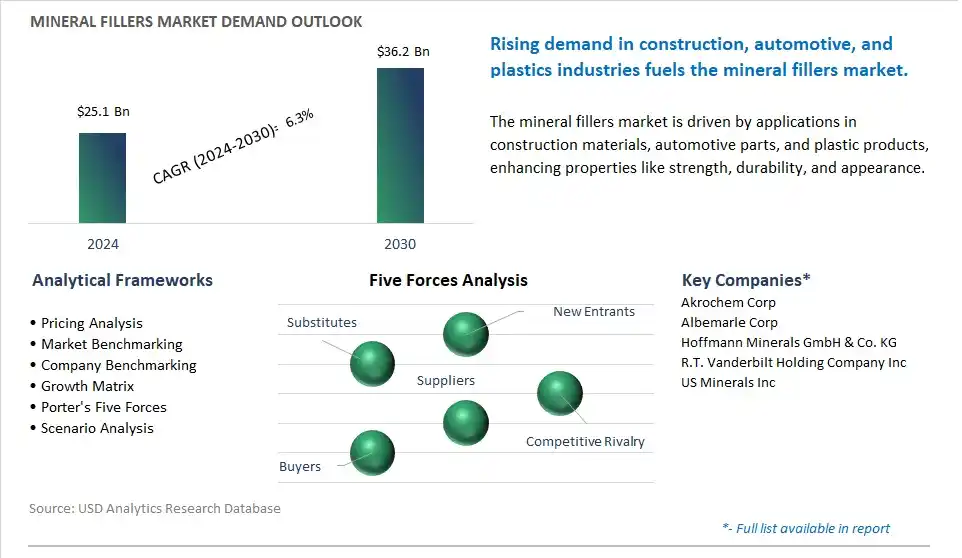
The global Mineral Fillers Market is poised to register a 6.3% CAGR from $25.1 Billion in 2024 to $36.2 Billion in 2030.
The global Mineral Fillers Market Study analyzes and forecasts the market size across 6 regions and 24 countries for diverse segments -By Type (Plastics, Composite Materials, Concrete), By Application (Mining, Building, Others).
An Introduction to Global Mineral Fillers Market in 2024
The future of mineral fillers is influenced by several key trends, including increasing demand for functional additives in plastics, paints, and construction materials, advancements in mineral processing and surface modification techniques, and growing emphasis on performance, cost-effectiveness, and sustainability. Mineral fillers are finely ground minerals such as calcium carbonate, talc, and silica used to enhance the properties of polymer composites, coatings, and building materials, offering benefits such as reinforcement, rheology control, and cost reduction. With the rise of lightweighting, energy efficiency, and circular economy principles, there's a growing need for mineral fillers that offer high purity, particle size control, and surface modification while minimizing environmental footprint and resource depletion in manufacturing processes. Moreover, advancements in mineral filler characterization, such as particle size analysis, surface area measurement, and chemical analysis, are driving the development of tailored fillers with optimized properties for specific applications in industries such as automotive, packaging, and infrastructure. Additionally, the integration of mineral fillers into advanced material formulations, such as nanocomposites, hybrid systems, and multifunctional additives, is enabling the development of high-performance products with enhanced mechanical, thermal, and barrier properties, addressing the evolving needs of end-users and regulatory requirements. Collaboration between mineral producers, material scientists, product developers, and end-users is essential to drive innovation, ensure filler performance, and address market demands in the mineral fillers industry.
Mineral Fillers Market Competitive Landscape
The market report analyses the leading companies in the industry including Akrochem Corp, Albemarle Corp, Hoffmann Minerals GmbH & Co. KG, R.T. Vanderbilt Holding Company Inc, US Minerals Inc.
Mineral Fillers Market Dynamics
Mineral Fillers Market Trend: Rising Demand for Sustainable and Eco-Friendly Materials
A significant trend in the mineral fillers market is the rising demand for sustainable and eco-friendly materials. With increasing environmental awareness and regulatory pressure to reduce carbon footprint, there's a growing preference for mineral fillers derived from natural sources and industrial by-products. Mineral fillers, such as calcium carbonate, talc, and silica, are being used as alternatives to synthetic fillers in various industries including plastics, paints and coatings, and construction materials. This trend is driven by the desire to minimize reliance on non-renewable resources, lower energy consumption in manufacturing processes, and reduce waste generation. As industries seek to adopt more sustainable practices and meet consumer demand for eco-friendly products, the market for mineral fillers sourced from natural and recycled materials is expected to experience steady growth.
Mineral Fillers Market Driver: Growth in Construction and Infrastructure Development
A major driver of the mineral fillers market is the growth in construction and infrastructure development activities worldwide. Mineral fillers are essential ingredients in construction materials such as concrete, asphalt, and plaster, where they enhance properties such as strength, durability, and workability. With rapid urbanization, population growth, and infrastructure investments in emerging economies, there's an increasing demand for construction materials that can meet stringent performance requirements while being cost-effective and sustainable. Mineral fillers play a crucial role in optimizing the properties of construction materials, improving workability, reducing shrinkage, and enhancing resistance to cracking and weathering. As construction projects continue to proliferate globally, particularly in developing regions, the demand for mineral fillers as key components of construction materials is expected to drive market growth.
Mineral Fillers Market Opportunity: Development of High-Performance Specialty Fillers
An opportunity within the mineral fillers market lies in the development of high-performance specialty fillers. While traditional mineral fillers such as calcium carbonate and silica are widely used in a range of applications, there's potential to innovate and develop specialty fillers with unique properties and functionalities tailored for specific end-use applications. For example, nanofillers derived from minerals such as clay, graphene, and nanosilica offer enhanced mechanical strength, thermal stability, and barrier properties, making them suitable for use in advanced materials such as composites, nanocomposites, and specialty coatings. Additionally, there's an opportunity to explore mineral fillers with functional attributes such as flame retardancy, UV resistance, and antimicrobial properties, which can impart additional value to end products in industries such as automotive, electronics, and healthcare. By investing in research and development to create innovative specialty fillers and collaborating with downstream industries to identify new application areas, companies can capitalize on the growing demand for high-performance mineral fillers and differentiate themselves in the market.
Mineral Fillers Market Share Analysis: The Concrete segment generated the highest revenue in 2024
The largest segment in the Mineral Fillers Market is Concrete. This dominance is primarily driving demand within this sector. Concrete is one of the most widely used construction materials globally, employed in various infrastructure projects, building construction, roads, bridges, and other civil engineering applications. Mineral fillers are commonly added to concrete mixtures to improve its properties and performance. These fillers, such as limestone, silica, and calcium carbonate, enhance the workability, strength, durability, and dimensional stability of concrete. Additionally, mineral fillers help reduce material costs by replacing a portion of the cementitious materials in concrete mixtures while maintaining or improving performance. Further, the growing construction industry, urbanization, and infrastructure development worldwide drive the demand for concrete and, consequently, mineral fillers used in concrete formulations. Furthermore, advancements in concrete technology, such as high-performance concrete mixes, self-compacting concrete, and sustainable concrete formulations, further boost the demand for mineral fillers in the Concrete segment of the Mineral Fillers Market. Over the forecast period, these factors contribute to Concrete emerging as the largest segment in the Mineral Fillers Market.
Mineral Fillers Market Share Analysis: The Building segment is poised to register the fastest growth rate (CAGR) over the forecast period to 2030
The fastest-growing segment in the Mineral Fillers Market is Building. The building industry encompasses a wide range of applications, including residential, commercial, industrial, and infrastructure construction projects. Mineral fillers are essential components in various building materials, including concrete, asphalt, plaster, drywall, and paints, among others. In the construction sector, mineral fillers are used to enhance the properties and performance of building materials, such as improving strength, durability, workability, and surface finish. Additionally, mineral fillers help optimize material costs by extending the volume of the building material while maintaining desired properties. Further, the increasing demand for sustainable and eco-friendly construction practices drives the adoption of mineral fillers derived from natural resources, such as limestone, silica, and calcium carbonate, which are abundant and widely available. Furthermore, ongoing urbanization, population growth, and infrastructure development projects worldwide contribute to the rising demand for building materials and, consequently, mineral fillers in the Building segment of the Mineral Fillers Market. Over the forecast period, these factors support the Building segment emerging as the fastest-growing segment in the Mineral Fillers Market.
Mineral Fillers Market Report Segmentation
By Type
Plastics
Composite Materials
Concrete
By Application
Mining
Building
Others
Regions Included
North America (US, Canada, Mexico)
Europe (Germany, UK, France, Spain, Italy, Russia, Rest of Europe)
Asia Pacific (China, India, Japan, South Korea, Australia, South East Asia, Rest of Asia)
South America (Brazil, Argentina, Rest of South America)
Middle East and Africa (Saudi Arabia, UAE, Rest of Middle East, South Africa, Egypt, Rest of Africa)
Mineral Fillers Companies Profiled in the Market Study
Akrochem Corp
Albemarle Corp
Hoffmann Minerals GmbH & Co. KG
R.T. Vanderbilt Holding Company Inc
US Minerals Inc
*- List Not Exhaustive
TABLE OF CONTENTS
1 Introduction to 2024 Mineral Fillers Market
1.1 Market Overview
1.2 Quick Facts
1.3 Scope/Objective of the Study
1.4 Market Definition
1.5 Countries and Regions Covered
1.6 Units, Currency, and Conversions
1.7 Industry Value Chain
2 Research Methodology
2.1 Market Size Estimation
2.2 Sources and Research Methodology
2.3 Data Triangulation
2.4 Assumptions and Limitations
3 Executive Summary
3.1 Global Mineral Fillers Market Size Outlook, $ Million, 2021 to 2030
3.2 Mineral Fillers Market Outlook by Type, $ Million, 2021 to 2030
3.3 Mineral Fillers Market Outlook by Product, $ Million, 2021 to 2030
3.4 Mineral Fillers Market Outlook by Application, $ Million, 2021 to 2030
3.5 Mineral Fillers Market Outlook by Key Countries, $ Million, 2021 to 2030
4 Market Dynamics
4.1 Key Driving Forces of Mineral Fillers Industry
4.2 Key Market Trends in Mineral Fillers Industry
4.3 Potential Opportunities in Mineral Fillers Industry
4.4 Key Challenges in Mineral Fillers Industry
5 Market Factor Analysis
5.1 Value Chain Analysis
5.2 Competitive Landscape
5.2.1 Global Mineral Fillers Market Share by Company (%), 2023
5.2.2 Product Offerings by Company
5.3 Porter’s Five Forces Analysis
5.4 Pricing Analysis and Outlook
6 Growth Outlook Across Scenarios
6.1 Growth Analysis-Case Scenario Definitions
6.2 Low Growth Scenario Forecasts
6.3 Reference Growth Scenario Forecasts
6.4 High Growth Scenario Forecasts
7 Global Mineral Fillers Market Outlook by Segments
7.1 Mineral Fillers Market Outlook by Segments, $ Million, 2021- 2030
By Type
Plastics
Composite Materials
Concrete
By Application
Mining
Building
Others
8 North America Mineral Fillers Market Analysis and Outlook To 2030
8.1 Introduction to North America Mineral Fillers Markets in 2024
8.2 North America Mineral Fillers Market Size Outlook by Country, 2021-2030
8.2.1 United States
8.2.2 Canada
8.2.3 Mexico
8.3 North America Mineral Fillers Market size Outlook by Segments, 2021-2030
By Type
Plastics
Composite Materials
Concrete
By Application
Mining
Building
Others
9 Europe Mineral Fillers Market Analysis and Outlook To 2030
9.1 Introduction to Europe Mineral Fillers Markets in 2024
9.2 Europe Mineral Fillers Market Size Outlook by Country, 2021-2030
9.2.1 Germany
9.2.2 France
9.2.3 Spain
9.2.4 United Kingdom
9.2.4 Italy
9.2.5 Russia
9.2.6 Norway
9.2.7 Rest of Europe
9.3 Europe Mineral Fillers Market Size Outlook by Segments, 2021-2030
By Type
Plastics
Composite Materials
Concrete
By Application
Mining
Building
Others
10 Asia Pacific Mineral Fillers Market Analysis and Outlook To 2030
10.1 Introduction to Asia Pacific Mineral Fillers Markets in 2024
10.2 Asia Pacific Mineral Fillers Market Size Outlook by Country, 2021-2030
10.2.1 China
10.2.2 India
10.2.3 Japan
10.2.4 South Korea
10.2.5 Indonesia
10.2.6 Malaysia
10.2.7 Australia
10.2.8 Rest of Asia Pacific
10.3 Asia Pacific Mineral Fillers Market size Outlook by Segments, 2021-2030
By Type
Plastics
Composite Materials
Concrete
By Application
Mining
Building
Others
11 South America Mineral Fillers Market Analysis and Outlook To 2030
11.1 Introduction to South America Mineral Fillers Markets in 2024
11.2 South America Mineral Fillers Market Size Outlook by Country, 2021-2030
11.2.1 Brazil
11.2.2 Argentina
11.2.3 Rest of South America
11.3 South America Mineral Fillers Market size Outlook by Segments, 2021-2030
By Type
Plastics
Composite Materials
Concrete
By Application
Mining
Building
Others
12 Middle East and Africa Mineral Fillers Market Analysis and Outlook To 2030
12.1 Introduction to Middle East and Africa Mineral Fillers Markets in 2024
12.2 Middle East and Africa Mineral Fillers Market Size Outlook by Country, 2021-2030
12.2.1 Saudi Arabia
12.2.2 UAE
12.2.3 Oman
12.2.4 Rest of Middle East
12.2.5 Egypt
12.2.6 Nigeria
12.2.7 South Africa
12.2.8 Rest of Africa
12.3 Middle East and Africa Mineral Fillers Market size Outlook by Segments, 2021-2030
By Type
Plastics
Composite Materials
Concrete
By Application
Mining
Building
Others
13 Company Profiles
13.1 Company Snapshot
13.2 SWOT Profiles
13.3 Products and Services
13.4 Recent Developments
13.5 Financial Profile
Akrochem Corp
Albemarle Corp
Hoffmann Minerals GmbH & Co. KG
R.T. Vanderbilt Holding Company Inc
US Minerals Inc
14 Appendix
14.1 Customization Offerings
14.2 Subscription Services
14.3 Related Reports
14.4 Publisher Expertise
By Type
Plastics
Composite Materials
Concrete
By Application
Mining
Building
Others
Countries Analyzed
North America (US, Canada, Mexico)
Europe (Germany, UK, France, Spain, Italy, Russia, Rest of Europe)
Asia Pacific (China, India, Japan, South Korea, Australia, South East Asia, Rest of Asia)
South America (Brazil, Argentina, Rest of South America)
Middle East and Africa (Saudi Arabia, UAE, Rest of Middle East, South Africa, Egypt, Rest of Africa)
