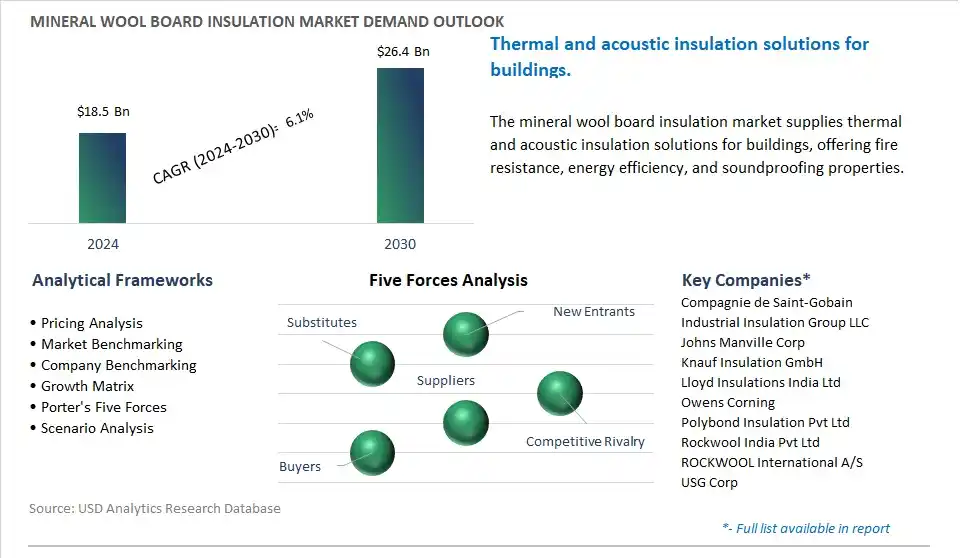
The global Mineral Wool Board Insulation Market is poised to register a 6.1% CAGR from $18.5 Billion in 2024 to $26.4 Billion in 2030.
The global Mineral Wool Board Insulation Market Study analyzes and forecasts the market size across 6 regions and 24 countries for diverse segments -By Type (Rock Wool, Glass Wool, Others), By Function (Thermal Insulation, Acoustic Insulation, Others), By Application (Industrial, Commercial, Residential, Others).
An Introduction to Global Mineral Wool Board Insulation Market in 2024
The future of mineral wool board insulation is influenced by several key trends reflecting advancements in construction technology, energy efficiency requirements, and sustainability initiatives. One significant trend is the increasing demand for high-performance insulation materials that offer superior thermal resistance, fire resistance, and sound attenuation properties in building construction. Mineral wool board insulation, made from natural rock or slag fibers, is valued for its excellent insulating properties, non-combustibility, and resistance to moisture, making it suitable for a wide range of applications in residential, commercial, and industrial buildings. Additionally, advancements in manufacturing processes, such as improved fiber orientation and binder formulations, are driving enhancements in insulation performance, durability, and installation efficiency. Moreover, there is growing emphasis on energy-efficient building design and green building standards, driving the adoption of mineral wool insulation as a sustainable solution to reduce energy consumption, lower carbon emissions, and improve indoor comfort and air quality. As building codes and regulations continue to evolve to promote energy efficiency and environmental sustainability, the demand for mineral wool board insulation is expected to grow, driving opportunities for manufacturers, contractors, and building owners to innovate and deliver solutions that meet the evolving needs of the construction industry while addressing sustainability and performance requirements.
Mineral Wool Board Insulation Market Competitive Landscape
The market report analyses the leading companies in the industry including Compagnie de Saint-Gobain, Industrial Insulation Group LLC, Johns Manville Corp, Knauf Insulation GmbH, Lloyd Insulations India Ltd, Owens Corning, Polybond Insulation Pvt Ltd, Rockwool India Pvt Ltd, ROCKWOOL International A/S, USG Corp.
Mineral Wool Board Insulation Market Dynamics
Mineral Wool Board Insulation Market Trend: Growing Emphasis on Energy Efficiency and Sustainable Building Materials
A significant trend in the Mineral Wool Board Insulation market is the growing emphasis on energy efficiency and sustainable building materials. As building codes and regulations evolve to promote energy conservation and reduce carbon emissions, there's increasing demand for insulation solutions that enhance the thermal performance of buildings while minimizing environmental impact. Mineral wool board insulation, known for its excellent thermal properties, fire resistance, and sound absorption capabilities, aligns with these sustainability objectives and is gaining popularity as a preferred choice for both residential and commercial construction projects. Additionally, the trend towards green building certifications such as LEED (Leadership in Energy and Environmental Design) further drives the adoption of mineral wool insulation as a sustainable building solution.
Mineral Wool Board Insulation Market Driver: Rising Construction Activities and Urbanization
A key driver propelling the Mineral Wool Board Insulation market is the rising construction activities and urbanization worldwide. With rapid urbanization and population growth, there's increasing demand for new residential, commercial, and industrial infrastructure to accommodate urban dwellers and support economic development. Construction projects, whether new builds or renovations, require effective thermal insulation solutions to enhance energy efficiency, reduce heating and cooling costs, and create comfortable indoor environments. Mineral wool board insulation, with its ability to provide superior thermal resistance, fire protection, and acoustic insulation, meets the stringent requirements of modern building codes and specifications, driving its adoption in construction projects across residential, commercial, and industrial sectors.
Mineral Wool Board Insulation Market Opportunity: Innovation in High-Performance Insulation Solutions
An opportunity in the Mineral Wool Board Insulation market lies in the innovation of high-performance insulation solutions tailored to meet the evolving needs of the construction industry. There's a growing demand for insulation materials that not only provide excellent thermal performance but also offer additional benefits such as moisture resistance, mold resistance, and ease of installation. Manufacturers aim to capitalize on this opportunity by developing advanced mineral wool board insulation products with enhanced properties, such as improved fire resistance, higher compressive strength, and reduced environmental impact. Furthermore, there's potential to innovate in the development of prefabricated insulation panels or systems that integrate mineral wool boards with other building components to streamline construction processes and minimize labor costs. By focusing on innovation and product differentiation, companies can position themselves as leaders in the market and address the growing demand for high-performance insulation solutions in the construction industry.
Mineral Wool Board Insulation Market Share Analysis: Glass Wool generated the highest revenue in 2024
The largest segment in the Mineral Wool Board Insulation Market is the Glass Wool segment. The market growth is driven by glass wool insulation is widely used in construction, industrial, and residential applications due to its excellent thermal and acoustic insulation properties. Glass wool boards offer effective heat insulation, sound absorption, and fire resistance, making them suitable for a wide range of building and construction projects. Further, glass wool insulation is manufactured from recycled glass materials, making it an environmentally friendly and sustainable insulation option. The production process involves melting recycled glass at high temperatures, spinning it into fibers, and compressing the fibers into boards or batts. This eco-friendly manufacturing process aligns with the increasing emphasis on sustainability and green building practices in the construction industry, driving the demand for glass wool insulation. In addition, glass wool boards are lightweight, easy to handle, and install, making them preferred by builders, contractors, and homeowners for insulation applications in walls, roofs, floors, and ceilings. Glass wool insulation offers good flexibility and compressibility, allowing it to conform to irregular surfaces and fill cavities effectively. Additionally, glass wool insulation provides excellent thermal performance, reducing energy consumption and improving indoor comfort levels in buildings. Further, glass wool insulation is cost-effective compared to other insulation materials, offering a favorable balance between performance, affordability, and durability. Over the forecast period, the combination of its thermal and acoustic insulation properties, sustainability, ease of installation, and cost-effectiveness positions the Glass Wool segment as the largest in the Mineral Wool Board Insulation Market.
Mineral Wool Board Insulation Market Share Analysis: Thermal Insulation Function segment is poised to register the fastest growth rate (CAGR) over the forecast period to 2030
The fastest-growing segment in the Mineral Wool Board Insulation Market is the Thermal Insulation function segment. There is a growing emphasis on energy efficiency and sustainability in building construction and renovation projects. Thermal insulation plays a crucial role in reducing heat transfer through building envelopes, including walls, roofs, floors, and ceilings, thereby improving energy performance and reducing heating and cooling costs. Mineral wool board insulation offers excellent thermal resistance, preventing heat loss in winter and heat gain in summer, resulting in energy savings and enhanced indoor comfort for building occupants. Further, stringent building codes, regulations, and standards mandate the use of energy-efficient insulation materials to meet sustainability targets and reduce greenhouse gas emissions in the construction sector. Mineral wool insulation products comply with these requirements and offer favorable thermal properties, fire resistance, and durability compared to other insulation materials. In addition, the increasing awareness of environmental concerns, climate change, and the need for sustainable building practices drives the demand for thermal insulation solutions with low embodied energy and minimal environmental impact. Mineral wool board insulation is manufactured from natural and recycled materials, making it a preferred choice for green building projects seeking LEED certification and other sustainability credentials. Additionally, technological advancements in mineral wool insulation manufacturing processes, such as improved fiberization techniques, binder formulations, and product designs, enhance thermal performance, durability, and installation efficiency. Over the forecast period, the combination of energy efficiency mandates, environmental concerns, technological advancements, and sustainability initiatives positions the Thermal Insulation function segment as the fastest-growing in the Mineral Wool Board Insulation Market.
Mineral Wool Board Insulation Market Share Analysis: Residential application segment is poised to register the fastest growth rate (CAGR) over the forecast period to 2030
The fastest-growing segment in the Mineral Wool Board Insulation Market is the Residential application segment. There is a growing trend towards energy-efficient and sustainable building practices in residential construction. Homeowners are increasingly concerned about reducing energy consumption, lowering utility costs, and improving indoor comfort levels, driving the demand for effective insulation solutions. Mineral wool board insulation offers excellent thermal performance, helping to minimize heat loss during winter and heat gain during summer, thereby enhancing energy efficiency and reducing heating and cooling expenses in residential buildings. Further, government incentives, rebates, and energy efficiency programs encourage homeowners to invest in insulation upgrades and energy-saving measures. Many governments worldwide offer financial incentives and tax credits to homeowners who install energy-efficient insulation products, including mineral wool board insulation, in their homes. These incentives stimulate demand for residential insulation solutions and accelerate market growth. In addition, the increasing focus on sustainable housing and green building certifications further drives the adoption of mineral wool board insulation in residential applications. Homebuilders and developers seek to meet sustainability standards such as LEED certification, Energy Star ratings, and Green Building Council guidelines, which prioritize energy efficiency, environmental performance, and occupant health and comfort. Mineral wool insulation products, with their environmentally friendly composition and high thermal resistance, align with these objectives and are favored in residential construction projects seeking green building credentials. Additionally, the renovation and retrofit market for residential buildings presents opportunities for mineral wool board insulation manufacturers. As homeowners upgrade their existing homes to improve energy efficiency and indoor comfort, there is a growing demand for insulation materials that offer superior performance, durability, and ease of installation. Over the forecast period, the combination of consumer demand for energy-efficient homes, government incentives, and sustainability initiatives positions the Residential application segment as the fastest-growing in the Mineral Wool Board Insulation Market.
Mineral Wool Board Insulation Market Report Segmentation
By Type
Rock Wool
Glass Wool
Others
By Function
Thermal Insulation
Acoustic Insulation
Others
By Application
Industrial
Commercial
Residential
Others
Regions Included
North America (US, Canada, Mexico)
Europe (Germany, UK, France, Spain, Italy, Russia, Rest of Europe)
Asia Pacific (China, India, Japan, South Korea, Australia, South East Asia, Rest of Asia)
South America (Brazil, Argentina, Rest of South America)
Middle East and Africa (Saudi Arabia, UAE, Rest of Middle East, South Africa, Egypt, Rest of Africa)
Mineral Wool Board Insulation Companies Profiled in the Market Study
Compagnie de Saint-Gobain
Industrial Insulation Group LLC
Johns Manville Corp
Knauf Insulation GmbH
Lloyd Insulations India Ltd
Owens Corning
Polybond Insulation Pvt Ltd
Rockwool India Pvt Ltd
ROCKWOOL International A/S
USG Corp
*- List Not Exhaustive
TABLE OF CONTENTS
1 Introduction to 2024 Mineral Wool Board Insulation Market
1.1 Market Overview
1.2 Quick Facts
1.3 Scope/Objective of the Study
1.4 Market Definition
1.5 Countries and Regions Covered
1.6 Units, Currency, and Conversions
1.7 Industry Value Chain
2 Research Methodology
2.1 Market Size Estimation
2.2 Sources and Research Methodology
2.3 Data Triangulation
2.4 Assumptions and Limitations
3 Executive Summary
3.1 Global Mineral Wool Board Insulation Market Size Outlook, $ Million, 2021 to 2030
3.2 Mineral Wool Board Insulation Market Outlook by Type, $ Million, 2021 to 2030
3.3 Mineral Wool Board Insulation Market Outlook by Product, $ Million, 2021 to 2030
3.4 Mineral Wool Board Insulation Market Outlook by Application, $ Million, 2021 to 2030
3.5 Mineral Wool Board Insulation Market Outlook by Key Countries, $ Million, 2021 to 2030
4 Market Dynamics
4.1 Key Driving Forces of Mineral Wool Board Insulation Industry
4.2 Key Market Trends in Mineral Wool Board Insulation Industry
4.3 Potential Opportunities in Mineral Wool Board Insulation Industry
4.4 Key Challenges in Mineral Wool Board Insulation Industry
5 Market Factor Analysis
5.1 Value Chain Analysis
5.2 Competitive Landscape
5.2.1 Global Mineral Wool Board Insulation Market Share by Company (%), 2023
5.2.2 Product Offerings by Company
5.3 Porter’s Five Forces Analysis
5.4 Pricing Analysis and Outlook
6 Growth Outlook Across Scenarios
6.1 Growth Analysis-Case Scenario Definitions
6.2 Low Growth Scenario Forecasts
6.3 Reference Growth Scenario Forecasts
6.4 High Growth Scenario Forecasts
7 Global Mineral Wool Board Insulation Market Outlook by Segments
7.1 Mineral Wool Board Insulation Market Outlook by Segments, $ Million, 2021- 2030
By Type
Rock Wool
Glass Wool
Others
By Function
Thermal Insulation
Acoustic Insulation
Others
By Application
Industrial
Commercial
Residential
Others
8 North America Mineral Wool Board Insulation Market Analysis and Outlook To 2030
8.1 Introduction to North America Mineral Wool Board Insulation Markets in 2024
8.2 North America Mineral Wool Board Insulation Market Size Outlook by Country, 2021-2030
8.2.1 United States
8.2.2 Canada
8.2.3 Mexico
8.3 North America Mineral Wool Board Insulation Market size Outlook by Segments, 2021-2030
By Type
Rock Wool
Glass Wool
Others
By Function
Thermal Insulation
Acoustic Insulation
Others
By Application
Industrial
Commercial
Residential
Others
9 Europe Mineral Wool Board Insulation Market Analysis and Outlook To 2030
9.1 Introduction to Europe Mineral Wool Board Insulation Markets in 2024
9.2 Europe Mineral Wool Board Insulation Market Size Outlook by Country, 2021-2030
9.2.1 Germany
9.2.2 France
9.2.3 Spain
9.2.4 United Kingdom
9.2.4 Italy
9.2.5 Russia
9.2.6 Norway
9.2.7 Rest of Europe
9.3 Europe Mineral Wool Board Insulation Market Size Outlook by Segments, 2021-2030
By Type
Rock Wool
Glass Wool
Others
By Function
Thermal Insulation
Acoustic Insulation
Others
By Application
Industrial
Commercial
Residential
Others
10 Asia Pacific Mineral Wool Board Insulation Market Analysis and Outlook To 2030
10.1 Introduction to Asia Pacific Mineral Wool Board Insulation Markets in 2024
10.2 Asia Pacific Mineral Wool Board Insulation Market Size Outlook by Country, 2021-2030
10.2.1 China
10.2.2 India
10.2.3 Japan
10.2.4 South Korea
10.2.5 Indonesia
10.2.6 Malaysia
10.2.7 Australia
10.2.8 Rest of Asia Pacific
10.3 Asia Pacific Mineral Wool Board Insulation Market size Outlook by Segments, 2021-2030
By Type
Rock Wool
Glass Wool
Others
By Function
Thermal Insulation
Acoustic Insulation
Others
By Application
Industrial
Commercial
Residential
Others
11 South America Mineral Wool Board Insulation Market Analysis and Outlook To 2030
11.1 Introduction to South America Mineral Wool Board Insulation Markets in 2024
11.2 South America Mineral Wool Board Insulation Market Size Outlook by Country, 2021-2030
11.2.1 Brazil
11.2.2 Argentina
11.2.3 Rest of South America
11.3 South America Mineral Wool Board Insulation Market size Outlook by Segments, 2021-2030
By Type
Rock Wool
Glass Wool
Others
By Function
Thermal Insulation
Acoustic Insulation
Others
By Application
Industrial
Commercial
Residential
Others
12 Middle East and Africa Mineral Wool Board Insulation Market Analysis and Outlook To 2030
12.1 Introduction to Middle East and Africa Mineral Wool Board Insulation Markets in 2024
12.2 Middle East and Africa Mineral Wool Board Insulation Market Size Outlook by Country, 2021-2030
12.2.1 Saudi Arabia
12.2.2 UAE
12.2.3 Oman
12.2.4 Rest of Middle East
12.2.5 Egypt
12.2.6 Nigeria
12.2.7 South Africa
12.2.8 Rest of Africa
12.3 Middle East and Africa Mineral Wool Board Insulation Market size Outlook by Segments, 2021-2030
By Type
Rock Wool
Glass Wool
Others
By Function
Thermal Insulation
Acoustic Insulation
Others
By Application
Industrial
Commercial
Residential
Others
13 Company Profiles
13.1 Company Snapshot
13.2 SWOT Profiles
13.3 Products and Services
13.4 Recent Developments
13.5 Financial Profile
Compagnie de Saint-Gobain
Industrial Insulation Group LLC
Johns Manville Corp
Knauf Insulation GmbH
Lloyd Insulations India Ltd
Owens Corning
Polybond Insulation Pvt Ltd
Rockwool India Pvt Ltd
ROCKWOOL International A/S
USG Corp
14 Appendix
14.1 Customization Offerings
14.2 Subscription Services
14.3 Related Reports
14.4 Publisher Expertise
By Type
Rock Wool
Glass Wool
Others
By Function
Thermal Insulation
Acoustic Insulation
Others
By Application
Industrial
Commercial
Residential
Others
Countries Analyzed
North America (US, Canada, Mexico)
Europe (Germany, UK, France, Spain, Italy, Russia, Rest of Europe)
Asia Pacific (China, India, Japan, South Korea, Australia, South East Asia, Rest of Asia)
South America (Brazil, Argentina, Rest of South America)
Middle East and Africa (Saudi Arabia, UAE, Rest of Middle East, South Africa, Egypt, Rest of Africa)
