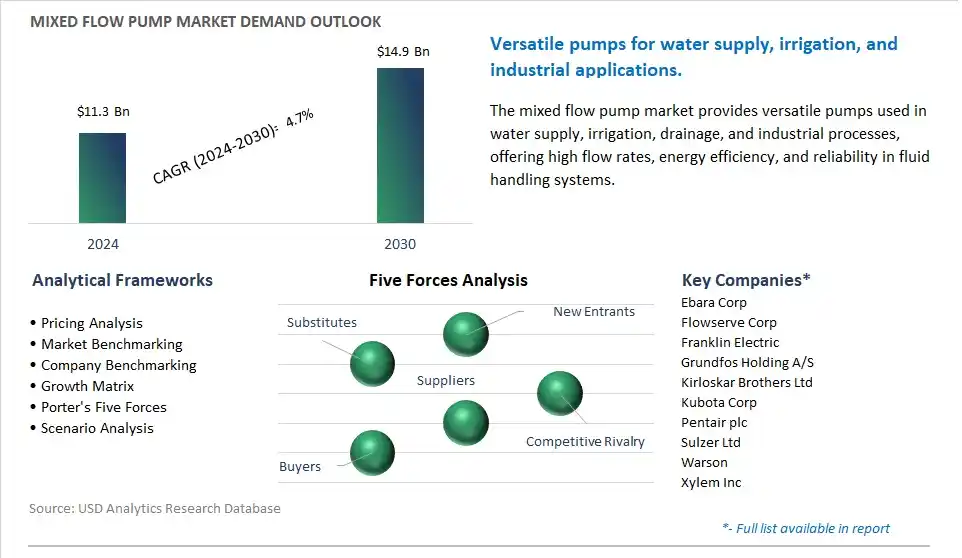
The global Mixed Flow Pump Market is poised to register a 4.7% CAGR from $11.3 Billion in 2024 to $14.9 Billion in 2030.
The global Mixed Flow Pump Market Study analyzes and forecasts the market size across 6 regions and 24 countries for diverse segments -By Configuration (Single-stage, Multi-stage), By End-User (Agriculture, Construction & Building, Water & Wastewater, Power Generation, Oil & Gas, Chemical, Others).
An Introduction to Global Mixed Flow Pump Market in 2024
The future of mixed flow pumps is characterized by a focus on efficiency, reliability, and adaptability to diverse applications. One key trend shaping this industry is the integration of smart technologies such as IoT sensors and predictive maintenance algorithms, enabling real-time monitoring and proactive servicing to minimize downtime and optimize performance. Manufacturers are also investing in research and development to design pumps that can handle a wider range of fluid viscosities and temperatures, catering to evolving industrial and agricultural needs. Furthermore, there's a growing emphasis on sustainability, with the development of energy-efficient pumps and the utilization of materials that minimize environmental impact throughout the product lifecycle. As water scarcity becomes a pressing global concern, mixed flow pumps are increasingly being engineered to maximize water conservation and minimize energy consumption in pumping operations, driving innovation in this sector.
Mixed Flow Pump Market Competitive Landscape
The market report analyses the leading companies in the industry including Ebara Corp, Flowserve Corp, Franklin Electric, Grundfos Holding A/S, Kirloskar Brothers Ltd, Kubota Corp, Pentair plc, Sulzer Ltd, Warson, Xylem Inc.
Mixed Flow Pump Market Dynamics
Mixed Flow Pump Market Trend: Growing Demand for Energy-Efficient Pumping Solutions
A significant trend in the Mixed Flow Pump market is the growing demand for energy-efficient pumping solutions. With increasing emphasis on sustainability and energy conservation, industries such as water management, agriculture, and wastewater treatment are seeking pumps that offer higher efficiency and lower energy consumption. Mixed flow pumps, known for their ability to handle large flow rates at moderate to high heads, are being increasingly adopted as a more energy-efficient alternative to traditional centrifugal pumps. The trend towards energy-efficient pumps is driven by the need to reduce operational costs, minimize carbon footprint, and comply with stringent energy efficiency regulations, presenting opportunities for manufacturers to innovate and offer eco-friendly pumping solutions.
Mixed Flow Pump Market Driver: Expansion of Water Infrastructure Projects and Urbanization
A key driver propelling the Mixed Flow Pump market is the expansion of water infrastructure projects and urbanization worldwide. As populations grow and urban areas expand, there's an increasing demand for water supply, wastewater treatment, flood control, and irrigation systems to meet the needs of growing communities and industries. Mixed flow pumps play a vital role in water management applications such as pumping water from rivers, lakes, and reservoirs for distribution to urban centers, as well as in drainage and flood control projects to mitigate the impact of heavy rainfall and stormwater runoff. Additionally, the agricultural sector relies on mixed flow pumps for irrigation purposes, driving market demand for pumps that can efficiently transport water over long distances and varying elevations.
Mixed Flow Pump Market Opportunity: Integration of Smart Monitoring and Control Technologies
An opportunity in the Mixed Flow Pump market lies in the integration of smart monitoring and control technologies to enhance pump performance, reliability, and operational efficiency. With the advent of the Internet of Things (IoT) and digitalization, there's a growing demand for pumps equipped with sensors, data analytics, and remote monitoring capabilities that enable real-time condition monitoring, predictive maintenance, and optimization of pump operations. Manufacturers aim to capitalize on this opportunity by developing mixed flow pumps with built-in smart features that allow users to remotely monitor pump performance, detect anomalies, and adjust operating parameters for optimal efficiency. By offering smart pumping solutions, manufacturers can meet the evolving needs of customers for advanced control and automation capabilities while improving overall system reliability and uptime.
Mixed Flow Pump Market Share Analysis: Single-stage generated the highest revenue in 2024
The largest segment in the Mixed Flow Pump Market is the Single-stage configuration segment. The market growth is driven by single-stage mixed-flow pumps are widely used in various applications due to their simplicity, reliability, and versatility. These pumps consist of a single impeller that rotates within the pump casing, generating flow and pressure to move fluids from one point to another. Single-stage mixed-flow pumps are suitable for a wide range of flow rates and heads, making them ideal for applications where moderate to high flow rates are required, such as irrigation, drainage, flood control, and wastewater treatment. Further, single-stage mixed-flow pumps offer cost-effective pumping solutions for medium to large-scale projects. They are relatively simpler in design, construction, and installation compared to multi-stage pumps, resulting in lower upfront capital costs, reduced maintenance requirements, and easier operation. Single-stage mixed-flow pumps are often favored for their efficient performance and low lifecycle costs in applications where high flow rates and low to moderate heads are predominant. In addition, single-stage mixed-flow pumps are commonly employed in municipal water supply systems, agricultural irrigation networks, industrial processes, and water treatment plants worldwide. Their robust construction, efficient hydraulic design, and reliable performance make them a preferred choice for pumping clean water, wastewater, sewage, and other fluids in diverse operating conditions. Additionally, single-stage mixed-flow pumps are available in a wide range of sizes, materials, and configurations to meet specific project requirements and performance criteria. Manufacturers offer customization options for impeller design, material selection, motor specifications, and control features, allowing customers to tailor pump solutions to their unique applications and operating environments. Further, single-stage mixed-flow pumps are well-suited for retrofit and replacement projects, offering compatibility with existing piping systems and infrastructure. Their ease of integration, versatility, and proven performance in various applications position the Single-stage configuration segment as the largest in the Mixed Flow Pump Market. Over the forecast period, the combination of their widespread application, cost-effectiveness, reliability, and adaptability makes single-stage mixed-flow pumps the preferred choice for many pumping projects worldwide.
Mixed Flow Pump Market Share Analysis: Water & Wastewater segment is poised to register the fastest growth rate (CAGR) over the forecast period to 2030
The fastest-growing segment in the Mixed Flow Pump Market is the Water & Wastewater end-user segment. There is an increasing global demand for water and wastewater management solutions driven by population growth, urbanization, and industrialization. As communities and industries expand, there is a growing need for efficient water supply systems, wastewater treatment plants, and water reclamation facilities to meet the demands for potable water, irrigation, industrial processes, and environmental sustainability. Mixed flow pumps play a crucial role in these applications by facilitating the movement of large volumes of water, wastewater, and other fluids efficiently and reliably. Further, regulatory requirements and environmental concerns mandate the implementation of advanced water and wastewater infrastructure to ensure compliance with water quality standards and pollution control regulations. Governments and regulatory bodies worldwide are investing in upgrading and expanding water treatment and distribution systems to address water scarcity, contamination, and pollution issues. Mixed flow pumps are essential components of these infrastructure projects, providing pumping solutions for water intake, distribution, circulation, and treatment processes. In addition, technological advancements in mixed-flow pump design, materials, and control systems enhance pump performance, energy efficiency, and reliability in water and wastewater applications. Manufacturers are developing innovative pump solutions with features such as variable frequency drives (VFDs), digital controls, predictive maintenance capabilities, and remote monitoring systems to optimize pump operation, minimize energy consumption, and reduce lifecycle costs. Additionally, the growing focus on sustainable water management practices and resource conservation drives investment in water reuse, desalination, and wastewater recycling projects. Mixed flow pumps play a vital role in these initiatives by facilitating the movement and treatment of reclaimed water, brackish water, and seawater for irrigation, industrial processes, and potable water supply. Further, the increasing incidence of extreme weather events, such as droughts, floods, and storms, underscores the importance of resilient water infrastructure capable of handling fluctuating water levels and flows. Mixed flow pumps offer robust, high-capacity pumping solutions suitable for managing water resources in challenging environmental conditions. Over the forecast period, the combination of increasing demand for water and wastewater management solutions, regulatory requirements, technological advancements, and sustainability initiatives positions the Water & Wastewater end-user segment as the fastest-growing in the Mixed Flow Pump Market.
Mixed Flow Pump Market Report Segmentation
By Configuration
Single-stage
Multi-stage
By End-User
Agriculture
Construction & Building
Water & Wastewater
Power Generation
Oil & Gas
Chemical
Others
Regions Included
North America (US, Canada, Mexico)
Europe (Germany, UK, France, Spain, Italy, Russia, Rest of Europe)
Asia Pacific (China, India, Japan, South Korea, Australia, South East Asia, Rest of Asia)
South America (Brazil, Argentina, Rest of South America)
Middle East and Africa (Saudi Arabia, UAE, Rest of Middle East, South Africa, Egypt, Rest of Africa)
Mixed Flow Pump Companies Profiled in the Market Study
Ebara Corp
Flowserve Corp
Franklin Electric
Grundfos Holding A/S
Kirloskar Brothers Ltd
Kubota Corp
Pentair plc
Sulzer Ltd
Warson
Xylem Inc
*- List Not Exhaustive
TABLE OF CONTENTS
1 Introduction to 2024 Mixed Flow Pump Market
1.1 Market Overview
1.2 Quick Facts
1.3 Scope/Objective of the Study
1.4 Market Definition
1.5 Countries and Regions Covered
1.6 Units, Currency, and Conversions
1.7 Industry Value Chain
2 Research Methodology
2.1 Market Size Estimation
2.2 Sources and Research Methodology
2.3 Data Triangulation
2.4 Assumptions and Limitations
3 Executive Summary
3.1 Global Mixed Flow Pump Market Size Outlook, $ Million, 2021 to 2030
3.2 Mixed Flow Pump Market Outlook by Type, $ Million, 2021 to 2030
3.3 Mixed Flow Pump Market Outlook by Product, $ Million, 2021 to 2030
3.4 Mixed Flow Pump Market Outlook by Application, $ Million, 2021 to 2030
3.5 Mixed Flow Pump Market Outlook by Key Countries, $ Million, 2021 to 2030
4 Market Dynamics
4.1 Key Driving Forces of Mixed Flow Pump Industry
4.2 Key Market Trends in Mixed Flow Pump Industry
4.3 Potential Opportunities in Mixed Flow Pump Industry
4.4 Key Challenges in Mixed Flow Pump Industry
5 Market Factor Analysis
5.1 Value Chain Analysis
5.2 Competitive Landscape
5.2.1 Global Mixed Flow Pump Market Share by Company (%), 2023
5.2.2 Product Offerings by Company
5.3 Porter’s Five Forces Analysis
5.4 Pricing Analysis and Outlook
6 Growth Outlook Across Scenarios
6.1 Growth Analysis-Case Scenario Definitions
6.2 Low Growth Scenario Forecasts
6.3 Reference Growth Scenario Forecasts
6.4 High Growth Scenario Forecasts
7 Global Mixed Flow Pump Market Outlook by Segments
7.1 Mixed Flow Pump Market Outlook by Segments, $ Million, 2021- 2030
By Configuration
Single-stage
Multi-stage
By End-User
Agriculture
Construction & Building
Water & Wastewater
Power Generation
Oil & Gas
Chemical
Others
8 North America Mixed Flow Pump Market Analysis and Outlook To 2030
8.1 Introduction to North America Mixed Flow Pump Markets in 2024
8.2 North America Mixed Flow Pump Market Size Outlook by Country, 2021-2030
8.2.1 United States
8.2.2 Canada
8.2.3 Mexico
8.3 North America Mixed Flow Pump Market size Outlook by Segments, 2021-2030
By Configuration
Single-stage
Multi-stage
By End-User
Agriculture
Construction & Building
Water & Wastewater
Power Generation
Oil & Gas
Chemical
Others
9 Europe Mixed Flow Pump Market Analysis and Outlook To 2030
9.1 Introduction to Europe Mixed Flow Pump Markets in 2024
9.2 Europe Mixed Flow Pump Market Size Outlook by Country, 2021-2030
9.2.1 Germany
9.2.2 France
9.2.3 Spain
9.2.4 United Kingdom
9.2.4 Italy
9.2.5 Russia
9.2.6 Norway
9.2.7 Rest of Europe
9.3 Europe Mixed Flow Pump Market Size Outlook by Segments, 2021-2030
By Configuration
Single-stage
Multi-stage
By End-User
Agriculture
Construction & Building
Water & Wastewater
Power Generation
Oil & Gas
Chemical
Others
10 Asia Pacific Mixed Flow Pump Market Analysis and Outlook To 2030
10.1 Introduction to Asia Pacific Mixed Flow Pump Markets in 2024
10.2 Asia Pacific Mixed Flow Pump Market Size Outlook by Country, 2021-2030
10.2.1 China
10.2.2 India
10.2.3 Japan
10.2.4 South Korea
10.2.5 Indonesia
10.2.6 Malaysia
10.2.7 Australia
10.2.8 Rest of Asia Pacific
10.3 Asia Pacific Mixed Flow Pump Market size Outlook by Segments, 2021-2030
By Configuration
Single-stage
Multi-stage
By End-User
Agriculture
Construction & Building
Water & Wastewater
Power Generation
Oil & Gas
Chemical
Others
11 South America Mixed Flow Pump Market Analysis and Outlook To 2030
11.1 Introduction to South America Mixed Flow Pump Markets in 2024
11.2 South America Mixed Flow Pump Market Size Outlook by Country, 2021-2030
11.2.1 Brazil
11.2.2 Argentina
11.2.3 Rest of South America
11.3 South America Mixed Flow Pump Market size Outlook by Segments, 2021-2030
By Configuration
Single-stage
Multi-stage
By End-User
Agriculture
Construction & Building
Water & Wastewater
Power Generation
Oil & Gas
Chemical
Others
12 Middle East and Africa Mixed Flow Pump Market Analysis and Outlook To 2030
12.1 Introduction to Middle East and Africa Mixed Flow Pump Markets in 2024
12.2 Middle East and Africa Mixed Flow Pump Market Size Outlook by Country, 2021-2030
12.2.1 Saudi Arabia
12.2.2 UAE
12.2.3 Oman
12.2.4 Rest of Middle East
12.2.5 Egypt
12.2.6 Nigeria
12.2.7 South Africa
12.2.8 Rest of Africa
12.3 Middle East and Africa Mixed Flow Pump Market size Outlook by Segments, 2021-2030
By Configuration
Single-stage
Multi-stage
By End-User
Agriculture
Construction & Building
Water & Wastewater
Power Generation
Oil & Gas
Chemical
Others
13 Company Profiles
13.1 Company Snapshot
13.2 SWOT Profiles
13.3 Products and Services
13.4 Recent Developments
13.5 Financial Profile
Ebara Corp
Flowserve Corp
Franklin Electric
Grundfos Holding A/S
Kirloskar Brothers Ltd
Kubota Corp
Pentair plc
Sulzer Ltd
Warson
Xylem Inc
14 Appendix
14.1 Customization Offerings
14.2 Subscription Services
14.3 Related Reports
14.4 Publisher Expertise
By Configuration
Single-stage
Multi-stage
By End-User
Agriculture
Construction & Building
Water & Wastewater
Power Generation
Oil & Gas
Chemical
Others
Countries Analyzed
North America (US, Canada, Mexico)
Europe (Germany, UK, France, Spain, Italy, Russia, Rest of Europe)
Asia Pacific (China, India, Japan, South Korea, Australia, South East Asia, Rest of Asia)
South America (Brazil, Argentina, Rest of South America)
Middle East and Africa (Saudi Arabia, UAE, Rest of Middle East, South Africa, Egypt, Rest of Africa)
