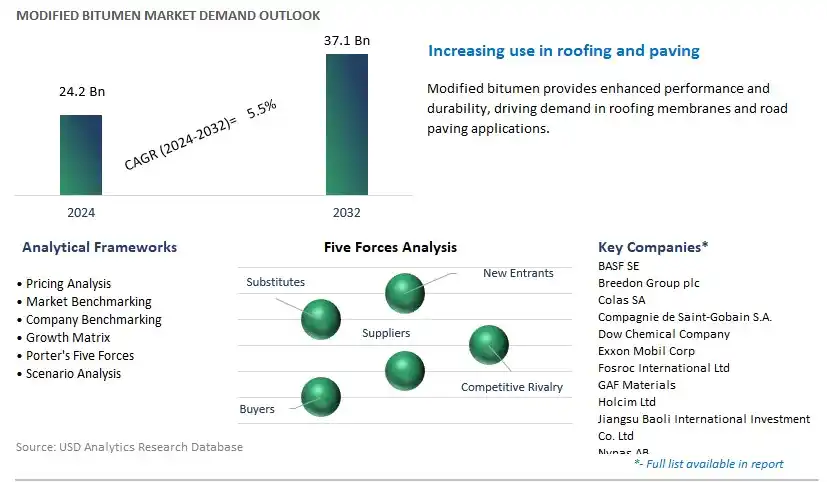
Global Modified Bitumen Market Size is valued at $24.2 Billion in 2025 and is forecast to register a growth rate (CAGR) of 5.5% to reach $37.1 Billion by 2034.
The global Modified Bitumen Market Study analyzes and forecasts the market size across 6 regions and 24 countries for diverse segments -By Type (Styrene-Butadiene-Styrene, Atactic Polypropylene, Crumb Rubber, Natural Rubber, Others), By Application (Hot Asphalt, Cold Asphalt, Torch Applied, Others), By End-User (Road Construction, Building Construction, Others).
An Introduction to Modified Bitumen Market in 2025
Modified bitumen, a versatile material used in the construction industry, has seen significant advancements and applications in 2025. This modified form of traditional bitumen combines the waterproofing properties of bitumen with added polymers or additives to enhance elasticity, durability, and resistance to temperature fluctuations. Modified bitumen finds extensive use in roofing systems, pavement construction, and waterproofing applications due to its ability to withstand harsh weather conditions and structural movements. In recent years, the market for modified bitumen has witnessed innovations such as self-adhering membranes, reflective coatings, and sustainable additives to meet evolving sustainability standards and performance requirements. As infrastructure development s globally, the demand for modified bitumen is expected to remain robust, driven by its superior performance and long-term cost-effectiveness.
Modified Bitumen Market Competitive Landscape
The market report analyses the leading companies in the industry including BASF SE, Breedon Group plc, Colas SA, Compagnie de Saint-Gobain S.A., Dow Chemical Company, Exxon Mobil Corp, Fosroc International Ltd, GAF Materials, Holcim Ltd, Jiangsu Baoli International Investment Co. Ltd, Nynas AB, Polski Koncern Naftowy ORLEN SA, Repsol SA, Rosneft Oil Co., Royal Dutch Shell plc, Sika AG, SK Innovation Co. Ltd, SOPREMA SAS, and others.
Modified Bitumen Market Dynamics
Market Trend: Increased Demand for Sustainable and Energy-Efficient Construction Materials
A prominent market trend for modified bitumen is the increased demand for sustainable and energy-efficient construction materials in the building and infrastructure sectors. With growing concerns about climate change, energy consumption, and environmental impact, there's a trend towards the adoption of modified bitumen roofing systems that offer enhanced thermal performance, durability, and sustainability. Modified bitumen membranes, incorporating polymer additives and reinforcement materials, provide improved weather resistance, UV protection, and waterproofing properties, contributing to energy savings, reduced maintenance costs, and extended service life of buildings and structures. This trend is driven by green building initiatives, energy efficiency regulations, and the need for resilient infrastructure solutions, leading to the widespread adoption of modified bitumen roofing systems in both new construction and retrofit projects.
Market Driver: Infrastructure Development and Urbanization
A key market driver for modified bitumen is the ongoing infrastructure development and urbanization, particularly in emerging economies and growing metropolitan areas worldwide. As urban populations continue to expand, there's a rising demand for durable and cost-effective roofing materials to meet the needs of residential, commercial, and industrial buildings. Modified bitumen offers advantages such as ease of installation, flexibility, and compatibility with various roof designs and substrates, making it a preferred choice for roofing contractors and developers in urban construction projects. The drive for infrastructure investment, urban renewal, and sustainable development initiatives fuels the demand for modified bitumen as a versatile and reliable roofing solution for modern cities and communities.
Market Opportunity: Innovation in Sustainable Roofing Solutions
A potential opportunity for modified bitumen manufacturers lies in innovation and differentiation in sustainable roofing solutions tailored to specific market needs and emerging trends. Opportunities exist for developing advanced modified bitumen formulations with improved environmental performance, such as bio-based polymers, recycled materials, and low-VOC (volatile organic compound) additives. By investing in research and development, manufacturers can create eco-friendly and energy-efficient modified bitumen products that meet or exceed industry standards for sustainability, performance, and durability. Additionally, there's an opportunity to expand into niche markets such as green roofs, solar roofing systems, and cool roofing technologies, where modified bitumen membranes can be integrated with other sustainable building components to enhance energy efficiency, reduce environmental impact, and promote urban resilience. By embracing innovation and sustainability, modified bitumen manufacturers can position themselves as leaders in the evolving roofing market and capitalize on the growing demand for environmentally responsible construction materials.
Modified Bitumen Market Share Analysis: Styrene-Butadiene-Styrene (SBS) Type segment generated the highest revenue in 2024
The Styrene-Butadiene-Styrene (SBS) Type segment is the largest segment in the Modified Bitumen Market. SBS-modified bitumen is widely favored in the construction industry for its superior performance characteristics, including enhanced flexibility, durability, and resistance to cracking and weathering. SBS polymers, derived from the copolymerization of styrene and butadiene monomers, are blended with bitumen to create a modified asphalt binder with improved properties. This modified bitumen is extensively used in various applications such as roofing, waterproofing, pavement rehabilitation, and bridge deck overlays. The addition of SBS polymers enhances the elasticity and elongation properties of bitumen, allowing it to withstand thermal cycling, freeze-thaw cycles, and heavy traffic loads. Moreover, SBS-modified bitumen offers excellent adhesion to various substrates, ensuring long-lasting performance in diverse climatic conditions. With the growing demand for durable and high-performance waterproofing and paving materials in construction projects worldwide, the SBS Type segment maintains its leadership position in the Modified Bitumen Market as the preferred choice for contractors, developers, and infrastructure agencies.
Modified Bitumen Market Share Analysis: Torch Applied is poised to register the fastest CAGR over the forecast period
The Torch Applied Application segment is the fastest-growing segment in the Modified Bitumen Market. Torch applied modified bitumen membranes offer a convenient and efficient solution for waterproofing and roofing applications in both residential and commercial construction projects. These membranes are manufactured with a base of bitumen modified with polymers such as SBS (Styrene-Butadiene-Styrene) or APP (Atactic Polypropylene) and are reinforced with fiberglass or polyester mats. Torch applied membranes are installed by heating the underside of the membrane with a propane torch, allowing for quick adhesion to the substrate. This method offers advantages such as faster installation times, reduced labor costs, and improved waterproofing performance compared to traditional installation methods. Additionally, torch applied membranes provide excellent resistance to water infiltration, UV radiation, and mechanical damage, making them suitable for use in demanding environments. With the growing demand for efficient and reliable waterproofing solutions in construction projects, particularly in regions prone to heavy rainfall or extreme weather conditions, the Torch Applied Application segment presents significant growth opportunities for manufacturers and suppliers in the Modified Bitumen Market.
Modified Bitumen Market Share Analysis: Road Construction segment generated the highest revenue in 2024
The Road Construction End-User segment is the largest segment in the Modified Bitumen Market. Modified bitumen is extensively utilized in road construction projects for its exceptional durability, resilience, and ability to withstand heavy traffic loads and adverse weather conditions. Roads paved with modified bitumen exhibit enhanced resistance to rutting, cracking, and deformation, resulting in longer service life and reduced maintenance costs. Moreover, the incorporation of polymer modifiers such as SBS (Styrene-Butadiene-Styrene) or APP (Atactic Polypropylene) enhances the elasticity and fatigue resistance of bitumen, allowing road surfaces to withstand repetitive loading and temperature fluctuations without compromising performance. Additionally, modified bitumen offers excellent adhesion to various pavement substrates, ensuring superior bond strength and resistance to delamination. With the growing investment in infrastructure development and road rehabilitation projects globally, particularly in emerging economies, the Road Construction End-User segment continues to dominate the Modified Bitumen Market as the preferred choice for durable and high-performance road surfaces.
Modified Bitumen Market
By Type
Styrene-Butadiene-Styrene
Atactic Polypropylene
Crumb Rubber
Natural Rubber
Others
By Application
Hot Asphalt
Cold Asphalt
Torch Applied
Others
By End-User
Road Construction
Building Construction
Others
Countries Analyzed
North America (US, Canada, Mexico)
Europe (Germany, UK, France, Spain, Italy, Russia, Rest of Europe)
Asia Pacific (China, India, Japan, South Korea, Australia, South East Asia, Rest of Asia)
South America (Brazil, Argentina, Rest of South America)
Middle East and Africa (Saudi Arabia, UAE, Rest of Middle East, South Africa, Egypt, Rest of Africa)
Modified Bitumen Companies Profiled in the Study
BASF SE
Breedon Group plc
Colas SA
Compagnie de Saint-Gobain S.A.
Dow Chemical Company
Exxon Mobil Corp
Fosroc International Ltd
GAF Materials
Holcim Ltd
Jiangsu Baoli International Investment Co. Ltd
Nynas AB
Polski Koncern Naftowy ORLEN SA
Repsol SA
Rosneft Oil Co.
Royal Dutch Shell plc
Sika AG
SK Innovation Co. Ltd
SOPREMA SAS
*- List Not Exhaustive
TABLE OF CONTENTS
1 Introduction to 2024 Modified Bitumen Market
1.1 Market Overview
1.2 Quick Facts
1.3 Scope/Objective of the Study
1.4 Market Definition
1.5 Countries and Regions Covered
1.6 Units, Currency, and Conversions
1.7 Industry Value Chain
2 Research Methodology
2.1 Market Size Estimation
2.2 Sources and Research Methodology
2.3 Data Triangulation
2.4 Assumptions and Limitations
3 Executive Summary
3.1 Global Modified Bitumen Market Size Outlook, $ Million, 2021 to 2032
3.2 Modified Bitumen Market Outlook by Type, $ Million, 2021 to 2032
3.3 Modified Bitumen Market Outlook by Product, $ Million, 2021 to 2032
3.4 Modified Bitumen Market Outlook by Application, $ Million, 2021 to 2032
3.5 Modified Bitumen Market Outlook by Key Countries, $ Million, 2021 to 2032
4 Market Dynamics
4.1 Key Driving Forces of Modified Bitumen Industry
4.2 Key Market Trends in Modified Bitumen Industry
4.3 Potential Opportunities in Modified Bitumen Industry
4.4 Key Challenges in Modified Bitumen Industry
5 Market Factor Analysis
5.1 Value Chain Analysis
5.2 Competitive Landscape
5.2.1 Global Modified Bitumen Market Share by Company (%), 2023
5.2.2 Product Offerings by Company
5.3 Porter’s Five Forces Analysis
5.4 Pricing Analysis and Outlook
6 Growth Outlook Across Scenarios
6.1 Growth Analysis-Case Scenario Definitions
6.2 Low Growth Scenario Forecasts
6.3 Reference Growth Scenario Forecasts
6.4 High Growth Scenario Forecasts
7 Global Modified Bitumen Market Outlook by Segments
7.1 Modified Bitumen Market Outlook by Segments, $ Million, 2021- 2032
By Type
Styrene-Butadiene-Styrene
Atactic Polypropylene
Crumb Rubber
Natural Rubber
Others
By Application
Hot Asphalt
Cold Asphalt
Torch Applied
Others
By End-User
Road Construction
Building Construction
Others
8 North America Modified Bitumen Market Analysis and Outlook To 2032
8.1 Introduction to North America Modified Bitumen Markets in 2024
8.2 North America Modified Bitumen Market Size Outlook by Country, 2021-2032
8.2.1 United States
8.2.2 Canada
8.2.3 Mexico
8.3 North America Modified Bitumen Market size Outlook by Segments, 2021-2032
By Type
Styrene-Butadiene-Styrene
Atactic Polypropylene
Crumb Rubber
Natural Rubber
Others
By Application
Hot Asphalt
Cold Asphalt
Torch Applied
Others
By End-User
Road Construction
Building Construction
Others
9 Europe Modified Bitumen Market Analysis and Outlook To 2032
9.1 Introduction to Europe Modified Bitumen Markets in 2024
9.2 Europe Modified Bitumen Market Size Outlook by Country, 2021-2032
9.2.1 Germany
9.2.2 France
9.2.3 Spain
9.2.4 United Kingdom
9.2.4 Italy
9.2.5 Russia
9.2.6 Norway
9.2.7 Rest of Europe
9.3 Europe Modified Bitumen Market Size Outlook by Segments, 2021-2032
By Type
Styrene-Butadiene-Styrene
Atactic Polypropylene
Crumb Rubber
Natural Rubber
Others
By Application
Hot Asphalt
Cold Asphalt
Torch Applied
Others
By End-User
Road Construction
Building Construction
Others
10 Asia Pacific Modified Bitumen Market Analysis and Outlook To 2032
10.1 Introduction to Asia Pacific Modified Bitumen Markets in 2024
10.2 Asia Pacific Modified Bitumen Market Size Outlook by Country, 2021-2032
10.2.1 China
10.2.2 India
10.2.3 Japan
10.2.4 South Korea
10.2.5 Indonesia
10.2.6 Malaysia
10.2.7 Australia
10.2.8 Rest of Asia Pacific
10.3 Asia Pacific Modified Bitumen Market size Outlook by Segments, 2021-2032
By Type
Styrene-Butadiene-Styrene
Atactic Polypropylene
Crumb Rubber
Natural Rubber
Others
By Application
Hot Asphalt
Cold Asphalt
Torch Applied
Others
By End-User
Road Construction
Building Construction
Others
11 South America Modified Bitumen Market Analysis and Outlook To 2032
11.1 Introduction to South America Modified Bitumen Markets in 2024
11.2 South America Modified Bitumen Market Size Outlook by Country, 2021-2032
11.2.1 Brazil
11.2.2 Argentina
11.2.3 Rest of South America
11.3 South America Modified Bitumen Market size Outlook by Segments, 2021-2032
By Type
Styrene-Butadiene-Styrene
Atactic Polypropylene
Crumb Rubber
Natural Rubber
Others
By Application
Hot Asphalt
Cold Asphalt
Torch Applied
Others
By End-User
Road Construction
Building Construction
Others
12 Middle East and Africa Modified Bitumen Market Analysis and Outlook To 2032
12.1 Introduction to Middle East and Africa Modified Bitumen Markets in 2024
12.2 Middle East and Africa Modified Bitumen Market Size Outlook by Country, 2021-2032
12.2.1 Saudi Arabia
12.2.2 UAE
12.2.3 Oman
12.2.4 Rest of Middle East
12.2.5 Egypt
12.2.6 Nigeria
12.2.7 South Africa
12.2.8 Rest of Africa
12.3 Middle East and Africa Modified Bitumen Market size Outlook by Segments, 2021-2032
By Type
Styrene-Butadiene-Styrene
Atactic Polypropylene
Crumb Rubber
Natural Rubber
Others
By Application
Hot Asphalt
Cold Asphalt
Torch Applied
Others
By End-User
Road Construction
Building Construction
Others
13 Company Profiles
13.1 Company Snapshot
13.2 SWOT Profiles
13.3 Products and Services
13.4 Recent Developments
13.5 Financial Profile
BASF SE
Breedon Group plc
Colas SA
Compagnie de Saint-Gobain S.A.
Dow Chemical Company
Exxon Mobil Corp
Fosroc International Ltd
GAF Materials
Holcim Ltd
Jiangsu Baoli International Investment Co. Ltd
Nynas AB
Polski Koncern Naftowy ORLEN SA
Repsol SA
Rosneft Oil Co.
Royal Dutch Shell plc
Sika AG
SK Innovation Co. Ltd
SOPREMA SAS
14 Appendix
14.1 Customization Offerings
14.2 Subscription Services
14.3 Related Reports
14.4 Publisher Expertise
By Type
Styrene-Butadiene-Styrene
Atactic Polypropylene
Crumb Rubber
Natural Rubber
Others
By Application
Hot Asphalt
Cold Asphalt
Torch Applied
Others
By End-User
Road Construction
Building Construction
Others
Countries Analyzed
North America (US, Canada, Mexico)
Europe (Germany, UK, France, Spain, Italy, Russia, Rest of Europe)
Asia Pacific (China, India, Japan, South Korea, Australia, South East Asia, Rest of Asia)
South America (Brazil, Argentina, Rest of South America)
Middle East and Africa (Saudi Arabia, UAE, Rest of Middle East, South Africa, Egypt, Rest of Africa)
