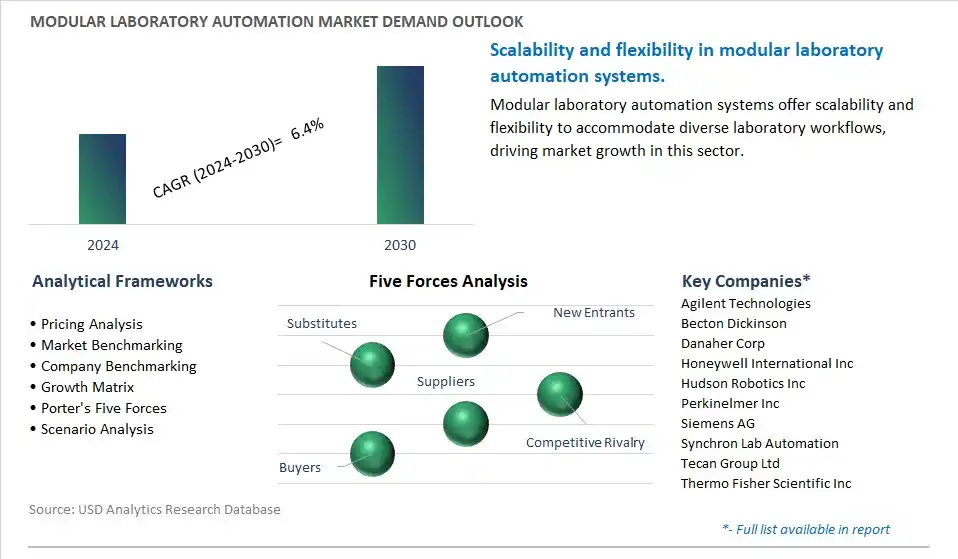
Modular Laboratory Automation Market is estimated to increase at a growth rate of 6.4% CAGR over the forecast period from 2024 to 2030.
The global Modular Laboratory Automation Market Study analyzes and forecasts the market size across 6 regions and 24 countries for diverse segments including By Type (Automated Liquid Handlers, Automated Plate Handlers, Robotic Arms, Automated Storage and Retrieval Systems (ASRS), Software, Analyzers), By Application (Drug Discovery, Genomics, Proteomics, Clinical Diagnostics, Others).
An Introduction to Modular Laboratory Automation Market in 2024
The modular laboratory automation market in 2024 is witnessing substantial growth driven by the increasing adoption of automated solutions to streamline laboratory workflows, improve efficiency, and enhance productivity in life sciences research, clinical diagnostics, and drug discovery. Modular laboratory automation systems offer flexibility, scalability, and customization, allowing laboratories to automate specific tasks or entire processes based on their unique requirements. With advancements in robotics, software integration, and high-throughput screening technologies, modular automation solutions are enabling faster data generation, better reproducibility, and cost savings for research and diagnostic laboratories worldwide. Market players are focusing on innovation, product development, and strategic collaborations to address evolving customer needs and capitalize on the growing demand for modular laboratory automation solutions.
Modular Laboratory Automation Market Competitive Landscape
The global Modular Laboratory Automation Industry is highly competitive with a large number of companies focusing on niche market segments. Amidst intense competitive conditions, Modular Laboratory Automation Companies are investing in new product launches and strengthening distribution channels. Key companies operating in the Modular Laboratory Automation Industry include- Agilent Technologies, Becton Dickinson, Danaher Corp, Honeywell International Inc, Hudson Robotics Inc, Perkinelmer Inc, Siemens AG, Synchron Lab Automation, Tecan Group Ltd, Thermo Fisher Scientific Inc.
Modular Laboratory Automation Market Trend: Adoption of Modular and Scalable Automation Solutions
A significant trend in the modular laboratory automation market is the increasing adoption of modular and scalable automation solutions. Laboratories across various sectors, including clinical diagnostics, pharmaceuticals, and biotechnology, are seeking flexible automation platforms that can adapt to evolving workflows, throughput requirements, and technological advancements. Modular automation systems offer the flexibility to configure and reconfigure laboratory processes quickly, allowing laboratories to customize their automation solutions according to specific application needs and space constraints. Moreover, scalability enables laboratories to expand their automation capabilities in response to growing sample volumes or changing operational demands. By implementing modular automation solutions, laboratories can enhance efficiency, productivity, and throughput while reducing manual errors and operational costs. This trend is driven by the need for streamlined laboratory workflows, improved sample throughput, and the integration of advanced technologies such as robotics, artificial intelligence, and cloud-based data management systems.
Modular Laboratory Automation Market Driver: Demand for High-throughput Screening and Analysis
A key driver of the modular laboratory automation market is the growing demand for high-throughput screening and analysis in various laboratory settings. Laboratories in the life sciences, drug discovery, genomics, and clinical diagnostics sectors are facing increasing pressure to process large volumes of samples efficiently and rapidly. High-throughput automation solutions enable laboratories to streamline sample handling, processing, and analysis workflows, accelerating research and diagnostic processes while maintaining data accuracy and reproducibility. The demand for high-throughput automation is fueled by several factors, including the need for expedited drug discovery and development, the rise of personalized medicine and precision diagnostics, and the growing complexity of biological and chemical analyses. Modular laboratory automation systems equipped with robotic workstations, liquid handling devices, and integrated software platforms empower laboratories to achieve high-throughput screening and analysis capabilities, leading to faster research outcomes, enhanced productivity, and improved decision-making in drug development, genomics research, and clinical diagnostics.
Modular Laboratory Automation Market Opportunity: Integration of Artificial Intelligence and Machine Learning
An opportunity for market growth lies in the integration of artificial intelligence (AI) and machine learning (ML) technologies into modular laboratory automation systems. AI and ML algorithms can optimize laboratory workflows, automate data analysis, and facilitate real-time decision-making, thereby enhancing the efficiency and effectiveness of automated laboratory processes. By leveraging AI-powered automation solutions, laboratories can extract valuable insights from large datasets, identify patterns, and predict experimental outcomes with greater accuracy and speed. For example, AI algorithms can analyze complex biological or chemical data generated from high-throughput screening assays, identify relevant biomarkers or drug candidates, and prioritize experiments for further investigation. Integrating AI and ML capabilities into modular laboratory automation platforms enables adaptive learning and continuous improvement, allowing laboratories to optimize experimental protocols, troubleshoot process inefficiencies, and accelerate scientific discovery. Collaborative partnerships between automation vendors, AI developers, and laboratory end-users can drive innovation in AI-enabled modular laboratory automation solutions, unlocking new opportunities for improving research productivity, accelerating drug discovery, and advancing precision diagnostics in various scientific disciplines.
Modular Laboratory Automation Market Share Analysis: Drug Discovery is the fastest growing market segment over the forecast period to 2030
Modular laboratory automation in drug discovery emerges as the fastest-growing segment within the modular laboratory automation market. This growth is driven by the increasing demand for innovative technologies that streamline and enhance the drug discovery process, enabling pharmaceutical and biotechnology companies to accelerate research and development efforts. Automated liquid handlers, robotic arms, and automated plate handlers are among the key components of modular laboratory automation systems used in drug discovery laboratories. These systems automate repetitive tasks such as sample preparation, compound screening, and assay development, allowing researchers to process large volumes of samples with precision and efficiency. Additionally, modular laboratory automation systems equipped with advanced software and analyzers facilitate data analysis, interpretation, and visualization, enabling researchers to make informed decisions and identify promising drug candidates more rapidly. As the pharmaceutical industry continues to invest in drug discovery research to address unmet medical needs and combat complex diseases, the demand for modular laboratory automation systems tailored for drug discovery applications is expected to surge. This growth underscores the critical role of automation in driving innovation and efficiency in the drug discovery process, ultimately leading to the development of novel therapeutics and improved patient outcomes.
Modular Laboratory Automation Market Segmentation
By Type
Automated Liquid Handlers
Automated Plate Handlers
Robotic Arms
Automated Storage and Retrieval Systems (ASRS)
Software
Analyzers
By Application
Drug Discovery
Genomics
Proteomics
Clinical Diagnostics
Others
Geographical Analysis
North America (United States, Canada, Mexico)
Europe (Germany, France, United Kingdom, Spain, Italy, Rest of Europe)
Asia Pacific (China, India, Japan, South Korea, Rest of Asia Pacific)
South America (Brazil, Argentina, Rest of South America)
Middle East and Africa (Saudi Arabia, UAE, Rest of Middle East, South Africa, Egypt, Rest of Africa)
Modular Laboratory Automation Companies
Agilent Technologies
Becton Dickinson
Danaher Corp
Honeywell International Inc
Hudson Robotics Inc
Perkinelmer Inc
Siemens AG
Synchron Lab Automation
Tecan Group Ltd
Thermo Fisher Scientific Inc
* List not Exhaustive
Reasons to Buy the Modular Laboratory Automation Market Study
• Deepen your industry insights and navigate uncertainties for strategy formulation, CAPEX, and Operational decisions
• Gain access to detailed insights on the Modular Laboratory Automation Market, encompassing current market size, growth trends, and forecasts till 2030.
• Access detailed competitor analysis, enabling competitive advantage through a thorough understanding of market players, strategies, and potential differentiation opportunities
• Stay ahead of the curve with insights on technological advancements, innovations, and upcoming trends
• Identify lucrative investment avenues and expansion opportunities within the Modular Laboratory Automation Industry, guided by robust, data-backed analysis.
• Understand regional and global markets through country-wise analysis, regional market potential, regulatory nuances, and dynamics
• Execute strategies with confidence and speed through information, analytics, and insights on the industry value chain
• Corporate leaders, strategists, financial experts, shareholders, asset managers, and governmental representatives can make long-term planning scenarios and build an integrated and timely understanding of market dynamics
• Benefit from tailored solutions and expert consultation based on report insights, providing personalized strategies aligned with specific business needs.
TABLE OF CONTENTS
1 Introduction to 2024 Modular Laboratory Automation Market
1.1 Market Overview
1.2 Quick Facts
1.3 Scope/Objective of the Study
1.4 Market Definition
1.5 Countries and Regions Analyzed
1.6 Units, Currency, and Conversions
1.7 Industry Value Chain
2 Research Methodology
2.1 Market Size Estimation
2.2 Sources and Research Methodology
2.3 Data Triangulation
2.4 Assumptions and Limitations
3 Executive Summary
3.1 Global Modular Laboratory Automation Market Size Outlook, $ Million, 2021 to 2030
3.2 Modular Laboratory Automation Market Outlook by Type, $ Million, 2021 to 2030
3.3 Modular Laboratory Automation Market Outlook by Product, $ Million, 2021 to 2030
3.4 Modular Laboratory Automation Market Outlook by Application, $ Million, 2021 to 2030
3.5 Modular Laboratory Automation Market Outlook by Key Countries, $ Million, 2021 to 2030
4 Market Dynamics
4.1 Key Driving Forces of Modular Laboratory Automation Industry
4.2 Key Market Trends in Modular Laboratory Automation Industry
4.3 Potential Opportunities in Modular Laboratory Automation Industry
4.4 Key Challenges in Modular Laboratory Automation Industry
5 Market Factor Analysis
5.1 Value Chain Analysis
5.2 Competitive Landscape
5.2.1 Global Modular Laboratory Automation Market Share by Company (%), 2023
5.2.2 Product Offerings by Company
5.3 Porter’s Five Forces Analysis
5.4 Pricing Analysis and Outlook
6 Growth Outlook Across Scenarios
6.1 Growth Analysis-Case Scenario Definitions
6.2 Low Growth Scenario Forecasts
6.3 Reference Growth Scenario Forecasts
6.4 High Growth Scenario Forecasts
7 Global Modular Laboratory Automation Market Outlook by Segments
7.1 Modular Laboratory Automation Market Outlook by Segments, $ Million, 2021- 2030
By Type
Automated Liquid Handlers
Automated Plate Handlers
Robotic Arms
Automated Storage and Retrieval Systems (ASRS)
Software
Analyzers
By Application
Drug Discovery
Genomics
Proteomics
Clinical Diagnostics
Others
8 North America Modular Laboratory Automation Market Analysis and Outlook To 2030
8.1 Introduction to North America Modular Laboratory Automation Markets in 2024
8.2 North America Modular Laboratory Automation Market Size Outlook by Country, 2021-2030
8.2.1 United States
8.2.2 Canada
8.2.3 Mexico
8.3 North America Modular Laboratory Automation Market size Outlook by Segments, 2021-2030
By Type
Automated Liquid Handlers
Automated Plate Handlers
Robotic Arms
Automated Storage and Retrieval Systems (ASRS)
Software
Analyzers
By Application
Drug Discovery
Genomics
Proteomics
Clinical Diagnostics
Others
9 Europe Modular Laboratory Automation Market Analysis and Outlook To 2030
9.1 Introduction to Europe Modular Laboratory Automation Markets in 2024
9.2 Europe Modular Laboratory Automation Market Size Outlook by Country, 2021-2030
9.2.1 Germany
9.2.2 France
9.2.3 Spain
9.2.4 United Kingdom
9.2.4 Italy
9.2.5 Russia
9.2.6 Norway
9.2.7 Rest of Europe
9.3 Europe Modular Laboratory Automation Market Size Outlook by Segments, 2021-2030
By Type
Automated Liquid Handlers
Automated Plate Handlers
Robotic Arms
Automated Storage and Retrieval Systems (ASRS)
Software
Analyzers
By Application
Drug Discovery
Genomics
Proteomics
Clinical Diagnostics
Others
10 Asia Pacific Modular Laboratory Automation Market Analysis and Outlook To 2030
10.1 Introduction to Asia Pacific Modular Laboratory Automation Markets in 2024
10.2 Asia Pacific Modular Laboratory Automation Market Size Outlook by Country, 2021-2030
10.2.1 China
10.2.2 India
10.2.3 Japan
10.2.4 South Korea
10.2.5 Indonesia
10.2.6 Malaysia
10.2.7 Australia
10.2.8 Rest of Asia Pacific
10.3 Asia Pacific Modular Laboratory Automation Market size Outlook by Segments, 2021-2030
By Type
Automated Liquid Handlers
Automated Plate Handlers
Robotic Arms
Automated Storage and Retrieval Systems (ASRS)
Software
Analyzers
By Application
Drug Discovery
Genomics
Proteomics
Clinical Diagnostics
Others
11 South America Modular Laboratory Automation Market Analysis and Outlook To 2030
11.1 Introduction to South America Modular Laboratory Automation Markets in 2024
11.2 South America Modular Laboratory Automation Market Size Outlook by Country, 2021-2030
11.2.1 Brazil
11.2.2 Argentina
11.2.3 Rest of South America
11.3 South America Modular Laboratory Automation Market size Outlook by Segments, 2021-2030
By Type
Automated Liquid Handlers
Automated Plate Handlers
Robotic Arms
Automated Storage and Retrieval Systems (ASRS)
Software
Analyzers
By Application
Drug Discovery
Genomics
Proteomics
Clinical Diagnostics
Others
12 Middle East and Africa Modular Laboratory Automation Market Analysis and Outlook To 2030
12.1 Introduction to Middle East and Africa Modular Laboratory Automation Markets in 2024
12.2 Middle East and Africa Modular Laboratory Automation Market Size Outlook by Country, 2021-2030
12.2.1 Saudi Arabia
12.2.2 UAE
12.2.3 Oman
12.2.4 Rest of Middle East
12.2.5 Egypt
12.2.6 Nigeria
12.2.7 South Africa
12.2.8 Rest of Africa
12.3 Middle East and Africa Modular Laboratory Automation Market size Outlook by Segments, 2021-2030
By Type
Automated Liquid Handlers
Automated Plate Handlers
Robotic Arms
Automated Storage and Retrieval Systems (ASRS)
Software
Analyzers
By Application
Drug Discovery
Genomics
Proteomics
Clinical Diagnostics
Others
13 Company Profiles
13.1 Company Snapshot
13.2 SWOT Profiles
13.3 Products and Services
13.4 Recent Developments
13.5 Financial Profile
List of Companies
Agilent Technologies
Becton Dickinson
Danaher Corp
Honeywell International Inc
Hudson Robotics Inc
Perkinelmer Inc
Siemens AG
Synchron Lab Automation
Tecan Group Ltd
Thermo Fisher Scientific Inc
14 Appendix
14.1 Customization Offerings
14.2 Subscription Services
14.3 Related Reports
14.4 Publisher Expertise
