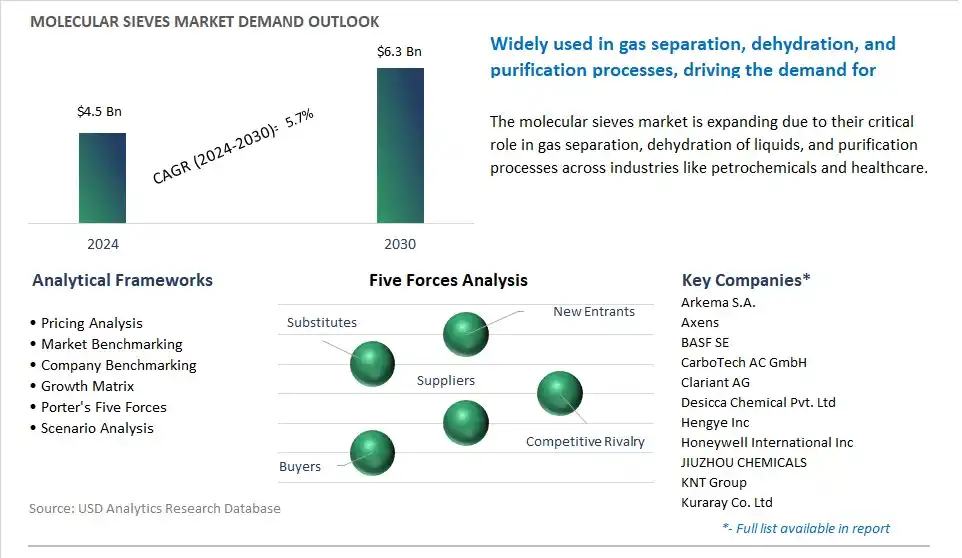
The global Molecular Sieves Market is poised to register a 5.7% CAGR from $4.5 Billion in 2024 to $6.3 Billion in 2030.
The global Molecular Sieves Market Study analyzes and forecasts the market size across 6 regions and 24 countries for diverse segments -By Shape (Pelleted, Beaded, Powdered), By Size (Microporous, Mesoporous, Macroporous), By Product (Carbon, Clay, Porous Glass, Silica Gel, Zeolite), By End-User (Automotive, Cosmetics and Detergent, Oil and Gas, Pharmaceutical, Waste and Water Treatment, Others).
An Introduction to Global Molecular Sieves Market in 2024
The future of molecular sieves is influenced by several key trends, including increasing demand for dehydration and adsorption solutions in chemical processing, advancements in sieve synthesis and customization techniques, and growing emphasis on energy efficiency, product purity, and environmental sustainability. Molecular sieves are crystalline materials with uniform nanopores that selectively adsorb molecules based on their size, shape, and polarity, used in various applications such as drying gases, purifying liquids, and separating chemicals. With the rise of stringent quality standards, volatile feedstocks, and environmental regulations, there's a growing need for molecular sieves that offer high adsorption capacity, selectivity, and regeneration efficiency while minimizing energy consumption and emissions in industrial processes. Moreover, advancements in molecular sieve synthesis methods, such as zeolite templating, ion exchange, and post-synthesis modifications, are driving the development of tailored sieves with optimized pore structures, surface chemistry, and thermal stability for specific applications in petrochemical, pharmaceutical, and environmental sectors. Additionally, the integration of molecular sieves into advanced separation processes such as pressure swing adsorption, membrane technology, and catalytic reactors is enabling efficient resource utilization, waste minimization, and value creation in chemical manufacturing and environmental remediation. Collaboration between sieve manufacturers, process engineers, research institutions, and regulatory agencies is essential to drive innovation, ensure sieve performance, and address market demands in the molecular sieves industry.
Molecular Sieves Market Competitive Landscape
The market report analyses the leading companies in the industry including Arkema S.A., Axens, BASF SE, CarboTech AC GmbH, Clariant AG, Desicca Chemical Pvt. Ltd, Hengye Inc, Honeywell International Inc, JIUZHOU CHEMICALS, KNT Group, Kuraray Co. Ltd, Merck KGaA, OMRON Healthcare Inc, Palmer Holland, Resonac Holdings Corp, Sorbead India, Tosoh Corp, W. R. Grace & Co, Zeochem AG, Zeolyst International.
Molecular Sieves Market Dynamics
Molecular Sieves Market Trend: Increasing Demand for Molecular Sieves in Petrochemical Industry
A significant trend in the molecular sieves market is the increasing demand from the petrochemical industry. Molecular sieves are highly porous materials with uniform pore sizes, making them ideal for adsorption and separation processes. In the petrochemical industry, molecular sieves are used for the purification of gases and liquids, dehydration of solvents, and removal of impurities from feedstocks and intermediate products. With the expansion of petrochemical manufacturing capacities globally and the growing focus on maximizing process efficiency and product purity, there's a rising demand for molecular sieves as essential adsorbents and catalyst supports. This trend is driven by the increasing production of petrochemicals such as ethylene, propylene, and aromatics for use in plastics, polymers, and specialty chemicals, which require stringent purification and separation processes to meet quality standards. As the petrochemical industry continues to grow, the demand for molecular sieves as key components of purification and separation systems is expected to remain strong.
Molecular Sieves Market Driver: Growth in Refining and Natural Gas Processing
A major driver of the molecular sieves market is the growth in refining and natural gas processing industries. Molecular sieves play a vital role in refining processes such as gas drying, hydrocarbon purification, and removal of sulfur compounds from fuels. Additionally, molecular sieves are used in natural gas processing plants for dehydration, sweetening, and removal of contaminants such as water, sulfur compounds, and carbon dioxide. With the increasing demand for cleaner fuels, stringent environmental regulations, and the need to maximize energy efficiency in refining and gas processing operations, there's a growing reliance on molecular sieves to achieve high levels of purification and separation. The expansion of refining capacities, particularly in emerging economies, coupled with the development of shale gas resources and LNG infrastructure, drives the demand for molecular sieves as indispensable adsorbents and catalysts in oil and gas processing industries.
Molecular Sieves Market Opportunity: Diversification into Environmental Remediation and Water Treatment
An opportunity within the molecular sieves market lies in diversifying into environmental remediation and water treatment applications. Molecular sieves possess excellent adsorption properties and can effectively remove pollutants, heavy metals, and contaminants from air and water streams. There's a growing need for sustainable solutions to address environmental pollution, industrial wastewater treatment, and groundwater remediation challenges, driven by regulatory compliance and public health concerns. Molecular sieves can be utilized in environmental applications such as air purification, volatile organic compound (VOC) removal, and water filtration to mitigate pollution and protect ecosystems and human health. By leveraging their adsorption capabilities and tailoring product formulations for environmental applications, manufacturers can capitalize on the growing demand for molecular sieves in environmental remediation and water treatment sectors, thereby expanding their market presence and driving growth in new market segments.
Molecular Sieves Market Share Analysis: The Pelleted molecular sieves segment generated the highest revenue in 2024
The largest segment in the Molecular Sieves Market is Pelleted molecular sieves. This dominance is primarily driving demand within this sector. Pelleted molecular sieves are widely preferred in various industrial applications due to their specific advantages over other shapes. pelleted molecular sieves offer excellent mechanical strength and durability, making them suitable for use in high-pressure and high-temperature environments commonly found in industrial processes. Additionally, the uniform shape and size of pelleted molecular sieves facilitate easy handling, packing, and installation in adsorption and separation equipment, ensuring efficient and consistent performance. Further, pelleted molecular sieves provide a large surface area and pore volume, allowing for enhanced adsorption capacity and efficiency in removing impurities, moisture, and contaminants from gases and liquids. Furthermore, pelleted molecular sieves exhibit excellent regenerability, enabling multiple cycles of adsorption and desorption without significant loss of performance, which contributes to cost savings and operational efficiency for end-users. Over the forecast period, these factors make Pelleted molecular sieves the preferred choice for a wide range of applications in industries such as petrochemicals, natural gas processing, air separation, dehydration, and purification processes, leading to their dominance in the Molecular Sieves Market.
Molecular Sieves Market Share Analysis: The Microporous molecular sieves segment is poised to register the fastest growth rate (CAGR) over the forecast period to 2030
The fastest-growing segment in the Molecular Sieves Market is Microporous molecular sieves. Microporous molecular sieves have pores with diameters less than 2 nanometers, making them highly effective in adsorbing small molecules and gases. This property makes them invaluable in various critical applications such as gas separation, dehydration, purification, and catalysis, particularly in industries such as petrochemicals, refining, and natural gas processing. Additionally, the increasing demand for clean energy, environmental sustainability, and stringent regulations on emissions drive the adoption of microporous molecular sieves for gas purification and separation processes. Further, advancements in material science and manufacturing technologies have led to the development of highly efficient and selective microporous molecular sieves with tailored pore sizes and surface properties, further expanding their applicability in niche markets such as fine chemicals, pharmaceuticals, and specialty gases. Furthermore, the growing emphasis on energy efficiency, process optimization, and cost reduction in industrial operations encourages the use of microporous molecular sieves for enhancing process performance and product quality, supporting their rapid growth in the Molecular Sieves Market. Over the forecast period, these factors contribute to Microporous molecular sieves emerging as the fastest-growing segment in the Molecular Sieves Market.
Molecular Sieves Market Share Analysis: The Zeolite-based molecular sieves segment is poised to register the fastest growth rate (CAGR) over the forecast period to 2030
The fastest-growing segment in the Molecular Sieves Market is Zeolite-based molecular sieves. Zeolites are crystalline aluminosilicate minerals with a highly ordered porous structure, making them ideal for molecular sieving applications. Zeolite-based molecular sieves offer exceptional adsorption and separation capabilities due to their uniform pore size distribution, high surface area, and chemical stability. This makes them versatile materials for various industrial applications such as gas separation, dehydration, purification, catalysis, and ion exchange processes. Additionally, zeolite-based molecular sieves are environmentally friendly and sustainable materials, as they are naturally occurring or synthetically produced from abundant and widely available raw materials. Further, the unique properties of zeolites, including their cation exchange capacity, acid-base properties, and thermal stability, make them highly desirable in industries such as petrochemicals, refining, environmental remediation, and specialty chemicals. Furthermore, ongoing research and development efforts focused on enhancing the performance and functionality of zeolite-based molecular sieves, along with advancements in synthesis and processing techniques, contribute to the continuous innovation and expansion of their applications in emerging markets such as energy storage, water treatment, and healthcare. Over the forecast period, these factors drive the rapid growth of Zeolite-based molecular sieves in the Molecular Sieves Market.
Molecular Sieves Market Report Segmentation
By Shape
Pelleted
Beaded
Powdered
By Size
Microporous
Mesoporous
Macroporous
By Product
Carbon
Clay
Porous Glass
Silica Gel
Zeolite
By End-User
Automotive
Cosmetics and Detergent
Oil and Gas
Pharmaceutical
Waste and Water Treatment
Others
Regions Included
North America (US, Canada, Mexico)
Europe (Germany, UK, France, Spain, Italy, Russia, Rest of Europe)
Asia Pacific (China, India, Japan, South Korea, Australia, South East Asia, Rest of Asia)
South America (Brazil, Argentina, Rest of South America)
Middle East and Africa (Saudi Arabia, UAE, Rest of Middle East, South Africa, Egypt, Rest of Africa)
Molecular Sieves Companies Profiled in the Market Study
Arkema S.A.
Axens
BASF SE
CarboTech AC GmbH
Clariant AG
Desicca Chemical Pvt. Ltd
Hengye Inc
Honeywell International Inc
JIUZHOU CHEMICALS
KNT Group
Kuraray Co. Ltd
Merck KGaA
OMRON Healthcare Inc
Palmer Holland
Resonac Holdings Corp
Sorbead India
Tosoh Corp
W. R. Grace & Co
Zeochem AG
Zeolyst International
*- List Not Exhaustive
TABLE OF CONTENTS
1 Introduction to 2024 Molecular Sieves Market
1.1 Market Overview
1.2 Quick Facts
1.3 Scope/Objective of the Study
1.4 Market Definition
1.5 Countries and Regions Covered
1.6 Units, Currency, and Conversions
1.7 Industry Value Chain
2 Research Methodology
2.1 Market Size Estimation
2.2 Sources and Research Methodology
2.3 Data Triangulation
2.4 Assumptions and Limitations
3 Executive Summary
3.1 Global Molecular Sieves Market Size Outlook, $ Million, 2021 to 2030
3.2 Molecular Sieves Market Outlook by Type, $ Million, 2021 to 2030
3.3 Molecular Sieves Market Outlook by Product, $ Million, 2021 to 2030
3.4 Molecular Sieves Market Outlook by Application, $ Million, 2021 to 2030
3.5 Molecular Sieves Market Outlook by Key Countries, $ Million, 2021 to 2030
4 Market Dynamics
4.1 Key Driving Forces of Molecular Sieves Industry
4.2 Key Market Trends in Molecular Sieves Industry
4.3 Potential Opportunities in Molecular Sieves Industry
4.4 Key Challenges in Molecular Sieves Industry
5 Market Factor Analysis
5.1 Value Chain Analysis
5.2 Competitive Landscape
5.2.1 Global Molecular Sieves Market Share by Company (%), 2023
5.2.2 Product Offerings by Company
5.3 Porter’s Five Forces Analysis
5.4 Pricing Analysis and Outlook
6 Growth Outlook Across Scenarios
6.1 Growth Analysis-Case Scenario Definitions
6.2 Low Growth Scenario Forecasts
6.3 Reference Growth Scenario Forecasts
6.4 High Growth Scenario Forecasts
7 Global Molecular Sieves Market Outlook by Segments
7.1 Molecular Sieves Market Outlook by Segments, $ Million, 2021- 2030
By Shape
Pelleted
Beaded
Powdered
By Size
Microporous
Mesoporous
Macroporous
By Product
Carbon
Clay
Porous Glass
Silica Gel
Zeolite
By End-User
Automotive
Cosmetics and Detergent
Oil and Gas
Pharmaceutical
Waste and Water Treatment
Others
8 North America Molecular Sieves Market Analysis and Outlook To 2030
8.1 Introduction to North America Molecular Sieves Markets in 2024
8.2 North America Molecular Sieves Market Size Outlook by Country, 2021-2030
8.2.1 United States
8.2.2 Canada
8.2.3 Mexico
8.3 North America Molecular Sieves Market size Outlook by Segments, 2021-2030
By Shape
Pelleted
Beaded
Powdered
By Size
Microporous
Mesoporous
Macroporous
By Product
Carbon
Clay
Porous Glass
Silica Gel
Zeolite
By End-User
Automotive
Cosmetics and Detergent
Oil and Gas
Pharmaceutical
Waste and Water Treatment
Others
9 Europe Molecular Sieves Market Analysis and Outlook To 2030
9.1 Introduction to Europe Molecular Sieves Markets in 2024
9.2 Europe Molecular Sieves Market Size Outlook by Country, 2021-2030
9.2.1 Germany
9.2.2 France
9.2.3 Spain
9.2.4 United Kingdom
9.2.4 Italy
9.2.5 Russia
9.2.6 Norway
9.2.7 Rest of Europe
9.3 Europe Molecular Sieves Market Size Outlook by Segments, 2021-2030
By Shape
Pelleted
Beaded
Powdered
By Size
Microporous
Mesoporous
Macroporous
By Product
Carbon
Clay
Porous Glass
Silica Gel
Zeolite
By End-User
Automotive
Cosmetics and Detergent
Oil and Gas
Pharmaceutical
Waste and Water Treatment
Others
10 Asia Pacific Molecular Sieves Market Analysis and Outlook To 2030
10.1 Introduction to Asia Pacific Molecular Sieves Markets in 2024
10.2 Asia Pacific Molecular Sieves Market Size Outlook by Country, 2021-2030
10.2.1 China
10.2.2 India
10.2.3 Japan
10.2.4 South Korea
10.2.5 Indonesia
10.2.6 Malaysia
10.2.7 Australia
10.2.8 Rest of Asia Pacific
10.3 Asia Pacific Molecular Sieves Market size Outlook by Segments, 2021-2030
By Shape
Pelleted
Beaded
Powdered
By Size
Microporous
Mesoporous
Macroporous
By Product
Carbon
Clay
Porous Glass
Silica Gel
Zeolite
By End-User
Automotive
Cosmetics and Detergent
Oil and Gas
Pharmaceutical
Waste and Water Treatment
Others
11 South America Molecular Sieves Market Analysis and Outlook To 2030
11.1 Introduction to South America Molecular Sieves Markets in 2024
11.2 South America Molecular Sieves Market Size Outlook by Country, 2021-2030
11.2.1 Brazil
11.2.2 Argentina
11.2.3 Rest of South America
11.3 South America Molecular Sieves Market size Outlook by Segments, 2021-2030
By Shape
Pelleted
Beaded
Powdered
By Size
Microporous
Mesoporous
Macroporous
By Product
Carbon
Clay
Porous Glass
Silica Gel
Zeolite
By End-User
Automotive
Cosmetics and Detergent
Oil and Gas
Pharmaceutical
Waste and Water Treatment
Others
12 Middle East and Africa Molecular Sieves Market Analysis and Outlook To 2030
12.1 Introduction to Middle East and Africa Molecular Sieves Markets in 2024
12.2 Middle East and Africa Molecular Sieves Market Size Outlook by Country, 2021-2030
12.2.1 Saudi Arabia
12.2.2 UAE
12.2.3 Oman
12.2.4 Rest of Middle East
12.2.5 Egypt
12.2.6 Nigeria
12.2.7 South Africa
12.2.8 Rest of Africa
12.3 Middle East and Africa Molecular Sieves Market size Outlook by Segments, 2021-2030
By Shape
Pelleted
Beaded
Powdered
By Size
Microporous
Mesoporous
Macroporous
By Product
Carbon
Clay
Porous Glass
Silica Gel
Zeolite
By End-User
Automotive
Cosmetics and Detergent
Oil and Gas
Pharmaceutical
Waste and Water Treatment
Others
13 Company Profiles
13.1 Company Snapshot
13.2 SWOT Profiles
13.3 Products and Services
13.4 Recent Developments
13.5 Financial Profile
Arkema S.A.
Axens
BASF SE
CarboTech AC GmbH
Clariant AG
Desicca Chemical Pvt. Ltd
Hengye Inc
Honeywell International Inc
JIUZHOU CHEMICALS
KNT Group
Kuraray Co. Ltd
Merck KGaA
OMRON Healthcare Inc
Palmer Holland
Resonac Holdings Corp
Sorbead India
Tosoh Corp
W. R. Grace & Co
Zeochem AG
Zeolyst International
14 Appendix
14.1 Customization Offerings
14.2 Subscription Services
14.3 Related Reports
14.4 Publisher Expertise
By Shape
Pelleted
Beaded
Powdered
By Size
Microporous
Mesoporous
Macroporous
By Product
Carbon
Clay
Porous Glass
Silica Gel
Zeolite
By End-User
Automotive
Cosmetics and Detergent
Oil and Gas
Pharmaceutical
Waste and Water Treatment
Others
Countries Analyzed
North America (US, Canada, Mexico)
Europe (Germany, UK, France, Spain, Italy, Russia, Rest of Europe)
Asia Pacific (China, India, Japan, South Korea, Australia, South East Asia, Rest of Asia)
South America (Brazil, Argentina, Rest of South America)
Middle East and Africa (Saudi Arabia, UAE, Rest of Middle East, South Africa, Egypt, Rest of Africa)
