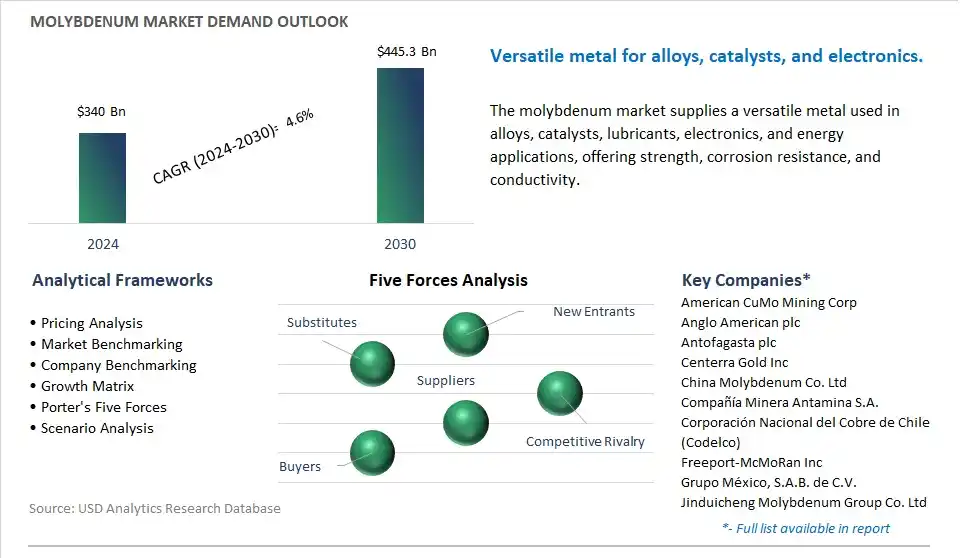
The global Molybdenum Market is poised to register a 4.6% CAGR from $340 Billion in 2024 to $445.3 Billion in 2030.
The global Molybdenum Market Study analyzes and forecasts the market size across 6 regions and 24 countries for diverse segments -By Product (Steel, Chemical, Foundry, MO-Metal, Nickel Alloy, Others), By End-User (Oil and Gas, Chemical and Petrochemical, Automotive, Industrial Usage, Building and Construction, Aerospace and Defense, Others).
An Introduction to Global Molybdenum Market in 2024
The future of molybdenum is shaped by its indispensable role in key industries such as metallurgy, chemicals, and electronics, as well as emerging applications in renewable energy and environmental technologies. Key trends include the development of molybdenum-based alloys and compounds with enhanced mechanical, thermal, and corrosion resistance properties, catering to the demanding requirements of aerospace, automotive, and oil & gas sectors. Additionally, there's a growing demand for molybdenum as a catalyst in various chemical processes such as petroleum refining, polymer production, and environmental remediation, driving innovation in catalyst design and synthesis. Moreover, with the increasing focus on energy efficiency and sustainability, molybdenum is gaining traction as a critical component in renewable energy technologies such as solar cells, wind turbines, and hydrogen fuel cells, as well as in energy storage systems like lithium-ion batteries. As global industrialization and urbanization continue to drive demand for advanced materials and technologies, molybdenum remains a vital enabler of innovation and progress across multiple sectors, shaping the future of industry and technology.
Molybdenum Market Competitive Landscape
The market report analyses the leading companies in the industry including American CuMo Mining Corp, Anglo American plc, Antofagasta plc, Centerra Gold Inc, China Molybdenum Co. Ltd, Compañía Minera Antamina S.A., Corporación Nacional del Cobre de Chile (Codelco), Freeport-McMoRan Inc, Grupo México, S.A.B. de C.V., Jinduicheng Molybdenum Group Co. Ltd, Moltun LLC, Rio Tinto Group.
Molybdenum Market Dynamics
Molybdenum Market Trend: Increasing Demand in Renewable Energy Technologies
One of the most prominent trends in the molybdenum market is the growing demand driven by its essential role in renewable energy technologies. Molybdenum is a crucial component in various renewable energy applications, including wind turbines, solar panels, and hydrogen production. As the world shifts towards sustainable energy sources to combat climate change, there is a rising need for molybdenum to support the expansion of these technologies. The trend is expected to continue as governments worldwide implement policies to encourage renewable energy adoption, creating a sustained demand for molybdenum in the market.
Molybdenum Market Driver: Industrial Growth and Infrastructure Development
A significant driver propelling the molybdenum market is the industrial growth and infrastructure development witnessed globally. Molybdenum is a key alloying element in steel production, enhancing its strength, corrosion resistance, and heat resistance. With ongoing urbanization, construction projects, and infrastructure investments in emerging economies, the demand for high-quality steel containing molybdenum is on the rise. Additionally, sectors such as automotive, aerospace, and oil and gas rely on molybdenum-based alloys for their manufacturing processes, further driving demand. The robust industrial activity worldwide continues to fuel the growth of the molybdenum market.
Molybdenum Market Opportunity: Expansion in High-Tech Applications
An exciting opportunity within the molybdenum market lies in its expansion into high-tech applications. Beyond traditional uses in steel production, molybdenum exhibits unique properties that make it indispensable in advanced technologies such as electronics, aerospace, and medical devices. Molybdenum's high melting point, thermal conductivity, and resistance to corrosion and wear make it an ideal material for electronic components, jet engines, and medical implants. As technological advancements accelerate and industries demand materials with superior performance characteristics, there is a growing opportunity for molybdenum to penetrate new high-tech sectors and diversify its market applications. Expanding into these emerging segments offers the potential for increased revenue streams and market growth for molybdenum producers.
Molybdenum Market Share Analysis: Steel generated the highest revenue in 2024
The largest segment in the Molybdenum Market is the Steel segment. The market growth is driven by molybdenum is primarily used as an alloying element in the production of various grades of steel, including stainless steel, tool steel, high-strength low-alloy (HSLA) steel, and alloy steel. Stainless steel, in particular, is a major consumer of molybdenum due to its corrosion resistance, high-temperature strength, and mechanical properties, making it suitable for a wide range of applications in construction, automotive, aerospace, energy, and manufacturing industries. Further, the steel demand continues to grow globally due to urbanization, infrastructure development, industrialization, and economic growth in emerging markets. Molybdenum enhances the performance and properties of steel by improving its strength, hardness, toughness, and weldability, enabling the production of high-quality and high-performance steel products for various end-use applications. In addition, advancements in steel manufacturing technologies and processes have led to the development of advanced high-strength steels (AHSS) and ultra-high-strength steels (UHSS) for lightweighting, fuel efficiency, and safety improvements in the automotive and transportation sectors. These advanced steel grades require higher levels of molybdenum content to meet stringent performance requirements and regulatory standards. Additionally, the steel industry is adopting sustainable and eco-friendly steelmaking practices, such as electric arc furnaces (EAFs) and recycling technologies, which further drive the demand for molybdenum as a critical alloying element in steel production. Over the forecast period, the combination of its indispensable role in steelmaking, growing demand for steel products, technological advancements, and sustainability initiatives positions the Steel segment as the largest in the Molybdenum Market.
Molybdenum Market Share Analysis: Aerospace and Defense segment is poised to register the fastest growth rate (CAGR) over the forecast period to 2030
The fastest-growing segment in the Molybdenum Market is the Aerospace and Defense end-user segment. The aerospace and defense industries require materials with exceptional mechanical properties, corrosion resistance, and high-temperature stability to withstand the extreme conditions encountered in aircraft, spacecraft, missiles, and defense systems. Molybdenum is a critical material in aerospace and defense applications due to its unique combination of properties, including high melting point, strength-to-weight ratio, thermal conductivity, and resistance to fatigue and creep. Further, advancements in aerospace technologies, such as next-generation aircraft designs, space exploration missions, and defense modernization programs, are driving the demand for innovative materials and manufacturing processes that offer enhanced performance, efficiency, and reliability. Molybdenum-based alloys and composites play a vital role in the development of lightweight structures, propulsion systems, landing gear components, armor plating, and electronics in aerospace and defense applications. In addition, geopolitical tensions, security threats, and geopolitical tensions drive investments in defense and security infrastructure worldwide, leading to increased spending on military aircraft, naval vessels, and defense systems. Molybdenum is essential in the production of critical components and systems used in military platforms, including engines, airframes, munitions, radar systems, and communication devices. Additionally, the aerospace and defense industries prioritize materials and technologies that comply with stringent regulatory standards, performance requirements, and quality assurance measures. Molybdenum suppliers and manufacturers focus on providing high-purity, high-performance molybdenum products that meet aerospace and defense specifications and certifications. Furthermore, the aerospace and defense sectors are increasingly adopting additive manufacturing (AM) and advanced machining techniques to produce complex, lightweight, and customized components using molybdenum-based materials. AM technologies enable rapid prototyping, design optimization, and cost-effective production of aerospace and defense parts, leading to greater adoption of molybdenum in additive manufacturing applications. Over the forecast period, the combination of increasing aerospace and defense activities, technological advancements, security imperatives, and regulatory compliance requirements positions the Aerospace and Defense end-user segment as the fastest-growing in the Molybdenum Market.
Molybdenum Market Report Segmentation
By Product
Steel
Chemical
Foundry
MO-Metal
Nickel Alloy
Others
By End-User
Oil and Gas
Chemical and Petrochemical
Automotive
Industrial Usage
Building and Construction
Aerospace and Defense
Others
Regions Included
North America (US, Canada, Mexico)
Europe (Germany, UK, France, Spain, Italy, Russia, Rest of Europe)
Asia Pacific (China, India, Japan, South Korea, Australia, South East Asia, Rest of Asia)
South America (Brazil, Argentina, Rest of South America)
Middle East and Africa (Saudi Arabia, UAE, Rest of Middle East, South Africa, Egypt, Rest of Africa)
Molybdenum Companies Profiled in the Market Study
American CuMo Mining Corp
Anglo American plc
Antofagasta plc
Centerra Gold Inc
China Molybdenum Co. Ltd
Compañía Minera Antamina S.A.
Corporación Nacional del Cobre de Chile (Codelco)
Freeport-McMoRan Inc
Grupo México, S.A.B. de C.V.
Jinduicheng Molybdenum Group Co. Ltd
Moltun LLC
Rio Tinto Group
*- List Not Exhaustive
TABLE OF CONTENTS
1 Introduction to 2024 Molybdenum Market
1.1 Market Overview
1.2 Quick Facts
1.3 Scope/Objective of the Study
1.4 Market Definition
1.5 Countries and Regions Covered
1.6 Units, Currency, and Conversions
1.7 Industry Value Chain
2 Research Methodology
2.1 Market Size Estimation
2.2 Sources and Research Methodology
2.3 Data Triangulation
2.4 Assumptions and Limitations
3 Executive Summary
3.1 Global Molybdenum Market Size Outlook, $ Million, 2021 to 2030
3.2 Molybdenum Market Outlook by Type, $ Million, 2021 to 2030
3.3 Molybdenum Market Outlook by Product, $ Million, 2021 to 2030
3.4 Molybdenum Market Outlook by Application, $ Million, 2021 to 2030
3.5 Molybdenum Market Outlook by Key Countries, $ Million, 2021 to 2030
4 Market Dynamics
4.1 Key Driving Forces of Molybdenum Industry
4.2 Key Market Trends in Molybdenum Industry
4.3 Potential Opportunities in Molybdenum Industry
4.4 Key Challenges in Molybdenum Industry
5 Market Factor Analysis
5.1 Value Chain Analysis
5.2 Competitive Landscape
5.2.1 Global Molybdenum Market Share by Company (%), 2023
5.2.2 Product Offerings by Company
5.3 Porter’s Five Forces Analysis
5.4 Pricing Analysis and Outlook
6 Growth Outlook Across Scenarios
6.1 Growth Analysis-Case Scenario Definitions
6.2 Low Growth Scenario Forecasts
6.3 Reference Growth Scenario Forecasts
6.4 High Growth Scenario Forecasts
7 Global Molybdenum Market Outlook by Segments
7.1 Molybdenum Market Outlook by Segments, $ Million, 2021- 2030
By Product
Steel
Chemical
Foundry
MO-Metal
Nickel Alloy
Others
By End-User
Oil and Gas
Chemical and Petrochemical
Automotive
Industrial Usage
Building and Construction
Aerospace and Defense
Others
8 North America Molybdenum Market Analysis and Outlook To 2030
8.1 Introduction to North America Molybdenum Markets in 2024
8.2 North America Molybdenum Market Size Outlook by Country, 2021-2030
8.2.1 United States
8.2.2 Canada
8.2.3 Mexico
8.3 North America Molybdenum Market size Outlook by Segments, 2021-2030
By Product
Steel
Chemical
Foundry
MO-Metal
Nickel Alloy
Others
By End-User
Oil and Gas
Chemical and Petrochemical
Automotive
Industrial Usage
Building and Construction
Aerospace and Defense
Others
9 Europe Molybdenum Market Analysis and Outlook To 2030
9.1 Introduction to Europe Molybdenum Markets in 2024
9.2 Europe Molybdenum Market Size Outlook by Country, 2021-2030
9.2.1 Germany
9.2.2 France
9.2.3 Spain
9.2.4 United Kingdom
9.2.4 Italy
9.2.5 Russia
9.2.6 Norway
9.2.7 Rest of Europe
9.3 Europe Molybdenum Market Size Outlook by Segments, 2021-2030
By Product
Steel
Chemical
Foundry
MO-Metal
Nickel Alloy
Others
By End-User
Oil and Gas
Chemical and Petrochemical
Automotive
Industrial Usage
Building and Construction
Aerospace and Defense
Others
10 Asia Pacific Molybdenum Market Analysis and Outlook To 2030
10.1 Introduction to Asia Pacific Molybdenum Markets in 2024
10.2 Asia Pacific Molybdenum Market Size Outlook by Country, 2021-2030
10.2.1 China
10.2.2 India
10.2.3 Japan
10.2.4 South Korea
10.2.5 Indonesia
10.2.6 Malaysia
10.2.7 Australia
10.2.8 Rest of Asia Pacific
10.3 Asia Pacific Molybdenum Market size Outlook by Segments, 2021-2030
By Product
Steel
Chemical
Foundry
MO-Metal
Nickel Alloy
Others
By End-User
Oil and Gas
Chemical and Petrochemical
Automotive
Industrial Usage
Building and Construction
Aerospace and Defense
Others
11 South America Molybdenum Market Analysis and Outlook To 2030
11.1 Introduction to South America Molybdenum Markets in 2024
11.2 South America Molybdenum Market Size Outlook by Country, 2021-2030
11.2.1 Brazil
11.2.2 Argentina
11.2.3 Rest of South America
11.3 South America Molybdenum Market size Outlook by Segments, 2021-2030
By Product
Steel
Chemical
Foundry
MO-Metal
Nickel Alloy
Others
By End-User
Oil and Gas
Chemical and Petrochemical
Automotive
Industrial Usage
Building and Construction
Aerospace and Defense
Others
12 Middle East and Africa Molybdenum Market Analysis and Outlook To 2030
12.1 Introduction to Middle East and Africa Molybdenum Markets in 2024
12.2 Middle East and Africa Molybdenum Market Size Outlook by Country, 2021-2030
12.2.1 Saudi Arabia
12.2.2 UAE
12.2.3 Oman
12.2.4 Rest of Middle East
12.2.5 Egypt
12.2.6 Nigeria
12.2.7 South Africa
12.2.8 Rest of Africa
12.3 Middle East and Africa Molybdenum Market size Outlook by Segments, 2021-2030
By Product
Steel
Chemical
Foundry
MO-Metal
Nickel Alloy
Others
By End-User
Oil and Gas
Chemical and Petrochemical
Automotive
Industrial Usage
Building and Construction
Aerospace and Defense
Others
13 Company Profiles
13.1 Company Snapshot
13.2 SWOT Profiles
13.3 Products and Services
13.4 Recent Developments
13.5 Financial Profile
American CuMo Mining Corp
Anglo American plc
Antofagasta plc
Centerra Gold Inc
China Molybdenum Co. Ltd
Compañía Minera Antamina S.A.
Corporación Nacional del Cobre de Chile (Codelco)
Freeport-McMoRan Inc
Grupo México, S.A.B. de C.V.
Jinduicheng Molybdenum Group Co. Ltd
Moltun LLC
Rio Tinto Group
14 Appendix
14.1 Customization Offerings
14.2 Subscription Services
14.3 Related Reports
14.4 Publisher Expertise
By Product
Steel
Chemical
Foundry
MO-Metal
Nickel Alloy
Others
By End-User
Oil and Gas
Chemical and Petrochemical
Automotive
Industrial Usage
Building and Construction
Aerospace and Defense
Others
Countries Analyzed
North America (US, Canada, Mexico)
Europe (Germany, UK, France, Spain, Italy, Russia, Rest of Europe)
Asia Pacific (China, India, Japan, South Korea, Australia, South East Asia, Rest of Asia)
South America (Brazil, Argentina, Rest of South America)
Middle East and Africa (Saudi Arabia, UAE, Rest of Middle East, South Africa, Egypt, Rest of Africa)
