
The global Motion Sickness Drugs Market Study analyzes and forecasts the market size across 6 regions and 24 countries for diverse segments including By Product (Antihistamines, Anticholinergics), By Distribution Channel (Offline, Online).
The motion sickness drugs market in 2024 is experiencing steady growth driven by the increasing prevalence of motion-related disorders and the growing demand for effective pharmacological interventions. Motion sickness, characterized by nausea, vomiting, and dizziness, can significantly impair the quality of life for individuals traveling by land, sea, or air. With advancements in drug development and formulation technology, motion sickness drugs offer relief from symptoms by modulating neurotransmitter pathways involved in motion perception and balance control. Market players are focusing on expanding product portfolios, improving drug delivery systems, and conducting clinical trials to address the unmet needs of patients and healthcare providers in managing motion-related disorders effectively.
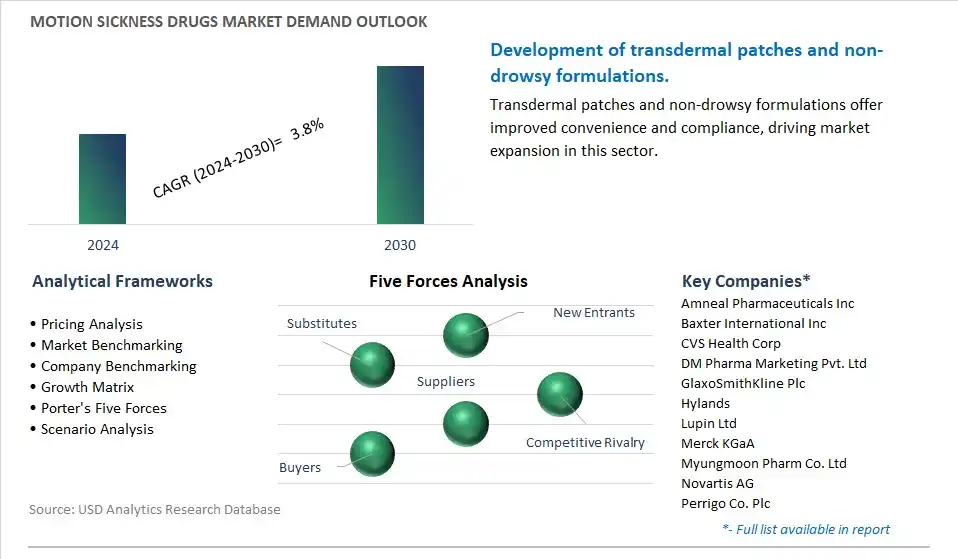
The global Motion Sickness Drugs Industry is highly competitive with a large number of companies focusing on niche market segments. Amidst intense competitive conditions, Motion Sickness Drugs Companies are investing in new product launches and strengthening distribution channels. Key companies operating in the Motion Sickness Drugs Industry include- Amneal Pharmaceuticals Inc, Baxter International Inc, CVS Health Corp, DM Pharma Marketing Pvt. Ltd, GlaxoSmithKline Plc, Hylands, Lupin Ltd, Merck KGaA, Myungmoon Pharm Co. Ltd, Novartis AG, Perrigo Co. Plc, Prestige Consumer Healthcare Inc, Sun Pharmaceutical Industries Ltd, Teva Pharmaceutical Industries Ltd, Tivic Health Systems Inc, Viatris Inc, WellSpring Pharmaceutical Corp, Zenomed Healthcare Pvt. Ltd, Zydus Lifesciences Ltd.
A prominent trend in the motion sickness drugs market is the increasing demand for natural and non-drug therapies to manage motion sickness symptoms. Traditional pharmacological treatments for motion sickness, such as antihistamines and anticholinergics, may cause drowsiness and other undesirable side effects, limiting their use in certain populations. As a result, there is a growing interest in alternative approaches, including herbal remedies, acupressure bands, and dietary supplements, which offer potential relief from motion sickness without the adverse effects associated with conventional medications. Natural remedies like ginger and peppermint have demonstrated anti-nausea properties and are increasingly utilized as complementary or alternative treatments for motion sickness. Additionally, wearable devices such as acupressure wristbands stimulate specific acupuncture points to alleviate symptoms of nausea and vomiting during travel. The shift towards natural and non-drug therapies reflects consumer preferences for gentler, holistic approaches to managing motion sickness, driving innovation and diversification in the market.
The primary driver of the motion sickness drugs market is the growing global travel and tourism industry, which increases the prevalence of motion sickness and drives demand for effective prophylactic and symptomatic treatments. With the expansion of air travel, cruise vacations, and adventure tourism, more individuals are exposed to motion-induced stimuli such as turbulence, ocean waves, and winding roads, leading to an increased incidence of motion sickness. As travelers seek to explore new destinations and engage in diverse recreational activities, the need for reliable motion sickness remedies becomes paramount to ensure a comfortable and enjoyable travel experience. Moreover, the rise of emerging markets in Asia-Pacific, Latin America, and the Middle East has led to a surge in outbound travel from these regions, further fueling demand for motion sickness drugs globally. The travel and tourism industry's robust growth, coupled with increasing awareness and accessibility of motion sickness treatments, serves as a key driver for market expansion and innovation in the development of novel therapies.
An opportunity for market growth lies in the development of targeted and personalized therapies for motion sickness based on individual susceptibility and underlying mechanisms. While existing treatments offer symptomatic relief for most individuals, there is variability in treatment response and tolerance among patients, highlighting the need for personalized approaches to managing motion sickness. Advances in pharmacogenomics, neuroimaging, and physiological monitoring enable a better understanding of the genetic, neurochemical, and vestibular factors contributing to motion sickness susceptibility. By leveraging precision medicine principles, pharmaceutical companies can develop tailored therapies that target specific pathways involved in motion sickness pathogenesis, optimizing efficacy and minimizing side effects. Furthermore, wearable biosensors and digital health platforms offer opportunities for real-time monitoring of motion sickness symptoms and personalized intervention strategies. Collaborations between academia, industry, and regulatory agencies can facilitate the translation of scientific discoveries into innovative therapeutics that address the diverse needs of individuals prone to motion sickness. By embracing personalized medicine approaches, stakeholders can capitalize on emerging opportunities to advance the treatment landscape and improve outcomes for patients affected by motion sickness.
Antihistamines emerge as the fastest-growing segment within the motion sickness drugs market. This growth is driven by the widespread availability and effectiveness of antihistamine medications in alleviating symptoms associated with motion sickness, such as nausea, vomiting, and dizziness. Antihistamines work by blocking histamine receptors in the brain, thereby reducing the brain's response to motion stimuli and mitigating the sensations of motion sickness. These drugs are available in various forms, including tablets, capsules, and oral liquids, making them convenient for individuals traveling by different modes of transportation, such as cars, airplanes, boats, and trains. Moreover, the non-prescription status of many antihistamine medications enables easy access to these drugs for consumers seeking relief from motion sickness symptoms without the need for a doctor's prescription. Additionally, the growing trend of online purchasing for healthcare products and medications has contributed to the rapid growth of antihistamine sales through online distribution channels. As more individuals recognize the efficacy and convenience of antihistamines in managing motion sickness, coupled with the increasing availability of these drugs through online platforms, the demand for antihistamine-based motion sickness treatments is expected to continue rising. This growth underscores the significant role of antihistamines in providing effective relief for individuals prone to motion sickness, enhancing their travel experiences and overall well-being.
By Product
Antihistamines
Anticholinergics
By Distribution Channel
Offline
Online
Geographical Analysis
North America (United States, Canada, Mexico)
Europe (Germany, France, United Kingdom, Spain, Italy, Rest of Europe)
Asia Pacific (China, India, Japan, South Korea, Rest of Asia Pacific)
South America (Brazil, Argentina, Rest of South America)
Middle East and Africa (Saudi Arabia, UAE, Rest of Middle East, South Africa, Egypt, Rest of Africa)
Amneal Pharmaceuticals Inc
Baxter International Inc
CVS Health Corp
DM Pharma Marketing Pvt. Ltd
GlaxoSmithKline Plc
Hylands
Lupin Ltd
Merck KGaA
Myungmoon Pharm Co. Ltd
Novartis AG
Perrigo Co. Plc
Prestige Consumer Healthcare Inc
Sun Pharmaceutical Industries Ltd
Teva Pharmaceutical Industries Ltd
Tivic Health Systems Inc
Viatris Inc
WellSpring Pharmaceutical Corp
Zenomed Healthcare Pvt. Ltd
Zydus Lifesciences Ltd
* List not Exhaustive
• Deepen your industry insights and navigate uncertainties for strategy formulation, CAPEX, and Operational decisions
• Gain access to detailed insights on the Motion Sickness Drugs Market, encompassing current market size, growth trends, and forecasts till 2030.
• Access detailed competitor analysis, enabling competitive advantage through a thorough understanding of market players, strategies, and potential differentiation opportunities
• Stay ahead of the curve with insights on technological advancements, innovations, and upcoming trends
• Identify lucrative investment avenues and expansion opportunities within the Motion Sickness Drugs Industry, guided by robust, data-backed analysis.
• Understand regional and global markets through country-wise analysis, regional market potential, regulatory nuances, and dynamics
• Execute strategies with confidence and speed through information, analytics, and insights on the industry value chain
• Corporate leaders, strategists, financial experts, shareholders, asset managers, and governmental representatives can make long-term planning scenarios and build an integrated and timely understanding of market dynamics
• Benefit from tailored solutions and expert consultation based on report insights, providing personalized strategies aligned with specific business needs.
TABLE OF CONTENTS
1 Introduction to 2024 Motion Sickness Drugs Market
1.1 Market Overview
1.2 Quick Facts
1.3 Scope/Objective of the Study
1.4 Market Definition
1.5 Countries and Regions Analyzed
1.6 Units, Currency, and Conversions
1.7 Industry Value Chain
2 Research Methodology
2.1 Market Size Estimation
2.2 Sources and Research Methodology
2.3 Data Triangulation
2.4 Assumptions and Limitations
3 Executive Summary
3.1 Global Motion Sickness Drugs Market Size Outlook, $ Million, 2021 to 2030
3.2 Motion Sickness Drugs Market Outlook by Type, $ Million, 2021 to 2030
3.3 Motion Sickness Drugs Market Outlook by Product, $ Million, 2021 to 2030
3.4 Motion Sickness Drugs Market Outlook by Application, $ Million, 2021 to 2030
3.5 Motion Sickness Drugs Market Outlook by Key Countries, $ Million, 2021 to 2030
4 Market Dynamics
4.1 Key Driving Forces of Motion Sickness Drugs Industry
4.2 Key Market Trends in Motion Sickness Drugs Industry
4.3 Potential Opportunities in Motion Sickness Drugs Industry
4.4 Key Challenges in Motion Sickness Drugs Industry
5 Market Factor Analysis
5.1 Value Chain Analysis
5.2 Competitive Landscape
5.2.1 Global Motion Sickness Drugs Market Share by Company (%), 2023
5.2.2 Product Offerings by Company
5.3 Porter’s Five Forces Analysis
5.4 Pricing Analysis and Outlook
6 Growth Outlook Across Scenarios
6.1 Growth Analysis-Case Scenario Definitions
6.2 Low Growth Scenario Forecasts
6.3 Reference Growth Scenario Forecasts
6.4 High Growth Scenario Forecasts
7 Global Motion Sickness Drugs Market Outlook by Segments
7.1 Motion Sickness Drugs Market Outlook by Segments, $ Million, 2021- 2030
By Product
Antihistamines
Anticholinergics
By Distribution Channel
Offline
Online
8 North America Motion Sickness Drugs Market Analysis and Outlook To 2030
8.1 Introduction to North America Motion Sickness Drugs Markets in 2024
8.2 North America Motion Sickness Drugs Market Size Outlook by Country, 2021-2030
8.2.1 United States
8.2.2 Canada
8.2.3 Mexico
8.3 North America Motion Sickness Drugs Market size Outlook by Segments, 2021-2030
By Product
Antihistamines
Anticholinergics
By Distribution Channel
Offline
Online
9 Europe Motion Sickness Drugs Market Analysis and Outlook To 2030
9.1 Introduction to Europe Motion Sickness Drugs Markets in 2024
9.2 Europe Motion Sickness Drugs Market Size Outlook by Country, 2021-2030
9.2.1 Germany
9.2.2 France
9.2.3 Spain
9.2.4 United Kingdom
9.2.4 Italy
9.2.5 Russia
9.2.6 Norway
9.2.7 Rest of Europe
9.3 Europe Motion Sickness Drugs Market Size Outlook by Segments, 2021-2030
By Product
Antihistamines
Anticholinergics
By Distribution Channel
Offline
Online
10 Asia Pacific Motion Sickness Drugs Market Analysis and Outlook To 2030
10.1 Introduction to Asia Pacific Motion Sickness Drugs Markets in 2024
10.2 Asia Pacific Motion Sickness Drugs Market Size Outlook by Country, 2021-2030
10.2.1 China
10.2.2 India
10.2.3 Japan
10.2.4 South Korea
10.2.5 Indonesia
10.2.6 Malaysia
10.2.7 Australia
10.2.8 Rest of Asia Pacific
10.3 Asia Pacific Motion Sickness Drugs Market size Outlook by Segments, 2021-2030
By Product
Antihistamines
Anticholinergics
By Distribution Channel
Offline
Online
11 South America Motion Sickness Drugs Market Analysis and Outlook To 2030
11.1 Introduction to South America Motion Sickness Drugs Markets in 2024
11.2 South America Motion Sickness Drugs Market Size Outlook by Country, 2021-2030
11.2.1 Brazil
11.2.2 Argentina
11.2.3 Rest of South America
11.3 South America Motion Sickness Drugs Market size Outlook by Segments, 2021-2030
By Product
Antihistamines
Anticholinergics
By Distribution Channel
Offline
Online
12 Middle East and Africa Motion Sickness Drugs Market Analysis and Outlook To 2030
12.1 Introduction to Middle East and Africa Motion Sickness Drugs Markets in 2024
12.2 Middle East and Africa Motion Sickness Drugs Market Size Outlook by Country, 2021-2030
12.2.1 Saudi Arabia
12.2.2 UAE
12.2.3 Oman
12.2.4 Rest of Middle East
12.2.5 Egypt
12.2.6 Nigeria
12.2.7 South Africa
12.2.8 Rest of Africa
12.3 Middle East and Africa Motion Sickness Drugs Market size Outlook by Segments, 2021-2030
By Product
Antihistamines
Anticholinergics
By Distribution Channel
Offline
Online
13 Company Profiles
13.1 Company Snapshot
13.2 SWOT Profiles
13.3 Products and Services
13.4 Recent Developments
13.5 Financial Profile
List of Companies
Amneal Pharmaceuticals Inc
Baxter International Inc
CVS Health Corp
DM Pharma Marketing Pvt. Ltd
GlaxoSmithKline Plc
Hylands
Lupin Ltd
Merck KGaA
Myungmoon Pharm Co. Ltd
Novartis AG
Perrigo Co. Plc
Prestige Consumer Healthcare Inc
Sun Pharmaceutical Industries Ltd
Teva Pharmaceutical Industries Ltd
Tivic Health Systems Inc
Viatris Inc
WellSpring Pharmaceutical Corp
Zenomed Healthcare Pvt. Ltd
Zydus Lifesciences Ltd
14 Appendix
14.1 Customization Offerings
14.2 Subscription Services
14.3 Related Reports
14.4 Publisher Expertise
By Product
Antihistamines
Anticholinergics
By Distribution Channel
Offline
Online
The global Motion Sickness Drugs Market is one of the lucrative growth markets, poised to register a 3.8% growth (CAGR) between 2024 and 2030.
Emerging Markets across Asia Pacific, Europe, and Americas present robust growth prospects.
Amneal Pharmaceuticals Inc, Baxter International Inc, CVS Health Corp, DM Pharma Marketing Pvt. Ltd, GlaxoSmithKline Plc, Hylands, Lupin Ltd, Merck KGaA, Myungmoon Pharm Co. Ltd, Novartis AG, Perrigo Co. Plc, Prestige Consumer Healthcare Inc, Sun Pharmaceutical Industries Ltd, Teva Pharmaceutical Industries Ltd, Tivic Health Systems Inc, Viatris Inc, WellSpring Pharmaceutical Corp, Zenomed Healthcare Pvt. Ltd, Zydus Lifesciences Ltd
Base Year- 2023; Estimated Year- 2024; Historic Period- 2018-2023; Forecast period- 2024 to 2030; Currency: USD; Volume