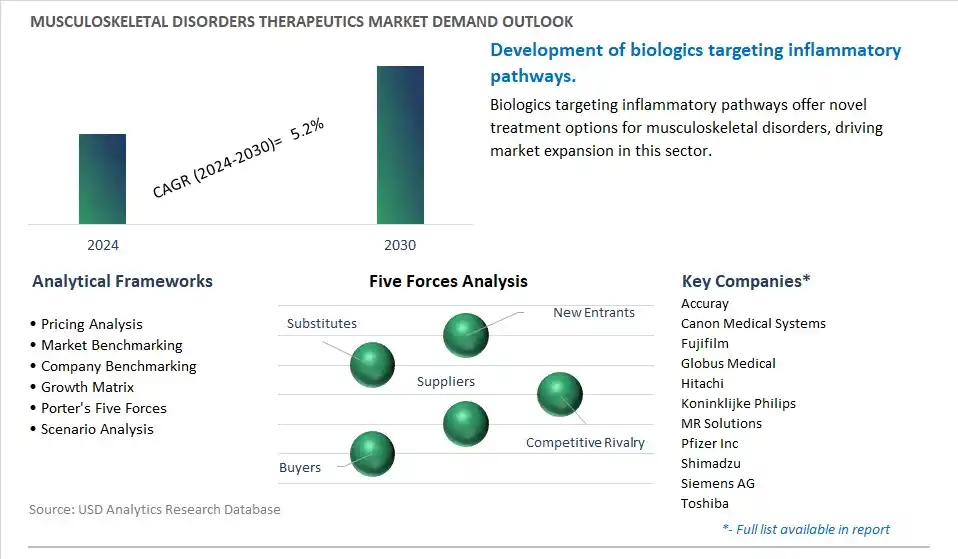
Musculoskeletal Disorders Therapeutics Market is estimated to increase at a growth rate of 5.2% CAGR over the forecast period from 2024 to 2030.
The global Musculoskeletal Disorders Therapeutics Market Study analyzes and forecasts the market size across 6 regions and 24 countries for diverse segments including By Disease (Arthritis, Osteoporosis, Spondylitis, Traumatic fractures, Sarcopenia, Fibromyalgia, Others), By Imaging Modality, (Magnetic Resonance Imaging (MRI), Computed Tomography (CT), Ultrasound, Others), By Medication, Acetaminophen, Nonsteroidal anti-inflammatory drugs (NSAIDs), Anti-neuropathic pain medications, Others), By Distribution Channel (Hospital Pharmacy, Retail Pharmacy, Online Pharmacy).
An Introduction to Musculoskeletal Disorders Therapeutics Market in 2024
The musculoskeletal disorders therapeutics market in 2024 is experiencing significant growth driven by the increasing prevalence of musculoskeletal conditions such as osteoarthritis, rheumatoid arthritis, osteoporosis, and musculoskeletal injuries. Musculoskeletal disorders pose substantial burdens on individuals, healthcare systems, and economies worldwide, necessitating effective therapeutic interventions to alleviate pain, improve function, and prevent disability. With the development of disease-modifying drugs, biologics, regenerative therapies, and innovative surgical techniques, the landscape of musculoskeletal disorder treatment is evolving rapidly. Market players are focusing on research and development, clinical trials, and strategic collaborations to bring novel therapeutics to market and address the unmet needs of patients with musculoskeletal disorders, driving further growth in the market.
Musculoskeletal Disorders Therapeutics Market Competitive Landscape
The global Musculoskeletal Disorders Therapeutics Industry is highly competitive with a large number of companies focusing on niche market segments. Amidst intense competitive conditions, Musculoskeletal Disorders Therapeutics Companies are investing in new product launches and strengthening distribution channels. Key companies operating in the Musculoskeletal Disorders Therapeutics Industry include- Accuray, Canon Medical Systems, Fujifilm, Globus Medical, Hitachi, Koninklijke Philips, MR Solutions, Pfizer Inc, Shimadzu, Siemens AG, Toshiba.
Musculoskeletal Disorders Therapeutics Market Trend: Shift Towards Non-Surgical Treatment Modalities
A prominent trend in the musculoskeletal disorders therapeutics market is the shift towards non-surgical treatment modalities for managing various musculoskeletal conditions. Traditionally, surgical interventions such as joint replacement surgeries, spinal fusion, and arthroscopic procedures have been commonly used to address musculoskeletal disorders, including osteoarthritis, rheumatoid arthritis, osteoporosis, and lower back pain. However, there has been a growing recognition of the limitations and risks associated with surgical interventions, including complications, prolonged recovery times, and the potential for reduced long-term efficacy. In response to these challenges, there has been increasing interest in non-surgical treatment options, such as pharmacological therapies, physical therapy, regenerative medicine techniques, and minimally invasive procedures. These non-surgical approaches offer several advantages, including reduced invasiveness, faster recovery times, lower healthcare costs, and potential preservation of natural joint function. Moreover, advancements in biologics, including growth factors, cytokines, stem cells, and platelet-rich plasma, have opened up new avenues for regenerative therapies that promote tissue repair and regeneration in musculoskeletal disorders. Additionally, the integration of digital health technologies, telemedicine, and remote monitoring solutions has facilitated the delivery of personalized and accessible care for patients with musculoskeletal conditions, further driving the adoption of non-surgical treatment modalities in the management of musculoskeletal disorders.
Musculoskeletal Disorders Therapeutics Market Driver: Growing Aging Population and Prevalence of Musculoskeletal Disorders
The primary driver of the musculoskeletal disorders therapeutics market is the growing aging population and the associated rise in the prevalence of musculoskeletal disorders globally. Musculoskeletal disorders, including osteoarthritis, osteoporosis, rheumatoid arthritis, and musculoskeletal injuries, represent a significant burden on healthcare systems worldwide, contributing to pain, disability, and impaired quality of life for millions of individuals. With demographic shifts such as population aging, urbanization, and sedentary lifestyles, the prevalence of musculoskeletal disorders is expected to increase substantially in the coming years. Aging is a major risk factor for musculoskeletal conditions, as age-related changes in bone density, joint structure, muscle mass, and connective tissue integrity predispose individuals to degenerative and inflammatory processes that underlie many musculoskeletal disorders. Furthermore, lifestyle factors such as obesity, physical inactivity, poor nutrition, and occupational hazards contribute to the development and progression of musculoskeletal disorders, exacerbating the burden on healthcare systems and driving demand for effective therapeutics. As the aging population continues to grow, fueled by demographic transitions and improvements in healthcare access and longevity, there is a critical need for innovative and accessible treatment options that can address the multifactorial nature of musculoskeletal disorders, mitigate disease progression, and improve functional outcomes for patients.
Musculoskeletal Disorders Therapeutics Market Opportunity: Integrated Care Models and Multidisciplinary Approaches
An opportunity for market growth lies in the adoption of integrated care models and multidisciplinary approaches for managing musculoskeletal disorders. Integrated care models aim to coordinate care delivery across different healthcare settings and specialties, including primary care, orthopedics, rheumatology, physiatry, physical therapy, pain management, and complementary medicine, to provide comprehensive and patient-centered care for individuals with musculoskeletal conditions. By leveraging a multidisciplinary team-based approach, integrated care models can address the diverse needs of patients with musculoskeletal disorders, including pain management, functional rehabilitation, psychosocial support, and lifestyle modification. Moreover, integrated care models facilitate seamless transitions between acute care, rehabilitation, and community-based services, promoting continuity of care, treatment adherence, and long-term health outcomes for patients. Furthermore, advancements in digital health technologies, data analytics, and artificial intelligence offer opportunities for remote monitoring, predictive analytics, and personalized care planning, enabling proactive disease management and early intervention in musculoskeletal disorders. Collaborative partnerships between healthcare providers, payers, policymakers, and patient advocacy groups are essential to implement integrated care models and advance multidisciplinary approaches in musculoskeletal care, offering opportunities for market expansion and improved patient outcomes in the management of musculoskeletal disorders.
Musculoskeletal Disorders Therapeutics Market Share Analysis: Osteoporosis is the fastest growing market segment over the forecast period to 2030
Among the various musculoskeletal disorders, the segment experiencing the fastest growth in therapeutics is osteoporosis. This growth is attributed to several factors, including the aging population, increasing awareness about bone health, and advancements in treatment options. Osteoporosis, characterized by low bone density and increased risk of fractures, poses a significant public health concern globally. As the aging population grows, the prevalence of osteoporosis rises, driving the demand for effective therapeutics. The emergence of novel medications, such as bisphosphonates, selective estrogen receptor modulators (SERMs), and monoclonal antibodies targeting bone metabolism pathways, has revolutionized the management of osteoporosis by offering treatments that can reduce fracture risk and improve bone density. Additionally, the integration of advanced imaging modalities like Magnetic Resonance Imaging (MRI) and Computed Tomography (CT) scans enables accurate diagnosis and monitoring of osteoporosis progression, facilitating personalized treatment approaches. These advancements, coupled with the availability of osteoporosis medications through various distribution channels including hospital pharmacies, retail pharmacies, and online pharmacies, contribute to the rapid growth of osteoporosis therapeutics. As the burden of osteoporosis continues to increase, the demand for innovative treatments and comprehensive management strategies for osteoporosis is expected to drive further growth in this segment, addressing the critical healthcare needs of individuals with musculoskeletal disorders.
Musculoskeletal Disorders Therapeutics Market Segmentation
By Disease
Arthritis
Osteoporosis
Spondylitis
Traumatic fractures
Sarcopenia
Fibromyalgia
Others
By Imaging Modality
Magnetic Resonance Imaging (MRI)
Computed Tomography (CT)
Ultrasound
Others
By Medication
Acetaminophen
Nonsteroidal anti-inflammatory drugs (NSAIDs)
Anti-neuropathic pain medications
Others
By Distribution Channel
Hospital Pharmacy
Retail Pharmacy
Online Pharmacy
Geographical Analysis
North America (United States, Canada, Mexico)
Europe (Germany, France, United Kingdom, Spain, Italy, Rest of Europe)
Asia Pacific (China, India, Japan, South Korea, Rest of Asia Pacific)
South America (Brazil, Argentina, Rest of South America)
Middle East and Africa (Saudi Arabia, UAE, Rest of Middle East, South Africa, Egypt, Rest of Africa)
Musculoskeletal Disorders Therapeutics Companies
Accuray
Canon Medical Systems
Fujifilm
Globus Medical
Hitachi
Koninklijke Philips
MR Solutions
Pfizer Inc
Shimadzu
Siemens AG
Toshiba
* List not Exhaustive
Reasons to Buy the Musculoskeletal Disorders Therapeutics Market Market Study
• Deepen your industry insights and navigate uncertainties for strategy formulation, CAPEX, and Operational decisions
• Gain access to detailed insights on the Musculoskeletal Disorders Therapeutics Market Market, encompassing current market size, growth trends, and forecasts till 2030.
• Access detailed competitor analysis, enabling competitive advantage through a thorough understanding of market players, strategies, and potential differentiation opportunities
• Stay ahead of the curve with insights on technological advancements, innovations, and upcoming trends
• Identify lucrative investment avenues and expansion opportunities within the Musculoskeletal Disorders Therapeutics Market Industry, guided by robust, data-backed analysis.
• Understand regional and global markets through country-wise analysis, regional market potential, regulatory nuances, and dynamics
• Execute strategies with confidence and speed through information, analytics, and insights on the industry value chain
• Corporate leaders, strategists, financial experts, shareholders, asset managers, and governmental representatives can make long-term planning scenarios and build an integrated and timely understanding of market dynamics
• Benefit from tailored solutions and expert consultation based on report insights, providing personalized strategies aligned with specific business needs.
TABLE OF CONTENTS
1 Introduction to 2024 Musculoskeletal Disorders Therapeutics Market
1.1 Market Overview
1.2 Quick Facts
1.3 Scope/Objective of the Study
1.4 Market Definition
1.5 Countries and Regions Analyzed
1.6 Units, Currency, and Conversions
1.7 Industry Value Chain
2 Research Methodology
2.1 Market Size Estimation
2.2 Sources and Research Methodology
2.3 Data Triangulation
2.4 Assumptions and Limitations
3 Executive Summary
3.1 Global Musculoskeletal Disorders Therapeutics Market Size Outlook, $ Million, 2021 to 2030
3.2 Musculoskeletal Disorders Therapeutics Market Outlook by Type, $ Million, 2021 to 2030
3.3 Musculoskeletal Disorders Therapeutics Market Outlook by Product, $ Million, 2021 to 2030
3.4 Musculoskeletal Disorders Therapeutics Market Outlook by Application, $ Million, 2021 to 2030
3.5 Musculoskeletal Disorders Therapeutics Market Outlook by Key Countries, $ Million, 2021 to 2030
4 Market Dynamics
4.1 Key Driving Forces of Musculoskeletal Disorders Therapeutics Industry
4.2 Key Market Trends in Musculoskeletal Disorders Therapeutics Industry
4.3 Potential Opportunities in Musculoskeletal Disorders Therapeutics Industry
4.4 Key Challenges in Musculoskeletal Disorders Therapeutics Industry
5 Market Factor Analysis
5.1 Value Chain Analysis
5.2 Competitive Landscape
5.2.1 Global Musculoskeletal Disorders Therapeutics Market Share by Company (%), 2023
5.2.2 Product Offerings by Company
5.3 Porter’s Five Forces Analysis
5.4 Pricing Analysis and Outlook
6 Growth Outlook Across Scenarios
6.1 Growth Analysis-Case Scenario Definitions
6.2 Low Growth Scenario Forecasts
6.3 Reference Growth Scenario Forecasts
6.4 High Growth Scenario Forecasts
7 Global Musculoskeletal Disorders Therapeutics Market Outlook by Segments
7.1 Musculoskeletal Disorders Therapeutics Market Outlook by Segments, $ Million, 2021- 2030
By Disease
Arthritis
Osteoporosis
Spondylitis
Traumatic fractures
Sarcopenia
Fibromyalgia
Others
By Imaging Modality
Magnetic Resonance Imaging (MRI)
Computed Tomography (CT)
Ultrasound
Others
By Medication
Acetaminophen
Nonsteroidal anti-inflammatory drugs (NSAIDs)
Anti-neuropathic pain medications
Others
By Distribution Channel
Hospital Pharmacy
Retail Pharmacy
Online Pharmacy
8 North America Musculoskeletal Disorders Therapeutics Market Analysis and Outlook To 2030
8.1 Introduction to North America Musculoskeletal Disorders Therapeutics Markets in 2024
8.2 North America Musculoskeletal Disorders Therapeutics Market Size Outlook by Country, 2021-2030
8.2.1 United States
8.2.2 Canada
8.2.3 Mexico
8.3 North America Musculoskeletal Disorders Therapeutics Market size Outlook by Segments, 2021-2030
By Disease
Arthritis
Osteoporosis
Spondylitis
Traumatic fractures
Sarcopenia
Fibromyalgia
Others
By Imaging Modality
Magnetic Resonance Imaging (MRI)
Computed Tomography (CT)
Ultrasound
Others
By Medication
Acetaminophen
Nonsteroidal anti-inflammatory drugs (NSAIDs)
Anti-neuropathic pain medications
Others
By Distribution Channel
Hospital Pharmacy
Retail Pharmacy
Online Pharmacy
9 Europe Musculoskeletal Disorders Therapeutics Market Analysis and Outlook To 2030
9.1 Introduction to Europe Musculoskeletal Disorders Therapeutics Markets in 2024
9.2 Europe Musculoskeletal Disorders Therapeutics Market Size Outlook by Country, 2021-2030
9.2.1 Germany
9.2.2 France
9.2.3 Spain
9.2.4 United Kingdom
9.2.4 Italy
9.2.5 Russia
9.2.6 Norway
9.2.7 Rest of Europe
9.3 Europe Musculoskeletal Disorders Therapeutics Market Size Outlook by Segments, 2021-2030
By Disease
Arthritis
Osteoporosis
Spondylitis
Traumatic fractures
Sarcopenia
Fibromyalgia
Others
By Imaging Modality
Magnetic Resonance Imaging (MRI)
Computed Tomography (CT)
Ultrasound
Others
By Medication
Acetaminophen
Nonsteroidal anti-inflammatory drugs (NSAIDs)
Anti-neuropathic pain medications
Others
By Distribution Channel
Hospital Pharmacy
Retail Pharmacy
Online Pharmacy
10 Asia Pacific Musculoskeletal Disorders Therapeutics Market Analysis and Outlook To 2030
10.1 Introduction to Asia Pacific Musculoskeletal Disorders Therapeutics Markets in 2024
10.2 Asia Pacific Musculoskeletal Disorders Therapeutics Market Size Outlook by Country, 2021-2030
10.2.1 China
10.2.2 India
10.2.3 Japan
10.2.4 South Korea
10.2.5 Indonesia
10.2.6 Malaysia
10.2.7 Australia
10.2.8 Rest of Asia Pacific
10.3 Asia Pacific Musculoskeletal Disorders Therapeutics Market size Outlook by Segments, 2021-2030
By Disease
Arthritis
Osteoporosis
Spondylitis
Traumatic fractures
Sarcopenia
Fibromyalgia
Others
By Imaging Modality
Magnetic Resonance Imaging (MRI)
Computed Tomography (CT)
Ultrasound
Others
By Medication
Acetaminophen
Nonsteroidal anti-inflammatory drugs (NSAIDs)
Anti-neuropathic pain medications
Others
By Distribution Channel
Hospital Pharmacy
Retail Pharmacy
Online Pharmacy
11 South America Musculoskeletal Disorders Therapeutics Market Analysis and Outlook To 2030
11.1 Introduction to South America Musculoskeletal Disorders Therapeutics Markets in 2024
11.2 South America Musculoskeletal Disorders Therapeutics Market Size Outlook by Country, 2021-2030
11.2.1 Brazil
11.2.2 Argentina
11.2.3 Rest of South America
11.3 South America Musculoskeletal Disorders Therapeutics Market size Outlook by Segments, 2021-2030
By Disease
Arthritis
Osteoporosis
Spondylitis
Traumatic fractures
Sarcopenia
Fibromyalgia
Others
By Imaging Modality
Magnetic Resonance Imaging (MRI)
Computed Tomography (CT)
Ultrasound
Others
By Medication
Acetaminophen
Nonsteroidal anti-inflammatory drugs (NSAIDs)
Anti-neuropathic pain medications
Others
By Distribution Channel
Hospital Pharmacy
Retail Pharmacy
Online Pharmacy
12 Middle East and Africa Musculoskeletal Disorders Therapeutics Market Analysis and Outlook To 2030
12.1 Introduction to Middle East and Africa Musculoskeletal Disorders Therapeutics Markets in 2024
12.2 Middle East and Africa Musculoskeletal Disorders Therapeutics Market Size Outlook by Country, 2021-2030
12.2.1 Saudi Arabia
12.2.2 UAE
12.2.3 Oman
12.2.4 Rest of Middle East
12.2.5 Egypt
12.2.6 Nigeria
12.2.7 South Africa
12.2.8 Rest of Africa
12.3 Middle East and Africa Musculoskeletal Disorders Therapeutics Market size Outlook by Segments, 2021-2030
By Disease
Arthritis
Osteoporosis
Spondylitis
Traumatic fractures
Sarcopenia
Fibromyalgia
Others
By Imaging Modality
Magnetic Resonance Imaging (MRI)
Computed Tomography (CT)
Ultrasound
Others
By Medication
Acetaminophen
Nonsteroidal anti-inflammatory drugs (NSAIDs)
Anti-neuropathic pain medications
Others
By Distribution Channel
Hospital Pharmacy
Retail Pharmacy
Online Pharmacy
13 Company Profiles
13.1 Company Snapshot
13.2 SWOT Profiles
13.3 Products and Services
13.4 Recent Developments
13.5 Financial Profile
List of Companies
Accuray
Canon Medical Systems
Fujifilm
Globus Medical
Hitachi
Koninklijke Philips
MR Solutions
Pfizer Inc
Shimadzu
Siemens AG
Toshiba
14 Appendix
14.1 Customization Offerings
14.2 Subscription Services
14.3 Related Reports
14.4 Publisher Expertise
