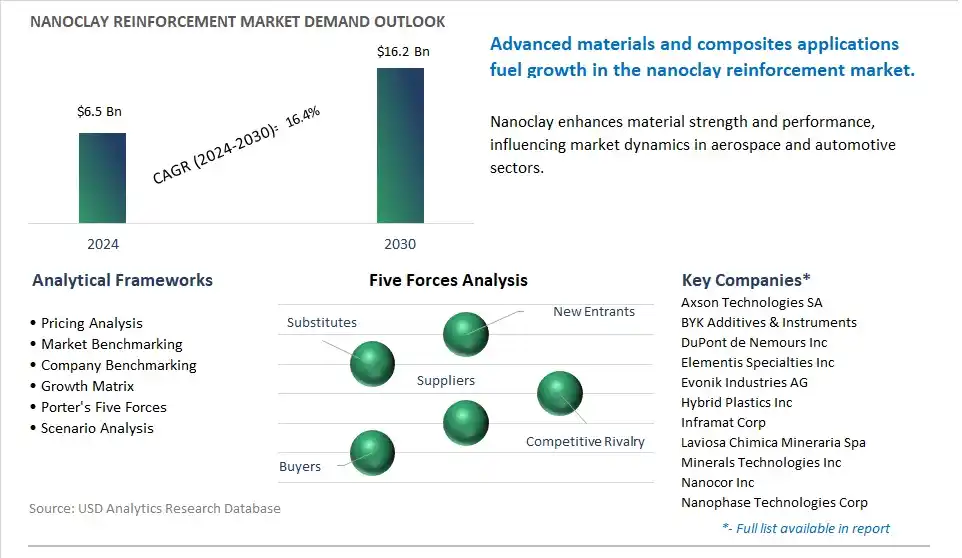
The global Nanoclay Reinforcement Market is poised to register a 16.4% CAGR from $6.5 Billion in 2024 to $16.2 Billion in 2030.
The global Nanoclay Reinforcement Market Study analyzes and forecasts the market size across 6 regions and 24 countries for diverse segments -By Application (Packaging, Automotive parts, Coatings, Others), By End-User (Construction, Marine, Electronics, Military, Automotive, Others).
An Introduction to Global Nanoclay Reinforcement Market in 2024
The market for nanoclay reinforcement is experiencing growth driven by the increasing demand for high-performance composite materials in industries such as automotive, aerospace, construction, and packaging. One key trend shaping the future of the industry is the adoption of nanoclay fillers to enhance the mechanical properties, durability, and flame retardancy of polymer matrices such as thermoplastics, thermosets, and elastomers. Nanoclay particles, typically derived from naturally occurring minerals such as montmorillonite, offer unique advantages such as high aspect ratio, large surface area, and compatibility with a wide range of polymer matrices, making them effective reinforcements for improving strength, stiffness, and barrier properties in composite materials. This trend is driving investments in nanoclay production technologies, surface modification techniques, and dispersion methods to optimize nanoclay-polymer interactions and achieve homogeneous dispersion within the matrix, thereby maximizing the reinforcement effect and improving overall material performance. Moreover, the growing emphasis on lightweighting, fuel efficiency, and sustainability in automotive and aerospace applications is driving the adoption of nanoclay-reinforced composites as alternatives to traditional materials such as metals and glass fibers, enabling weight reduction, improved fuel economy, and reduced environmental impact. Additionally, the expansion of the packaging industry and the increasing demand for sustainable packaging solutions are driving the adoption of nanoclay-based barrier films and coatings to enhance the shelf-life, freshness, and recyclability of packaged goods, contributing to the development of eco-friendly packaging materials and circular economy initiatives. Furthermore, the integration of nanoclay reinforcements into construction materials such as concrete, cement, and polymer composites is driving innovation in building materials, enabling the development of lightweight, durable, and energy-efficient structures with enhanced mechanical and thermal properties, thereby meeting the evolving needs of the construction industry for sustainable and resilient infrastructure solutions.
Nanoclay Reinforcement Market Competitive Landscape
The market report analyses the leading companies in the industry including Axson Technologies SA, BYK Additives & Instruments, DuPont de Nemours Inc, Elementis Specialties Inc, Evonik Industries AG, Hybrid Plastics Inc, Inframat Corp, Laviosa Chimica Mineraria Spa, Minerals Technologies Inc, Nanocor Inc, Nanophase Technologies Corp, Nanoshel LLC, Powdermet Inc, Sika AG, The 3M Company.
Nanoclay Reinforcement Market Dynamics
Nanoclay Reinforcement Market Trend: Growing Demand for Lightweight and High-Performance Materials
A prominent trend in the nanoclay reinforcement market is the growing demand for lightweight and high-performance materials driven by various industries such as automotive, aerospace, construction, and packaging. Nanoclay reinforcements, comprising layered silicate nanoparticles dispersed in polymer matrices, offer significant enhancements in mechanical properties, barrier properties, and flame retardancy when incorporated into composite materials. With industries seeking to improve product performance, fuel efficiency, and sustainability, there is a rising interest in nanoclay reinforcements as additives in polymer composites to achieve lightweighting, durability, and enhanced functionality. This trend reflects the shift towards advanced materials that offer superior strength-to-weight ratios, thermal stability, and resistance to environmental factors, driving market growth and adoption in diverse applications requiring high-performance materials.
Nanoclay Reinforcement Market Driver: Need for Enhanced Material Properties and Performance
A key driver propelling the nanoclay reinforcement market is the need for enhanced material properties and performance in various industrial sectors such as automotive, aerospace, and packaging. Nanoclay reinforcements, with their unique nanostructure and surface properties, can significantly improve the mechanical strength, thermal stability, and barrier properties of polymer composites compared to traditional fillers or reinforcements. Industries seeking to develop lighter, stronger, and more durable materials for structural components, automotive parts, packaging films, and building materials turn to nanoclay reinforcements to achieve superior performance and functionality. Additionally, the demand for environmentally friendly materials that offer reduced carbon footprint and improved recyclability further drives the adoption of nanoclay reinforcements as sustainable alternatives to conventional materials. The need for enhanced material properties and performance across diverse applications acts as a strong driver for market growth and innovation in the nanoclay reinforcement industry.
Nanoclay Reinforcement Market Opportunity: Expansion into Renewable Energy and Energy Storage Applications
An opportunity for market expansion lies in the expansion into renewable energy and energy storage applications where nanoclay reinforcements can offer solutions for improving the performance and durability of materials used in solar panels, wind turbine blades, and energy storage systems. With the increasing global focus on renewable energy sources and energy storage technologies, there is a growing demand for lightweight, durable, and corrosion-resistant materials that can withstand harsh environmental conditions and contribute to the efficiency and reliability of renewable energy systems. Nanoclay reinforcements, with their ability to enhance the mechanical strength, thermal stability, and weather resistance of polymer composites, offer opportunities for improving the performance and longevity of renewable energy infrastructure components. By incorporating nanoclay reinforcements into composite materials for solar panel supports, wind turbine blades, battery enclosures, and energy storage tanks, manufacturers can develop robust, long-lasting components that contribute to the advancement of renewable energy technologies, driving further growth and market opportunities in the nanoclay reinforcement segment.
Nanoclay Reinforcement Market Share Analysis: Packaging segment generated the highest revenue in the industry
The Packaging segment is the largest segment in the Nanoclay Reinforcement Market due to diverse key factors driving its dominance. Nanoclay reinforcement offers numerous benefits for packaging applications, including enhanced barrier properties, mechanical strength, and thermal stability. Nanoclay particles dispersed within polymer matrices form a nanocomposite material that improves the performance and functionality of packaging materials. In particular, nanoclay-reinforced packaging films and containers exhibit superior gas barrier properties, preventing the permeation of oxygen, moisture, and other contaminants, thereby extending the shelf life of packaged goods and preserving their freshness. Additionally, nanoclay reinforcement enhances the mechanical strength and puncture resistance of packaging materials, ensuring product protection during handling, storage, and transportation. The packaging industry's growing emphasis on sustainability further drives the adoption of nanoclay reinforcement, as it allows for the development of lightweight, eco-friendly packaging solutions that reduce material usage and environmental impact. In addition, the versatility of nanoclay reinforcement enables its incorporation into various packaging formats, including flexible films, rigid containers, and composite materials, catering to diverse packaging needs across industries such as food and beverage, pharmaceuticals, and consumer goods. With the increasing demand for high-performance and sustainable packaging solutions, the Packaging segment continues to dominate the Nanoclay Reinforcement Market, driven by its extensive applications and tangible benefits for packaging materials.
Nanoclay Reinforcement Market Share Analysis: Automotive Segment is poised to register the fastest growth rate (CAGR) over the forecast period to 2030
The Automotive segment is the fastest growing segment in the Nanoclay Reinforcement Market due to diverse driving factors propelling its expansion. Nanoclay reinforcement offers significant advantages for automotive applications, including enhanced mechanical properties, lightweighting, and improved performance characteristics. In automotive manufacturing, nanoclay-reinforced composites are utilized in various components such as body panels, interior trim, structural parts, and under-the-hood components. These composites provide exceptional strength-to-weight ratio, stiffness, and impact resistance, allowing for the production of lighter yet structurally robust automotive parts. In addition, nanoclay reinforcement contributes to noise reduction, vibration damping, and thermal stability, enhancing the Over the forecast period comfort and safety of vehicles. With the automotive industry's increasing focus on fuel efficiency, emissions reduction, and sustainability, nanoclay reinforcement enables the development of lightweight vehicles that meet stringent regulatory standards while maintaining performance and safety requirements. Additionally, advancements in nanotechnology and composite materials continue to expand the scope of applications for nanoclay-reinforced composites in the automotive sector, driving their adoption in next-generation vehicles and electric vehicles. As automotive manufacturers strive to innovate and differentiate their products in a competitive market landscape, the Automotive segment experiences rapid growth in the Nanoclay Reinforcement Market, fueled by the increasing demand for lightweight, high-performance materials that improve vehicle efficiency and sustainability.
Nanoclay Reinforcement Market Report Segmentation
By Application
Packaging
Automotive parts
Coatings
Others
By End-User
Construction
Marine
Electronics
Military
Automotive
Others
Regions Included
North America (US, Canada, Mexico)
Europe (Germany, UK, France, Spain, Italy, Russia, Rest of Europe)
Asia Pacific (China, India, Japan, South Korea, Australia, South East Asia, Rest of Asia)
South America (Brazil, Argentina, Rest of South America)
Middle East and Africa (Saudi Arabia, UAE, Rest of Middle East, South Africa, Egypt, Rest of Africa)
Nanoclay Reinforcement Companies Profiled in the Market Study
Axson Technologies SA
BYK Additives & Instruments
DuPont de Nemours Inc
Elementis Specialties Inc
Evonik Industries AG
Hybrid Plastics Inc
Inframat Corp
Laviosa Chimica Mineraria Spa
Minerals Technologies Inc
Nanocor Inc
Nanophase Technologies Corp
Nanoshel LLC
Powdermet Inc
Sika AG
The 3M Company
*- List Not Exhaustive
TABLE OF CONTENTS
1 Introduction to 2024 Nanoclay Reinforcement Market
1.1 Market Overview
1.2 Quick Facts
1.3 Scope/Objective of the Study
1.4 Market Definition
1.5 Countries and Regions Covered
1.6 Units, Currency, and Conversions
1.7 Industry Value Chain
2 Research Methodology
2.1 Market Size Estimation
2.2 Sources and Research Methodology
2.3 Data Triangulation
2.4 Assumptions and Limitations
3 Executive Summary
3.1 Global Nanoclay Reinforcement Market Size Outlook, $ Million, 2021 to 2030
3.2 Nanoclay Reinforcement Market Outlook by Type, $ Million, 2021 to 2030
3.3 Nanoclay Reinforcement Market Outlook by Product, $ Million, 2021 to 2030
3.4 Nanoclay Reinforcement Market Outlook by Application, $ Million, 2021 to 2030
3.5 Nanoclay Reinforcement Market Outlook by Key Countries, $ Million, 2021 to 2030
4 Market Dynamics
4.1 Key Driving Forces of Nanoclay Reinforcement Industry
4.2 Key Market Trends in Nanoclay Reinforcement Industry
4.3 Potential Opportunities in Nanoclay Reinforcement Industry
4.4 Key Challenges in Nanoclay Reinforcement Industry
5 Market Factor Analysis
5.1 Value Chain Analysis
5.2 Competitive Landscape
5.2.1 Global Nanoclay Reinforcement Market Share by Company (%), 2023
5.2.2 Product Offerings by Company
5.3 Porter’s Five Forces Analysis
5.4 Pricing Analysis and Outlook
6 Growth Outlook Across Scenarios
6.1 Growth Analysis-Case Scenario Definitions
6.2 Low Growth Scenario Forecasts
6.3 Reference Growth Scenario Forecasts
6.4 High Growth Scenario Forecasts
7 Global Nanoclay Reinforcement Market Outlook by Segments
7.1 Nanoclay Reinforcement Market Outlook by Segments, $ Million, 2021- 2030
By Application
Packaging
Automotive parts
Coatings
Others
By End-User
Construction
Marine
Electronics
Military
Automotive
Others
8 North America Nanoclay Reinforcement Market Analysis and Outlook To 2030
8.1 Introduction to North America Nanoclay Reinforcement Markets in 2024
8.2 North America Nanoclay Reinforcement Market Size Outlook by Country, 2021-2030
8.2.1 United States
8.2.2 Canada
8.2.3 Mexico
8.3 North America Nanoclay Reinforcement Market size Outlook by Segments, 2021-2030
By Application
Packaging
Automotive parts
Coatings
Others
By End-User
Construction
Marine
Electronics
Military
Automotive
Others
9 Europe Nanoclay Reinforcement Market Analysis and Outlook To 2030
9.1 Introduction to Europe Nanoclay Reinforcement Markets in 2024
9.2 Europe Nanoclay Reinforcement Market Size Outlook by Country, 2021-2030
9.2.1 Germany
9.2.2 France
9.2.3 Spain
9.2.4 United Kingdom
9.2.4 Italy
9.2.5 Russia
9.2.6 Norway
9.2.7 Rest of Europe
9.3 Europe Nanoclay Reinforcement Market Size Outlook by Segments, 2021-2030
By Application
Packaging
Automotive parts
Coatings
Others
By End-User
Construction
Marine
Electronics
Military
Automotive
Others
10 Asia Pacific Nanoclay Reinforcement Market Analysis and Outlook To 2030
10.1 Introduction to Asia Pacific Nanoclay Reinforcement Markets in 2024
10.2 Asia Pacific Nanoclay Reinforcement Market Size Outlook by Country, 2021-2030
10.2.1 China
10.2.2 India
10.2.3 Japan
10.2.4 South Korea
10.2.5 Indonesia
10.2.6 Malaysia
10.2.7 Australia
10.2.8 Rest of Asia Pacific
10.3 Asia Pacific Nanoclay Reinforcement Market size Outlook by Segments, 2021-2030
By Application
Packaging
Automotive parts
Coatings
Others
By End-User
Construction
Marine
Electronics
Military
Automotive
Others
11 South America Nanoclay Reinforcement Market Analysis and Outlook To 2030
11.1 Introduction to South America Nanoclay Reinforcement Markets in 2024
11.2 South America Nanoclay Reinforcement Market Size Outlook by Country, 2021-2030
11.2.1 Brazil
11.2.2 Argentina
11.2.3 Rest of South America
11.3 South America Nanoclay Reinforcement Market size Outlook by Segments, 2021-2030
By Application
Packaging
Automotive parts
Coatings
Others
By End-User
Construction
Marine
Electronics
Military
Automotive
Others
12 Middle East and Africa Nanoclay Reinforcement Market Analysis and Outlook To 2030
12.1 Introduction to Middle East and Africa Nanoclay Reinforcement Markets in 2024
12.2 Middle East and Africa Nanoclay Reinforcement Market Size Outlook by Country, 2021-2030
12.2.1 Saudi Arabia
12.2.2 UAE
12.2.3 Oman
12.2.4 Rest of Middle East
12.2.5 Egypt
12.2.6 Nigeria
12.2.7 South Africa
12.2.8 Rest of Africa
12.3 Middle East and Africa Nanoclay Reinforcement Market size Outlook by Segments, 2021-2030
By Application
Packaging
Automotive parts
Coatings
Others
By End-User
Construction
Marine
Electronics
Military
Automotive
Others
13 Company Profiles
13.1 Company Snapshot
13.2 SWOT Profiles
13.3 Products and Services
13.4 Recent Developments
13.5 Financial Profile
Axson Technologies SA
BYK Additives & Instruments
DuPont de Nemours Inc
Elementis Specialties Inc
Evonik Industries AG
Hybrid Plastics Inc
Inframat Corp
Laviosa Chimica Mineraria Spa
Minerals Technologies Inc
Nanocor Inc
Nanophase Technologies Corp
Nanoshel LLC
Powdermet Inc
Sika AG
The 3M Company
14 Appendix
14.1 Customization Offerings
14.2 Subscription Services
14.3 Related Reports
14.4 Publisher Expertise
By Application
Packaging
Automotive parts
Coatings
Others
By End-User
Construction
Marine
Electronics
Military
Automotive
Others
Countries Analyzed
North America (US, Canada, Mexico)
Europe (Germany, UK, France, Spain, Italy, Russia, Rest of Europe)
Asia Pacific (China, India, Japan, South Korea, Australia, South East Asia, Rest of Asia)
South America (Brazil, Argentina, Rest of South America)
Middle East and Africa (Saudi Arabia, UAE, Rest of Middle East, South Africa, Egypt, Rest of Africa)
