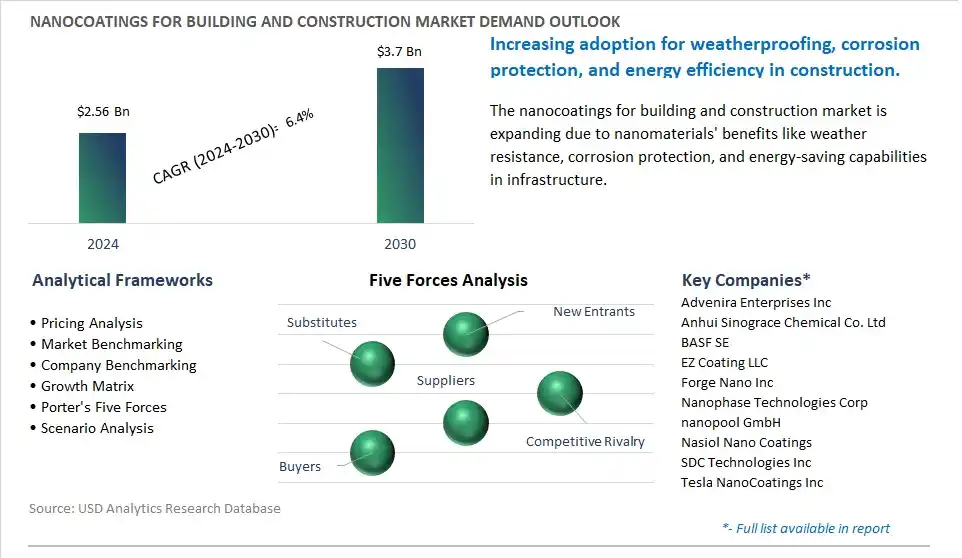
The global Nanocoatings for Building and Construction Market is poised to register a 6.4% CAGR from $2.56 Billion in 2024 to $3.7 Billion in 2030.
The global Nanocoatings for Building and Construction Market Study analyzes and forecasts the market size across 6 regions and 24 countries for diverse segments -By End-User (Building, Infrastructure), By Type (Vapor Deposition, Electroplate, Spraying, Others).
An Introduction to Global Nanocoatings for Building and Construction Market in 2024
The future of nanocoatings for building and construction is influenced by several key trends, including increasing demand for high-performance coatings that improve durability, energy efficiency, and sustainability of buildings and infrastructure, advancements in nanomaterials and surface engineering technologies, and growing emphasis on green building standards, urbanization, and climate resilience. Nanocoatings are thin films containing nanoparticles or nanocomposites applied to surfaces such as walls, roofs, and facades to impart functionalities such as waterproofing, self-cleaning, and UV protection while enhancing mechanical properties and aesthetic appeal. With the rise of population growth, resource scarcity, and climate change impacts on the built environment, there's a growing need for nanocoatings that offer superior weatherability, thermal insulation, and environmental resistance, contributing to energy savings, maintenance reduction, and longevity of buildings and infrastructure. Moreover, advancements in nanocoating formulation, application methods, and compatibility with existing construction materials are driving the development of next-generation coatings with tailored properties for specific applications in residential, commercial, and industrial sectors. Additionally, the integration of nanotechnology into construction practices such as concrete reinforcement, corrosion protection, and air purification is enabling the development of multifunctional building materials and systems that promote sustainability, occupant health, and urban resilience. Collaboration between coating manufacturers, construction companies, research institutions, and regulatory agencies is essential to drive innovation, ensure coating performance, and address market demands in the nanocoatings for building and construction industry.
Nanocoatings for Building and Construction Market Competitive Landscape
The market report analyses the leading companies in the industry including Advenira Enterprises Inc, Anhui Sinograce Chemical Co. Ltd, BASF SE, EZ Coating LLC, Forge Nano Inc, Nanophase Technologies Corp, nanopool GmbH, Nasiol Nano Coatings, SDC Technologies Inc, Tesla NanoCoatings Inc.
Nanocoatings for Building and Construction Market Dynamics
Nanocoatings for Building and Construction Market Trend: Increasing Focus on Sustainable and Energy-Efficient Buildings
A significant trend in the nanocoatings for building and construction market is the increasing focus on sustainable and energy-efficient buildings. Nanocoatings, consisting of nano-sized particles dispersed in a coating matrix, are being utilized in building materials such as paints, sealants, and coatings to enhance durability, weather resistance, and energy performance. With growing awareness of climate change and environmental sustainability, there's a shift towards green building practices that reduce energy consumption, minimize environmental impact, and improve indoor air quality. Nanocoatings offer benefits such as thermal insulation, UV protection, and self-cleaning properties, contributing to the energy efficiency and sustainability of building envelopes. This trend is driven by government regulations, green building certifications, and incentives promoting energy-efficient construction practices. As architects, developers, and building owners seek innovative solutions to meet sustainability goals and enhance building performance, the demand for nanocoatings in the building and construction sector is expected to continue growing.
Nanocoatings for Building and Construction Market Driver: Increasing Need for Durability and Protection in Harsh Environments
A major driver of the nanocoatings for building and construction market is the increasing need for durability and protection in harsh environments. Building exteriors are exposed to a wide range of environmental stresses such as UV radiation, moisture, pollutants, and temperature fluctuations, which can degrade surface materials and compromise structural integrity over time. Nanocoatings provide a thin, protective barrier that enhances resistance to weathering, corrosion, and microbial growth, extending the lifespan of building components and reducing maintenance costs. The demand for durable and long-lasting coatings is particularly high in coastal areas, urban environments, and industrial facilities where buildings are subjected to aggressive weather conditions and chemical exposure. As building owners and facility managers prioritize asset protection and lifecycle maintenance, the adoption of nanocoatings as a protective measure for building exteriors, facades, and infrastructure components is expected to drive market growth.
Nanocoatings for Building and Construction Market Opportunity: Integration of Smart Coatings for Functional and Aesthetic Enhancement
An opportunity within the nanocoatings for building and construction market lies in the integration of smart coatings for functional and aesthetic enhancement. Smart coatings, infused with responsive materials or additives, offer advanced functionalities such as self-healing, color-changing, and anti-graffiti properties, enhancing both performance and aesthetics of building surfaces. Nanotechnology enables the development of smart coatings that can respond to external stimuli such as temperature, humidity, or light, providing adaptive protection and enhancing user experience. Additionally, smart coatings can incorporate sensor technologies for real-time monitoring of building conditions such as structural integrity, air quality, and occupancy levels. By leveraging the capabilities of smart coatings and nanotechnology, manufacturers can create innovative solutions that address the evolving needs of building owners, architects, and occupants for buildings that are not only durable and sustainable but also intelligent and aesthetically pleasing. Investing in research and development to advance smart coating technologies and collaborate with building industry stakeholders offers an opportunity to differentiate products, expand market presence, and drive growth in the nanocoatings for building and construction segment.
Nanocoatings for Building and Construction Market Share Analysis: The Building sector segment generated the highest revenue in 2024
The largest segment in the Nanocoatings for Building and Construction Market is the Building sector. This dominance is primarily driving demand within this sector. Nanocoatings offer numerous advantages for building applications, including enhanced durability, weather resistance, UV protection, antimicrobial properties, and self-cleaning capabilities. These coatings can be applied to various building materials such as concrete, wood, metal, glass, and ceramics to provide protection against environmental factors such as moisture, corrosion, abrasion, and microbial growth. In the building sector, nanocoatings find extensive applications in exterior surfaces such as facades, roofs, windows, doors, and cladding systems to improve their longevity, aesthetics, and performance. Additionally, nanocoatings can enhance energy efficiency by reducing heat transfer and improving insulation properties, thereby contributing to sustainable building practices. Further, the building sector represents a large market with diverse applications and end-users ranging from residential, commercial, and institutional buildings to industrial facilities and infrastructure projects. The growing construction activities, urbanization, and infrastructure development worldwide drive the demand for high-performance coatings that can withstand harsh environmental conditions and provide long-term protection for building structures. Furthermore, advancements in nanotechnology, material science, and coating formulations continue to drive innovation in nanocoatings, leading to the development of new functionalities and application methods tailored to the specific needs of the building and construction industry. Over the forecast period, these factors contribute to the Building sector emerging as the largest segment in the Nanocoatings for Building and Construction Market.
Nanocoatings for Building and Construction Market Share Analysis: The Vapor Deposition segment is poised to register the fastest growth rate (CAGR) over the forecast period to 2030
The fastest-growing segment in the Nanocoatings for Building and Construction Market is Vapor Deposition. Vapor deposition techniques, such as physical vapor deposition (PVD) and chemical vapor deposition (CVD), offer unique advantages for applying nanocoatings to building and construction materials. These techniques allow for precise control over coating thickness, uniformity, and composition, resulting in high-quality, high-performance coatings with superior properties. Vapor deposition methods enable the deposition of thin films of nanomaterials onto various substrates, including metals, glass, ceramics, and polymers, without altering the substrate's properties or dimensions significantly. In the building and construction industry, vapor-deposited nanocoatings are used for a wide range of applications, including surface protection, corrosion resistance, anti-fingerprint coatings, and decorative finishes. These coatings provide durable and long-lasting protection against environmental factors such as moisture, abrasion, UV radiation, and chemical exposure, thereby extending the lifespan of building materials and reducing maintenance costs. Further, vapor deposition techniques offer scalability and versatility, making them suitable for large-scale production and integration into existing manufacturing processes. Additionally, advancements in vapor deposition technology, equipment design, and process optimization have led to improvements in coating quality, throughput, and cost-effectiveness, further driving their adoption in the building and construction sector. Furthermore, the increasing demand for sustainable and eco-friendly building materials and coatings fuels the growth of vapor-deposited nanocoatings, as these techniques involve low waste generation and minimal environmental impact compared to traditional coating methods. Over the forecast period, these factors contribute to Vapor Deposition emerging as the fastest-growing segment in the Nanocoatings for Building and Construction Market.
Nanocoatings for Building and Construction Market Report Segmentation
By End-User
Building
Infrastructure
By Type
Vapor Deposition
Electroplate
Spraying
Others
Regions Included
North America (US, Canada, Mexico)
Europe (Germany, UK, France, Spain, Italy, Russia, Rest of Europe)
Asia Pacific (China, India, Japan, South Korea, Australia, South East Asia, Rest of Asia)
South America (Brazil, Argentina, Rest of South America)
Middle East and Africa (Saudi Arabia, UAE, Rest of Middle East, South Africa, Egypt, Rest of Africa)
Nanocoatings for Building and Construction Companies Profiled in the Market Study
Advenira Enterprises Inc
Anhui Sinograce Chemical Co. Ltd
BASF SE
EZ Coating LLC
Forge Nano Inc
Nanophase Technologies Corp
nanopool GmbH
Nasiol Nano Coatings
SDC Technologies Inc
Tesla NanoCoatings Inc
*- List Not Exhaustive
TABLE OF CONTENTS
1 Introduction to 2024 Nanocoatings for Building and Construction Market
1.1 Market Overview
1.2 Quick Facts
1.3 Scope/Objective of the Study
1.4 Market Definition
1.5 Countries and Regions Covered
1.6 Units, Currency, and Conversions
1.7 Industry Value Chain
2 Research Methodology
2.1 Market Size Estimation
2.2 Sources and Research Methodology
2.3 Data Triangulation
2.4 Assumptions and Limitations
3 Executive Summary
3.1 Global Nanocoatings for Building and Construction Market Size Outlook, $ Million, 2021 to 2030
3.2 Nanocoatings for Building and Construction Market Outlook by Type, $ Million, 2021 to 2030
3.3 Nanocoatings for Building and Construction Market Outlook by Product, $ Million, 2021 to 2030
3.4 Nanocoatings for Building and Construction Market Outlook by Application, $ Million, 2021 to 2030
3.5 Nanocoatings for Building and Construction Market Outlook by Key Countries, $ Million, 2021 to 2030
4 Market Dynamics
4.1 Key Driving Forces of Nanocoatings for Building and Construction Industry
4.2 Key Market Trends in Nanocoatings for Building and Construction Industry
4.3 Potential Opportunities in Nanocoatings for Building and Construction Industry
4.4 Key Challenges in Nanocoatings for Building and Construction Industry
5 Market Factor Analysis
5.1 Value Chain Analysis
5.2 Competitive Landscape
5.2.1 Global Nanocoatings for Building and Construction Market Share by Company (%), 2023
5.2.2 Product Offerings by Company
5.3 Porter’s Five Forces Analysis
5.4 Pricing Analysis and Outlook
6 Growth Outlook Across Scenarios
6.1 Growth Analysis-Case Scenario Definitions
6.2 Low Growth Scenario Forecasts
6.3 Reference Growth Scenario Forecasts
6.4 High Growth Scenario Forecasts
7 Global Nanocoatings for Building and Construction Market Outlook by Segments
7.1 Nanocoatings for Building and Construction Market Outlook by Segments, $ Million, 2021- 2030
By End-User
Building
Infrastructure
By Type
Vapor Deposition
Electroplate
Spraying
Others
8 North America Nanocoatings for Building and Construction Market Analysis and Outlook To 2030
8.1 Introduction to North America Nanocoatings for Building and Construction Markets in 2024
8.2 North America Nanocoatings for Building and Construction Market Size Outlook by Country, 2021-2030
8.2.1 United States
8.2.2 Canada
8.2.3 Mexico
8.3 North America Nanocoatings for Building and Construction Market size Outlook by Segments, 2021-2030
By End-User
Building
Infrastructure
By Type
Vapor Deposition
Electroplate
Spraying
Others
9 Europe Nanocoatings for Building and Construction Market Analysis and Outlook To 2030
9.1 Introduction to Europe Nanocoatings for Building and Construction Markets in 2024
9.2 Europe Nanocoatings for Building and Construction Market Size Outlook by Country, 2021-2030
9.2.1 Germany
9.2.2 France
9.2.3 Spain
9.2.4 United Kingdom
9.2.4 Italy
9.2.5 Russia
9.2.6 Norway
9.2.7 Rest of Europe
9.3 Europe Nanocoatings for Building and Construction Market Size Outlook by Segments, 2021-2030
By End-User
Building
Infrastructure
By Type
Vapor Deposition
Electroplate
Spraying
Others
10 Asia Pacific Nanocoatings for Building and Construction Market Analysis and Outlook To 2030
10.1 Introduction to Asia Pacific Nanocoatings for Building and Construction Markets in 2024
10.2 Asia Pacific Nanocoatings for Building and Construction Market Size Outlook by Country, 2021-2030
10.2.1 China
10.2.2 India
10.2.3 Japan
10.2.4 South Korea
10.2.5 Indonesia
10.2.6 Malaysia
10.2.7 Australia
10.2.8 Rest of Asia Pacific
10.3 Asia Pacific Nanocoatings for Building and Construction Market size Outlook by Segments, 2021-2030
By End-User
Building
Infrastructure
By Type
Vapor Deposition
Electroplate
Spraying
Others
11 South America Nanocoatings for Building and Construction Market Analysis and Outlook To 2030
11.1 Introduction to South America Nanocoatings for Building and Construction Markets in 2024
11.2 South America Nanocoatings for Building and Construction Market Size Outlook by Country, 2021-2030
11.2.1 Brazil
11.2.2 Argentina
11.2.3 Rest of South America
11.3 South America Nanocoatings for Building and Construction Market size Outlook by Segments, 2021-2030
By End-User
Building
Infrastructure
By Type
Vapor Deposition
Electroplate
Spraying
Others
12 Middle East and Africa Nanocoatings for Building and Construction Market Analysis and Outlook To 2030
12.1 Introduction to Middle East and Africa Nanocoatings for Building and Construction Markets in 2024
12.2 Middle East and Africa Nanocoatings for Building and Construction Market Size Outlook by Country, 2021-2030
12.2.1 Saudi Arabia
12.2.2 UAE
12.2.3 Oman
12.2.4 Rest of Middle East
12.2.5 Egypt
12.2.6 Nigeria
12.2.7 South Africa
12.2.8 Rest of Africa
12.3 Middle East and Africa Nanocoatings for Building and Construction Market size Outlook by Segments, 2021-2030
By End-User
Building
Infrastructure
By Type
Vapor Deposition
Electroplate
Spraying
Others
13 Company Profiles
13.1 Company Snapshot
13.2 SWOT Profiles
13.3 Products and Services
13.4 Recent Developments
13.5 Financial Profile
Advenira Enterprises Inc
Anhui Sinograce Chemical Co. Ltd
BASF SE
EZ Coating LLC
Forge Nano Inc
Nanophase Technologies Corp
nanopool GmbH
Nasiol Nano Coatings
SDC Technologies Inc
Tesla NanoCoatings Inc
14 Appendix
14.1 Customization Offerings
14.2 Subscription Services
14.3 Related Reports
14.4 Publisher Expertise
By End-User
Building
Infrastructure
By Type
Vapor Deposition
Electroplate
Spraying
Others
Countries Analyzed
North America (US, Canada, Mexico)
Europe (Germany, UK, France, Spain, Italy, Russia, Rest of Europe)
Asia Pacific (China, India, Japan, South Korea, Australia, South East Asia, Rest of Asia)
South America (Brazil, Argentina, Rest of South America)
Middle East and Africa (Saudi Arabia, UAE, Rest of Middle East, South Africa, Egypt, Rest of Africa)
