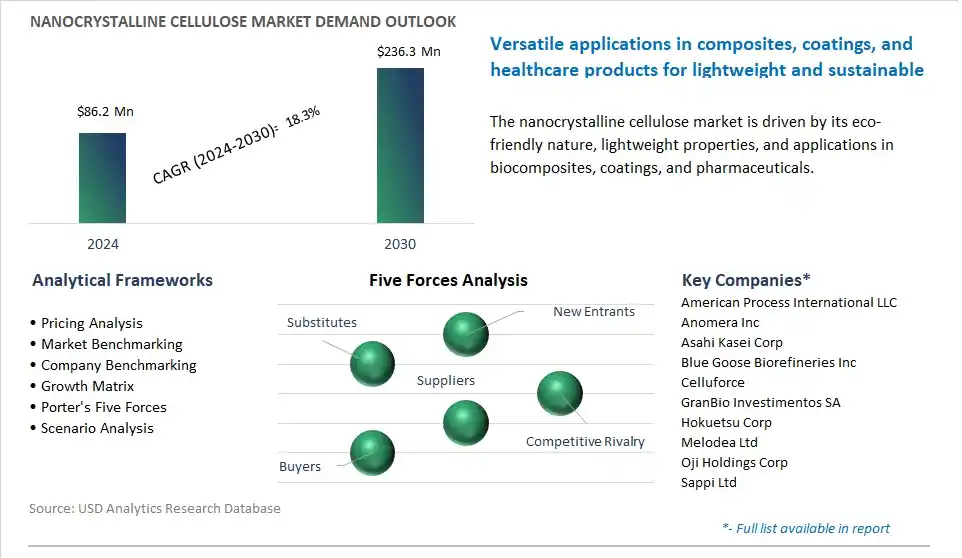
The global Nanocrystalline Cellulose Market is poised to register a 18.3% CAGR from $86.2 Million in 2024 to $236.3 Million in 2030.
The global Nanocrystalline Cellulose Market Study analyzes and forecasts the market size across 6 regions and 24 countries for diverse segments -By Form (Liquid, Powder), By Grade (Industrial Grade, Pharmaceutical Grade, Food Grade), By Application (Paper & Textile Manufacturing, Personal Care, Food & Beverage, Paper Processing, Medicine, Packaging, Others).
An Introduction to Global Nanocrystalline Cellulose Market in 2024
The future of nanocrystalline cellulose (NCC) is shaped by several key trends, including increasing demand for sustainable materials in packaging, composites, and biomedical applications, advancements in nanocellulose extraction and modification techniques, and growing emphasis on circular economy, bioeconomy, and biodegradability. NCC is a renewable nanomaterial derived from cellulose fibers through mechanical or chemical processes, offering properties such as high strength, stiffness, and biocompatibility for various applications in materials science and engineering. With the rise of plastic pollution, resource depletion, and environmental awareness, there's a growing need for NCC-based materials that offer renewable, biodegradable alternatives to conventional plastics and synthetic fibers, enabling the development of sustainable products with reduced environmental impact throughout their lifecycle. Moreover, advancements in NCC production methods, such as enzymatic hydrolysis, acid hydrolysis, and mechanical disintegration, are driving the development of cost-effective and scalable processes for producing NCC from diverse biomass feedstocks such as wood pulp, agricultural residues, and industrial byproducts. Additionally, the integration of NCC into advanced material formulations such as nanocomposites, films, and coatings is enabling the development of lightweight, strong, and functional products with applications in packaging, automotive, electronics, and healthcare sectors. Collaboration between NCC producers, material scientists, product developers, and sustainability experts is essential to drive innovation, ensure material performance, and address market demands in the nanocrystalline cellulose industry.
Nanocrystalline Cellulose Market Competitive Landscape
The market report analyses the leading companies in the industry including American Process International LLC, Anomera Inc, Asahi Kasei Corp, Blue Goose Biorefineries Inc, Celluforce, GranBio Investimentos SA, Hokuetsu Corp, Melodea Ltd, Oji Holdings Corp, Sappi Ltd.
Nanocrystalline Cellulose Market Dynamics
Nanocrystalline Cellulose Market Trend: Increasing Demand for Sustainable and Biodegradable Materials
A significant trend in the nanocrystalline cellulose market is the increasing demand for sustainable and biodegradable materials. Nanocrystalline cellulose (NCC), derived from cellulose fibers through mechanical or enzymatic processes, offers a renewable and eco-friendly alternative to traditional petroleum-based materials. With growing concerns over plastic pollution, climate change, and environmental sustainability, there's a rising interest in NCC as a versatile biomaterial for various applications. NCC exhibits exceptional mechanical properties, biocompatibility, and low environmental impact, making it suitable for use in packaging, composites, coatings, and biomedical applications. This trend is driven by consumer preferences for eco-friendly products, regulatory initiatives promoting sustainable materials, and industry efforts to reduce reliance on non-renewable resources. As companies across sectors seek to innovate and adopt greener materials in their products and processes, the demand for NCC as a sustainable biomaterial is expected to continue growing.
Nanocrystalline Cellulose Market Driver: Advancements in Nanotechnology and Material Science
A major driver of the nanocrystalline cellulose market is advancements in nanotechnology and material science. NCC, with its unique nanostructure and properties, has garnered attention for its potential applications in areas such as nanocomposites, rheology modifiers, and biomedical devices. Researchers and manufacturers are exploring novel techniques to isolate and functionalize NCC particles, enhancing their dispersibility, compatibility, and performance in various matrices. The development of scalable production methods, surface modification techniques, and characterization tools has facilitated the commercialization of NCC-based materials across industries. Additionally, advancements in nanocellulose processing and engineering enable the customization of NCC properties to meet specific application requirements, opening up opportunities for innovation and product development. As nanotechnology continues to evolve and interdisciplinary research collaborations drive advancements in material science, the potential applications and market opportunities for nanocrystalline cellulose are expected to expand.
Nanocrystalline Cellulose Market Opportunity: Diversification into High-Value Applications and Emerging Markets
An opportunity within the nanocrystalline cellulose market lies in diversification into high-value applications and emerging markets. While NCC finds applications in sectors such as packaging, paper manufacturing, and personal care products, there's potential to explore new markets and value-added applications. For example, NCC can be utilized in advanced materials such as nanocomposites for automotive and aerospace industries, where its lightweight, high-strength properties offer advantages in structural components and reinforcements. Additionally, NCC-based hydrogels and biomaterials hold promise for medical and healthcare applications such as wound dressings, drug delivery systems, and tissue engineering scaffolds. By leveraging its unique properties and versatility, manufacturers can tap into emerging markets and collaborate with industry partners to develop innovative solutions that address unmet needs and create value. Investing in research and development, market intelligence, and strategic partnerships offers an opportunity to expand the market presence and unlock new revenue streams in the evolving landscape of nanocrystalline cellulose applications.
Nanocrystalline Cellulose Market Share Analysis: The Powder form segment generated the highest revenue in 2024
The largest segment in the Nanocrystalline Cellulose Market is the Powder form. This dominance is primarily driving demand within this sector. Nanocrystalline cellulose (NCC) in powder form offers potential advantages that make it highly versatile and suitable for a wide range of applications. Powdered NCC has a high surface area-to-volume ratio, which enhances its reactivity and compatibility with various matrices and solvents. This form allows for easier handling, dispersion, and incorporation into composite materials, coatings, films, and other products. Powdered NCC can be easily dispersed in water or organic solvents to form stable suspensions or solutions, facilitating its integration into manufacturing processes and end-products. Additionally, powdered NCC exhibits excellent mechanical properties, including high strength, stiffness, and toughness, which enhance the performance and functionality of composite materials when used as a reinforcement agent. Further, powdered NCC is compatible with a wide range of polymers, resins, and additives, allowing for the formulation of customized blends and composites tailored to specific applications and performance requirements. Furthermore, advancements in processing techniques and equipment have enabled the production of powdered NCC in large quantities at a competitive cost, meeting the growing demand from various industries such as automotive, packaging, electronics, healthcare, and construction. Over the forecast period, these factors contribute to Powder being the largest segment in the Nanocrystalline Cellulose Market.
Nanocrystalline Cellulose Market Share Analysis: The Pharmaceutical Grade segment is poised to register the fastest growth rate (CAGR) over the forecast period to 2030
The fastest-growing segment in the Nanocrystalline Cellulose (NCC) Market is the Pharmaceutical Grade. Pharmaceutical-grade NCC is increasingly being recognized for its unique properties and versatile applications in the pharmaceutical and biomedical fields. NCC offers potential advantages such as biocompatibility, biodegradability, low toxicity, and other superior properties.
Nanocrystalline Cellulose Market Share Analysis: The Medicine segment is poised to register the fastest growth rate (CAGR) over the forecast period to 2030
The fastest-growing segment in the Nanocrystalline Cellulose Market is Medicine. This growth is driven by to the increasing utilization of nanocrystalline cellulose in pharmaceutical and biomedical applications. Nanocrystalline cellulose offers unique properties such as biocompatibility, biodegradability, and non-toxicity, making it highly suitable for drug delivery systems, tissue engineering, wound healing, and regenerative medicine. In drug delivery, nanocrystalline cellulose serves as a versatile carrier for controlled release formulations, improving drug solubility, stability, and bioavailability. Further, its fibrous structure and high surface area enable efficient encapsulation and protection of bioactive compounds, peptides, and proteins. Furthermore, nanocrystalline cellulose-based biomaterials show promising results in tissue engineering applications, facilitating cell adhesion, proliferation, and differentiation for tissue regeneration and repair. With ongoing research and development efforts focused on expanding the scope of nanocrystalline cellulose-based pharmaceutical products, the Medicine segment is poised for significant growth in the Nanocrystalline Cellulose Market.
Nanocrystalline Cellulose Market Report Segmentation
By Form
Liquid
Powder
By Grade
Industrial Grade
Pharmaceutical Grade
Food Grade
By Application
Paper & Textile Manufacturing
Personal Care
Food & Beverage
Paper Processing
Medicine
Packaging
Others
Regions Included
North America (US, Canada, Mexico)
Europe (Germany, UK, France, Spain, Italy, Russia, Rest of Europe)
Asia Pacific (China, India, Japan, South Korea, Australia, South East Asia, Rest of Asia)
South America (Brazil, Argentina, Rest of South America)
Middle East and Africa (Saudi Arabia, UAE, Rest of Middle East, South Africa, Egypt, Rest of Africa)
Nanocrystalline Cellulose Companies Profiled in the Market Study
American Process International LLC
Anomera Inc
Asahi Kasei Corp
Blue Goose Biorefineries Inc
Celluforce
GranBio Investimentos SA
Hokuetsu Corp
Melodea Ltd
Oji Holdings Corp
Sappi Ltd
*- List Not Exhaustive
TABLE OF CONTENTS
1 Introduction to 2024 Nanocrystalline Cellulose Market
1.1 Market Overview
1.2 Quick Facts
1.3 Scope/Objective of the Study
1.4 Market Definition
1.5 Countries and Regions Covered
1.6 Units, Currency, and Conversions
1.7 Industry Value Chain
2 Research Methodology
2.1 Market Size Estimation
2.2 Sources and Research Methodology
2.3 Data Triangulation
2.4 Assumptions and Limitations
3 Executive Summary
3.1 Global Nanocrystalline Cellulose Market Size Outlook, $ Million, 2021 to 2030
3.2 Nanocrystalline Cellulose Market Outlook by Type, $ Million, 2021 to 2030
3.3 Nanocrystalline Cellulose Market Outlook by Product, $ Million, 2021 to 2030
3.4 Nanocrystalline Cellulose Market Outlook by Application, $ Million, 2021 to 2030
3.5 Nanocrystalline Cellulose Market Outlook by Key Countries, $ Million, 2021 to 2030
4 Market Dynamics
4.1 Key Driving Forces of Nanocrystalline Cellulose Industry
4.2 Key Market Trends in Nanocrystalline Cellulose Industry
4.3 Potential Opportunities in Nanocrystalline Cellulose Industry
4.4 Key Challenges in Nanocrystalline Cellulose Industry
5 Market Factor Analysis
5.1 Value Chain Analysis
5.2 Competitive Landscape
5.2.1 Global Nanocrystalline Cellulose Market Share by Company (%), 2023
5.2.2 Product Offerings by Company
5.3 Porter’s Five Forces Analysis
5.4 Pricing Analysis and Outlook
6 Growth Outlook Across Scenarios
6.1 Growth Analysis-Case Scenario Definitions
6.2 Low Growth Scenario Forecasts
6.3 Reference Growth Scenario Forecasts
6.4 High Growth Scenario Forecasts
7 Global Nanocrystalline Cellulose Market Outlook by Segments
7.1 Nanocrystalline Cellulose Market Outlook by Segments, $ Million, 2021- 2030
By Form
Liquid
Powder
By Grade
Industrial Grade
Pharmaceutical Grade
Food Grade
By Application
Paper & Textile Manufacturing
Personal Care
Food & Beverage
Paper Processing
Medicine
Packaging
Others
8 North America Nanocrystalline Cellulose Market Analysis and Outlook To 2030
8.1 Introduction to North America Nanocrystalline Cellulose Markets in 2024
8.2 North America Nanocrystalline Cellulose Market Size Outlook by Country, 2021-2030
8.2.1 United States
8.2.2 Canada
8.2.3 Mexico
8.3 North America Nanocrystalline Cellulose Market size Outlook by Segments, 2021-2030
By Form
Liquid
Powder
By Grade
Industrial Grade
Pharmaceutical Grade
Food Grade
By Application
Paper & Textile Manufacturing
Personal Care
Food & Beverage
Paper Processing
Medicine
Packaging
Others
9 Europe Nanocrystalline Cellulose Market Analysis and Outlook To 2030
9.1 Introduction to Europe Nanocrystalline Cellulose Markets in 2024
9.2 Europe Nanocrystalline Cellulose Market Size Outlook by Country, 2021-2030
9.2.1 Germany
9.2.2 France
9.2.3 Spain
9.2.4 United Kingdom
9.2.4 Italy
9.2.5 Russia
9.2.6 Norway
9.2.7 Rest of Europe
9.3 Europe Nanocrystalline Cellulose Market Size Outlook by Segments, 2021-2030
By Form
Liquid
Powder
By Grade
Industrial Grade
Pharmaceutical Grade
Food Grade
By Application
Paper & Textile Manufacturing
Personal Care
Food & Beverage
Paper Processing
Medicine
Packaging
Others
10 Asia Pacific Nanocrystalline Cellulose Market Analysis and Outlook To 2030
10.1 Introduction to Asia Pacific Nanocrystalline Cellulose Markets in 2024
10.2 Asia Pacific Nanocrystalline Cellulose Market Size Outlook by Country, 2021-2030
10.2.1 China
10.2.2 India
10.2.3 Japan
10.2.4 South Korea
10.2.5 Indonesia
10.2.6 Malaysia
10.2.7 Australia
10.2.8 Rest of Asia Pacific
10.3 Asia Pacific Nanocrystalline Cellulose Market size Outlook by Segments, 2021-2030
By Form
Liquid
Powder
By Grade
Industrial Grade
Pharmaceutical Grade
Food Grade
By Application
Paper & Textile Manufacturing
Personal Care
Food & Beverage
Paper Processing
Medicine
Packaging
Others
11 South America Nanocrystalline Cellulose Market Analysis and Outlook To 2030
11.1 Introduction to South America Nanocrystalline Cellulose Markets in 2024
11.2 South America Nanocrystalline Cellulose Market Size Outlook by Country, 2021-2030
11.2.1 Brazil
11.2.2 Argentina
11.2.3 Rest of South America
11.3 South America Nanocrystalline Cellulose Market size Outlook by Segments, 2021-2030
By Form
Liquid
Powder
By Grade
Industrial Grade
Pharmaceutical Grade
Food Grade
By Application
Paper & Textile Manufacturing
Personal Care
Food & Beverage
Paper Processing
Medicine
Packaging
Others
12 Middle East and Africa Nanocrystalline Cellulose Market Analysis and Outlook To 2030
12.1 Introduction to Middle East and Africa Nanocrystalline Cellulose Markets in 2024
12.2 Middle East and Africa Nanocrystalline Cellulose Market Size Outlook by Country, 2021-2030
12.2.1 Saudi Arabia
12.2.2 UAE
12.2.3 Oman
12.2.4 Rest of Middle East
12.2.5 Egypt
12.2.6 Nigeria
12.2.7 South Africa
12.2.8 Rest of Africa
12.3 Middle East and Africa Nanocrystalline Cellulose Market size Outlook by Segments, 2021-2030
By Form
Liquid
Powder
By Grade
Industrial Grade
Pharmaceutical Grade
Food Grade
By Application
Paper & Textile Manufacturing
Personal Care
Food & Beverage
Paper Processing
Medicine
Packaging
Others
13 Company Profiles
13.1 Company Snapshot
13.2 SWOT Profiles
13.3 Products and Services
13.4 Recent Developments
13.5 Financial Profile
American Process International LLC
Anomera Inc
Asahi Kasei Corp
Blue Goose Biorefineries Inc
Celluforce
GranBio Investimentos SA
Hokuetsu Corp
Melodea Ltd
Oji Holdings Corp
Sappi Ltd
14 Appendix
14.1 Customization Offerings
14.2 Subscription Services
14.3 Related Reports
14.4 Publisher Expertise
By Form
Liquid
Powder
By Grade
Industrial Grade
Pharmaceutical Grade
Food Grade
By Application
Paper & Textile Manufacturing
Personal Care
Food & Beverage
Paper Processing
Medicine
Packaging
Others
Countries Analyzed
North America (US, Canada, Mexico)
Europe (Germany, UK, France, Spain, Italy, Russia, Rest of Europe)
Asia Pacific (China, India, Japan, South Korea, Australia, South East Asia, Rest of Asia)
South America (Brazil, Argentina, Rest of South America)
Middle East and Africa (Saudi Arabia, UAE, Rest of Middle East, South Africa, Egypt, Rest of Africa)
