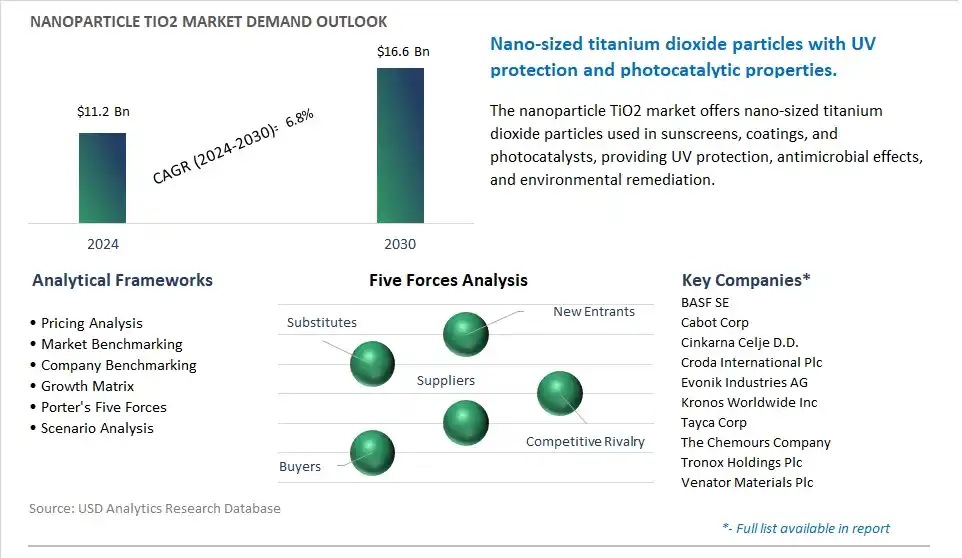
The global Nanoparticle TiO2 Market is poised to register a 6.8% CAGR from $11.2 Billion in 2024 to $16.6 Billion in 2030.
The global Nanoparticle TiO2 Market Study analyzes and forecasts the market size across 6 regions and 24 countries for diverse segments -By Type (Rutile, Anatase, Combination of Rutile & Anatase), By Application ( Paints & Coatings, Pigments, Cosmetics, Plastics, Energy, Others).
An Introduction to Global Nanoparticle TiO2 Market in 2024
The future of nanoparticle titanium dioxide (TiO2) is characterized by its versatile applications across various industries, including coatings, cosmetics, electronics, and environmental remediation. Key trends include the development of TiO2 nanoparticles with tailored properties such as particle size, crystalline structure, and surface morphology to achieve desired functionalities and performance enhancements. Manufacturers are exploring innovative synthesis methods such as sol-gel processing, hydrothermal synthesis, and flame pyrolysis to produce TiO2 nanoparticles with high purity, uniformity, and reproducibility. Additionally, there's a growing interest in functionalized TiO2 nanoparticles that offer specific surface chemistries and surface modifications to enable applications such as photocatalysis, antimicrobial activity, and UV protection. Furthermore, TiO2 nanoparticles are being integrated into advanced materials and products such as self-cleaning coatings, sunscreens, photovoltaic cells, and air purification systems, where their unique optical, electronic, and photocatalytic properties provide significant performance advantages. As research continues to drive innovation in nanoparticle TiO2 synthesis, characterization, and applications, collaboration between academia, industry, and regulatory agencies will be essential to address challenges related to safety, environmental impact, and commercial scalability, ensuring the responsible and beneficial deployment of TiO2 nanoparticles in diverse applications and shaping the future of materials science and technology.
Nanoparticle TiO2 Market Competitive Landscape
The market report analyses the leading companies in the industry including BASF SE, Cabot Corp, Cinkarna Celje D.D., Croda International Plc, Evonik Industries AG, Kronos Worldwide Inc, Tayca Corp, The Chemours Company, Tronox Holdings Plc, Venator Materials Plc.
Nanoparticle TiO2 Market Dynamics
Nanoparticle TiO2 Market Trend: Increasing Demand for Photocatalytic and Self-Cleaning Coatings
One of the most prominent trends in the nanoparticle TiO2 market is the increasing demand for photocatalytic and self-cleaning coatings across various industries. Nanoparticle TiO2, specifically in its anatase form, exhibits excellent photocatalytic properties when exposed to ultraviolet (UV) light, enabling the decomposition of organic pollutants and the self-cleaning of surfaces. As concerns over environmental pollution, air quality, and surface cleanliness grow, there's a growing interest in nanoparticle TiO2 coatings for applications in architectural coatings, automotive coatings, and building materials. The trend is driving the adoption of nanoparticle TiO2 as a key component in the development of advanced coatings that offer improved durability, cleanliness, and environmental sustainability.
Nanoparticle TiO2 Market Driver: Regulatory Requirements for Environmental Protection
A significant driver propelling the nanoparticle TiO2 market is the increasing regulatory requirements for environmental protection and sustainability. Nanoparticle TiO2 coatings, with their ability to break down organic pollutants and inhibit microbial growth, align with regulations aimed at reducing air pollution, combating climate change, and improving indoor air quality. Moreover, nanoparticle TiO2 coatings contribute to the development of sustainable buildings and infrastructure by reducing the need for frequent cleaning and maintenance, thus conserving resources and lowering environmental impact. As governments worldwide implement stricter regulations to address environmental concerns, the demand for nanoparticle TiO2 coatings as environmentally friendly solutions continues to grow, driving market expansion and adoption.
Nanoparticle TiO2 Market Opportunity: Integration into Advanced Functional Materials
An exciting opportunity within the nanoparticle TiO2 market lies in its integration into advanced functional materials for a wide range of applications. Beyond photocatalytic coatings, nanoparticle TiO2 can be incorporated into various functional materials such as paints, ceramics, textiles, and plastics to impart additional functionalities such as UV protection, antimicrobial properties, and enhanced mechanical strength. By leveraging the unique properties of nanoparticle TiO2, manufacturers can develop innovative materials that address specific performance requirements in diverse industries such as healthcare, automotive, consumer electronics, and packaging. This opportunity to integrate nanoparticle TiO2 into advanced functional materials presents a potential avenue for market growth and differentiation, as industries seek multifunctional solutions that offer superior performance and added value.
Nanoparticle TiO2 Market Share Analysis: Rutile generated the highest revenue in 2024
The largest segment in the Nanoparticle TiO2 Market is the Rutile type segment. The market growth is driven by rutile titanium dioxide (TiO2) nanoparticles are widely used across various industries due to their superior properties and performance characteristics. Rutile TiO2 nanoparticles exhibit a high refractive index, excellent UV absorption, outstanding durability, and superior photocatalytic activity compared to other types of TiO2 nanoparticles, such as anatase. These properties make rutile TiO2 nanoparticles highly versatile and suitable for numerous applications, including paints and coatings, cosmetics, plastics, textiles, and photocatalysis. Further, rutile TiO2 nanoparticles offer excellent opacity, brightness, and whiteness when incorporated into formulations, making them ideal additives for achieving desired optical and aesthetic properties in end products. Rutile TiO2 nanoparticles are commonly used as white pigments in paints, coatings, plastics, and paper products to impart opacity, color, and brightness, enhancing the visual appeal and performance of these materials. In addition, advancements in nanotechnology, materials science, and manufacturing processes have enabled the production of rutile TiO2 nanoparticles with controlled morphology, particle size, surface area, and crystalline structure, allowing for precise tuning of their properties and functionalities to meet specific application requirements. Techniques such as sol-gel synthesis, hydrothermal processing, and flame pyrolysis enable the synthesis of rutile TiO2 nanoparticles with tailored characteristics for targeted applications. Further, rutile TiO2 nanoparticles exhibit excellent stability, compatibility, and dispersion in various matrices, enabling their integration into diverse formulations and systems without compromising performance or stability. Additionally, regulatory approvals, industry standards, and customer preferences drive the demand for rutile TiO2 nanoparticles as performance additives in a wide range of products and applications. The broad applicability, superior properties, and established market presence of rutile TiO2 nanoparticles position the Rutile type segment as the largest in the Nanoparticle TiO2 Market. Over the forecast period, the combination of outstanding properties, versatile applications, and market demand drives the dominance of rutile TiO2 nanoparticles in the Nanoparticle TiO2 Market.
Nanoparticle TiO2 Market Share Analysis: Energy segment is poised to register the fastest growth rate (CAGR) over the forecast period to 2030
The fastest-growing segment in the Nanoparticle TiO2 Market is the Energy application segment. Nanoparticles of titanium dioxide (TiO2) exhibit unique photocatalytic properties, particularly under ultraviolet (UV) light irradiation, making them highly suitable for various energy-related applications, such as solar cells and photocatalysis. TiO2 nanoparticles can efficiently absorb UV light and generate electron-hole pairs, initiating photocatalytic reactions that facilitate energy conversion processes, such as water splitting and pollutant degradation. Further, advancements in nanotechnology and materials science have led to the development of novel TiO2-based nanomaterials and nanocomposites with enhanced photochemical and photophysical properties, enabling improved performance and efficiency in energy conversion and storage devices. For instance, TiO2 nanoparticles are utilized as electron transport materials and photoanodes in dye-sensitized solar cells (DSSCs) and perovskite solar cells (PSCs) to enhance charge separation, electron mobility, and light harvesting efficiency, resulting in higher solar-to-electricity conversion efficiency. In addition, the increasing global focus on renewable energy sources, sustainability, and environmental conservation drives the demand for efficient and cost-effective energy technologies, such as solar cells, hydrogen production, and pollutant remediation systems, utilizing TiO2 nanoparticles as key components. TiO2-based photocatalytic materials offer promising solutions for clean energy generation, environmental remediation, and sustainable development, addressing critical energy and environmental challenges worldwide. Further, research and development initiatives, government incentives, and industry collaborations support the advancement and commercialization of TiO2-based energy technologies, accelerating market growth and adoption across various sectors. Additionally, the versatility, scalability, and cost-effectiveness of TiO2 nanoparticles make them attractive candidates for energy-related applications, contributing to their increasing prominence and market share in the Nanoparticle TiO2 Market. Over the forecast period, the combination of technological advancements, market demand, and environmental imperatives drives the rapid growth of TiO2 nanoparticles in the Energy application segment of the Nanoparticle TiO2 Market.
Nanoparticle TiO2 Market Report Segmentation
By Type
Rutile
Anatase
Combination of Rutile & Anatase
By Application
Paints & Coatings
Pigments
Cosmetics
Plastics
Energy
Others
Regions Included
North America (US, Canada, Mexico)
Europe (Germany, UK, France, Spain, Italy, Russia, Rest of Europe)
Asia Pacific (China, India, Japan, South Korea, Australia, South East Asia, Rest of Asia)
South America (Brazil, Argentina, Rest of South America)
Middle East and Africa (Saudi Arabia, UAE, Rest of Middle East, South Africa, Egypt, Rest of Africa)
Nanoparticle TiO2 Companies Profiled in the Market Study
BASF SE
Cabot Corp
Cinkarna Celje D.D.
Croda International Plc
Evonik Industries AG
Kronos Worldwide Inc
Tayca Corp
The Chemours Company
Tronox Holdings Plc
Venator Materials Plc
*- List Not Exhaustive
TABLE OF CONTENTS
1 Introduction to 2024 Nanoparticle TiO2 Market
1.1 Market Overview
1.2 Quick Facts
1.3 Scope/Objective of the Study
1.4 Market Definition
1.5 Countries and Regions Covered
1.6 Units, Currency, and Conversions
1.7 Industry Value Chain
2 Research Methodology
2.1 Market Size Estimation
2.2 Sources and Research Methodology
2.3 Data Triangulation
2.4 Assumptions and Limitations
3 Executive Summary
3.1 Global Nanoparticle TiO2 Market Size Outlook, $ Million, 2021 to 2030
3.2 Nanoparticle TiO2 Market Outlook by Type, $ Million, 2021 to 2030
3.3 Nanoparticle TiO2 Market Outlook by Product, $ Million, 2021 to 2030
3.4 Nanoparticle TiO2 Market Outlook by Application, $ Million, 2021 to 2030
3.5 Nanoparticle TiO2 Market Outlook by Key Countries, $ Million, 2021 to 2030
4 Market Dynamics
4.1 Key Driving Forces of Nanoparticle TiO2 Industry
4.2 Key Market Trends in Nanoparticle TiO2 Industry
4.3 Potential Opportunities in Nanoparticle TiO2 Industry
4.4 Key Challenges in Nanoparticle TiO2 Industry
5 Market Factor Analysis
5.1 Value Chain Analysis
5.2 Competitive Landscape
5.2.1 Global Nanoparticle TiO2 Market Share by Company (%), 2023
5.2.2 Product Offerings by Company
5.3 Porter’s Five Forces Analysis
5.4 Pricing Analysis and Outlook
6 Growth Outlook Across Scenarios
6.1 Growth Analysis-Case Scenario Definitions
6.2 Low Growth Scenario Forecasts
6.3 Reference Growth Scenario Forecasts
6.4 High Growth Scenario Forecasts
7 Global Nanoparticle TiO2 Market Outlook by Segments
7.1 Nanoparticle TiO2 Market Outlook by Segments, $ Million, 2021- 2030
By Type
Rutile
Anatase
Combination of Rutile & Anatase
By Application
Paints & Coatings
Pigments
Cosmetics
Plastics
Energy
Others
8 North America Nanoparticle TiO2 Market Analysis and Outlook To 2030
8.1 Introduction to North America Nanoparticle TiO2 Markets in 2024
8.2 North America Nanoparticle TiO2 Market Size Outlook by Country, 2021-2030
8.2.1 United States
8.2.2 Canada
8.2.3 Mexico
8.3 North America Nanoparticle TiO2 Market size Outlook by Segments, 2021-2030
By Type
Rutile
Anatase
Combination of Rutile & Anatase
By Application
Paints & Coatings
Pigments
Cosmetics
Plastics
Energy
Others
9 Europe Nanoparticle TiO2 Market Analysis and Outlook To 2030
9.1 Introduction to Europe Nanoparticle TiO2 Markets in 2024
9.2 Europe Nanoparticle TiO2 Market Size Outlook by Country, 2021-2030
9.2.1 Germany
9.2.2 France
9.2.3 Spain
9.2.4 United Kingdom
9.2.4 Italy
9.2.5 Russia
9.2.6 Norway
9.2.7 Rest of Europe
9.3 Europe Nanoparticle TiO2 Market Size Outlook by Segments, 2021-2030
By Type
Rutile
Anatase
Combination of Rutile & Anatase
By Application
Paints & Coatings
Pigments
Cosmetics
Plastics
Energy
Others
10 Asia Pacific Nanoparticle TiO2 Market Analysis and Outlook To 2030
10.1 Introduction to Asia Pacific Nanoparticle TiO2 Markets in 2024
10.2 Asia Pacific Nanoparticle TiO2 Market Size Outlook by Country, 2021-2030
10.2.1 China
10.2.2 India
10.2.3 Japan
10.2.4 South Korea
10.2.5 Indonesia
10.2.6 Malaysia
10.2.7 Australia
10.2.8 Rest of Asia Pacific
10.3 Asia Pacific Nanoparticle TiO2 Market size Outlook by Segments, 2021-2030
By Type
Rutile
Anatase
Combination of Rutile & Anatase
By Application
Paints & Coatings
Pigments
Cosmetics
Plastics
Energy
Others
11 South America Nanoparticle TiO2 Market Analysis and Outlook To 2030
11.1 Introduction to South America Nanoparticle TiO2 Markets in 2024
11.2 South America Nanoparticle TiO2 Market Size Outlook by Country, 2021-2030
11.2.1 Brazil
11.2.2 Argentina
11.2.3 Rest of South America
11.3 South America Nanoparticle TiO2 Market size Outlook by Segments, 2021-2030
By Type
Rutile
Anatase
Combination of Rutile & Anatase
By Application
Paints & Coatings
Pigments
Cosmetics
Plastics
Energy
Others
12 Middle East and Africa Nanoparticle TiO2 Market Analysis and Outlook To 2030
12.1 Introduction to Middle East and Africa Nanoparticle TiO2 Markets in 2024
12.2 Middle East and Africa Nanoparticle TiO2 Market Size Outlook by Country, 2021-2030
12.2.1 Saudi Arabia
12.2.2 UAE
12.2.3 Oman
12.2.4 Rest of Middle East
12.2.5 Egypt
12.2.6 Nigeria
12.2.7 South Africa
12.2.8 Rest of Africa
12.3 Middle East and Africa Nanoparticle TiO2 Market size Outlook by Segments, 2021-2030
By Type
Rutile
Anatase
Combination of Rutile & Anatase
By Application
Paints & Coatings
Pigments
Cosmetics
Plastics
Energy
Others
13 Company Profiles
13.1 Company Snapshot
13.2 SWOT Profiles
13.3 Products and Services
13.4 Recent Developments
13.5 Financial Profile
BASF SE
Cabot Corp
Cinkarna Celje D.D.
Croda International Plc
Evonik Industries AG
Kronos Worldwide Inc
Tayca Corp
The Chemours Company
Tronox Holdings Plc
Venator Materials Plc
14 Appendix
14.1 Customization Offerings
14.2 Subscription Services
14.3 Related Reports
14.4 Publisher Expertise
By Type
Rutile
Anatase
Combination of Rutile & Anatase
By Application
Paints & Coatings
Pigments
Cosmetics
Plastics
Energy
Others
Countries Analyzed
North America (US, Canada, Mexico)
Europe (Germany, UK, France, Spain, Italy, Russia, Rest of Europe)
Asia Pacific (China, India, Japan, South Korea, Australia, South East Asia, Rest of Asia)
South America (Brazil, Argentina, Rest of South America)
Middle East and Africa (Saudi Arabia, UAE, Rest of Middle East, South Africa, Egypt, Rest of Africa)
