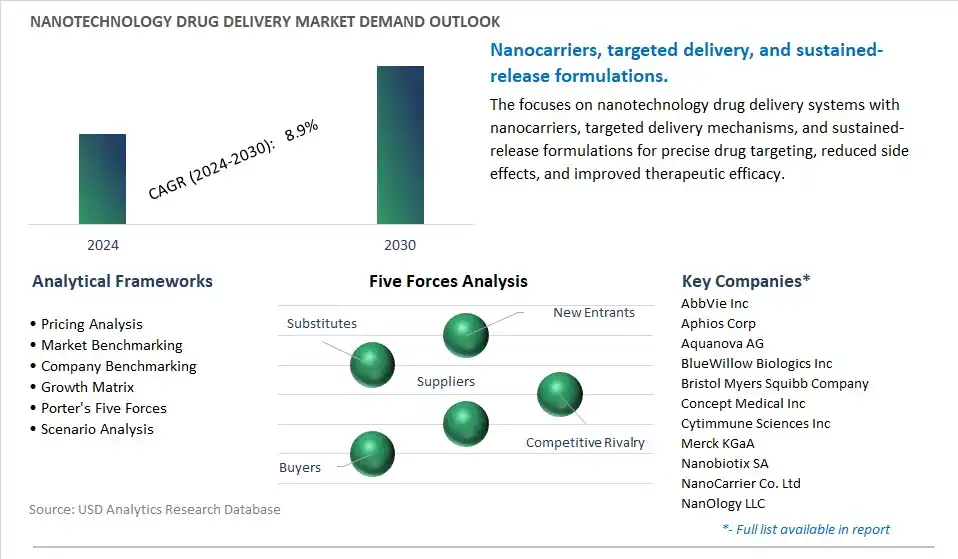
Nanotechnology Drug Delivery Market is estimated to increase at a Compounded Annual Growth Rate of 8.9% CAGR over the forecast period from 2024 to 2030
The Nanotechnology Drug Delivery Market study analyzes and forecasts the market size across 6 regions and 24 countries for diverse segments- By Technology (Nanocrystals, Nanoparticles, Liposomes, Micelles, Others), By Application (Neurology, Oncology, Cardiovascular/Physiology, Anti-inflammatory/Immunology, Anti-infective, Others).
An Introduction to Nanotechnology Drug Delivery Market in 2024
In 2024, the market for nanotechnology drug delivery continues to revolutionize the field of pharmaceuticals, offering novel approaches for enhancing drug efficacy, improving patient compliance, and reducing adverse effects. Nanotechnology-based drug delivery systems utilize nanoparticles, liposomes, micelles, dendrimers, and other nanoscale carriers to encapsulate, protect, and deliver therapeutic agents to target tissues or cells with high precision and specificity. These advanced delivery systems offer several advantages over conventional drug formulations, including prolonged circulation time, enhanced cellular uptake, controlled release kinetics, and the ability to overcome biological barriers such as the blood-brain barrier. Nanotechnology-enabled drug delivery holds promise for a wide range of medical applications, including cancer therapy, infectious disease treatment, gene therapy, regenerative medicine, and personalized medicine. Technological advancements in nanomaterial synthesis, surface modification, and functionalization enable the design of multifunctional nanocarriers with tailored properties for specific therapeutic applications, such as stimuli-responsive release, targeted ligand conjugation, and imaging capabilities. Moreover, the integration of nanotechnology with other disciplines such as molecular biology, materials science, and computational modeling facilitates the development of next-generation drug delivery platforms with enhanced efficacy, safety, and patient outcomes. With ongoing research and development efforts focused on nanomedicine, biomaterials, and translational research, the market for nanotechnology drug delivery is poised for continued growth and innovation, offering transformative solutions for addressing unmet medical needs and advancing the future of healthcare.
Market Trend: Advancements in Targeted Drug Delivery Systems
A prominent trend in the nanotechnology drug delivery market is the continuous advancements in targeted drug delivery systems. Nanotechnology enables the design and fabrication of nanoscale drug delivery carriers, such as nanoparticles, liposomes, and micelles, which can encapsulate therapeutic agents and deliver them to specific target sites within the body with precision and efficacy. This trend is driven by the growing demand for personalized medicine and precision therapies, where targeted drug delivery systems enable the delivery of therapeutics directly to diseased tissues or cells while minimizing systemic side effects and improving therapeutic outcomes. Additionally, advancements in nanomaterials, surface engineering, and drug conjugation techniques contribute to the development of next-generation nanotechnology-based drug delivery platforms with enhanced biocompatibility, stability, and controlled release properties. As researchers and pharmaceutical companies continue to innovate in targeted drug delivery technologies, the market for nanotechnology drug delivery is expected to witness significant growth and adoption in various therapeutic areas, including oncology, immunology, and neurology.
Market Driver: Need for Improved Drug Efficacy and Patient Compliance
The primary driver propelling the nanotechnology drug delivery market is the need for improved drug efficacy and patient compliance in the treatment of complex diseases and medical conditions. Conventional drug delivery methods often face challenges such as poor solubility, low bioavailability, rapid clearance, and off-target effects, which limit therapeutic efficacy and patient adherence to treatment regimens. Nanotechnology-based drug delivery systems offer solutions to overcome these challenges by enhancing drug solubility, prolonging circulation time, and enabling targeted delivery to specific cells or tissues. This driver is further fueled by the increasing prevalence of chronic diseases, aging population, and rising healthcare costs, which necessitate the development of innovative drug delivery strategies to improve therapeutic outcomes and reduce healthcare burden. Additionally, the emergence of biologics, gene therapies, and personalized medicine approaches creates opportunities for nanotechnology drug delivery to enhance the delivery and performance of these advanced therapeutics. As healthcare providers and patients seek more effective and convenient treatment options, the demand for nanotechnology-based drug delivery systems is expected to grow, driving market expansion and investment in drug delivery research and development.
Market Opportunity: Expansion into Gene and Cell Therapy Delivery
An opportunity within the nanotechnology drug delivery market lies in the expansion into gene and cell therapy delivery applications, where nanotechnology-based platforms offer solutions to overcome delivery challenges and optimize therapeutic outcomes. Gene and cell therapies hold great promise for the treatment of genetic disorders, cancer, and other diseases by delivering therapeutic genes, nucleic acids, or cells to target tissues or organs to correct genetic defects, modulate gene expression, or induce immune responses. However, effective delivery of therapeutic payloads to the desired cells or tissues remains a major hurdle in the clinical translation of gene and cell therapies. Nanotechnology-based drug delivery systems, such as viral vectors, lipid nanoparticles, and polymeric nanoparticles, can be engineered to encapsulate and protect genetic materials or cells, facilitate cellular uptake, and enable controlled release at the target site. By leveraging the capabilities of nanotechnology, researchers and biopharmaceutical companies can develop advanced delivery platforms that improve the safety, efficacy, and scalability of gene and cell therapies, accelerating their clinical development and commercialization. As gene and cell therapies continue to advance toward clinical applications, the market for nanotechnology drug delivery in gene and cell therapy delivery is poised for growth and innovation, offering opportunities for collaboration and investment in the evolving field of regenerative medicine.
Nanotechnology Drug Delivery Market Share Analysis: Oncology
The fast-growing segment within the nanotechnology drug delivery market is for oncology applications. This growth is propelled by several factors. Firstly, oncology remains one of the leading therapeutic areas driving innovation and investment in drug delivery technologies, owing to the complexity and heterogeneity of cancer tumors, challenges associated with conventional chemotherapy, and the need for targeted and personalized treatment approaches. Nanotechnology-based drug delivery systems offer unique advantages for oncology applications, including enhanced tumor targeting, improved drug solubility, prolonged circulation time, and reduced systemic toxicity, thereby overcoming limitations of traditional cancer therapies and improving therapeutic outcomes. Secondly, the growing prevalence of cancer worldwide, coupled with advancements in molecular diagnostics, biomarker identification, and genomic profiling, underscores the importance of precision medicine and targeted drug delivery strategies in oncology practice. Nanoparticle-based formulations of chemotherapeutic agents, immunotherapies, and targeted therapies enable selective delivery of anticancer drugs to tumor cells while sparing healthy tissues, minimizing off-target effects, and enhancing therapeutic efficacy. Additionally, the versatility of nanotechnology platforms, including liposomes, micelles, polymer nanoparticles, and dendrimers, allows for the encapsulation, conjugation, or surface modification of diverse anticancer agents, such as small molecules, biologics, nucleic acids, and imaging agents, enabling multifunctional and synergistic treatment modalities for cancer patients. Moreover, the increasing adoption of nanotechnology drug delivery systems in oncology is driven by regulatory approvals, clinical validation, and commercialization of nanoparticle-based cancer therapies, leading to expanded market access and reimbursement opportunities for innovative cancer treatments. Furthermore, collaborations between pharmaceutical companies, academic research institutions, and cancer centers drive innovation and investment in nanotechnology drug delivery for oncology, fostering the development of next-generation nanomedicines and combination therapies to address unmet medical needs and improve patient outcomes in the fight against cancer. Overall, the combination of therapeutic demand, technological advancements, and market dynamics positions oncology as the fast-growing segment within the nanotechnology drug delivery market.
Nanotechnology Drug Delivery Competitive Analysis
The market research study provides in-depth insights into leading companies including the SWOT analyses, product profile, financial details, and recent developments acrossAbbVie Inc, Aphios Corp, Aquanova AG, BlueWillow Biologics Inc, Bristol Myers Squibb Company, Concept Medical Inc, Cytimmune Sciences Inc, Merck KGaA, Nanobiotix SA, NanoCarrier Co. Ltd, NanOlogy LLC, Taiwan Liposome Company Ltd
Nanotechnology Drug Delivery Market Segmentation
By Technology
Nanocrystals
Nanoparticles
Liposomes
Micelles
Others
By Application
Neurology
Oncology
Cardiovascular/Physiology
Anti-inflammatory/Immunology
Anti-infective
Others
Geographical Analysis
North America (United States, Canada, Mexico)
Europe (Germany, France, United Kingdom, Spain, Italy, Rest of Europe)
Asia Pacific (China, India, Japan, South Korea, Rest of Asia Pacific)
South America (Brazil, Argentina, Rest of South America)
Middle East and Africa (Saudi Arabia, UAE, Rest of Middle East, South Africa, Egypt, Rest of Africa)
Nanotechnology Drug Delivery Market Companies
AbbVie Inc
Aphios Corp
Aquanova AG
BlueWillow Biologics Inc
Bristol Myers Squibb Company
Concept Medical Inc
Cytimmune Sciences Inc
Merck KGaA
Nanobiotix SA
NanoCarrier Co. Ltd
NanOlogy LLC
Taiwan Liposome Company Ltd
Reasons to Buy the Nanotechnology Drug Delivery Market Study
• Deepen your industry insights and navigate uncertainties for strategy formulation, CAPEX, and Operational decisions
• Gain access to detailed insights on the Nanotechnology Drug Delivery Market, encompassing current market size, growth trends, and forecasts till 2030.
• Access detailed competitor analysis, enabling competitive advantage through a thorough understanding of market players, strategies, and potential differentiation opportunities
• Stay ahead of the curve with insights on technological advancements, innovations, and upcoming trends
• Identify lucrative investment avenues and expansion opportunities within the Nanotechnology Drug Delivery Market industry, guided by robust, data-backed analysis.
• Understand regional and global markets through country-wise analysis, regional market potential, regulatory nuances, and dynamics
• Execute strategies with confidence and speed through information, analytics, and insights on the industry value chain
• Corporate leaders, strategists, financial experts, shareholders, asset managers, and governmental representatives can make long-term planning scenarios and build an integrated and timely understanding of market dynamics
• Benefit from tailored solutions and expert consultation based on report insights, providing personalized strategies aligned with specific business needs.
TABLE OF CONTENTS
1 Introduction to 2024 Nanotechnology Drug Delivery Market
1.1 Market Overview
1.2 Quick Facts
1.3 Scope/Objective of the Study
1.4 Market Definition
1.5 Countries and Regions Covered
1.6 Units, Currency, and Conversions
1.7 Industry Value Chain
2 Research Methodology
2.1 Market Size Estimation
2.2 Sources and Research Methodology
2.3 Data Triangulation
2.4 Assumptions and Limitations
3 Executive Summary
3.1 Global Nanotechnology Drug Delivery Market Size Outlook, $ Million, 2021 to 2030
3.2 Nanotechnology Drug Delivery Market Outlook by Type, $ Million, 2021 to 2030
3.3 Nanotechnology Drug Delivery Market Outlook by Product, $ Million, 2021 to 2030
3.4 Nanotechnology Drug Delivery Market Outlook by Application, $ Million, 2021 to 2030
3.5 Nanotechnology Drug Delivery Market Outlook by Key Countries, $ Million, 2021 to 2030
4 Market Dynamics
4.1 Key Driving Forces of Nanotechnology Drug Delivery Industry
4.2 Key Market Trends in Nanotechnology Drug Delivery Industry
4.3 Potential Opportunities in Nanotechnology Drug Delivery Industry
4.4 Key Challenges in Nanotechnology Drug Delivery Industry
5 Market Factor Analysis
5.1 Value Chain Analysis
5.2 Competitive Landscape
5.2.1 Global Nanotechnology Drug Delivery Market Share by Company (%), 2023
5.2.2 Product Offerings by Company
5.3 Porter’s Five Forces Analysis
5.4 Pricing Analysis and Outlook
6 Growth Outlook Across Scenarios
6.1 Growth Analysis-Case Scenario Definitions
6.2 Low Growth Scenario Forecasts
6.3 Reference Growth Scenario Forecasts
6.4 High Growth Scenario Forecasts
7 Global Nanotechnology Drug Delivery Market Outlook by Segments
7.1 Nanotechnology Drug Delivery Market Outlook by Segments, $ Million, 2021- 2030
By Technology
Nanocrystals
Nanoparticles
Liposomes
Micelles
Others
By Application
Neurology
Oncology
Cardiovascular/Physiology
Anti-inflammatory/Immunology
Anti-infective
Others
8 North America Nanotechnology Drug Delivery Market Analysis and Outlook To 2030
8.1 Introduction to North America Nanotechnology Drug Delivery Markets in 2024
8.2 North America Nanotechnology Drug Delivery Market Size Outlook by Country, 2021-2030
8.2.1 United States
8.2.2 Canada
8.2.3 Mexico
8.3 North America Nanotechnology Drug Delivery Market size Outlook by Segments, 2021-2030
By Technology
Nanocrystals
Nanoparticles
Liposomes
Micelles
Others
By Application
Neurology
Oncology
Cardiovascular/Physiology
Anti-inflammatory/Immunology
Anti-infective
Others
9 Europe Nanotechnology Drug Delivery Market Analysis and Outlook To 2030
9.1 Introduction to Europe Nanotechnology Drug Delivery Markets in 2024
9.2 Europe Nanotechnology Drug Delivery Market Size Outlook by Country, 2021-2030
9.2.1 Germany
9.2.2 France
9.2.3 Spain
9.2.4 United Kingdom
9.2.4 Italy
9.2.5 Russia
9.2.6 Norway
9.2.7 Rest of Europe
9.3 Europe Nanotechnology Drug Delivery Market Size Outlook by Segments, 2021-2030
By Technology
Nanocrystals
Nanoparticles
Liposomes
Micelles
Others
By Application
Neurology
Oncology
Cardiovascular/Physiology
Anti-inflammatory/Immunology
Anti-infective
Others
10 Asia Pacific Nanotechnology Drug Delivery Market Analysis and Outlook To 2030
10.1 Introduction to Asia Pacific Nanotechnology Drug Delivery Markets in 2024
10.2 Asia Pacific Nanotechnology Drug Delivery Market Size Outlook by Country, 2021-2030
10.2.1 China
10.2.2 India
10.2.3 Japan
10.2.4 South Korea
10.2.5 Indonesia
10.2.6 Malaysia
10.2.7 Australia
10.2.8 Rest of Asia Pacific
10.3 Asia Pacific Nanotechnology Drug Delivery Market size Outlook by Segments, 2021-2030
By Technology
Nanocrystals
Nanoparticles
Liposomes
Micelles
Others
By Application
Neurology
Oncology
Cardiovascular/Physiology
Anti-inflammatory/Immunology
Anti-infective
Others
11 South America Nanotechnology Drug Delivery Market Analysis and Outlook To 2030
11.1 Introduction to South America Nanotechnology Drug Delivery Markets in 2024
11.2 South America Nanotechnology Drug Delivery Market Size Outlook by Country, 2021-2030
11.2.1 Brazil
11.2.2 Argentina
11.2.3 Rest of South America
11.3 South America Nanotechnology Drug Delivery Market size Outlook by Segments, 2021-2030
By Technology
Nanocrystals
Nanoparticles
Liposomes
Micelles
Others
By Application
Neurology
Oncology
Cardiovascular/Physiology
Anti-inflammatory/Immunology
Anti-infective
Others
12 Middle East and Africa Nanotechnology Drug Delivery Market Analysis and Outlook To 2030
12.1 Introduction to Middle East and Africa Nanotechnology Drug Delivery Markets in 2024
12.2 Middle East and Africa Nanotechnology Drug Delivery Market Size Outlook by Country, 2021-2030
12.2.1 Saudi Arabia
12.2.2 UAE
12.2.3 Oman
12.2.4 Rest of Middle East
12.2.5 Egypt
12.2.6 Nigeria
12.2.7 South Africa
12.2.8 Rest of Africa
12.3 Middle East and Africa Nanotechnology Drug Delivery Market size Outlook by Segments, 2021-2030
By Technology
Nanocrystals
Nanoparticles
Liposomes
Micelles
Others
By Application
Neurology
Oncology
Cardiovascular/Physiology
Anti-inflammatory/Immunology
Anti-infective
Others
13 Company Profiles
13.1 Company Snapshot
13.2 SWOT Profiles
13.3 Products and Services
13.4 Recent Developments
13.5 Financial Profile
List of Companies
AbbVie Inc
Aphios Corp
Aquanova AG
BlueWillow Biologics Inc
Bristol Myers Squibb Company
Concept Medical Inc
Cytimmune Sciences Inc
Merck KGaA
Nanobiotix SA
NanoCarrier Co. Ltd
NanOlogy LLC
Taiwan Liposome Company Ltd
14 Appendix
14.1 Customization Offerings
14.2 Subscription Services
14.3 Related Reports
14.4 Publisher Expertise
