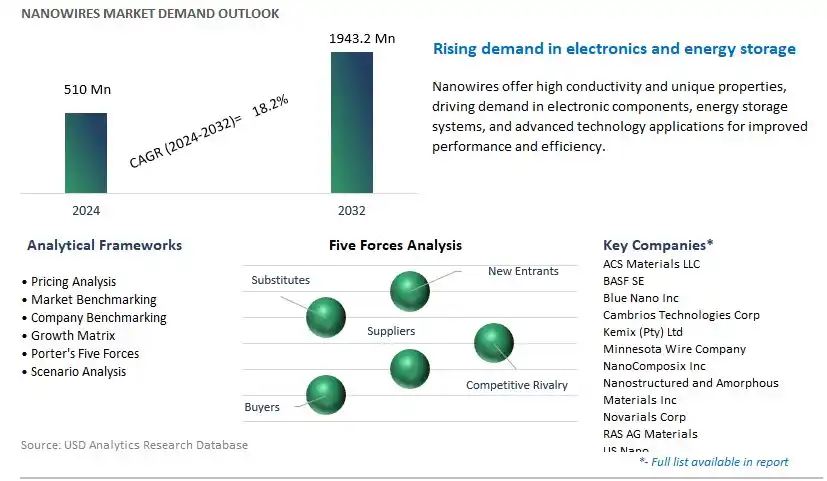
Global Nanowires Market Size is valued at $510 Million in 2024 and is forecast to register a growth rate (CAGR) of 18.2% to reach $1943.2 Million by 2032.
The global Nanowires Market Study analyzes and forecasts the market size across 6 regions and 24 countries for diverse segments -By Type (Metal Nanowires, Semiconductor Nanowires, Oxide Nanowires, Multi-Segment Nanowires, Semiconductor Quantum Wires), By Application (Consumer Electronics, Chemical and Biological sensors, Electronics, Solar Cells, Others).
An Introduction to Nanowires Market in 2024
The nanowires market is anticipated to witness robust growth in 2024, driven by the increasing demand for nanoscale materials with exceptional electrical, thermal, and mechanical properties. Nanowires, which are one-dimensional nanostructures, are utilized in various applications, including electronics, energy storage, sensors, and photonics. The electronics industry benefits from nanowires' high surface area-to-volume ratio and excellent conductivity, enabling the development of advanced transistors, memory devices, and flexible electronics. In the energy sector, nanowires enhance the performance of batteries and solar cells. The healthcare industry explores nanowires for biosensors and drug delivery systems. The market's growth is fueled by ongoing advancements in nanotechnology, increasing investment in research and development, and the rising demand for high-performance materials in various industries.
Nanowires Market Competitive Landscape
The market report analyses the leading companies in the industry including ACS Materials LLC, BASF SE, Blue Nano Inc, Cambrios Technologies Corp, Kemix (Pty) Ltd, Minnesota Wire Company, NanoComposix Inc, Nanostructured and Amorphous Materials Inc, Novarials Corp, RAS AG Materials, US Nano, and others.
Nanowires Market Dynamics
Market Trend: Growing Demand for Miniaturized Electronic Devices
A significant trend in the nanowires market is the growing demand for miniaturized electronic devices. Nanowires, with diameters on the nanometer scale and lengths ranging from micrometers to millimeters, offer unique properties such as high conductivity, tunable bandgap, and large surface-to-volume ratio. These characteristics make nanowires ideal for use in electronic devices, including transistors, sensors, photodetectors, and solar cells. As consumer electronics, wearable devices, and IoT (Internet of Things) applications continue to demand smaller, faster, and more efficient devices, there is an increasing reliance on nanowires to enable the development of next-generation electronic technologies. This trend drives market growth for nanowires as manufacturers and researchers explore new ways to integrate nanowires into electronic devices for improved performance and functionality.
Market Driver: Technological Advancements in Nanowire Synthesis and Integration
A key driver fueling the nanowires market is the continuous technological advancements in nanowire synthesis and integration. Researchers are developing innovative methods and techniques for synthesizing nanowires with precise control over size, shape, composition, and crystal structure. Techniques such as vapor-phase deposition, solution-phase synthesis, and bottom-up growth enable the production of nanowires with tailored properties to meet specific application requirements. Furthermore, advancements in nanowire integration and assembly techniques, including directed self-assembly, transfer printing, and wafer-scale integration, facilitate the incorporation of nanowires into device architectures with high precision and scalability. These technological advancements drive the commercialization and adoption of nanowires across various industries, unlocking new opportunities for their use in advanced electronic devices and systems.
Market Opportunity: Expansion into Emerging Applications in Biomedicine and Energy
A promising opportunity for the nanowires market lies in the expansion into emerging applications in biomedicine and energy. In biomedicine, nanowires show potential for use in biomedical imaging, drug delivery, and tissue engineering applications due to their biocompatibility, high surface area, and unique optical and electrical properties. Nanowire-based biosensors and diagnostic devices offer sensitive and selective detection of biomolecules for medical diagnostics and personalized healthcare. In the energy sector, nanowires are being investigated for applications in energy harvesting, storage, and conversion, including photovoltaics, thermoelectrics, and batteries, owing to their efficient light absorption, charge transport, and electrochemical properties. By exploring these emerging applications, nanowire manufacturers can diversify their product portfolios, enter new markets, and capitalize on the growing demand for advanced materials and technologies in healthcare and renewable energy sectors, thereby driving further market expansion and innovation in the nanowires market.
Nanowires Market Share Analysis: Metal Nanowires segment generated the highest revenue in 2024
Within the Nanowires market, the largest segment is Metal Nanowires. Metal nanowires exhibit unique electrical, thermal, and mechanical properties that make them highly desirable for a wide range of applications. In particular, metal nanowires are extensively utilized in the electronics industry for applications such as transparent conductive films, flexible displays, touch screens, and electrodes. Their high electrical conductivity, transparency, and flexibility make them ideal candidates for replacing indium tin oxide (ITO), which is commonly used in electronic devices but is expensive and brittle. Metal nanowires, such as silver and copper nanowires, offer comparable or superior conductivity to ITO while being more cost-effective and flexible, thus driving their widespread adoption. Moreover, metal nanowires find applications in areas such as sensors, catalysts, and biomedical devices, further contributing to their dominance in the Nanowires market. Over the forecast period, these factors position Metal Nanowires as the largest segment due to their versatility and wide range of applications.
Nanowires Market Share Analysis: Solar Cells is poised to register the fastest CAGR over the forecast period
Among the segmented applications in the Nanowires market, the fastest-growing segment is Solar Cells. Nanowires offer unique advantages for improving the performance and efficiency of solar cells, making them increasingly favored in the renewable energy sector. Nanowires, particularly semiconductor nanowires, enhance light absorption, charge separation, and electron transport within solar cells, leading to higher power conversion efficiencies. Additionally, nanowire-based solar cells can be fabricated using low-cost and scalable manufacturing techniques, making them economically viable for large-scale deployment. With the growing global demand for clean and sustainable energy sources, there is a significant emphasis on enhancing the efficiency and reducing the cost of solar photovoltaic systems, driving the demand for nanowires in solar cell applications. Moreover, ongoing research and development efforts focused on optimizing nanowire-based solar cell designs and materials further contribute to the rapid growth of this segment. Over the forecast period, these factors position Solar Cells as the fastest-growing segment in the Nanowires market.
Nanowires Market
By Type
Metal Nanowires
Semiconductor Nanowires
Oxide Nanowires
Multi-Segment Nanowires
Semiconductor Quantum Wires
By Application
Consumer Electronics
Chemical and Biological sensors
Electronics
Solar Cells
Others
Countries Analyzed
North America (US, Canada, Mexico)
Europe (Germany, UK, France, Spain, Italy, Russia, Rest of Europe)
Asia Pacific (China, India, Japan, South Korea, Australia, South East Asia, Rest of Asia)
South America (Brazil, Argentina, Rest of South America)
Middle East and Africa (Saudi Arabia, UAE, Rest of Middle East, South Africa, Egypt, Rest of Africa)
Nanowires Companies Profiled in the Study
ACS Materials LLC
BASF SE
Blue Nano Inc
Cambrios Technologies Corp
Kemix (Pty) Ltd
Minnesota Wire Company
NanoComposix Inc
Nanostructured and Amorphous Materials Inc
Novarials Corp
RAS AG Materials
US Nano
*- List Not Exhaustive
TABLE OF CONTENTS
1 Introduction to 2024 Nanowires Market
1.1 Market Overview
1.2 Quick Facts
1.3 Scope/Objective of the Study
1.4 Market Definition
1.5 Countries and Regions Covered
1.6 Units, Currency, and Conversions
1.7 Industry Value Chain
2 Research Methodology
2.1 Market Size Estimation
2.2 Sources and Research Methodology
2.3 Data Triangulation
2.4 Assumptions and Limitations
3 Executive Summary
3.1 Global Nanowires Market Size Outlook, $ Million, 2021 to 2032
3.2 Nanowires Market Outlook by Type, $ Million, 2021 to 2032
3.3 Nanowires Market Outlook by Product, $ Million, 2021 to 2032
3.4 Nanowires Market Outlook by Application, $ Million, 2021 to 2032
3.5 Nanowires Market Outlook by Key Countries, $ Million, 2021 to 2032
4 Market Dynamics
4.1 Key Driving Forces of Nanowires Industry
4.2 Key Market Trends in Nanowires Industry
4.3 Potential Opportunities in Nanowires Industry
4.4 Key Challenges in Nanowires Industry
5 Market Factor Analysis
5.1 Value Chain Analysis
5.2 Competitive Landscape
5.2.1 Global Nanowires Market Share by Company (%), 2023
5.2.2 Product Offerings by Company
5.3 Porter’s Five Forces Analysis
5.4 Pricing Analysis and Outlook
6 Growth Outlook Across Scenarios
6.1 Growth Analysis-Case Scenario Definitions
6.2 Low Growth Scenario Forecasts
6.3 Reference Growth Scenario Forecasts
6.4 High Growth Scenario Forecasts
7 Global Nanowires Market Outlook by Segments
7.1 Nanowires Market Outlook by Segments, $ Million, 2021- 2032
By Type
Metal Nanowires
Semiconductor Nanowires
Oxide Nanowires
Multi-Segment Nanowires
Semiconductor Quantum Wires
By Application
Consumer Electronics
Chemical and Biological sensors
Electronics
Solar Cells
Others
8 North America Nanowires Market Analysis and Outlook To 2032
8.1 Introduction to North America Nanowires Markets in 2024
8.2 North America Nanowires Market Size Outlook by Country, 2021-2032
8.2.1 United States
8.2.2 Canada
8.2.3 Mexico
8.3 North America Nanowires Market size Outlook by Segments, 2021-2032
By Type
Metal Nanowires
Semiconductor Nanowires
Oxide Nanowires
Multi-Segment Nanowires
Semiconductor Quantum Wires
By Application
Consumer Electronics
Chemical and Biological sensors
Electronics
Solar Cells
Others
9 Europe Nanowires Market Analysis and Outlook To 2032
9.1 Introduction to Europe Nanowires Markets in 2024
9.2 Europe Nanowires Market Size Outlook by Country, 2021-2032
9.2.1 Germany
9.2.2 France
9.2.3 Spain
9.2.4 United Kingdom
9.2.4 Italy
9.2.5 Russia
9.2.6 Norway
9.2.7 Rest of Europe
9.3 Europe Nanowires Market Size Outlook by Segments, 2021-2032
By Type
Metal Nanowires
Semiconductor Nanowires
Oxide Nanowires
Multi-Segment Nanowires
Semiconductor Quantum Wires
By Application
Consumer Electronics
Chemical and Biological sensors
Electronics
Solar Cells
Others
10 Asia Pacific Nanowires Market Analysis and Outlook To 2032
10.1 Introduction to Asia Pacific Nanowires Markets in 2024
10.2 Asia Pacific Nanowires Market Size Outlook by Country, 2021-2032
10.2.1 China
10.2.2 India
10.2.3 Japan
10.2.4 South Korea
10.2.5 Indonesia
10.2.6 Malaysia
10.2.7 Australia
10.2.8 Rest of Asia Pacific
10.3 Asia Pacific Nanowires Market size Outlook by Segments, 2021-2032
By Type
Metal Nanowires
Semiconductor Nanowires
Oxide Nanowires
Multi-Segment Nanowires
Semiconductor Quantum Wires
By Application
Consumer Electronics
Chemical and Biological sensors
Electronics
Solar Cells
Others
11 South America Nanowires Market Analysis and Outlook To 2032
11.1 Introduction to South America Nanowires Markets in 2024
11.2 South America Nanowires Market Size Outlook by Country, 2021-2032
11.2.1 Brazil
11.2.2 Argentina
11.2.3 Rest of South America
11.3 South America Nanowires Market size Outlook by Segments, 2021-2032
By Type
Metal Nanowires
Semiconductor Nanowires
Oxide Nanowires
Multi-Segment Nanowires
Semiconductor Quantum Wires
By Application
Consumer Electronics
Chemical and Biological sensors
Electronics
Solar Cells
Others
12 Middle East and Africa Nanowires Market Analysis and Outlook To 2032
12.1 Introduction to Middle East and Africa Nanowires Markets in 2024
12.2 Middle East and Africa Nanowires Market Size Outlook by Country, 2021-2032
12.2.1 Saudi Arabia
12.2.2 UAE
12.2.3 Oman
12.2.4 Rest of Middle East
12.2.5 Egypt
12.2.6 Nigeria
12.2.7 South Africa
12.2.8 Rest of Africa
12.3 Middle East and Africa Nanowires Market size Outlook by Segments, 2021-2032
By Type
Metal Nanowires
Semiconductor Nanowires
Oxide Nanowires
Multi-Segment Nanowires
Semiconductor Quantum Wires
By Application
Consumer Electronics
Chemical and Biological sensors
Electronics
Solar Cells
Others
13 Company Profiles
13.1 Company Snapshot
13.2 SWOT Profiles
13.3 Products and Services
13.4 Recent Developments
13.5 Financial Profile
ACS Materials LLC
BASF SE
Blue Nano Inc
Cambrios Technologies Corp
Kemix (Pty) Ltd
Minnesota Wire Company
NanoComposix Inc
Nanostructured and Amorphous Materials Inc
Novarials Corp
RAS AG Materials
US Nano
14 Appendix
14.1 Customization Offerings
14.2 Subscription Services
14.3 Related Reports
14.4 Publisher Expertise
By Type
Metal Nanowires
Semiconductor Nanowires
Oxide Nanowires
Multi-Segment Nanowires
Semiconductor Quantum Wires
By Application
Consumer Electronics
Chemical and Biological sensors
Electronics
Solar Cells
Others
Countries Analyzed
North America (US, Canada, Mexico)
Europe (Germany, UK, France, Spain, Italy, Russia, Rest of Europe)
Asia Pacific (China, India, Japan, South Korea, Australia, South East Asia, Rest of Asia)
South America (Brazil, Argentina, Rest of South America)
Middle East and Africa (Saudi Arabia, UAE, Rest of Middle East, South Africa, Egypt, Rest of Africa)
