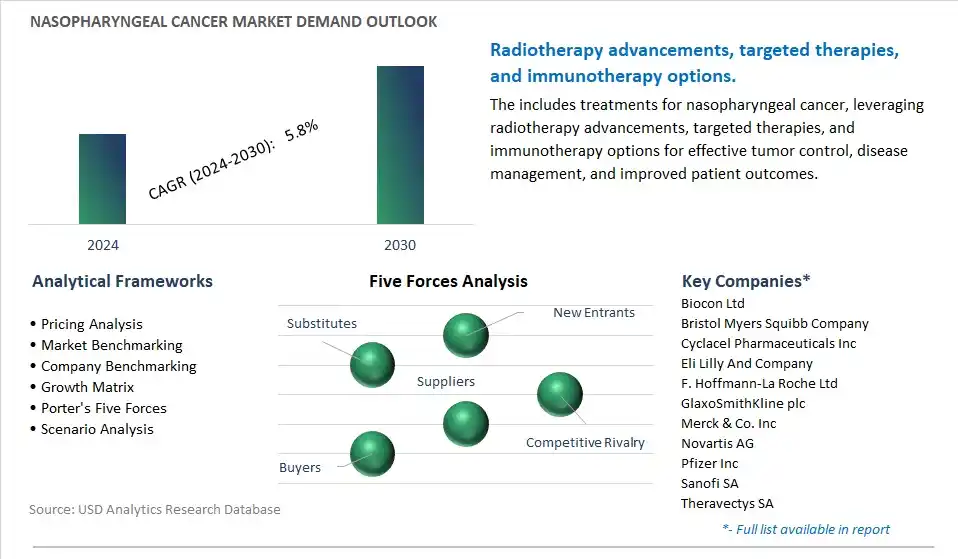
Nasopharyngeal Cancer Market is estimated to increase at a Compounded Annual Growth Rate of 5.8% CAGR over the forecast period from 2024 to 2030
The Nasopharyngeal Cancer Market study analyzes and forecasts the market size across 6 regions and 24 countries for diverse segments- By Therapy (Chemotherapy, Immunotherapy, Radiation Therapy, Others), By End-User (Hospitals and Clinics, Ambulatory Surgery Centers, Others).
An Introduction to Nasopharyngeal Cancer Market in 2024
In 2024, the market for nasopharyngeal cancer (NPC) continues to address the challenges associated with this rare but aggressive form of head and neck cancer that arises from the nasopharynx, the upper part of the throat located behind the nose. Nasopharyngeal cancer is strongly associated with infection by the Epstein-Barr virus (EBV), as well as genetic and environmental factors, and is characterized by nonspecific symptoms such as nasal congestion, nosebleeds, hearing loss, and neck swelling, which can often lead to delayed diagnosis and advanced disease stage at presentation. Treatment options for nasopharyngeal cancer typically include a combination of radiation therapy, chemotherapy, and targeted therapy, depending on the stage of the disease, tumor characteristics, and patient factors. Technological advancements in nasopharyngeal cancer treatment include intensity-modulated radiation therapy (IMRT), proton therapy, and image-guided radiation therapy (IGRT), which enable precise and targeted delivery of radiation to tumor tissues while sparing adjacent normal structures, thereby reducing treatment-related toxicities and improving outcomes. Moreover, the development of novel targeted therapies, such as immune checkpoint inhibitors and epidermal growth factor receptor (EGFR) inhibitors, offers new hope for patients with advanced or recurrent nasopharyngeal cancer by enhancing tumor control and prolonging survival. With ongoing research efforts focused on understanding the molecular mechanisms underlying nasopharyngeal cancer and identifying novel therapeutic targets, the market for nasopharyngeal cancer treatment is poised for continued growth and innovation, offering promising advancements in the management of this challenging malignancy.
Market Trend: Advancements in Treatment Modalities
A prominent trend in the nasopharyngeal cancer market is the continuous advancements in treatment modalities, including surgery, radiation therapy, chemotherapy, and immunotherapy. Nasopharyngeal cancer, a type of head and neck cancer, presents unique challenges due to its anatomical location and association with Epstein-Barr virus (EBV) infection. Recent developments in precision medicine, targeted therapies, and immune checkpoint inhibitors have expanded treatment options and improved outcomes for patients with nasopharyngeal cancer. This trend is driven by ongoing research efforts, clinical trials, and multidisciplinary collaborations aimed at optimizing treatment strategies, reducing treatment-related toxicities, and enhancing long-term survival rates. Additionally, advancements in diagnostic imaging, biomarker identification, and molecular profiling contribute to personalized treatment approaches tailored to individual patient characteristics and tumor biology. As the understanding of nasopharyngeal cancer biology and treatment options continues to evolve, the market for nasopharyngeal cancer therapies is expected to witness significant growth and innovation in the coming years.
Market Driver: High Incidence Rates in Endemic Regions
The primary driver propelling the nasopharyngeal cancer market is the high incidence rates observed in endemic regions, particularly in Southeast Asia, Southern China, and parts of North Africa. Nasopharyngeal cancer exhibits marked geographic and ethnic disparities, with the highest incidence rates reported in regions with a high prevalence of EBV infection, genetic susceptibility, and environmental risk factors such as consumption of preserved foods and exposure to tobacco smoke and environmental carcinogens. The burden of nasopharyngeal cancer on public health systems, patient outcomes, and healthcare expenditures is significant, driving the need for early detection, accurate diagnosis, and effective treatment interventions. Additionally, genetic predisposition and familial clustering of nasopharyngeal cancer cases underscore the importance of genetic counseling, screening programs, and prevention strategies to mitigate the risk of disease development and transmission. As healthcare providers and policymakers prioritize cancer control and prevention initiatives, the demand for nasopharyngeal cancer treatments and supportive care services is expected to grow, particularly in regions with high disease burden and limited access to healthcare resources.
Market Opportunity: Development of EBV-Targeted Therapies
An opportunity within the nasopharyngeal cancer market lies in the development of Epstein-Barr virus (EBV)-targeted therapies that specifically inhibit viral replication, modulate immune responses, and prevent tumor progression. EBV is implicated in the pathogenesis of nasopharyngeal cancer, with nearly all nasopharyngeal carcinoma (NPC) cases expressing EBV-encoded genes and antigens. Targeting EBV-infected cells and viral proteins presents opportunities for novel therapeutic interventions that complement existing treatment modalities and improve treatment outcomes for patients with nasopharyngeal cancer. Additionally, advancements in viral gene therapy, adoptive cell therapy, and immune-based approaches offer potential strategies for harnessing the host immune system to recognize and eliminate EBV-infected cells while sparing normal tissues. By leveraging the unique biology of EBV-associated nasopharyngeal cancer, researchers and pharmaceutical companies can develop targeted therapies that address unmet medical needs, enhance treatment efficacy, and improve patient survival rates. As the understanding of EBV biology and nasopharyngeal cancer immunology deepens, the market for EBV-targeted therapies represents a promising opportunity to transform the management of nasopharyngeal cancer and improve patient outcomes in endemic and non-endemic regions alike.
Nasopharyngeal Cancer Market Share Analysis: Immunotherapy
The fast-growing segment within the nasopharyngeal cancer market is for immunotherapy. This growth is driven by several factors. Firstly, immunotherapy has emerged as a promising treatment modality for nasopharyngeal cancer due to its ability to harness the body's immune system to target and destroy cancer cells specifically. Nasopharyngeal cancer is often associated with the Epstein-Barr virus (EBV), which can modulate the immune response within the tumor microenvironment. Immunotherapeutic agents, such as immune checkpoint inhibitors targeting programmed cell death protein 1 (PD-1) or its ligand (PD-L1), have shown efficacy in enhancing antitumor immunity and improving clinical outcomes in patients with advanced or recurrent nasopharyngeal cancer. Secondly, the favorable safety profile and durable responses observed with immunotherapy in nasopharyngeal cancer, either as monotherapy or in combination with other treatment modalities such as chemotherapy or radiation therapy, have led to increased adoption and utilization in clinical practice. Immunotherapy offers the potential for long-term disease control and survival benefits in patients who have failed conventional treatments or experience disease progression despite prior therapies. Additionally, the expanding landscape of immunotherapeutic agents and ongoing research efforts to identify novel targets and combination regimens further drive market growth and innovation in the field of nasopharyngeal cancer treatment. Moreover, the growing recognition of the importance of personalized medicine and biomarker-driven approaches in selecting patients who are most to benefit from immunotherapy contributes to market expansion and optimization of treatment strategies for nasopharyngeal cancer. Furthermore, collaborations between pharmaceutical companies, academic institutions, and healthcare providers facilitate clinical trials, biomarker discovery, and regulatory approvals of immunotherapeutic agents for nasopharyngeal cancer, paving the way for improved patient outcomes and the advancement of precision oncology. Overall, the combination of therapeutic efficacy, safety, and innovation positions immunotherapy as the fast-growing segment within the nasopharyngeal cancer market.
Nasopharyngeal Cancer Competitive Analysis
The market research study provides in-depth insights into leading companies including the SWOT analyses, product profile, financial details, and recent developments acrossBiocon Ltd, Bristol Myers Squibb Company, Cyclacel Pharmaceuticals Inc, Eli Lilly And Company, F. Hoffmann-La Roche Ltd, GlaxoSmithKline plc, Merck & Co. Inc, Novartis AG, Pfizer Inc, Sanofi SA, Theravectys SA
Nasopharyngeal Cancer Market Segmentation
By Therapy
Chemotherapy
Immunotherapy
Radiation Therapy
Others
By End-User
Hospitals and Clinics
Ambulatory Surgery Centers
Others
Geographical Analysis
North America (United States, Canada, Mexico)
Europe (Germany, France, United Kingdom, Spain, Italy, Rest of Europe)
Asia Pacific (China, India, Japan, South Korea, Rest of Asia Pacific)
South America (Brazil, Argentina, Rest of South America)
Middle East and Africa (Saudi Arabia, UAE, Rest of Middle East, South Africa, Egypt, Rest of Africa)
Nasopharyngeal Cancer Market Companies
Biocon Ltd
Bristol Myers Squibb Company
Cyclacel Pharmaceuticals Inc
Eli Lilly And Company
F. Hoffmann-La Roche Ltd
GlaxoSmithKline plc
Merck & Co. Inc
Novartis AG
Pfizer Inc
Sanofi SA
Theravectys SA
Reasons to Buy the Nasopharyngeal Cancer Market Study
• Deepen your industry insights and navigate uncertainties for strategy formulation, CAPEX, and Operational decisions
• Gain access to detailed insights on the Nasopharyngeal Cancer Market, encompassing current market size, growth trends, and forecasts till 2030.
• Access detailed competitor analysis, enabling competitive advantage through a thorough understanding of market players, strategies, and potential differentiation opportunities
• Stay ahead of the curve with insights on technological advancements, innovations, and upcoming trends
• Identify lucrative investment avenues and expansion opportunities within the Nasopharyngeal Cancer Market industry, guided by robust, data-backed analysis.
• Understand regional and global markets through country-wise analysis, regional market potential, regulatory nuances, and dynamics
• Execute strategies with confidence and speed through information, analytics, and insights on the industry value chain
• Corporate leaders, strategists, financial experts, shareholders, asset managers, and governmental representatives can make long-term planning scenarios and build an integrated and timely understanding of market dynamics
• Benefit from tailored solutions and expert consultation based on report insights, providing personalized strategies aligned with specific business needs.
TABLE OF CONTENTS
1 Introduction to 2024 Nasopharyngeal Cancer Market
1.1 Market Overview
1.2 Quick Facts
1.3 Scope/Objective of the Study
1.4 Market Definition
1.5 Countries and Regions Covered
1.6 Units, Currency, and Conversions
1.7 Industry Value Chain
2 Research Methodology
2.1 Market Size Estimation
2.2 Sources and Research Methodology
2.3 Data Triangulation
2.4 Assumptions and Limitations
3 Executive Summary
3.1 Global Nasopharyngeal Cancer Market Size Outlook, $ Million, 2021 to 2030
3.2 Nasopharyngeal Cancer Market Outlook by Type, $ Million, 2021 to 2030
3.3 Nasopharyngeal Cancer Market Outlook by Product, $ Million, 2021 to 2030
3.4 Nasopharyngeal Cancer Market Outlook by Application, $ Million, 2021 to 2030
3.5 Nasopharyngeal Cancer Market Outlook by Key Countries, $ Million, 2021 to 2030
4 Market Dynamics
4.1 Key Driving Forces of Nasopharyngeal Cancer Industry
4.2 Key Market Trends in Nasopharyngeal Cancer Industry
4.3 Potential Opportunities in Nasopharyngeal Cancer Industry
4.4 Key Challenges in Nasopharyngeal Cancer Industry
5 Market Factor Analysis
5.1 Value Chain Analysis
5.2 Competitive Landscape
5.2.1 Global Nasopharyngeal Cancer Market Share by Company (%), 2023
5.2.2 Product Offerings by Company
5.3 Porter’s Five Forces Analysis
5.4 Pricing Analysis and Outlook
6 Growth Outlook Across Scenarios
6.1 Growth Analysis-Case Scenario Definitions
6.2 Low Growth Scenario Forecasts
6.3 Reference Growth Scenario Forecasts
6.4 High Growth Scenario Forecasts
7 Global Nasopharyngeal Cancer Market Outlook by Segments
7.1 Nasopharyngeal Cancer Market Outlook by Segments, $ Million, 2021- 2030
By Therapy
Chemotherapy
Immunotherapy
Radiation Therapy
Others
By End-User
Hospitals and Clinics
Ambulatory Surgery Centers
Others
8 North America Nasopharyngeal Cancer Market Analysis and Outlook To 2030
8.1 Introduction to North America Nasopharyngeal Cancer Markets in 2024
8.2 North America Nasopharyngeal Cancer Market Size Outlook by Country, 2021-2030
8.2.1 United States
8.2.2 Canada
8.2.3 Mexico
8.3 North America Nasopharyngeal Cancer Market size Outlook by Segments, 2021-2030
By Therapy
Chemotherapy
Immunotherapy
Radiation Therapy
Others
By End-User
Hospitals and Clinics
Ambulatory Surgery Centers
Others
9 Europe Nasopharyngeal Cancer Market Analysis and Outlook To 2030
9.1 Introduction to Europe Nasopharyngeal Cancer Markets in 2024
9.2 Europe Nasopharyngeal Cancer Market Size Outlook by Country, 2021-2030
9.2.1 Germany
9.2.2 France
9.2.3 Spain
9.2.4 United Kingdom
9.2.4 Italy
9.2.5 Russia
9.2.6 Norway
9.2.7 Rest of Europe
9.3 Europe Nasopharyngeal Cancer Market Size Outlook by Segments, 2021-2030
By Therapy
Chemotherapy
Immunotherapy
Radiation Therapy
Others
By End-User
Hospitals and Clinics
Ambulatory Surgery Centers
Others
10 Asia Pacific Nasopharyngeal Cancer Market Analysis and Outlook To 2030
10.1 Introduction to Asia Pacific Nasopharyngeal Cancer Markets in 2024
10.2 Asia Pacific Nasopharyngeal Cancer Market Size Outlook by Country, 2021-2030
10.2.1 China
10.2.2 India
10.2.3 Japan
10.2.4 South Korea
10.2.5 Indonesia
10.2.6 Malaysia
10.2.7 Australia
10.2.8 Rest of Asia Pacific
10.3 Asia Pacific Nasopharyngeal Cancer Market size Outlook by Segments, 2021-2030
By Therapy
Chemotherapy
Immunotherapy
Radiation Therapy
Others
By End-User
Hospitals and Clinics
Ambulatory Surgery Centers
Others
11 South America Nasopharyngeal Cancer Market Analysis and Outlook To 2030
11.1 Introduction to South America Nasopharyngeal Cancer Markets in 2024
11.2 South America Nasopharyngeal Cancer Market Size Outlook by Country, 2021-2030
11.2.1 Brazil
11.2.2 Argentina
11.2.3 Rest of South America
11.3 South America Nasopharyngeal Cancer Market size Outlook by Segments, 2021-2030
By Therapy
Chemotherapy
Immunotherapy
Radiation Therapy
Others
By End-User
Hospitals and Clinics
Ambulatory Surgery Centers
Others
12 Middle East and Africa Nasopharyngeal Cancer Market Analysis and Outlook To 2030
12.1 Introduction to Middle East and Africa Nasopharyngeal Cancer Markets in 2024
12.2 Middle East and Africa Nasopharyngeal Cancer Market Size Outlook by Country, 2021-2030
12.2.1 Saudi Arabia
12.2.2 UAE
12.2.3 Oman
12.2.4 Rest of Middle East
12.2.5 Egypt
12.2.6 Nigeria
12.2.7 South Africa
12.2.8 Rest of Africa
12.3 Middle East and Africa Nasopharyngeal Cancer Market size Outlook by Segments, 2021-2030
By Therapy
Chemotherapy
Immunotherapy
Radiation Therapy
Others
By End-User
Hospitals and Clinics
Ambulatory Surgery Centers
Others
13 Company Profiles
13.1 Company Snapshot
13.2 SWOT Profiles
13.3 Products and Services
13.4 Recent Developments
13.5 Financial Profile
List of Companies
Biocon Ltd
Bristol Myers Squibb Company
Cyclacel Pharmaceuticals Inc
Eli Lilly And Company
F. Hoffmann-La Roche Ltd
GlaxoSmithKline plc
Merck & Co. Inc
Novartis AG
Pfizer Inc
Sanofi SA
Theravectys SA
14 Appendix
14.1 Customization Offerings
14.2 Subscription Services
14.3 Related Reports
14.4 Publisher Expertise
By Therapy
Chemotherapy
Immunotherapy
Radiation Therapy
Others
By End-User
Hospitals and Clinics
Ambulatory Surgery Centers
Others
Countries Analyzed
North America (United States, Canada, Mexico)
Europe (Germany, France, United Kingdom, Spain, Italy, Rest of Europe)
Asia Pacific (China, India, Japan, South Korea, Rest of Asia Pacific)
South America (Brazil, Argentina, Rest of South America)
Middle East and Africa (Saudi Arabia, UAE, Rest of Middle East, South Africa, Egypt, Rest of Africa)
