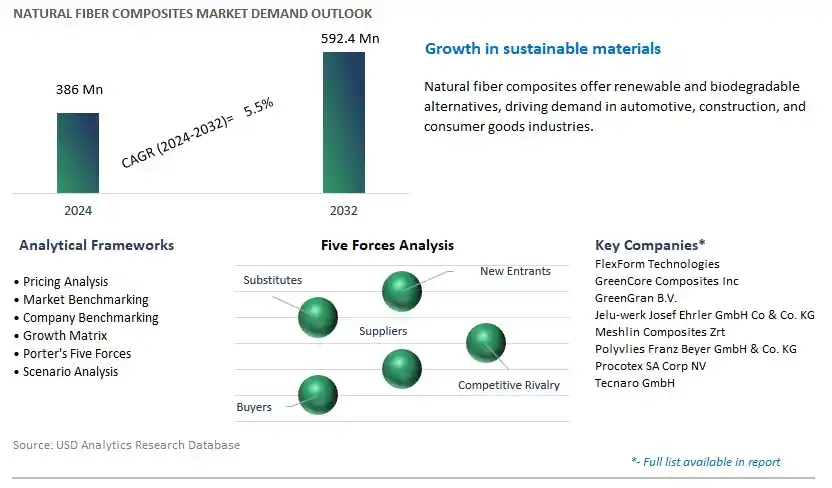
Global Natural Fiber Composites Market Size is valued at $386 Million in 2024 and is forecast to register a growth rate (CAGR) of 5.5% to reach $592.4 Million by 2032.
The global Natural Fiber Composites Market Study analyzes and forecasts the market size across 6 regions and 24 countries for diverse segments -By Type (Flax, Kenaf, Hemp, Others), By Resin (PP, PE, PA, Others), By Manufacturing Process (Compression Molding, Injection Molding, Others), By End-User (Automotive, Building & Construction, Others).
An Introduction to Natural Fiber Composites Market in 2024
Natural fiber composites represent a sustainable alternative to traditional fiber-reinforced materials, offering comparable mechanical properties with reduced environmental impact. In 2024, the market for natural fiber composites s to gain traction across industries such as automotive, construction, consumer goods, and packaging, driven by the demand for lightweight, eco-friendly materials with improved sustainability credentials. These composites utilize natural fibers such as jute, flax, hemp, bamboo, and kenaf as reinforcement materials, combined with biodegradable or recyclable polymers such as polypropylene, polylactic acid (PLA), or bio-based resins. Natural fiber composites find applications in various components such as interior panels, door trims, packaging trays, and furniture, offering benefits such as reduced weight, enhanced acoustic properties, and lower carbon footprint compared to conventional materials. Market trends include the development of advanced processing techniques for better fiber-matrix compatibility, optimization of material formulations for specific performance requirements, and collaboration among stakeholders to address challenges related to scalability, cost-effectiveness, and end-of-life recyclability.
Natural Fiber Composites Market Competitive Landscape
The market report analyses the leading companies in the industry including FlexForm Technologies, GreenCore Composites Inc, GreenGran B.V., Jelu-werk Josef Ehrler GmbH Co & Co. KG, Meshlin Composites Zrt, Polyvlies Franz Beyer GmbH & Co. KG, Procotex SA Corp NV, Tecnaro GmbH, and others.
Natural Fiber Composites Market Dynamics
Market Trend: Shift Towards Sustainable and Biodegradable Materials
A notable market trend in natural fiber composites is the shift towards sustainable and biodegradable materials across industries such as automotive, construction, and consumer goods. Natural fiber composites, made from renewable resources such as wood, bamboo, hemp, and flax fibers, offer an environmentally friendly alternative to traditional synthetic composites. With increasing concerns about climate change and environmental pollution, there is a growing preference among consumers and businesses for products that have a lower carbon footprint and are derived from renewable sources. As a result, the demand for natural fiber composites is on the rise, driven by their eco-friendly properties and potential to reduce dependence on non-renewable materials.
Market Driver: Regulatory Pressures and Emission Reduction Goals
A key driver for the natural fiber composites market is regulatory pressures and emission reduction goals set by governments and industry standards. Regulations aimed at reducing greenhouse gas emissions, promoting sustainable manufacturing practices, and minimizing waste generation are driving the adoption of eco-friendly materials like natural fiber composites. In sectors such as automotive and construction, where emissions and environmental impact are significant, manufacturers are under pressure to meet stringent sustainability criteria. Natural fiber composites offer a viable solution by providing lightweight, durable, and recyclable alternatives to conventional materials, helping companies achieve their emission reduction targets and comply with regulatory requirements.
Market Opportunity: Expansion in Automotive Lightweighting Applications
A significant market opportunity for natural fiber composites lies in their expansion into automotive lightweighting applications. With the automotive industry increasingly focusing on fuel efficiency, emissions reduction, and sustainability, there is a growing demand for lightweight materials that can replace traditional metal components. Natural fiber composites, with their high strength-to-weight ratio and low density, offer an attractive solution for reducing vehicle weight while maintaining structural integrity and safety standards. By incorporating natural fiber composites into vehicle interiors, exteriors, and structural components, automakers can achieve significant weight savings, leading to improved fuel economy and reduced emissions. Collaborations between automotive manufacturers, material suppliers, and research institutions can drive innovation and accelerate the adoption of natural fiber composites in the automotive sector, creating new opportunities for market growth and differentiation.
Natural Fiber Composites Market Share Analysis: Flax Type segment generated the highest revenue in 2024
Among the types in the Natural Fiber Composites Market, Flax is the largest segment. Flax fibers possess excellent mechanical properties such as high tensile strength, stiffness, and impact resistance, making them suitable reinforcements for various composite applications. Additionally, flax fibers are lightweight, biodegradable, and renewable, aligning with the growing demand for sustainable and eco-friendly materials across industries. Flax-based composites find extensive use in automotive components, construction materials, and consumer goods, where they offer a viable alternative to traditional synthetic fibers. Moreover, advancements in processing technologies have improved the compatibility between flax fibers and matrix materials, enhancing the overall performance and durability of flax-based composites. As sustainability initiatives drive the demand for bio-based materials, the Flax segment of the Natural Fiber Composites Market is poised to maintain its leading position, driving innovation and market expansion in the composite materials industry.
Natural Fiber Composites Market Share Analysis: Compression Molding segment generated the highest revenue in 2024
Among the manufacturing processes in the Natural Fiber Composites Market, Compression Molding is the largest segment. Compression molding offers potential advantages, including simplicity, cost-effectiveness, and versatility in producing large and complex parts with consistent quality. Additionally, compression molding allows for efficient fiber orientation and distribution within the composite matrix, resulting in enhanced mechanical properties and dimensional stability. Moreover, the process is well-suited for mass production, making it ideal for automotive components, construction materials, and consumer goods where high-volume manufacturing is required. As industries continue to seek sustainable alternatives to conventional materials, the Compression Molding segment remains at the forefront, driving innovation and market growth in the natural fiber composites industry.
Natural Fiber Composites Market Share Analysis: Building & Construction is poised to register the fastest CAGR over the forecast period
The fastest-growing segment in the Natural Fiber Composites Market is the Building & Construction sector. This growth is driven by the demand for natural fiber composites in construction-related applications. With increasing awareness of sustainability and environmental conservation, there is a growing preference for eco-friendly building materials that offer comparable or superior performance to traditional alternatives. Natural fiber composites, with their lightweight, high strength-to-weight ratio, and biodegradability, are increasingly being used in various construction applications such as decking, cladding, roofing, and structural components. Additionally, stringent building regulations and standards focusing on energy efficiency and carbon footprint reduction further drive the adoption of natural fiber composites in the construction industry. As construction projects worldwide increasingly prioritize sustainability and green building practices, the demand for natural fiber composites in the Building & Construction sector is expected to experience significant growth, making it the fastest-growing segment in the Natural Fiber Composites Market.
Natural Fiber Composites Market
By Type
Flax
Kenaf
Hemp
Others
By Resin
PP
PE
PA
Others
By Manufacturing Process
Compression Molding
Injection Molding
Others
By End-User
Automotive
Building & Construction
Others
Countries Analyzed
North America (US, Canada, Mexico)
Europe (Germany, UK, France, Spain, Italy, Russia, Rest of Europe)
Asia Pacific (China, India, Japan, South Korea, Australia, South East Asia, Rest of Asia)
South America (Brazil, Argentina, Rest of South America)
Middle East and Africa (Saudi Arabia, UAE, Rest of Middle East, South Africa, Egypt, Rest of Africa)
Natural Fiber Composites Companies Profiled in the Study
FlexForm Technologies
GreenCore Composites Inc
GreenGran B.V.
Jelu-werk Josef Ehrler GmbH Co & Co. KG
Meshlin Composites Zrt
Polyvlies Franz Beyer GmbH & Co. KG
Procotex SA Corp NV
Tecnaro GmbH
*- List Not Exhaustive
TABLE OF CONTENTS
1 Introduction to 2024 Natural Fiber Composites Market
1.1 Market Overview
1.2 Quick Facts
1.3 Scope/Objective of the Study
1.4 Market Definition
1.5 Countries and Regions Covered
1.6 Units, Currency, and Conversions
1.7 Industry Value Chain
2 Research Methodology
2.1 Market Size Estimation
2.2 Sources and Research Methodology
2.3 Data Triangulation
2.4 Assumptions and Limitations
3 Executive Summary
3.1 Global Natural Fiber Composites Market Size Outlook, $ Million, 2021 to 2032
3.2 Natural Fiber Composites Market Outlook by Type, $ Million, 2021 to 2032
3.3 Natural Fiber Composites Market Outlook by Product, $ Million, 2021 to 2032
3.4 Natural Fiber Composites Market Outlook by Application, $ Million, 2021 to 2032
3.5 Natural Fiber Composites Market Outlook by Key Countries, $ Million, 2021 to 2032
4 Market Dynamics
4.1 Key Driving Forces of Natural Fiber Composites Industry
4.2 Key Market Trends in Natural Fiber Composites Industry
4.3 Potential Opportunities in Natural Fiber Composites Industry
4.4 Key Challenges in Natural Fiber Composites Industry
5 Market Factor Analysis
5.1 Value Chain Analysis
5.2 Competitive Landscape
5.2.1 Global Natural Fiber Composites Market Share by Company (%), 2023
5.2.2 Product Offerings by Company
5.3 Porter’s Five Forces Analysis
5.4 Pricing Analysis and Outlook
6 Growth Outlook Across Scenarios
6.1 Growth Analysis-Case Scenario Definitions
6.2 Low Growth Scenario Forecasts
6.3 Reference Growth Scenario Forecasts
6.4 High Growth Scenario Forecasts
7 Global Natural Fiber Composites Market Outlook by Segments
7.1 Natural Fiber Composites Market Outlook by Segments, $ Million, 2021- 2032
By Type
Flax
Kenaf
Hemp
Others
By Resin
PP
PE
PA
Others
By Manufacturing Process
Compression Molding
Injection Molding
Others
By End-User
Automotive
Building & Construction
Others
8 North America Natural Fiber Composites Market Analysis and Outlook To 2032
8.1 Introduction to North America Natural Fiber Composites Markets in 2024
8.2 North America Natural Fiber Composites Market Size Outlook by Country, 2021-2032
8.2.1 United States
8.2.2 Canada
8.2.3 Mexico
8.3 North America Natural Fiber Composites Market size Outlook by Segments, 2021-2032
By Type
Flax
Kenaf
Hemp
Others
By Resin
PP
PE
PA
Others
By Manufacturing Process
Compression Molding
Injection Molding
Others
By End-User
Automotive
Building & Construction
Others
9 Europe Natural Fiber Composites Market Analysis and Outlook To 2032
9.1 Introduction to Europe Natural Fiber Composites Markets in 2024
9.2 Europe Natural Fiber Composites Market Size Outlook by Country, 2021-2032
9.2.1 Germany
9.2.2 France
9.2.3 Spain
9.2.4 United Kingdom
9.2.4 Italy
9.2.5 Russia
9.2.6 Norway
9.2.7 Rest of Europe
9.3 Europe Natural Fiber Composites Market Size Outlook by Segments, 2021-2032
By Type
Flax
Kenaf
Hemp
Others
By Resin
PP
PE
PA
Others
By Manufacturing Process
Compression Molding
Injection Molding
Others
By End-User
Automotive
Building & Construction
Others
10 Asia Pacific Natural Fiber Composites Market Analysis and Outlook To 2032
10.1 Introduction to Asia Pacific Natural Fiber Composites Markets in 2024
10.2 Asia Pacific Natural Fiber Composites Market Size Outlook by Country, 2021-2032
10.2.1 China
10.2.2 India
10.2.3 Japan
10.2.4 South Korea
10.2.5 Indonesia
10.2.6 Malaysia
10.2.7 Australia
10.2.8 Rest of Asia Pacific
10.3 Asia Pacific Natural Fiber Composites Market size Outlook by Segments, 2021-2032
By Type
Flax
Kenaf
Hemp
Others
By Resin
PP
PE
PA
Others
By Manufacturing Process
Compression Molding
Injection Molding
Others
By End-User
Automotive
Building & Construction
Others
11 South America Natural Fiber Composites Market Analysis and Outlook To 2032
11.1 Introduction to South America Natural Fiber Composites Markets in 2024
11.2 South America Natural Fiber Composites Market Size Outlook by Country, 2021-2032
11.2.1 Brazil
11.2.2 Argentina
11.2.3 Rest of South America
11.3 South America Natural Fiber Composites Market size Outlook by Segments, 2021-2032
By Type
Flax
Kenaf
Hemp
Others
By Resin
PP
PE
PA
Others
By Manufacturing Process
Compression Molding
Injection Molding
Others
By End-User
Automotive
Building & Construction
Others
12 Middle East and Africa Natural Fiber Composites Market Analysis and Outlook To 2032
12.1 Introduction to Middle East and Africa Natural Fiber Composites Markets in 2024
12.2 Middle East and Africa Natural Fiber Composites Market Size Outlook by Country, 2021-2032
12.2.1 Saudi Arabia
12.2.2 UAE
12.2.3 Oman
12.2.4 Rest of Middle East
12.2.5 Egypt
12.2.6 Nigeria
12.2.7 South Africa
12.2.8 Rest of Africa
12.3 Middle East and Africa Natural Fiber Composites Market size Outlook by Segments, 2021-2032
By Type
Flax
Kenaf
Hemp
Others
By Resin
PP
PE
PA
Others
By Manufacturing Process
Compression Molding
Injection Molding
Others
By End-User
Automotive
Building & Construction
Others
13 Company Profiles
13.1 Company Snapshot
13.2 SWOT Profiles
13.3 Products and Services
13.4 Recent Developments
13.5 Financial Profile
FlexForm Technologies
GreenCore Composites Inc
GreenGran B.V.
Jelu-werk Josef Ehrler GmbH Co & Co. KG
Meshlin Composites Zrt
Polyvlies Franz Beyer GmbH & Co. KG
Procotex SA Corp NV
Tecnaro GmbH
14 Appendix
14.1 Customization Offerings
14.2 Subscription Services
14.3 Related Reports
14.4 Publisher Expertise
By Type
Flax
Kenaf
Hemp
Others
By Resin
PP
PE
PA
Others
By Manufacturing Process
Compression Molding
Injection Molding
Others
By End-User
Automotive
Building & Construction
Others
Countries Analyzed
North America (US, Canada, Mexico)
Europe (Germany, UK, France, Spain, Italy, Russia, Rest of Europe)
Asia Pacific (China, India, Japan, South Korea, Australia, South East Asia, Rest of Asia)
South America (Brazil, Argentina, Rest of South America)
Middle East and Africa (Saudi Arabia, UAE, Rest of Middle East, South Africa, Egypt, Rest of Africa)
