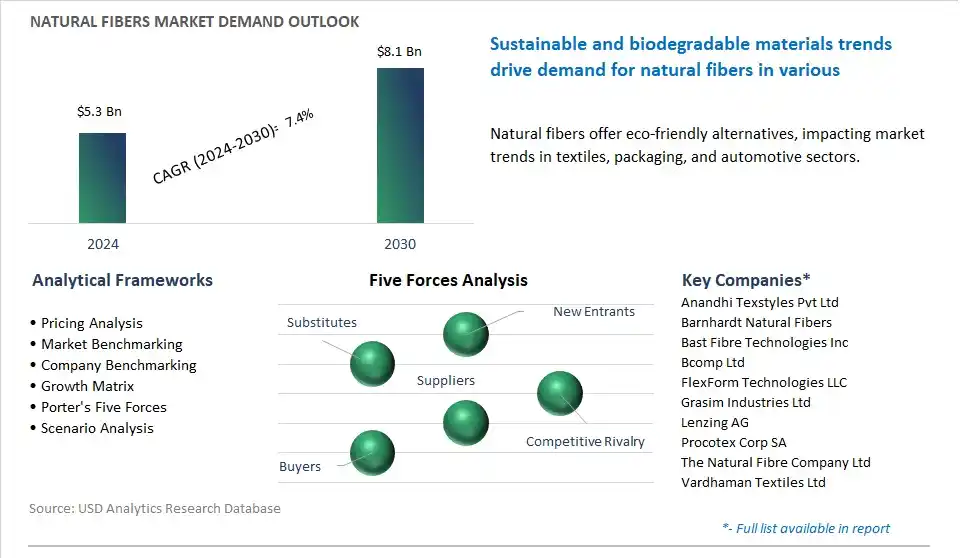
According to USD Analytics the Global Natural Fibers Market is projected to grow from $5.3 Billion in 2025 to $8.1 Billion by 2034, at a CAGR of 7.4%. from 2025 to 2034.
The global Natural Fibers Market Study analyzes and forecasts the market size across 6 regions and 24 countries for diverse segments -By Fiber (Cotton, Wool, Flax, Silk, Jute, Hemp, Sisal, Kenaf, Others), By Distribution Channel (Manufacturers, Distributors, Wholesalers, Retailers, Others), By Application (Clothing, Furnishing, Industrial, Others).
An Introduction to Global Natural Fibers Market in 2025
The market for natural fibers is witnessing growth driven by the increasing demand for sustainable, eco-friendly materials in industries such as automotive, construction, textiles, and consumer goods. One key trend shaping the future of the industry is the adoption of natural fibers such as jute, hemp, flax, cotton, and bamboo as alternatives to synthetic fibers in various applications, driven by environmental concerns, regulatory mandates, and consumer preferences for renewable and biodegradable materials. Natural fibers offer several advantages such as low environmental impact, biodegradability, renewability, and good mechanical properties, making them suitable for a wide range of applications including automotive interiors, insulation materials, textiles, packaging, and consumer products. This trend is driving investments in natural fiber cultivation, processing technologies, and product development to improve fiber quality, consistency, and performance while ensuring sustainability and ethical sourcing practices throughout the supply chain. Moreover, the growing emphasis on carbon footprint reduction, energy efficiency, and resource conservation in industries such as automotive manufacturing is driving the adoption of natural fiber composites for lightweighting, acoustic insulation, and interior trim applications, enabling vehicle manufacturers to meet regulatory requirements and consumer demands for greener transportation solutions. Additionally, the expansion of the textile and apparel industry and the increasing demand for sustainable fashion are driving the adoption of natural fibers in clothing, footwear, and accessories, as consumers seek alternatives to synthetic fabrics derived from petrochemicals. Furthermore, the integration of natural fibers into packaging materials such as corrugated cardboard, paperboard, and bioplastics is driving market growth, driven by their renewable, recyclable, and compostable properties, contributing to the development of eco-friendly packaging solutions and circular economy initiatives in the global marketplace.
Natural Fibers Market Competitive Landscape
The market report analyses the leading companies in the industry including Anandhi Texstyles Pvt Ltd, Barnhardt Natural Fibers, Bast Fibre Technologies Inc, Bcomp Ltd, FlexForm Technologies LLC, Grasim Industries Ltd, Lenzing AG, Procotex Corp SA, The Natural Fibre Company Ltd, Vardhaman Textiles Ltd.
Natural Fibers Market Dynamics
Natural Fibers Market Trend: Growing Preference for Sustainable and Biodegradable Materials
A significant trend in the natural fibers market is the growing preference for sustainable and biodegradable materials driven by increasing environmental awareness, regulations promoting eco-friendly alternatives, and consumer demand for greener products. Natural fibers, derived from plant and animal sources such as cotton, hemp, jute, wool, and bamboo, are valued for their renewable nature, low environmental impact, and biodegradability. With concerns about plastic pollution, carbon emissions, and resource depletion, there is a rising interest in natural fibers as substitutes for synthetic materials in various industries, including textiles, automotive, construction, and packaging. This trend reflects the shift towards sustainable consumption patterns and the adoption of eco-friendly materials that reduce environmental footprint and contribute to a circular economy, driving market growth and adoption of natural fibers across different applications.
Natural Fibers Market Driver: Demand for Eco-Friendly and Ethical Products
A key driver propelling the natural fibers market is the demand for eco-friendly and ethical products fueled by consumer preferences for sustainable, non-toxic, and ethically sourced materials. As consumers become more environmentally conscious and socially responsible, there is a growing demand for products made from natural fibers that offer benefits such as breathability, moisture absorption, and biodegradability. Natural fibers are perceived as safer alternatives to synthetic fibers, which may contain harmful chemicals and microplastics, making them increasingly popular choices for clothing, home textiles, and personal care products. Additionally, the adoption of sustainability certifications and ethical sourcing practices by brands and retailers further drives the demand for natural fibers, as consumers seek assurance of environmentally and socially responsible production processes. The growing demand for eco-friendly and ethical products drives market growth and adoption of natural fibers, positioning them as preferred materials in the global market for sustainable textiles and consumer goods.
Natural Fibers Market Opportunity: Innovation in Composite Materials and Biocomposites
An opportunity for market expansion lies in the innovation and development of composite materials and biocomposites where natural fibers can be used as reinforcement materials in combination with polymers or resins. With the increasing demand for lightweight, durable, and environmentally friendly materials in industries such as automotive, aerospace, construction, and consumer goods, there is a growing opportunity to utilize natural fibers as reinforcements in composite materials. Natural fibers offer advantages such as high strength-to-weight ratios, low cost, and recyclability, making them attractive alternatives to traditional reinforcement materials like glass fibers or carbon fibers. By incorporating natural fibers into composite materials, manufacturers can create biocomposites with enhanced mechanical properties, reduced environmental impact, and potential applications in a wide range of industries. The development of innovative composite materials and biocomposites presents opportunities for collaboration between natural fiber producers, polymer manufacturers, and end-users to capitalize on the unique properties of natural fibers and drive further growth and market penetration in the natural fibers segment.
Natural Fibers Market Share Analysis: Cotton segment generated the highest revenue in the industry
The Cotton segment is the largest segment in the Natural Fibers Market due to diverse key factors that contribute to its dominance. Cotton is one of the most widely cultivated and utilized natural fibers globally, with extensive applications across various industries, including textiles, apparel, home furnishings, and industrial products. Its popularity stems from diverse advantageous properties, including softness, breathability, absorbency, and versatility in processing. In the textile and apparel industry, cotton fibers are prized for their comfort, durability, and ease of dyeing, making them a preferred choice for a wide range of garments, from everyday wear to high-end fashion. Additionally, cotton fibers are highly adaptable to different weaving and knitting techniques, allowing for the creation of a diverse array of fabrics with varying textures and appearances. Beyond textiles, cotton fibers are also used in non-textile applications such as medical supplies, paper products, and industrial materials. Further, cotton's natural origin and biodegradability align with consumer preferences for eco-friendly and sustainable products, further solidifying its position as the largest segment in the Natural Fibers Market. With its widespread availability, versatile applications, and favorable characteristics, cotton continues to be the dominant natural fiber in the market.
Natural Fibers Market Share Analysis: Retailers Segment is poised to register the fastest growth rate (CAGR) over the forecast period to 2034
The Retailers segment is the fastest growing segment in the Natural Fibers Market due to diverse key factors driving its rapid expansion. Retailers play a pivotal role in shaping consumer preferences and driving demand for natural fiber products through their marketing strategies, product offerings, and consumer education initiatives. With increasing consumer awareness and demand for sustainable and eco-friendly products, retailers are increasingly emphasizing natural fiber options across various product categories, including apparel, home textiles, accessories, and personal care products. Retailers leverage their influence and reach to promote the benefits of natural fibers such as cotton, wool, linen, and hemp, highlighting their superior comfort, breathability, durability, and biodegradability compared to synthetic alternatives. Additionally, retailers are investing in sustainable sourcing practices and supply chain transparency to ensure the authenticity and ethical production of natural fiber products, resonating with environmentally conscious consumers. In addition, the rise of e-commerce platforms and online retailing has expanded the accessibility of natural fiber products to a wider consumer base, driving sales growth in this segment. As retailers continue to prioritize sustainability and cater to evolving consumer preferences, the Retailers segment experiences significant growth in the Natural Fibers Market, driving the adoption of natural fiber products and reshaping the landscape of the textile and apparel industry.
Natural Fibers Market Share Analysis: Industrial Segment is poised to register the fastest growth rate (CAGR) over the forecast period to 2034
The Industrial segment is the fastest growing segment in the Natural Fibers Market due to diverse driving factors propelling its expansion. Natural fibers are increasingly recognized for their sustainable, renewable, and biodegradable properties, making them attractive alternatives to synthetic materials in various industrial applications. In sectors such as automotive, construction, packaging, and composites, natural fibers offer numerous advantages, including lightweight, high strength-to-weight ratio, thermal insulation, and acoustic dampening properties. These qualities make natural fibers well-suited for applications such as automotive interior components, building insulation materials, packaging solutions, and reinforcement materials for composites. In addition, the growing emphasis on sustainability and environmental responsibility across industries drives the demand for natural fiber-based products as companies seek to reduce their carbon footprint and minimize environmental impact. Additionally, advancements in manufacturing processes and technologies have expanded the range of industrial applications for natural fibers, driving innovation and adoption in sectors previously dominated by synthetic materials. As industries increasingly prioritize sustainability, performance, and cost-effectiveness, the Industrial segment experiences rapid growth in the Natural Fibers Market, fueled by the increasing demand for eco-friendly and high-performance materials.
Natural Fibers Market Report Segmentation
By Fiber
Cotton
Wool
Flax
Silk
Jute
Hemp
Sisal
Kenaf
Others
By Distribution Channel
Manufacturers
Distributors
Wholesalers
Retailers
Others
By Application
Clothing
Furnishing
Industrial
Others
Regions Included
North America (US, Canada, Mexico)
Europe (Germany, UK, France, Spain, Italy, Russia, Rest of Europe)
Asia Pacific (China, India, Japan, South Korea, Australia, South East Asia, Rest of Asia)
South America (Brazil, Argentina, Rest of South America)
Middle East and Africa (Saudi Arabia, UAE, Rest of Middle East, South Africa, Egypt, Rest of Africa)
Natural Fibers Companies Profiled in the Market Study
Anandhi Texstyles Pvt Ltd
Barnhardt Natural Fibers
Bast Fibre Technologies Inc
Bcomp Ltd
FlexForm Technologies LLC
Grasim Industries Ltd
Lenzing AG
Procotex Corp SA
The Natural Fibre Company Ltd
Vardhaman Textiles Ltd
*- List Not Exhaustive
TABLE OF CONTENTS
1 Introduction to 2025 Natural Fibers Market
1.1 Market Overview
1.2 Quick Facts
1.3 Scope/Objective of the Study
1.4 Market Definition
1.5 Countries and Regions Covered
1.6 Units, Currency, and Conversions
1.7 Industry Value Chain
2 Research Methodology
2.1 Market Size Estimation
2.2 Sources and Research Methodology
2.3 Data Triangulation
2.4 Assumptions and Limitations
3 Executive Summary
3.1 Global Natural Fibers Market Size Outlook, $ Million, 2021 to 2034
3.2 Natural Fibers Market Outlook by Type, $ Million, 2021 to 2034
3.3 Natural Fibers Market Outlook by Product, $ Million, 2021 to 2034
3.4 Natural Fibers Market Outlook by Application, $ Million, 2021 to 2034
3.5 Natural Fibers Market Outlook by Key Countries, $ Million, 2021 to 2034
4 Market Dynamics
4.1 Key Driving Forces of Natural Fibers Industry
4.2 Key Market Trends in Natural Fibers Industry
4.3 Potential Opportunities in Natural Fibers Industry
4.4 Key Challenges in Natural Fibers Industry
5 Market Factor Analysis
5.1 Value Chain Analysis
5.2 Competitive Landscape
5.2.1 Global Natural Fibers Market Share by Company (%), 2023
5.2.2 Product Offerings by Company
5.3 Porter’s Five Forces Analysis
5.4 Pricing Analysis and Outlook
6 Growth Outlook Across Scenarios
6.1 Growth Analysis-Case Scenario Definitions
6.2 Low Growth Scenario Forecasts
6.3 Reference Growth Scenario Forecasts
6.4 High Growth Scenario Forecasts
7 Global Natural Fibers Market Outlook by Segments
7.1 Natural Fibers Market Outlook by Segments, $ Million, 2021- 2034
By Fiber
Cotton
Wool
Flax
Silk
Jute
Hemp
Sisal
Kenaf
Others
By Distribution Channel
Manufacturers
Distributors
Wholesalers
Retailers
Others
By Application
Clothing
Furnishing
Industrial
Others
8 North America Natural Fibers Market Analysis and Outlook To 2030
8.1 Introduction to North America Natural Fibers Markets in 2024
8.2 North America Natural Fibers Market Size Outlook by Country, 2021-2034
8.2.1 United States
8.2.2 Canada
8.2.3 Mexico
8.3 North America Natural Fibers Market size Outlook by Segments, 2021-2034
By Fiber
Cotton
Wool
Flax
Silk
Jute
Hemp
Sisal
Kenaf
Others
By Distribution Channel
Manufacturers
Distributors
Wholesalers
Retailers
Others
By Application
Clothing
Furnishing
Industrial
Others
9 Europe Natural Fibers Market Analysis and Outlook To 2030
9.1 Introduction to Europe Natural Fibers Markets in 2024
9.2 Europe Natural Fibers Market Size Outlook by Country, 2021-2034
9.2.1 Germany
9.2.2 France
9.2.3 Spain
9.2.4 United Kingdom
9.2.4 Italy
9.2.5 Russia
9.2.6 Norway
9.2.7 Rest of Europe
9.3 Europe Natural Fibers Market Size Outlook by Segments, 2021-2034
By Fiber
Cotton
Wool
Flax
Silk
Jute
Hemp
Sisal
Kenaf
Others
By Distribution Channel
Manufacturers
Distributors
Wholesalers
Retailers
Others
By Application
Clothing
Furnishing
Industrial
Others
10 Asia Pacific Natural Fibers Market Analysis and Outlook To 2030
10.1 Introduction to Asia Pacific Natural Fibers Markets in 2024
10.2 Asia Pacific Natural Fibers Market Size Outlook by Country, 2021-2034
10.2.1 China
10.2.2 India
10.2.3 Japan
10.2.4 South Korea
10.2.5 Indonesia
10.2.6 Malaysia
10.2.7 Australia
10.2.8 Rest of Asia Pacific
10.3 Asia Pacific Natural Fibers Market size Outlook by Segments, 2021-2034
By Fiber
Cotton
Wool
Flax
Silk
Jute
Hemp
Sisal
Kenaf
Others
By Distribution Channel
Manufacturers
Distributors
Wholesalers
Retailers
Others
By Application
Clothing
Furnishing
Industrial
Others
11 South America Natural Fibers Market Analysis and Outlook To 2030
11.1 Introduction to South America Natural Fibers Markets in 2024
11.2 South America Natural Fibers Market Size Outlook by Country, 2021-2034
11.2.1 Brazil
11.2.2 Argentina
11.2.3 Rest of South America
11.3 South America Natural Fibers Market size Outlook by Segments, 2021-2034
By Fiber
Cotton
Wool
Flax
Silk
Jute
Hemp
Sisal
Kenaf
Others
By Distribution Channel
Manufacturers
Distributors
Wholesalers
Retailers
Others
By Application
Clothing
Furnishing
Industrial
Others
12 Middle East and Africa Natural Fibers Market Analysis and Outlook To 2030
12.1 Introduction to Middle East and Africa Natural Fibers Markets in 2024
12.2 Middle East and Africa Natural Fibers Market Size Outlook by Country, 2021-2034
12.2.1 Saudi Arabia
12.2.2 UAE
12.2.3 Oman
12.2.4 Rest of Middle East
12.2.5 Egypt
12.2.6 Nigeria
12.2.7 South Africa
12.2.8 Rest of Africa
12.3 Middle East and Africa Natural Fibers Market size Outlook by Segments, 2021-2034
By Fiber
Cotton
Wool
Flax
Silk
Jute
Hemp
Sisal
Kenaf
Others
By Distribution Channel
Manufacturers
Distributors
Wholesalers
Retailers
Others
By Application
Clothing
Furnishing
Industrial
Others
13 Company Profiles
13.1 Company Snapshot
13.2 SWOT Profiles
13.3 Products and Services
13.4 Recent Developments
13.5 Financial Profile
Anandhi Texstyles Pvt Ltd
Barnhardt Natural Fibers
Bast Fibre Technologies Inc
Bcomp Ltd
FlexForm Technologies LLC
Grasim Industries Ltd
Lenzing AG
Procotex Corp SA
The Natural Fibre Company Ltd
Vardhaman Textiles Ltd
14 Appendix
14.1 Customization Offerings
14.2 Subscription Services
14.3 Related Reports
14.4 Publisher Expertise
