The global Nematicides Market is poised to register a 6.8% CAGR from $2.6 Billion in 2024 to $3.9 Billion in 2030.
The global Nematicides Market Study analyzes and forecasts the market size across 6 regions and 24 countries for diverse segments -By Type (Chemical, Biological), By Formulation (Granular, Liquid, Others), By Nematode (Root-Knot Nematodes, Cyst Nematodes, Lesion Nematodes, Others).
An Introduction to Global Nematicides Market in 2024
The nematicides market is witnessing steady growth driven by the increasing prevalence of nematode infestations in agriculture and the rising demand for high-value crops with enhanced yields and quality. Key trends shaping the future of this industry include the growing adoption of integrated pest management (IPM) practices and sustainable soil management techniques, leading to the development of novel nematicides with lower environmental impact and improved efficacy. With regulatory pressures and consumer concerns over chemical residues in food, manufacturers are investing in the research and development of biological and bio-based nematicides derived from plant extracts, microbial agents, and natural compounds. Additionally, advancements in formulation technologies and precision application methods are enhancing the targeted delivery and efficacy of nematicide products while minimizing off-target effects. Furthermore, the increasing adoption of soil health management practices such as crop rotation, cover cropping, and organic amendments is driving market expansion, as farmers seek holistic solutions to mitigate nematode damage and improve soil fertility. As agriculture continues to evolve towards sustainable and resilient production systems, the nematicides market is expected to witness continued innovation and investment in environmentally friendly solutions, offering opportunities for market players to address evolving pest management challenges and customer needs.
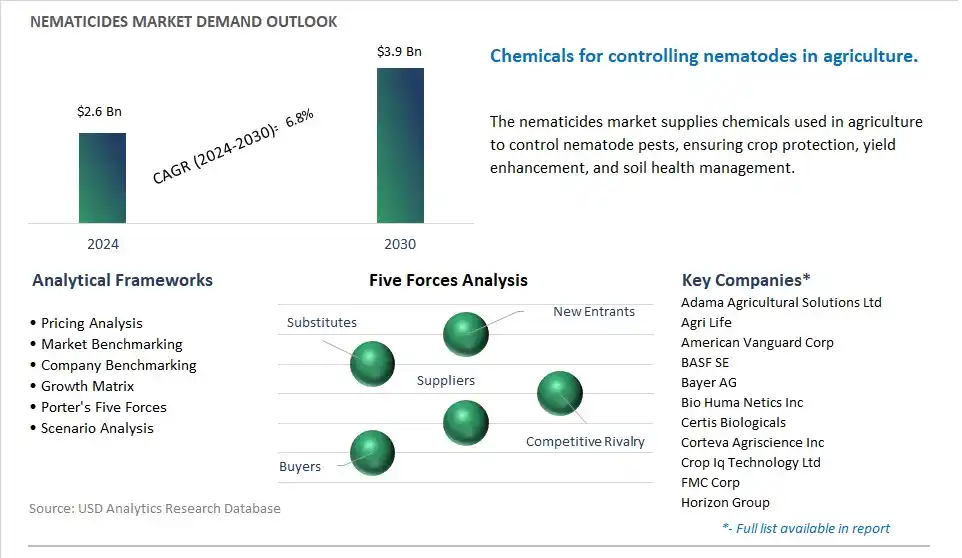
Nematicides Market Competitive Landscape
The market report analyses the leading companies in the industry including Adama Agricultural Solutions Ltd, Agri Life, American Vanguard Corp, BASF SE, Bayer AG, Bio Huma Netics Inc, Certis Biologicals, Corteva Agriscience Inc, Crop Iq Technology Ltd, FMC Corp, Horizon Group, Isagro S.p.A, Marrone Bio Innovations, Nufarm Ltd, Syngenta AG, T. Stanes & Company Ltd, UPL Ltd, Valent Biosciences Llc.
Nematicides Market Dynamics
Nematicides Market Trend: Shift Towards Sustainable and Eco-Friendly Solutions
A prominent trend in the nematicides market is the increasing shift towards sustainable and eco-friendly solutions for pest and nematode control. With growing concerns over the environmental impact of chemical pesticides and their harmful effects on ecosystems, there is a rising demand for nematicides that offer effective pest management while minimizing adverse effects on non-target organisms and the environment. The trend is driving research and development efforts towards the creation of bio-based nematicides derived from natural sources or employing innovative formulations that reduce ecological risks, aligning with the broader sustainability goals of agriculture and horticulture industries.
Nematicides Market Driver: Escalating Need for Higher Crop Yields and Quality
A key driver propelling the nematicides market is the escalating need for higher crop yields and quality due to the persistent threat posed by nematode infestations. Nematodes are destructive pests that can cause significant damage to a wide range of crops, leading to yield losses, reduced crop quality, and economic losses for farmers. As global food demand continues to rise with population growth, there is an increasing pressure on agricultural producers to enhance productivity and ensure food security. Nematicides play a crucial role in protecting crops from nematode damage, thereby enabling farmers to achieve higher yields and maintain product quality, driving the demand for these pest management solutions.
Nematicides Market Opportunity: Development of Integrated Pest Management (IPM) Solutions
An opportunity in the nematicides market lies in the development and implementation of integrated pest management (IPM) solutions that offer holistic and sustainable approaches to nematode control. IPM strategies involve the use of multiple pest management tactics, including cultural practices, biological control agents, and judicious use of pesticides, to minimize reliance on chemical nematicides and mitigate the development of resistance in nematode populations. By integrating nematicides with other control methods within an IPM framework, manufacturers and agricultural stakeholders can optimize pest management outcomes while reducing environmental risks and preserving beneficial organisms. This presents an opportunity for innovation and collaboration across the agricultural value chain to deliver comprehensive and sustainable solutions for nematode management.
Nematicides Market Share Analysis: Chemical Segment generated the highest revenue in 2024
The Chemical segment is the largest in the Nematicides Market. Chemical nematicides have historically dominated the market due to their efficacy in controlling nematode populations and their widespread availability. Chemical nematicides are formulated with active ingredients that target and disrupt nematode populations in soil, offering a quick and reliable solution for farmers to manage nematode infestations and protect crop yields. Additionally, chemical nematicides often have a broad spectrum of activity, providing control against a wide range of nematode species and stages of development. Furthermore, chemical nematicides have undergone extensive research and development, resulting in the development of new formulations with improved efficacy, safety, and environmental profiles. Despite growing interest in biological alternatives, chemical nematicides remain the go-to solution for many farmers due to their proven effectiveness and ease of use. Hence, the Chemical segment is the largest in the Nematicides Market, driven by its efficacy, broad-spectrum activity, and established market presence.
Nematicides Market Share Analysis: Liquid segment is poised to register the fastest growth rate (CAGR) over the forecast period to 2030
The Liquid segment is the fastest-growing segment in the Nematicides Market. Liquid formulations offer potential advantages over granular formulations, contributing to their rapid growth in the market. liquid nematicides are more convenient and easy to apply, allowing for uniform coverage and distribution over the soil surface. This ensures better contact with nematodes and improved efficacy in controlling nematode populations. Further, liquid formulations can be applied using various application methods, including foliar spraying, soil drenching, and drip irrigation, providing flexibility to farmers in choosing the most suitable application method for their crops and farming practices. Additionally, liquid nematicides are often formulated with advanced delivery systems and adjuvants to enhance their efficacy, stability, and plant compatibility. Furthermore, liquid formulations are more readily absorbed by the soil and plant roots, facilitating faster uptake and translocation of the active ingredients within the plant tissues, leading to quicker and more effective nematode control. The growing adoption of precision agriculture practices and integrated pest management strategies further drives the demand for liquid nematicides, as they offer precise application and targeted pest control, minimizing environmental impact and optimizing crop protection. Hence, the Liquid segment is the fastest-growing segment in the Nematicides Market, propelled by its convenience, efficacy, versatility, and compatibility with modern agricultural practices.
Nematicides Market Share Analysis: Root-Knot Nematodes segment is poised to register the fastest growth rate (CAGR) over the forecast period to 2030
The fastest-growing segment in the Nematicides Market is the Root-Knot Nematodes segment. Root-knot nematodes are one of the most economically damaging plant-parasitic nematodes globally, causing significant yield losses in a wide range of crops, including vegetables, fruits, and ornamentals. Accordingly, there has been a growing demand for effective nematicides targeting root-knot nematodes to mitigate crop damage and enhance yields. Additionally, root-knot nematodes have a wide host range and can infect a diverse array of plant species, making them a major concern for farmers worldwide. Further, root-knot nematodes have a high reproductive rate and can quickly build up populations in infested soils, posing challenges for sustainable nematode management. Consequently, there is a pressing need for nematicides with specific efficacy against root-knot nematodes to address this growing agricultural problem. Accordingly, the Root-Knot Nematodes segment is experiencing rapid growth in the Nematicides Market due to the increasing demand for targeted solutions to combat this widespread and economically significant nematode pest.
Nematicides Market Report Segmentation
By Type
Chemical
-Fumigants
-Organophosphates
-Carbamates
-Others
Biological
-Microbials
-Biochemical
-Macrobials
By Formulation
Granular
Liquid
Others
By Nematode
Root-Knot Nematodes
Cyst Nematodes
Lesion Nematodes
Others
Regions Included
North America (US, Canada, Mexico)
Europe (Germany, UK, France, Spain, Italy, Russia, Rest of Europe)
Asia Pacific (China, India, Japan, South Korea, Australia, South East Asia, Rest of Asia)
South America (Brazil, Argentina, Rest of South America)
Middle East and Africa (Saudi Arabia, UAE, Rest of Middle East, South Africa, Egypt, Rest of Africa)
Nematicides Companies Profiled in the Market Study
Adama Agricultural Solutions Ltd
Agri Life
American Vanguard Corp
BASF SE
Bayer AG
Bio Huma Netics Inc
Certis Biologicals
Corteva Agriscience Inc
Crop Iq Technology Ltd
FMC Corp
Horizon Group
Isagro S.p.A
Marrone Bio Innovations
Nufarm Ltd
Syngenta AG
T. Stanes & Company Ltd
UPL Ltd
Valent Biosciences Llc
*- List Not Exhaustive
TABLE OF CONTENTS
1 Introduction to 2024 Nematicides Market
1.1 Market Overview
1.2 Quick Facts
1.3 Scope/Objective of the Study
1.4 Market Definition
1.5 Countries and Regions Covered
1.6 Units, Currency, and Conversions
1.7 Industry Value Chain
2 Research Methodology
2.1 Market Size Estimation
2.2 Sources and Research Methodology
2.3 Data Triangulation
2.4 Assumptions and Limitations
3 Executive Summary
3.1 Global Nematicides Market Size Outlook, $ Million, 2021 to 2030
3.2 Nematicides Market Outlook by Type, $ Million, 2021 to 2030
3.3 Nematicides Market Outlook by Product, $ Million, 2021 to 2030
3.4 Nematicides Market Outlook by Application, $ Million, 2021 to 2030
3.5 Nematicides Market Outlook by Key Countries, $ Million, 2021 to 2030
4 Market Dynamics
4.1 Key Driving Forces of Nematicides Industry
4.2 Key Market Trends in Nematicides Industry
4.3 Potential Opportunities in Nematicides Industry
4.4 Key Challenges in Nematicides Industry
5 Market Factor Analysis
5.1 Value Chain Analysis
5.2 Competitive Landscape
5.2.1 Global Nematicides Market Share by Company (%), 2023
5.2.2 Product Offerings by Company
5.3 Porter’s Five Forces Analysis
5.4 Pricing Analysis and Outlook
6 Growth Outlook Across Scenarios
6.1 Growth Analysis-Case Scenario Definitions
6.2 Low Growth Scenario Forecasts
6.3 Reference Growth Scenario Forecasts
6.4 High Growth Scenario Forecasts
7 Global Nematicides Market Outlook by Segments
7.1 Nematicides Market Outlook by Segments, $ Million, 2021- 2030
By Type
Chemical
-Fumigants
-Organophosphates
-Carbamates
-Others
Biological
-Microbials
-Biochemical
-Macrobials
By Formulation
Granular
Liquid
Others
By Nematode
Root-Knot Nematodes
Cyst Nematodes
Lesion Nematodes
Others
8 North America Nematicides Market Analysis and Outlook To 2030
8.1 Introduction to North America Nematicides Markets in 2024
8.2 North America Nematicides Market Size Outlook by Country, 2021-2030
8.2.1 United States
8.2.2 Canada
8.2.3 Mexico
8.3 North America Nematicides Market size Outlook by Segments, 2021-2030
By Type
Chemical
-Fumigants
-Organophosphates
-Carbamates
-Others
Biological
-Microbials
-Biochemical
-Macrobials
By Formulation
Granular
Liquid
Others
By Nematode
Root-Knot Nematodes
Cyst Nematodes
Lesion Nematodes
Others
9 Europe Nematicides Market Analysis and Outlook To 2030
9.1 Introduction to Europe Nematicides Markets in 2024
9.2 Europe Nematicides Market Size Outlook by Country, 2021-2030
9.2.1 Germany
9.2.2 France
9.2.3 Spain
9.2.4 United Kingdom
9.2.4 Italy
9.2.5 Russia
9.2.6 Norway
9.2.7 Rest of Europe
9.3 Europe Nematicides Market Size Outlook by Segments, 2021-2030
By Type
Chemical
-Fumigants
-Organophosphates
-Carbamates
-Others
Biological
-Microbials
-Biochemical
-Macrobials
By Formulation
Granular
Liquid
Others
By Nematode
Root-Knot Nematodes
Cyst Nematodes
Lesion Nematodes
Others
10 Asia Pacific Nematicides Market Analysis and Outlook To 2030
10.1 Introduction to Asia Pacific Nematicides Markets in 2024
10.2 Asia Pacific Nematicides Market Size Outlook by Country, 2021-2030
10.2.1 China
10.2.2 India
10.2.3 Japan
10.2.4 South Korea
10.2.5 Indonesia
10.2.6 Malaysia
10.2.7 Australia
10.2.8 Rest of Asia Pacific
10.3 Asia Pacific Nematicides Market size Outlook by Segments, 2021-2030
By Type
Chemical
-Fumigants
-Organophosphates
-Carbamates
-Others
Biological
-Microbials
-Biochemical
-Macrobials
By Formulation
Granular
Liquid
Others
By Nematode
Root-Knot Nematodes
Cyst Nematodes
Lesion Nematodes
Others
11 South America Nematicides Market Analysis and Outlook To 2030
11.1 Introduction to South America Nematicides Markets in 2024
11.2 South America Nematicides Market Size Outlook by Country, 2021-2030
11.2.1 Brazil
11.2.2 Argentina
11.2.3 Rest of South America
11.3 South America Nematicides Market size Outlook by Segments, 2021-2030
By Type
Chemical
-Fumigants
-Organophosphates
-Carbamates
-Others
Biological
-Microbials
-Biochemical
-Macrobials
By Formulation
Granular
Liquid
Others
By Nematode
Root-Knot Nematodes
Cyst Nematodes
Lesion Nematodes
Others
12 Middle East and Africa Nematicides Market Analysis and Outlook To 2030
12.1 Introduction to Middle East and Africa Nematicides Markets in 2024
12.2 Middle East and Africa Nematicides Market Size Outlook by Country, 2021-2030
12.2.1 Saudi Arabia
12.2.2 UAE
12.2.3 Oman
12.2.4 Rest of Middle East
12.2.5 Egypt
12.2.6 Nigeria
12.2.7 South Africa
12.2.8 Rest of Africa
12.3 Middle East and Africa Nematicides Market size Outlook by Segments, 2021-2030
By Type
Chemical
-Fumigants
-Organophosphates
-Carbamates
-Others
Biological
-Microbials
-Biochemical
-Macrobials
By Formulation
Granular
Liquid
Others
By Nematode
Root-Knot Nematodes
Cyst Nematodes
Lesion Nematodes
Others
13 Company Profiles
13.1 Company Snapshot
13.2 SWOT Profiles
13.3 Products and Services
13.4 Recent Developments
13.5 Financial Profile
Adama Agricultural Solutions Ltd
Agri Life
American Vanguard Corp
BASF SE
Bayer AG
Bio Huma Netics Inc
Certis Biologicals
Corteva Agriscience Inc
Crop Iq Technology Ltd
FMC Corp
Horizon Group
Isagro S.p.A
Marrone Bio Innovations
Nufarm Ltd
Syngenta AG
T. Stanes & Company Ltd
UPL Ltd
Valent Biosciences Llc
14 Appendix
14.1 Customization Offerings
14.2 Subscription Services
14.3 Related Reports
14.4 Publisher Expertise
By Type
Chemical
-Fumigants
-Organophosphates
-Carbamates
-Others
Biological
-Microbials
-Biochemical
-Macrobials
By Formulation
Granular
Liquid
Others
By Nematode
Root-Knot Nematodes
Cyst Nematodes
Lesion Nematodes
Others
Countries Analyzed
North America (US, Canada, Mexico)
Europe (Germany, UK, France, Spain, Italy, Russia, Rest of Europe)
Asia Pacific (China, India, Japan, South Korea, Australia, South East Asia, Rest of Asia)
South America (Brazil, Argentina, Rest of South America)
Middle East and Africa (Saudi Arabia, UAE, Rest of Middle East, South Africa, Egypt, Rest of Africa)
