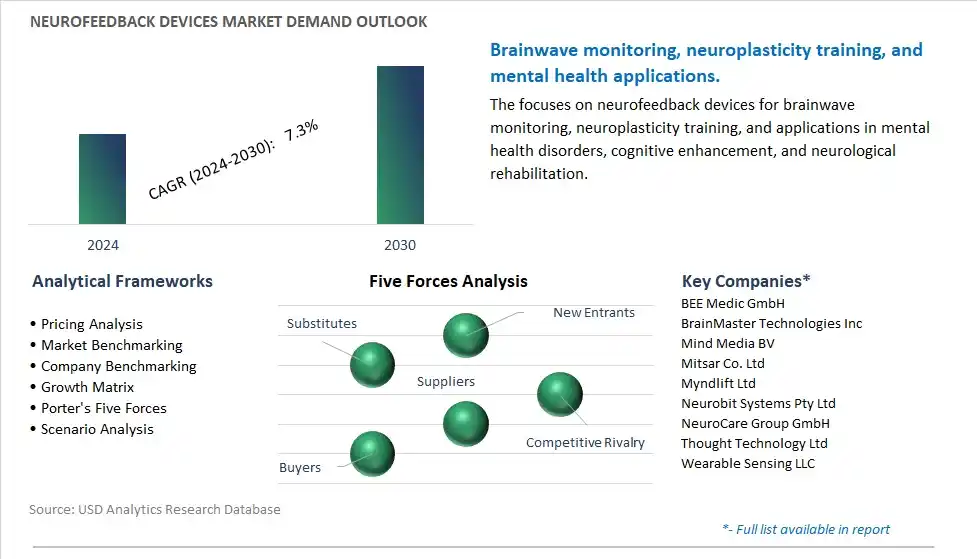
Neurofeedback Devices Market is estimated to increase at a Compounded Annual Growth Rate of 7.3% CAGR over the forecast period from 2024 to 2030
The Neurofeedback Devices Market study analyzes and forecasts the market size across 6 regions and 24 countries for diverse segments- By Application (Attention Deficit Hyperactivity Disorder (ADHD), Pain Management, Insomnia, Anxiety Disorder, Others).
An Introduction to Neurofeedback Devices Market in 2024
In 2024, the market for neurofeedback devices continues to grow, driven by the increasing demand for non-invasive, drug-free approaches to brain health and performance optimization. Neurofeedback, also known as EEG biofeedback or neurotherapy, is a form of brain training that uses real-time monitoring of brainwave activity to teach individuals to self-regulate their brain function and activity patterns. Neurofeedback devices typically consist of electroencephalography (EEG) sensors, amplifiers, and software algorithms that analyze brainwave signals and provide visual or auditory feedback to users, allowing them to learn to modulate their brain activity in response to specific cues or tasks. These devices offer potential applications for improving cognitive function, managing stress, enhancing attention and focus, treating neurological disorders such as ADHD, anxiety, depression, and PTSD, and optimizing performance in sports, education, and professional settings. Technological advancements in neurofeedback devices include portable, wireless systems, virtual reality (VR) environments, and smartphone-based applications, offering convenient and accessible solutions for home use, clinical practice, and research applications. Moreover, the integration of machine learning algorithms, artificial intelligence (AI) analytics, and personalized neurofeedback protocols enhances the effectiveness and individualization of neurofeedback interventions, enabling tailored approaches for addressing diverse cognitive and emotional challenges. With the growing interest in brain health, mental wellness, and personalized performance enhancement, the market for neurofeedback devices is poised for continued growth and innovation, offering promising opportunities for individuals seeking to optimize their brain function and well-being.
Market Trend: Growing Interest in Mental Health and Wellness Solutions
A prominent trend in the neurofeedback devices market is the growing interest in mental health and wellness solutions that leverage neurofeedback technology to improve cognitive function, manage stress, and enhance overall well-being. Neurofeedback, also known as EEG biofeedback, is a non-invasive technique that provides real-time feedback on brain activity, allowing individuals to learn self-regulation skills and optimize brain functioning. With increasing awareness of the importance of mental health and the impact of stress on cognitive performance, there is a rising demand for accessible and effective neurofeedback devices for both clinical and consumer applications. This trend is driven by factors such as the growing prevalence of mental health disorders, the rise of digital health and self-care technologies, and the shift towards holistic approaches to mental wellness that prioritize prevention and self-management. Additionally, advancements in wearable technology, mobile apps, and virtual reality platforms offer opportunities to expand the reach of neurofeedback interventions and personalize therapy options for individuals seeking to improve their mental resilience and cognitive performance. As consumers and healthcare providers embrace neurofeedback as a complementary therapy for mental health and performance enhancement, the market for neurofeedback devices is expected to experience significant growth and diversification in the coming years.
Market Driver: Increasing Incidence of Neurological Disorders and Mental Health Conditions
The primary driver propelling the neurofeedback devices market is the increasing incidence of neurological disorders and mental health conditions, driving the demand for non-pharmacological interventions that address symptoms and improve quality of life. Neurological disorders, such as attention deficit hyperactivity disorder (ADHD), anxiety disorders, depression, and post-traumatic stress disorder (PTSD), affect millions of individuals worldwide and are associated with impairments in cognitive function, emotional regulation, and behavioral control. Traditional treatment approaches often involve medication and psychotherapy, but there is growing recognition of the limitations and side effects of pharmacological interventions, leading to the exploration of alternative therapies such as neurofeedback. This driver is further fueled by demographic trends such as population aging, increasing stress levels, and changing lifestyle factors, which contribute to the rising burden of neurological and mental health conditions across diverse age groups and demographics. Additionally, regulatory initiatives, reimbursement policies, and public health campaigns aimed at promoting mental health awareness and access to evidence-based treatments create opportunities for market growth and adoption of neurofeedback devices in clinical practice. As healthcare systems prioritize the integration of non-pharmacological interventions into mental health care pathways, the demand for neurofeedback devices as adjunctive therapies is expected to continue to rise, driven by the imperative to improve patient outcomes and reduce the societal burden of neurological and mental health disorders.
Market Opportunity: Expansion into Brain-Computer Interface (BCI) Applications
An opportunity within the neurofeedback devices market lies in the expansion into brain-computer interface (BCI) applications that enable direct communication between the brain and external devices for rehabilitation, assistive technology, and human-machine interaction. BCI technology integrates neurofeedback principles with machine learning algorithms, signal processing techniques, and sensor technology to decode brain signals and translate them into actionable commands or feedback for controlling external devices or applications. By leveraging advancements in neuroimaging, electroencephalography (EEG), and neural interface technology, manufacturers can develop innovative BCI-enabled neurofeedback devices for applications such as neurorehabilitation, stroke recovery, motor rehabilitation, and assistive communication for individuals with paralysis or neurological disabilities. Additionally, BCI applications hold promise for enhancing cognitive performance, augmenting human capabilities, and facilitating immersive experiences in virtual reality, gaming, and entertainment industries. Collaborations between neuroscientists, engineers, and technology companies can drive innovation and commercialization of BCI-enabled neurofeedback devices, expanding the market reach and therapeutic potential of neurofeedback technology beyond traditional clinical settings. As the field of BCI research and development continues to evolve, the market for neurofeedback devices presents opportunities for differentiation, customization, and market leadership in harnessing the power of brain-computer interfaces to improve human health and performance.
Neurofeedback Devices Market Share Analysis: Attention Deficit Hyperactivity Disorder (ADHD)
The fast-growing segment within the neurofeedback devices market is for the treatment of Attention Deficit Hyperactivity Disorder (ADHD). This growth is driven by several factors. Firstly, ADHD is one of the most prevalent neurodevelopmental disorders affecting children and adults, characterized by symptoms such as inattention, hyperactivity, and impulsivity, which can significantly impair daily functioning and quality of life. Neurofeedback therapy, also known as EEG biofeedback or neurotherapy, has emerged as a non-pharmacological intervention for ADHD that aims to modulate brain activity and improve attention, self-regulation, and behavioral control through operant conditioning principles. Secondly, neurofeedback devices provide real-time feedback on brainwave activity, allowing individuals with ADHD to learn self-regulation techniques and enhance neuroplasticity by modifying dysfunctional neural patterns associated with attentional deficits and executive dysfunction. Neurofeedback protocols tailored to target specific brain regions, such as the prefrontal cortex and anterior cingulate cortex, have demonstrated efficacy in reducing ADHD symptoms and improving cognitive performance, academic achievement, and psychosocial functioning in children, adolescents, and adults with ADHD. Additionally, the growing preference for non-invasive, drug-free treatment options and the desire to avoid the potential side effects and long-term use of psychostimulant medications drive interest in neurofeedback therapy as an alternative or adjunctive approach for managing ADHD symptoms. Moreover, advancements in neurofeedback technology, including portable, user-friendly EEG devices, cloud-based data analytics, and gamified neurofeedback applications, enhance accessibility, affordability, and engagement in neurofeedback training programs, expanding the reach of neurofeedback therapy to a broader population of individuals with ADHD across diverse clinical and educational settings. Furthermore, the increasing awareness of neuroplasticity and the brain's capacity for self-regulation, coupled with growing research evidence supporting the efficacy and safety of neurofeedback for ADHD, contribute to market growth and acceptance among healthcare professionals, educators, and patients seeking evidence-based interventions for ADHD management. Overall, the combination of clinical need, technological innovation, and patient demand positions ADHD as the fast-growing segment within the neurofeedback devices market.
Neurofeedback Devices Competitive Analysis
The market research study provides in-depth insights into leading companies including the SWOT analyses, product profile, financial details, and recent developments acrossBEE Medic GmbH, BrainMaster Technologies Inc, Mind Media BV, Mitsar Co. Ltd, Myndlift Ltd, Neurobit Systems Pty Ltd, NeuroCare Group GmbH, Thought Technology Ltd, Wearable Sensing LLC
Neurofeedback Devices Market Segmentation
By Application
Attention Deficit Hyperactivity Disorder (ADHD)
Pain Management
Insomnia
Anxiety Disorder
Others
Geographical Analysis
North America (United States, Canada, Mexico)
Europe (Germany, France, United Kingdom, Spain, Italy, Rest of Europe)
Asia Pacific (China, India, Japan, South Korea, Rest of Asia Pacific)
South America (Brazil, Argentina, Rest of South America)
Middle East and Africa (Saudi Arabia, UAE, Rest of Middle East, South Africa, Egypt, Rest of Africa)
Neurofeedback Devices Market Companies
BEE Medic GmbH
BrainMaster Technologies Inc
Mind Media BV
Mitsar Co. Ltd
Myndlift Ltd
Neurobit Systems Pty Ltd
NeuroCare Group GmbH
Thought Technology Ltd
Wearable Sensing LLC
Reasons to Buy the Neurofeedback Devices Market Study
• Deepen your industry insights and navigate uncertainties for strategy formulation, CAPEX, and Operational decisions
• Gain access to detailed insights on the Neurofeedback Devices Market, encompassing current market size, growth trends, and forecasts till 2030.
• Access detailed competitor analysis, enabling competitive advantage through a thorough understanding of market players, strategies, and potential differentiation opportunities
• Stay ahead of the curve with insights on technological advancements, innovations, and upcoming trends
• Identify lucrative investment avenues and expansion opportunities within the Neurofeedback Devices Market industry, guided by robust, data-backed analysis.
• Understand regional and global markets through country-wise analysis, regional market potential, regulatory nuances, and dynamics
• Execute strategies with confidence and speed through information, analytics, and insights on the industry value chain
• Corporate leaders, strategists, financial experts, shareholders, asset managers, and governmental representatives can make long-term planning scenarios and build an integrated and timely understanding of market dynamics
• Benefit from tailored solutions and expert consultation based on report insights, providing personalized strategies aligned with specific business needs.
TABLE OF CONTENTS
1 Introduction to 2024 Neurofeedback Devices Market
1.1 Market Overview
1.2 Quick Facts
1.3 Scope/Objective of the Study
1.4 Market Definition
1.5 Countries and Regions Covered
1.6 Units, Currency, and Conversions
1.7 Industry Value Chain
2 Research Methodology
2.1 Market Size Estimation
2.2 Sources and Research Methodology
2.3 Data Triangulation
2.4 Assumptions and Limitations
3 Executive Summary
3.1 Global Neurofeedback Devices Market Size Outlook, $ Million, 2021 to 2030
3.2 Neurofeedback Devices Market Outlook by Type, $ Million, 2021 to 2030
3.3 Neurofeedback Devices Market Outlook by Product, $ Million, 2021 to 2030
3.4 Neurofeedback Devices Market Outlook by Application, $ Million, 2021 to 2030
3.5 Neurofeedback Devices Market Outlook by Key Countries, $ Million, 2021 to 2030
4 Market Dynamics
4.1 Key Driving Forces of Neurofeedback Devices Industry
4.2 Key Market Trends in Neurofeedback Devices Industry
4.3 Potential Opportunities in Neurofeedback Devices Industry
4.4 Key Challenges in Neurofeedback Devices Industry
5 Market Factor Analysis
5.1 Value Chain Analysis
5.2 Competitive Landscape
5.2.1 Global Neurofeedback Devices Market Share by Company (%), 2023
5.2.2 Product Offerings by Company
5.3 Porter’s Five Forces Analysis
5.4 Pricing Analysis and Outlook
6 Growth Outlook Across Scenarios
6.1 Growth Analysis-Case Scenario Definitions
6.2 Low Growth Scenario Forecasts
6.3 Reference Growth Scenario Forecasts
6.4 High Growth Scenario Forecasts
7 Global Neurofeedback Devices Market Outlook by Segments
7.1 Neurofeedback Devices Market Outlook by Segments, $ Million, 2021- 2030
By Application
Attention Deficit Hyperactivity Disorder (ADHD)
Pain Management
Insomnia
Anxiety Disorder
Others
8 North America Neurofeedback Devices Market Analysis and Outlook To 2030
8.1 Introduction to North America Neurofeedback Devices Markets in 2024
8.2 North America Neurofeedback Devices Market Size Outlook by Country, 2021-2030
8.2.1 United States
8.2.2 Canada
8.2.3 Mexico
8.3 North America Neurofeedback Devices Market size Outlook by Segments, 2021-2030
By Application
Attention Deficit Hyperactivity Disorder (ADHD)
Pain Management
Insomnia
Anxiety Disorder
Others
9 Europe Neurofeedback Devices Market Analysis and Outlook To 2030
9.1 Introduction to Europe Neurofeedback Devices Markets in 2024
9.2 Europe Neurofeedback Devices Market Size Outlook by Country, 2021-2030
9.2.1 Germany
9.2.2 France
9.2.3 Spain
9.2.4 United Kingdom
9.2.4 Italy
9.2.5 Russia
9.2.6 Norway
9.2.7 Rest of Europe
9.3 Europe Neurofeedback Devices Market Size Outlook by Segments, 2021-2030
By Application
Attention Deficit Hyperactivity Disorder (ADHD)
Pain Management
Insomnia
Anxiety Disorder
Others
10 Asia Pacific Neurofeedback Devices Market Analysis and Outlook To 2030
10.1 Introduction to Asia Pacific Neurofeedback Devices Markets in 2024
10.2 Asia Pacific Neurofeedback Devices Market Size Outlook by Country, 2021-2030
10.2.1 China
10.2.2 India
10.2.3 Japan
10.2.4 South Korea
10.2.5 Indonesia
10.2.6 Malaysia
10.2.7 Australia
10.2.8 Rest of Asia Pacific
10.3 Asia Pacific Neurofeedback Devices Market size Outlook by Segments, 2021-2030
By Application
Attention Deficit Hyperactivity Disorder (ADHD)
Pain Management
Insomnia
Anxiety Disorder
Others
11 South America Neurofeedback Devices Market Analysis and Outlook To 2030
11.1 Introduction to South America Neurofeedback Devices Markets in 2024
11.2 South America Neurofeedback Devices Market Size Outlook by Country, 2021-2030
11.2.1 Brazil
11.2.2 Argentina
11.2.3 Rest of South America
11.3 South America Neurofeedback Devices Market size Outlook by Segments, 2021-2030
By Application
Attention Deficit Hyperactivity Disorder (ADHD)
Pain Management
Insomnia
Anxiety Disorder
Others
12 Middle East and Africa Neurofeedback Devices Market Analysis and Outlook To 2030
12.1 Introduction to Middle East and Africa Neurofeedback Devices Markets in 2024
12.2 Middle East and Africa Neurofeedback Devices Market Size Outlook by Country, 2021-2030
12.2.1 Saudi Arabia
12.2.2 UAE
12.2.3 Oman
12.2.4 Rest of Middle East
12.2.5 Egypt
12.2.6 Nigeria
12.2.7 South Africa
12.2.8 Rest of Africa
12.3 Middle East and Africa Neurofeedback Devices Market size Outlook by Segments, 2021-2030
By Application
Attention Deficit Hyperactivity Disorder (ADHD)
Pain Management
Insomnia
Anxiety Disorder
Others
13 Company Profiles
13.1 Company Snapshot
13.2 SWOT Profiles
13.3 Products and Services
13.4 Recent Developments
13.5 Financial Profile
List of Companies
BEE Medic GmbH
BrainMaster Technologies Inc
Mind Media BV
Mitsar Co. Ltd
Myndlift Ltd
Neurobit Systems Pty Ltd
NeuroCare Group GmbH
Thought Technology Ltd
Wearable Sensing LLC
14 Appendix
14.1 Customization Offerings
14.2 Subscription Services
14.3 Related Reports
14.4 Publisher Expertise
By Application
Attention Deficit Hyperactivity Disorder (ADHD)
Pain Management
Insomnia
Anxiety Disorder
Others
Countries Analyzed
North America (United States, Canada, Mexico)
Europe (Germany, France, United Kingdom, Spain, Italy, Rest of Europe)
Asia Pacific (China, India, Japan, South Korea, Rest of Asia Pacific)
South America (Brazil, Argentina, Rest of South America)
Middle East and Africa (Saudi Arabia, UAE, Rest of Middle East, South Africa, Egypt, Rest of Africa)
