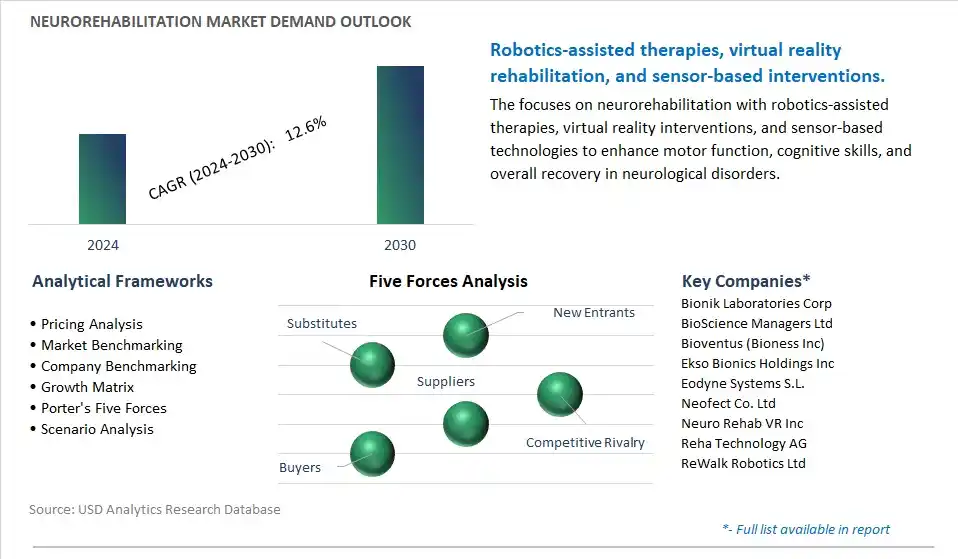
Neurorehabilitation Market is estimated to increase at a Compounded Annual Growth Rate of 12.6% CAGR over the forecast period from 2024 to 2030
The Neurorehabilitation Market study analyzes and forecasts the market size across 6 regions and 24 countries for diverse segments- By Type (Neuro-Robotic Devices, Non-Invasive Stimulators, Brain-Computer Interfaces), By Application (Brain Stroke, Parkinson's Disease, Multiple Sclerosis, Spinal Cord Injury, Traumatic Brain Injury, Cerebral Palsy, Others), By End-User (Rehabilitation Centers, Hospitals, Clinics).
An Introduction to Neurorehabilitation Market in 2024
In 2024, the market for neurorehabilitation continues to expand, driven by advancements in rehabilitation science, technology, and interdisciplinary care models for patients recovering from neurological injuries or diseases. Neurorehabilitation encompasses a comprehensive approach to restoring function, mobility, and independence in individuals with neurological impairments resulting from stroke, traumatic brain injury, spinal cord injury, multiple sclerosis, Parkinson's disease, and other neurological conditions. Rehabilitation interventions may include physical therapy, occupational therapy, speech therapy, cognitive rehabilitation, gait training, assistive technology, and neurostimulation techniques, tailored to address the specific needs and goals of each patient. Technological advancements in neurorehabilitation include the development of robotic exoskeletons, virtual reality (VR) systems, brain-computer interfaces (BCIs), functional electrical stimulation (FES) devices, and neuroprosthetic implants, which offer innovative solutions for promoting neuroplasticity, motor learning, and recovery of function. Moreover, the integration of telemedicine, remote monitoring, and home-based rehabilitation programs enables greater access to care, continuity of services, and patient engagement outside of traditional clinical settings. With the increasing recognition of the importance of early intervention, intensive therapy, and personalized rehabilitation plans in optimizing neurological recovery and long-term outcomes, the market for neurorehabilitation is poised for continued growth and innovation, offering new hope and opportunities for individuals living with neurological disabilities to achieve their fullest potential.
Market Trend: Integration of Technology in Neurorehabilitation
A prominent trend in the neurorehabilitation market is the increasing integration of technology to enhance rehabilitation outcomes for individuals with neurological conditions. Advancements in robotics, virtual reality, wearable sensors, and artificial intelligence are revolutionizing neurorehabilitation by providing personalized, engaging, and intensive therapy interventions. These technologies offer opportunities for neurorehabilitation providers to deliver targeted, evidence-based interventions, monitor patient progress in real-time, and tailor treatment plans to individual needs. Additionally, tele-rehabilitation platforms enable remote delivery of therapy services, expanding access to care for patients in underserved areas and improving continuity of care. This trend is driven by the growing demand for innovative solutions that optimize functional recovery, maximize independence, and improve quality of life for individuals with neurological impairments. As healthcare systems prioritize value-based care, patient-centered approaches, and technological innovation, the market for technology-enabled neurorehabilitation solutions is expected to witness significant growth and adoption, driven by the imperative to improve patient outcomes and enhance the efficiency of rehabilitation services.
Market Driver: Increasing Incidence of Neurological Conditions
The primary driver propelling the neurorehabilitation market is the increasing incidence of neurological conditions such as stroke, traumatic brain injury, spinal cord injury, multiple sclerosis, Parkinson's disease, and cerebral palsy, driving the demand for rehabilitation services to optimize functional recovery and quality of life for affected individuals. Neurological conditions represent leading causes of disability worldwide, posing significant challenges to healthcare systems, caregivers, and society as a whole. The socioeconomic burden of neurological disabilities encompasses healthcare costs, caregiver burden, loss of productivity, and reduced quality of life for patients and their families. This driver is further fueled by demographic trends such as population aging, increasing life expectancy, and the growing prevalence of chronic diseases associated with neurodegeneration and neuroinflammation. Additionally, advances in acute care, neuroimaging, and neurosurgical interventions have improved survival rates for individuals with neurological injuries and disorders, leading to increased demand for neurorehabilitation services to address residual impairments and optimize long-term outcomes. As healthcare systems prioritize early detection, intervention, and management of neurological conditions, the market for neurorehabilitation services is expected to experience sustained growth and innovation, driven by the imperative to improve functional independence and quality of life for individuals with neurological disabilities.
Market Opportunity: Personalized Rehabilitation Programs
An opportunity within the neurorehabilitation market lies in the development of personalized rehabilitation programs that leverage technology, data analytics, and interdisciplinary collaboration to tailor interventions to individual patient needs, preferences, and goals. Personalized rehabilitation programs consider factors such as the type and severity of neurological impairment, patient demographics, comorbidities, psychosocial factors, and treatment response profiles to optimize therapy outcomes and enhance patient engagement and adherence. Opportunities exist for neurorehabilitation providers to implement comprehensive assessment tools, outcome measures, and digital health platforms that capture patient-reported outcomes, monitor functional progress, and facilitate shared decision-making between patients and providers. Additionally, collaborations between rehabilitation specialists, neurologists, physiatrists, therapists, engineers, and data scientists can drive innovation and the development of personalized neurorehabilitation interventions that address the diverse needs and preferences of individuals with neurological conditions. As the field of neurorehabilitation evolves towards precision medicine and patient-centered care, the market presents opportunities for differentiation, market expansion, and leadership in delivering personalized rehabilitation services that optimize functional recovery and quality of life for individuals with neurological disabilities.
Neurorehabilitation Market Share Analysis: Neuro-Robotic Devices for Stroke Rehabilitation
The fast-growing segment within the neurorehabilitation market is neuro-robotic devices for stroke rehabilitation. This growth is propelled by several key factors. Firstly, stroke is a leading cause of long-term disability worldwide, resulting in motor impairments, functional limitations, and reduced quality of life for stroke survivors. Neuro-robotic devices offer innovative rehabilitation solutions by combining advanced robotics technology with principles of neuroplasticity to facilitate motor recovery, restore movement, and improve functional outcomes in stroke patients. These devices utilize robotic exoskeletons, end-effector systems, or assistive devices to provide repetitive, task-specific training, guided movement assistance, and real-time feedback during rehabilitation exercises, targeting upper and lower limb motor deficits, balance impairments, and gait abnormalities commonly observed in stroke survivors. Secondly, neuro-robotic rehabilitation interventions have demonstrated efficacy in enhancing motor function, muscle strength, range of motion, and motor control in stroke patients through intensive, customized therapy regimens tailored to individual patient needs, abilities, and rehabilitation goals. Robotic-assisted therapy enables precise control over movement parameters, adaptive assistance levels, and exercise intensity, optimizing neurorecovery mechanisms and promoting neural reorganization in the damaged brain areas associated with stroke. Additionally, the interactive nature of neuro-robotic rehabilitation promotes patient engagement, motivation, and participation in therapy sessions, fostering a positive rehabilitation experience and enhancing treatment adherence and long-term outcomes. Furthermore, advancements in robotics technology, including sensorimotor interfaces, artificial intelligence, virtual reality, and haptic feedback systems, continue to drive innovation in neuro-robotic devices, enabling personalized, immersive rehabilitation environments, adaptive training protocols, and remote monitoring capabilities that enhance the effectiveness, efficiency, and accessibility of stroke rehabilitation interventions. Moreover, collaborations between academia, industry, rehabilitation centers, and healthcare providers facilitate research, development, and clinical translation of neuro-robotic rehabilitation technologies, fostering the integration of evidence-based practices and best-in-class robotic-assisted therapy solutions into stroke rehabilitation programs worldwide. Overall, the combination of clinical demand, technological innovation, and collaborative research efforts positions neuro-robotic devices for stroke rehabilitation as the fast-growing segment within the neurorehabilitation market.
Neurorehabilitation Competitive Analysis
The market research study provides in-depth insights into leading companies including the SWOT analyses, product profile, financial details, and recent developments acrossBionik Laboratories Corp, BioScience Managers Ltd, Bioventus (Bioness Inc), Ekso Bionics Holdings Inc, Eodyne Systems S.L., Neofect Co. Ltd, Neuro Rehab VR Inc, Reha Technology AG, ReWalk Robotics Ltd
Neurorehabilitation Market Segmentation
By Type
Neuro-Robotic Devices
Non-Invasive Stimulators
Brain-Computer Interfaces
By Application
Brain Stroke
Parkinson's Disease
Multiple Sclerosis
Spinal Cord Injury
Traumatic Brain Injury
Cerebral Palsy
Others
By End-User
Rehabilitation Centers
Hospitals
Clinics
Geographical Analysis
North America (United States, Canada, Mexico)
Europe (Germany, France, United Kingdom, Spain, Italy, Rest of Europe)
Asia Pacific (China, India, Japan, South Korea, Rest of Asia Pacific)
South America (Brazil, Argentina, Rest of South America)
Middle East and Africa (Saudi Arabia, UAE, Rest of Middle East, South Africa, Egypt, Rest of Africa)
Neurorehabilitation Market Companies
Bionik Laboratories Corp
BioScience Managers Ltd
Bioventus (Bioness Inc)
Ekso Bionics Holdings Inc
Eodyne Systems S.L.
Neofect Co. Ltd
Neuro Rehab VR Inc
Reha Technology AG
ReWalk Robotics Ltd
Reasons to Buy the Neurorehabilitation Market Study
• Deepen your industry insights and navigate uncertainties for strategy formulation, CAPEX, and Operational decisions
• Gain access to detailed insights on the Neurorehabilitation Market, encompassing current market size, growth trends, and forecasts till 2030.
• Access detailed competitor analysis, enabling competitive advantage through a thorough understanding of market players, strategies, and potential differentiation opportunities
• Stay ahead of the curve with insights on technological advancements, innovations, and upcoming trends
• Identify lucrative investment avenues and expansion opportunities within the Neurorehabilitation Market industry, guided by robust, data-backed analysis.
• Understand regional and global markets through country-wise analysis, regional market potential, regulatory nuances, and dynamics
• Execute strategies with confidence and speed through information, analytics, and insights on the industry value chain
• Corporate leaders, strategists, financial experts, shareholders, asset managers, and governmental representatives can make long-term planning scenarios and build an integrated and timely understanding of market dynamics
• Benefit from tailored solutions and expert consultation based on report insights, providing personalized strategies aligned with specific business needs.
TABLE OF CONTENTS
1 Introduction to 2024 Neurorehabilitation Market
1.1 Market Overview
1.2 Quick Facts
1.3 Scope/Objective of the Study
1.4 Market Definition
1.5 Countries and Regions Covered
1.6 Units, Currency, and Conversions
1.7 Industry Value Chain
2 Research Methodology
2.1 Market Size Estimation
2.2 Sources and Research Methodology
2.3 Data Triangulation
2.4 Assumptions and Limitations
3 Executive Summary
3.1 Global Neurorehabilitation Market Size Outlook, $ Million, 2021 to 2030
3.2 Neurorehabilitation Market Outlook by Type, $ Million, 2021 to 2030
3.3 Neurorehabilitation Market Outlook by Product, $ Million, 2021 to 2030
3.4 Neurorehabilitation Market Outlook by Application, $ Million, 2021 to 2030
3.5 Neurorehabilitation Market Outlook by Key Countries, $ Million, 2021 to 2030
4 Market Dynamics
4.1 Key Driving Forces of Neurorehabilitation Industry
4.2 Key Market Trends in Neurorehabilitation Industry
4.3 Potential Opportunities in Neurorehabilitation Industry
4.4 Key Challenges in Neurorehabilitation Industry
5 Market Factor Analysis
5.1 Value Chain Analysis
5.2 Competitive Landscape
5.2.1 Global Neurorehabilitation Market Share by Company (%), 2023
5.2.2 Product Offerings by Company
5.3 Porter’s Five Forces Analysis
5.4 Pricing Analysis and Outlook
6 Growth Outlook Across Scenarios
6.1 Growth Analysis-Case Scenario Definitions
6.2 Low Growth Scenario Forecasts
6.3 Reference Growth Scenario Forecasts
6.4 High Growth Scenario Forecasts
7 Global Neurorehabilitation Market Outlook by Segments
7.1 Neurorehabilitation Market Outlook by Segments, $ Million, 2021- 2030
By Type
Neuro-Robotic Devices
Non-Invasive Stimulators
Brain-Computer Interfaces
By Application
Brain Stroke
Parkinson's Disease
Multiple Sclerosis
Spinal Cord Injury
Traumatic Brain Injury
Cerebral Palsy
Others
By End-User
Rehabilitation Centers
Hospitals
Clinics
8 North America Neurorehabilitation Market Analysis and Outlook To 2030
8.1 Introduction to North America Neurorehabilitation Markets in 2024
8.2 North America Neurorehabilitation Market Size Outlook by Country, 2021-2030
8.2.1 United States
8.2.2 Canada
8.2.3 Mexico
8.3 North America Neurorehabilitation Market size Outlook by Segments, 2021-2030
By Type
Neuro-Robotic Devices
Non-Invasive Stimulators
Brain-Computer Interfaces
By Application
Brain Stroke
Parkinson's Disease
Multiple Sclerosis
Spinal Cord Injury
Traumatic Brain Injury
Cerebral Palsy
Others
By End-User
Rehabilitation Centers
Hospitals
Clinics
9 Europe Neurorehabilitation Market Analysis and Outlook To 2030
9.1 Introduction to Europe Neurorehabilitation Markets in 2024
9.2 Europe Neurorehabilitation Market Size Outlook by Country, 2021-2030
9.2.1 Germany
9.2.2 France
9.2.3 Spain
9.2.4 United Kingdom
9.2.4 Italy
9.2.5 Russia
9.2.6 Norway
9.2.7 Rest of Europe
9.3 Europe Neurorehabilitation Market Size Outlook by Segments, 2021-2030
By Type
Neuro-Robotic Devices
Non-Invasive Stimulators
Brain-Computer Interfaces
By Application
Brain Stroke
Parkinson's Disease
Multiple Sclerosis
Spinal Cord Injury
Traumatic Brain Injury
Cerebral Palsy
Others
By End-User
Rehabilitation Centers
Hospitals
Clinics
10 Asia Pacific Neurorehabilitation Market Analysis and Outlook To 2030
10.1 Introduction to Asia Pacific Neurorehabilitation Markets in 2024
10.2 Asia Pacific Neurorehabilitation Market Size Outlook by Country, 2021-2030
10.2.1 China
10.2.2 India
10.2.3 Japan
10.2.4 South Korea
10.2.5 Indonesia
10.2.6 Malaysia
10.2.7 Australia
10.2.8 Rest of Asia Pacific
10.3 Asia Pacific Neurorehabilitation Market size Outlook by Segments, 2021-2030
By Type
Neuro-Robotic Devices
Non-Invasive Stimulators
Brain-Computer Interfaces
By Application
Brain Stroke
Parkinson's Disease
Multiple Sclerosis
Spinal Cord Injury
Traumatic Brain Injury
Cerebral Palsy
Others
By End-User
Rehabilitation Centers
Hospitals
Clinics
11 South America Neurorehabilitation Market Analysis and Outlook To 2030
11.1 Introduction to South America Neurorehabilitation Markets in 2024
11.2 South America Neurorehabilitation Market Size Outlook by Country, 2021-2030
11.2.1 Brazil
11.2.2 Argentina
11.2.3 Rest of South America
11.3 South America Neurorehabilitation Market size Outlook by Segments, 2021-2030
By Type
Neuro-Robotic Devices
Non-Invasive Stimulators
Brain-Computer Interfaces
By Application
Brain Stroke
Parkinson's Disease
Multiple Sclerosis
Spinal Cord Injury
Traumatic Brain Injury
Cerebral Palsy
Others
By End-User
Rehabilitation Centers
Hospitals
Clinics
12 Middle East and Africa Neurorehabilitation Market Analysis and Outlook To 2030
12.1 Introduction to Middle East and Africa Neurorehabilitation Markets in 2024
12.2 Middle East and Africa Neurorehabilitation Market Size Outlook by Country, 2021-2030
12.2.1 Saudi Arabia
12.2.2 UAE
12.2.3 Oman
12.2.4 Rest of Middle East
12.2.5 Egypt
12.2.6 Nigeria
12.2.7 South Africa
12.2.8 Rest of Africa
12.3 Middle East and Africa Neurorehabilitation Market size Outlook by Segments, 2021-2030
By Type
Neuro-Robotic Devices
Non-Invasive Stimulators
Brain-Computer Interfaces
By Application
Brain Stroke
Parkinson's Disease
Multiple Sclerosis
Spinal Cord Injury
Traumatic Brain Injury
Cerebral Palsy
Others
By End-User
Rehabilitation Centers
Hospitals
Clinics
13 Company Profiles
13.1 Company Snapshot
13.2 SWOT Profiles
13.3 Products and Services
13.4 Recent Developments
13.5 Financial Profile
List of Companies
Bionik Laboratories Corp
BioScience Managers Ltd
Bioventus (Bioness Inc)
Ekso Bionics Holdings Inc
Eodyne Systems S.L.
Neofect Co. Ltd
Neuro Rehab VR Inc
Reha Technology AG
ReWalk Robotics Ltd
14 Appendix
14.1 Customization Offerings
14.2 Subscription Services
14.3 Related Reports
14.4 Publisher Expertise
