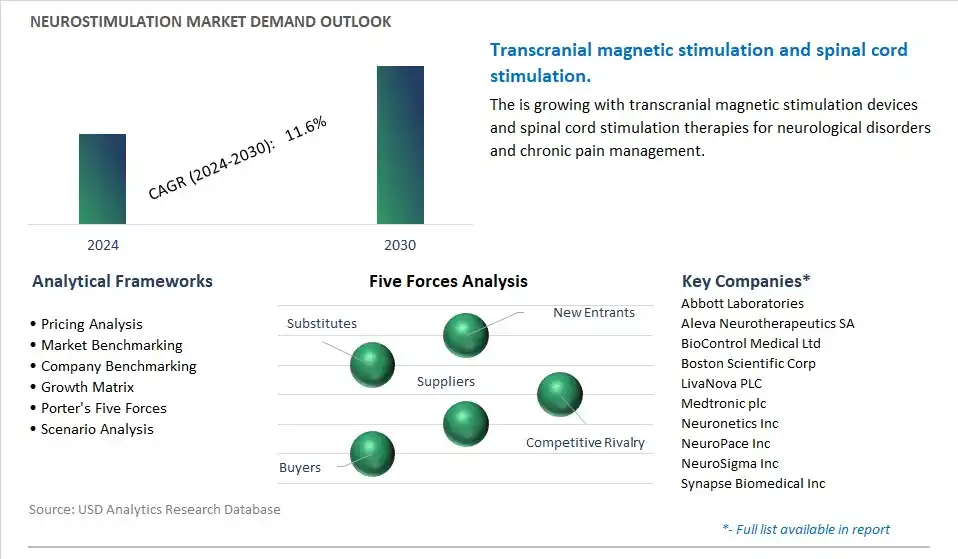
Neurostimulation Market is estimated to increase at a Compounded Annual Growth Rate of 11.6% CAGR over the forecast period from 2024 to 2030
The Neurostimulation Market study analyzes and forecasts the market size across 6 regions and 24 countries for diverse segments- By Product (Deep Brain Stimulation (DBS) Systems, Sacral Nerve Stimulation (SNS) Systems, Vagus Nerve Stimulation (VNS) Systems, Transcranial Magnetic Stimulation (TMS) Systems, Spinal Cord Stimulation (SCS) Systems, Gastric Electrical Stimulation (GES) Systems), By Technology (Non-invasive Neurostimulation, Invasive Neurostimulation), By Application (Chronic Pain Management, Essential Tremor, Epilepsy, Urinary and Fecal Incontinence, Parkinson's Disease, Depression, Obsessive-Compulsive Disorder, Gastroparesis), By End-User (Hospitals, Clinics, Ambulatory Surgical Centers, Others).
An Introduction to Neurostimulation Market in 2024
Neurostimulation therapies involve the application of electrical or magnetic stimulation to modulate neural activity, offering potential treatments for neurological disorders, chronic pain, and psychiatric conditions. In 2024, the market for neurostimulation continues to grow, driven by advancements in neuromodulation technologies, expanding clinical indications, and the demand for non-pharmacological approaches to managing neurological symptoms. Neurostimulation techniques encompass a variety of modalities, including spinal cord stimulation (SCS), deep brain stimulation (DBS), transcranial magnetic stimulation (TMS), and vagus nerve stimulation (VNS), which target specific neural circuits to alleviate pain, control movement disorders, and regulate mood and cognition. With innovations in electrode design, stimulation parameters, and closed-loop systems, neurostimulation devices offer personalized therapy options that optimize treatment outcomes while minimizing side effects. Moreover, the integration of neuroimaging techniques, artificial intelligence (AI), and neurophysiological monitoring enhances the precision and efficacy of neurostimulation therapies, enabling real-time adjustments and personalized treatment algorithms. As the understanding of brain-behavior relationships advances and the demand for neuromodulation therapies grows, neurostimulation technologies play an increasingly important role in improving quality of life for patients with neurological and psychiatric conditions, offering hope for symptom relief and functional restoration.
Market Trend: Expansion of Indications and Applications
A prominent trend in the neurostimulation market is the expansion of indications and applications beyond traditional neurological disorders. Neurostimulation therapies, such as spinal cord stimulation (SCS), deep brain stimulation (DBS), and transcranial magnetic stimulation (TMS), are increasingly being explored for the treatment of various chronic conditions, including chronic pain, movement disorders, psychiatric disorders, and neurological rehabilitation. Advancements in neurostimulation technology, coupled with growing clinical evidence supporting its efficacy across a range of medical conditions, are driving the adoption of neurostimulation therapies in new therapeutic areas. This trend towards expanding indications and applications is broadening the market scope and driving innovation in neurostimulation techniques and devices.
Market Driver: Growing Demand for Non-Opioid Pain Management
A key driver fueling the demand for neurostimulation therapies is the growing concern over the opioid epidemic and the need for non-opioid pain management alternatives. Chronic pain affects millions of individuals worldwide, contributing to decreased quality of life, disability, and healthcare costs. With the rising awareness of the risks associated with long-term opioid use, there is a growing emphasis on non-pharmacological approaches to pain management, including neurostimulation. Neurostimulation therapies offer an effective and drug-free alternative for managing chronic pain by modulating the nervous system's activity and altering pain perception. As healthcare providers seek safer and more sustainable pain management solutions, the demand for neurostimulation devices is expected to increase, driving market growth and adoption of neurostimulation therapies as a standard of care for chronic pain management.
Market Opportunity: Integration of Artificial Intelligence and Machine Learning
A significant opportunity for the neurostimulation market lies in the integration of artificial intelligence (AI) and machine learning (ML) technologies to enhance therapy outcomes and patient customization. AI and ML algorithms can analyze large datasets, including patient demographics, clinical outcomes, and physiological responses, to develop predictive models and optimize neurostimulation therapy parameters in real-time. By leveraging AI and ML-driven decision support systems, clinicians can personalize neurostimulation treatments based on individual patient characteristics, disease progression, and treatment responses, leading to improved efficacy and patient satisfaction. Furthermore, AI-enabled neurostimulation devices can continuously adapt therapy settings based on real-time feedback, ensuring optimal therapy delivery and maximizing patient outcomes. Collaborations between neurostimulation device manufacturers, AI technology companies, and healthcare providers can drive innovation in AI-driven neurostimulation solutions, unlocking new opportunities for growth and differentiation in the neurostimulation market.
Neurostimulation Market Share Analysis: Deep Brain Stimulation (DBS) Systems for Parkinson's Disease Management in Hospitals is the fastest growing segment over the forecast period to 2030
Among the segments listed, deep brain stimulation (DBS) systems for Parkinson's disease management in hospitals are experiencing rapid growth in the neurostimulation market. This growth is primarily driven by the increasing prevalence of Parkinson's disease globally and the growing adoption of DBS therapy as an effective treatment option for managing motor symptoms and improving quality of life in patients with advanced Parkinson's disease. DBS systems deliver electrical stimulation to specific areas of the brain, such as the subthalamic nucleus or globus pallidus, to modulate abnormal neuronal activity and alleviate motor symptoms, including tremor, rigidity, and bradykinesia. As hospitals strive to enhance patient outcomes and offer comprehensive neurological care, the demand for DBS systems for Parkinson's disease management continues to surge. Moreover, ongoing advancements in DBS technology, including improvements in electrode design, programming algorithms, and surgical techniques, further contribute to the growth of this segment. With the expanding aging population and increasing awareness of DBS therapy's efficacy, particularly in managing Parkinson's disease symptoms, DBS systems represent a key growth segment in the neurostimulation market, facilitating improved symptom control and functional outcomes for patients with Parkinson's disease.
Neurostimulation Competitive Analysis
The market research study provides in-depth insights into leading companies including the SWOT analyses, product profile, financial details, and recent developments acrossAbbott Laboratories, Aleva Neurotherapeutics SA, BioControl Medical Ltd, Boston Scientific Corp, LivaNova PLC, Medtronic plc, Neuronetics Inc, NeuroPace Inc, NeuroSigma Inc, Synapse Biomedical Inc
Neurostimulation Market Segmentation
By Product
Deep Brain Stimulation (DBS) Systems
Sacral Nerve Stimulation (SNS) Systems
Vagus Nerve Stimulation (VNS) Systems
Transcranial Magnetic Stimulation (TMS) Systems
Spinal Cord Stimulation (SCS) Systems
Gastric Electrical Stimulation (GES) Systems
By Technology
Non-invasive Neurostimulation
Invasive Neurostimulation
By Application
Chronic Pain Management
Essential Tremor
Epilepsy
Urinary and Fecal Incontinence
Parkinson's Disease
Depression
Obsessive-Compulsive Disorder
Gastroparesis
By End-User
Hospitals
Clinics
Ambulatory Surgical Centers
Others
Geographical Analysis
North America (United States, Canada, Mexico)
Europe (Germany, France, United Kingdom, Spain, Italy, Rest of Europe)
Asia Pacific (China, India, Japan, South Korea, Rest of Asia Pacific)
South America (Brazil, Argentina, Rest of South America)
Middle East and Africa (Saudi Arabia, UAE, Rest of Middle East, South Africa, Egypt, Rest of Africa)
Neurostimulation Market Companies
Abbott Laboratories
Aleva Neurotherapeutics SA
BioControl Medical Ltd
Boston Scientific Corp
LivaNova PLC
Medtronic plc
Neuronetics Inc
NeuroPace Inc
NeuroSigma Inc
Synapse Biomedical Inc
Reasons to Buy the Neurostimulation Market Study
• Deepen your industry insights and navigate uncertainties for strategy formulation, CAPEX, and Operational decisions
• Gain access to detailed insights on the Neurostimulation Market, encompassing current market size, growth trends, and forecasts till 2030.
• Access detailed competitor analysis, enabling competitive advantage through a thorough understanding of market players, strategies, and potential differentiation opportunities
• Stay ahead of the curve with insights on technological advancements, innovations, and upcoming trends
• Identify lucrative investment avenues and expansion opportunities within the Neurostimulation Market industry, guided by robust, data-backed analysis.
• Understand regional and global markets through country-wise analysis, regional market potential, regulatory nuances, and dynamics
• Execute strategies with confidence and speed through information, analytics, and insights on the industry value chain
• Corporate leaders, strategists, financial experts, shareholders, asset managers, and governmental representatives can make long-term planning scenarios and build an integrated and timely understanding of market dynamics
• Benefit from tailored solutions and expert consultation based on report insights, providing personalized strategies aligned with specific business needs.
TABLE OF CONTENTS
1 Introduction to 2024 Neurostimulation Market
1.1 Market Overview
1.2 Quick Facts
1.3 Scope/Objective of the Study
1.4 Market Definition
1.5 Countries and Regions Covered
1.6 Units, Currency, and Conversions
1.7 Industry Value Chain
2 Research Methodology
2.1 Market Size Estimation
2.2 Sources and Research Methodology
2.3 Data Triangulation
2.4 Assumptions and Limitations
3 Executive Summary
3.1 Global Neurostimulation Market Size Outlook, $ Million, 2021 to 2030
3.2 Neurostimulation Market Outlook by Type, $ Million, 2021 to 2030
3.3 Neurostimulation Market Outlook by Product, $ Million, 2021 to 2030
3.4 Neurostimulation Market Outlook by Application, $ Million, 2021 to 2030
3.5 Neurostimulation Market Outlook by Key Countries, $ Million, 2021 to 2030
4 Market Dynamics
4.1 Key Driving Forces of Neurostimulation Industry
4.2 Key Market Trends in Neurostimulation Industry
4.3 Potential Opportunities in Neurostimulation Industry
4.4 Key Challenges in Neurostimulation Industry
5 Market Factor Analysis
5.1 Value Chain Analysis
5.2 Competitive Landscape
5.2.1 Global Neurostimulation Market Share by Company (%), 2023
5.2.2 Product Offerings by Company
5.3 Porter’s Five Forces Analysis
5.4 Pricing Analysis and Outlook
6 Growth Outlook Across Scenarios
6.1 Growth Analysis-Case Scenario Definitions
6.2 Low Growth Scenario Forecasts
6.3 Reference Growth Scenario Forecasts
6.4 High Growth Scenario Forecasts
7 Global Neurostimulation Market Outlook by Segments
7.1 Neurostimulation Market Outlook by Segments, $ Million, 2021- 2030
By Product
Deep Brain Stimulation (DBS) Systems
Sacral Nerve Stimulation (SNS) Systems
Vagus Nerve Stimulation (VNS) Systems
Transcranial Magnetic Stimulation (TMS) Systems
Spinal Cord Stimulation (SCS) Systems
Gastric Electrical Stimulation (GES) Systems
By Technology
Non-invasive Neurostimulation
Invasive Neurostimulation
By Application
Chronic Pain Management
Essential Tremor
Epilepsy
Urinary and Fecal Incontinence
Parkinson's Disease
Depression
Obsessive-Compulsive Disorder
Gastroparesis
By End-User
Hospitals
Clinics
Ambulatory Surgical Centers
Others
8 North America Neurostimulation Market Analysis and Outlook To 2030
8.1 Introduction to North America Neurostimulation Markets in 2024
8.2 North America Neurostimulation Market Size Outlook by Country, 2021-2030
8.2.1 United States
8.2.2 Canada
8.2.3 Mexico
8.3 North America Neurostimulation Market size Outlook by Segments, 2021-2030
By Product
Deep Brain Stimulation (DBS) Systems
Sacral Nerve Stimulation (SNS) Systems
Vagus Nerve Stimulation (VNS) Systems
Transcranial Magnetic Stimulation (TMS) Systems
Spinal Cord Stimulation (SCS) Systems
Gastric Electrical Stimulation (GES) Systems
By Technology
Non-invasive Neurostimulation
Invasive Neurostimulation
By Application
Chronic Pain Management
Essential Tremor
Epilepsy
Urinary and Fecal Incontinence
Parkinson's Disease
Depression
Obsessive-Compulsive Disorder
Gastroparesis
By End-User
Hospitals
Clinics
Ambulatory Surgical Centers
Others
9 Europe Neurostimulation Market Analysis and Outlook To 2030
9.1 Introduction to Europe Neurostimulation Markets in 2024
9.2 Europe Neurostimulation Market Size Outlook by Country, 2021-2030
9.2.1 Germany
9.2.2 France
9.2.3 Spain
9.2.4 United Kingdom
9.2.4 Italy
9.2.5 Russia
9.2.6 Norway
9.2.7 Rest of Europe
9.3 Europe Neurostimulation Market Size Outlook by Segments, 2021-2030
By Product
Deep Brain Stimulation (DBS) Systems
Sacral Nerve Stimulation (SNS) Systems
Vagus Nerve Stimulation (VNS) Systems
Transcranial Magnetic Stimulation (TMS) Systems
Spinal Cord Stimulation (SCS) Systems
Gastric Electrical Stimulation (GES) Systems
By Technology
Non-invasive Neurostimulation
Invasive Neurostimulation
By Application
Chronic Pain Management
Essential Tremor
Epilepsy
Urinary and Fecal Incontinence
Parkinson's Disease
Depression
Obsessive-Compulsive Disorder
Gastroparesis
By End-User
Hospitals
Clinics
Ambulatory Surgical Centers
Others
10 Asia Pacific Neurostimulation Market Analysis and Outlook To 2030
10.1 Introduction to Asia Pacific Neurostimulation Markets in 2024
10.2 Asia Pacific Neurostimulation Market Size Outlook by Country, 2021-2030
10.2.1 China
10.2.2 India
10.2.3 Japan
10.2.4 South Korea
10.2.5 Indonesia
10.2.6 Malaysia
10.2.7 Australia
10.2.8 Rest of Asia Pacific
10.3 Asia Pacific Neurostimulation Market size Outlook by Segments, 2021-2030
By Product
Deep Brain Stimulation (DBS) Systems
Sacral Nerve Stimulation (SNS) Systems
Vagus Nerve Stimulation (VNS) Systems
Transcranial Magnetic Stimulation (TMS) Systems
Spinal Cord Stimulation (SCS) Systems
Gastric Electrical Stimulation (GES) Systems
By Technology
Non-invasive Neurostimulation
Invasive Neurostimulation
By Application
Chronic Pain Management
Essential Tremor
Epilepsy
Urinary and Fecal Incontinence
Parkinson's Disease
Depression
Obsessive-Compulsive Disorder
Gastroparesis
By End-User
Hospitals
Clinics
Ambulatory Surgical Centers
Others
11 South America Neurostimulation Market Analysis and Outlook To 2030
11.1 Introduction to South America Neurostimulation Markets in 2024
11.2 South America Neurostimulation Market Size Outlook by Country, 2021-2030
11.2.1 Brazil
11.2.2 Argentina
11.2.3 Rest of South America
11.3 South America Neurostimulation Market size Outlook by Segments, 2021-2030
By Product
Deep Brain Stimulation (DBS) Systems
Sacral Nerve Stimulation (SNS) Systems
Vagus Nerve Stimulation (VNS) Systems
Transcranial Magnetic Stimulation (TMS) Systems
Spinal Cord Stimulation (SCS) Systems
Gastric Electrical Stimulation (GES) Systems
By Technology
Non-invasive Neurostimulation
Invasive Neurostimulation
By Application
Chronic Pain Management
Essential Tremor
Epilepsy
Urinary and Fecal Incontinence
Parkinson's Disease
Depression
Obsessive-Compulsive Disorder
Gastroparesis
By End-User
Hospitals
Clinics
Ambulatory Surgical Centers
Others
12 Middle East and Africa Neurostimulation Market Analysis and Outlook To 2030
12.1 Introduction to Middle East and Africa Neurostimulation Markets in 2024
12.2 Middle East and Africa Neurostimulation Market Size Outlook by Country, 2021-2030
12.2.1 Saudi Arabia
12.2.2 UAE
12.2.3 Oman
12.2.4 Rest of Middle East
12.2.5 Egypt
12.2.6 Nigeria
12.2.7 South Africa
12.2.8 Rest of Africa
12.3 Middle East and Africa Neurostimulation Market size Outlook by Segments, 2021-2030
By Product
Deep Brain Stimulation (DBS) Systems
Sacral Nerve Stimulation (SNS) Systems
Vagus Nerve Stimulation (VNS) Systems
Transcranial Magnetic Stimulation (TMS) Systems
Spinal Cord Stimulation (SCS) Systems
Gastric Electrical Stimulation (GES) Systems
By Technology
Non-invasive Neurostimulation
Invasive Neurostimulation
By Application
Chronic Pain Management
Essential Tremor
Epilepsy
Urinary and Fecal Incontinence
Parkinson's Disease
Depression
Obsessive-Compulsive Disorder
Gastroparesis
By End-User
Hospitals
Clinics
Ambulatory Surgical Centers
Others
13 Company Profiles
13.1 Company Snapshot
13.2 SWOT Profiles
13.3 Products and Services
13.4 Recent Developments
13.5 Financial Profile
List of Companies
Abbott Laboratories
Aleva Neurotherapeutics SA
BioControl Medical Ltd
Boston Scientific Corp
LivaNova PLC
Medtronic plc
Neuronetics Inc
NeuroPace Inc
NeuroSigma Inc
Synapse Biomedical Inc
14 Appendix
14.1 Customization Offerings
14.2 Subscription Services
14.3 Related Reports
14.4 Publisher Expertise
By Product
Deep Brain Stimulation (DBS) Systems
Sacral Nerve Stimulation (SNS) Systems
Vagus Nerve Stimulation (VNS) Systems
Transcranial Magnetic Stimulation (TMS) Systems
Spinal Cord Stimulation (SCS) Systems
Gastric Electrical Stimulation (GES) Systems
By Technology
Non-invasive Neurostimulation
Invasive Neurostimulation
By Application
Chronic Pain Management
Essential Tremor
Epilepsy
Urinary and Fecal Incontinence
Parkinson's Disease
Depression
Obsessive-Compulsive Disorder
Gastroparesis
By End-User
Hospitals
Clinics
Ambulatory Surgical Centers
Others
Countries Analyzed
North America (United States, Canada, Mexico)
Europe (Germany, France, United Kingdom, Spain, Italy, Rest of Europe)
Asia Pacific (China, India, Japan, South Korea, Rest of Asia Pacific)
South America (Brazil, Argentina, Rest of South America)
Middle East and Africa (Saudi Arabia, UAE, Rest of Middle East, South Africa, Egypt, Rest of Africa)
