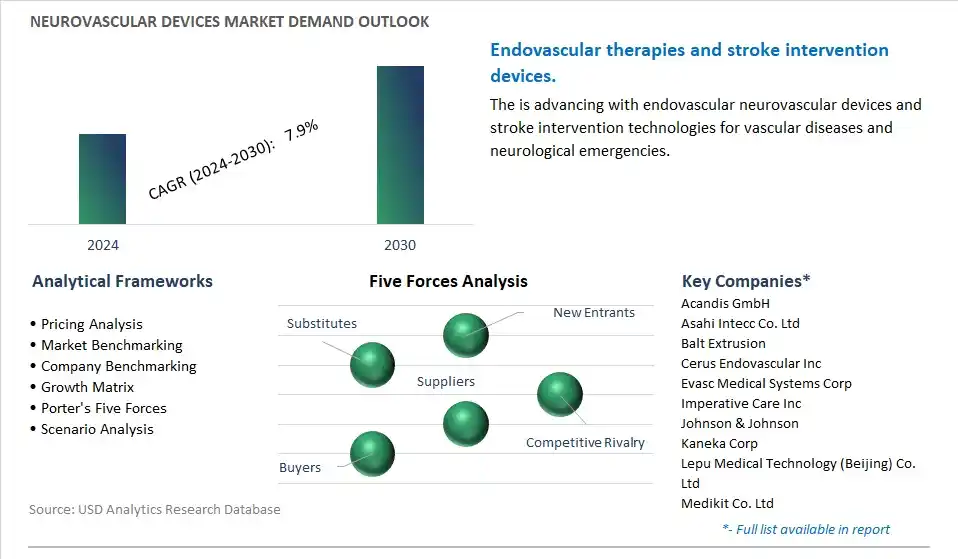
Neurovascular Devices Market is estimated to increase at a Compounded Annual Growth Rate of 7.9% CAGR over the forecast period from 2024 to 2030
The Neurovascular Devices Market study analyzes and forecasts the market size across 6 regions and 24 countries for diverse segments- By Disease (Cerebral Aneurysm, Ischemic Stroke, Carotid Artery Stenosis, Arteriovenous Malformation & Fistulas, Others), By End-User (Hospitals & Surgical Centers, Ambulatory Care Centers, Research Laboratories, Others).
An Introduction to Neurovascular Devices Market in 2024
Neurovascular devices are specialized medical devices used in the diagnosis and treatment of vascular conditions affecting the brain and central nervous system, including aneurysms, stroke, and arteriovenous malformations (AVMs). In 2024, the market for neurovascular devices continues to grow, driven by technological innovations, expanding indications for endovascular interventions, and the increasing prevalence of cerebrovascular diseases. Neurovascular devices encompass a wide range of products, including neurovascular stents, embolization coils, flow diverters, thrombectomy devices, and intracranial balloons, which enable neuro interventionalists to restore blood flow, reinforce vessel walls, and prevent or treat cerebrovascular pathologies. With advancements in device design, materials science, and imaging technologies, neurovascular devices offer improved navigability, trackability, and deliverability, enhancing procedural success rates and patient outcomes. Moreover, the integration of advanced imaging modalities, such as digital subtraction angiography (DSA) and cone-beam computed tomography (CBCT), enhances procedural planning and guidance, enabling precise placement of neurovascular devices and minimizing the risk of complications. As the demand for minimally invasive neurointerventional procedures continues to grow, neurovascular devices play a crucial role in enabling neurointerventionalists to provide timely, effective treatments for patients with acute ischemic stroke, intracranial aneurysms, and other neurovascular disorders, ultimately improving patient outcomes and quality of life.
Market Trend: Shift Towards Minimally Invasive Neurovascular Interventions
A prominent trend in the neurovascular devices market is the shift towards minimally invasive interventions for the treatment of neurovascular disorders. Neurovascular conditions such as stroke, aneurysms, and arteriovenous malformations require precise and effective treatment options to prevent severe neurological complications. Minimally invasive techniques, including endovascular procedures and neurointerventional radiology, offer less invasive alternatives to traditional open surgeries, reducing patient morbidity, recovery times, and healthcare costs. As a result, there is an increasing demand for neurovascular devices such as embolization coils, stents, flow diverters, and catheters that support minimally invasive interventions. This trend towards minimally invasive neurovascular procedures is driving innovation in device design and technology, catering to the evolving needs of neurovascular surgeons and improving patient outcomes.
Market Driver: Rising Incidence of Neurovascular Diseases
A key driver fueling the demand for neurovascular devices is the rising incidence of neurovascular diseases globally. Neurovascular diseases, including ischemic stroke, hemorrhagic stroke, and cerebral aneurysms, represent significant causes of morbidity and mortality worldwide. Factors such as aging populations, unhealthy lifestyles, and increased awareness and detection contribute to the growing prevalence of neurovascular diseases. As a result, there is a growing need for effective treatment options to manage these conditions and reduce their impact on patients' lives. Neurovascular devices play a crucial role in the diagnosis, treatment, and management of neurovascular diseases, providing clinicians with the tools necessary to perform interventions safely and effectively. The increasing incidence of neurovascular diseases serves as a significant driver for market growth and investment in neurovascular devices, driving innovation and advancements in the field.
Market Opportunity: Integration of Digital Health and Remote Monitoring
A significant opportunity for the neurovascular devices market lies in the integration of digital health technologies and remote monitoring solutions to enhance patient care and outcomes. Digital health platforms, including telemedicine, remote monitoring, and mobile health applications, offer opportunities to improve access to neurovascular care, especially in underserved or remote regions. By integrating neurovascular devices with digital health platforms, healthcare providers can remotely monitor patients' neurovascular health, track treatment outcomes, and provide timely interventions when necessary. Additionally, digital health technologies can empower patients to actively participate in their care, improving treatment adherence and long-term management of neurovascular conditions. Collaborations between medical device companies, technology developers, and healthcare providers can drive innovation in digital health-enabled neurovascular devices, unlocking new opportunities for growth and differentiation in the market while improving patient care and outcomes.
Neurovascular Devices Market Share Analysis: Clot Retrievers Devices for Ischemic Stroke in Hospitals & Surgical Centers is the fastest growing segment over the forecast period to 2030
Among the segments listed, clot retrievers devices for ischemic stroke treatment in hospitals and surgical centers are experiencing rapid growth in the neurovascular devices market. This growth is primarily fueled by the increasing incidence of ischemic stroke worldwide and the growing adoption of minimally invasive endovascular procedures for stroke management. Clot retrievers, also known as thrombectomy devices, are designed to remove blood clots from occluded cerebral arteries, restoring blood flow to the brain and minimizing neurological damage in ischemic stroke patients. As hospitals and surgical centers strive to enhance stroke care and improve patient outcomes, the demand for clot retrievers devices continues to surge. Additionally, advancements in clot retrieval technology, including the development of innovative devices with improved efficacy and navigational capabilities, further contribute to the growth of this segment. With the expanding aging population and the emphasis on timely and effective stroke interventions, clot retrievers devices represent a key growth area in the neurovascular devices market, facilitating enhanced stroke treatment and patient recovery.
Neurovascular Devices Competitive Analysis
The market research study provides in-depth insights into leading companies including the SWOT analyses, product profile, financial details, and recent developments acrossAcandis GmbH, Asahi Intecc Co. Ltd, Balt Extrusion, Cerus Endovascular Inc, Evasc Medical Systems Corp, Imperative Care Inc, Johnson & Johnson, Kaneka Corp, Lepu Medical Technology (Beijing) Co. Ltd, Medikit Co. Ltd, Medtronic plc, MicroPort Scientific Corp, Penumbra Inc, Perflow Medical Ltd, Phenox GmbH, Rapid Medical, Sensome, Stryker Corp, Terumo Corp, Zylox-Tonbridge Medical Co. Ltd
Neurovascular Devices Market Segmentation
By Disease
Cerebral Aneurysm
-Embolic coils
-Flow Diversion Devices
-Microcatheters
-Intracranial Stent
-Guidewires
Ischemic Stroke
-Clot Retrievers Devices
-Suction and Aspiration Devices
-Vascular Snares
-Microcatheter
-Micro guidewires
-Balloon Guide Catheters
Carotid Artery Stenosis
-Carotid Artery Stents
-Embolic Protection Devices
-Balloon Catheters
Arteriovenous Malformation & Fistulas
-Liquid Embolic Agents
-Microcatheters
-Occlusion Balloon Catheters
Others
By End-User
Hospitals & Surgical Centers
Ambulatory Care Centers
Research Laboratories
Others
Geographical Analysis
North America (United States, Canada, Mexico)
Europe (Germany, France, United Kingdom, Spain, Italy, Rest of Europe)
Asia Pacific (China, India, Japan, South Korea, Rest of Asia Pacific)
South America (Brazil, Argentina, Rest of South America)
Middle East and Africa (Saudi Arabia, UAE, Rest of Middle East, South Africa, Egypt, Rest of Africa)
Neurovascular Devices Market Companies
Acandis GmbH
Asahi Intecc Co. Ltd
Balt Extrusion
Cerus Endovascular Inc
Evasc Medical Systems Corp
Imperative Care Inc
Johnson & Johnson
Kaneka Corp
Lepu Medical Technology (Beijing) Co. Ltd
Medikit Co. Ltd
Medtronic plc
MicroPort Scientific Corp
Penumbra Inc
Perflow Medical Ltd
Phenox GmbH
Rapid Medical
Sensome
Stryker Corp
Terumo Corp
Zylox-Tonbridge Medical Co. Ltd
Reasons to Buy the Neurovascular Devices Market Study
• Deepen your industry insights and navigate uncertainties for strategy formulation, CAPEX, and Operational decisions
• Gain access to detailed insights on the Neurovascular Devices Market, encompassing current market size, growth trends, and forecasts till 2030.
• Access detailed competitor analysis, enabling competitive advantage through a thorough understanding of market players, strategies, and potential differentiation opportunities
• Stay ahead of the curve with insights on technological advancements, innovations, and upcoming trends
• Identify lucrative investment avenues and expansion opportunities within the Neurovascular Devices Market industry, guided by robust, data-backed analysis.
• Understand regional and global markets through country-wise analysis, regional market potential, regulatory nuances, and dynamics
• Execute strategies with confidence and speed through information, analytics, and insights on the industry value chain
• Corporate leaders, strategists, financial experts, shareholders, asset managers, and governmental representatives can make long-term planning scenarios and build an integrated and timely understanding of market dynamics
• Benefit from tailored solutions and expert consultation based on report insights, providing personalized strategies aligned with specific business needs.
TABLE OF CONTENTS
1 Introduction to 2024 Neurovascular Devices Market
1.1 Market Overview
1.2 Quick Facts
1.3 Scope/Objective of the Study
1.4 Market Definition
1.5 Countries and Regions Covered
1.6 Units, Currency, and Conversions
1.7 Industry Value Chain
2 Research Methodology
2.1 Market Size Estimation
2.2 Sources and Research Methodology
2.3 Data Triangulation
2.4 Assumptions and Limitations
3 Executive Summary
3.1 Global Neurovascular Devices Market Size Outlook, $ Million, 2021 to 2030
3.2 Neurovascular Devices Market Outlook by Type, $ Million, 2021 to 2030
3.3 Neurovascular Devices Market Outlook by Product, $ Million, 2021 to 2030
3.4 Neurovascular Devices Market Outlook by Application, $ Million, 2021 to 2030
3.5 Neurovascular Devices Market Outlook by Key Countries, $ Million, 2021 to 2030
4 Market Dynamics
4.1 Key Driving Forces of Neurovascular Devices Industry
4.2 Key Market Trends in Neurovascular Devices Industry
4.3 Potential Opportunities in Neurovascular Devices Industry
4.4 Key Challenges in Neurovascular Devices Industry
5 Market Factor Analysis
5.1 Value Chain Analysis
5.2 Competitive Landscape
5.2.1 Global Neurovascular Devices Market Share by Company (%), 2023
5.2.2 Product Offerings by Company
5.3 Porter’s Five Forces Analysis
5.4 Pricing Analysis and Outlook
6 Growth Outlook Across Scenarios
6.1 Growth Analysis-Case Scenario Definitions
6.2 Low Growth Scenario Forecasts
6.3 Reference Growth Scenario Forecasts
6.4 High Growth Scenario Forecasts
7 Global Neurovascular Devices Market Outlook by Segments
7.1 Neurovascular Devices Market Outlook by Segments, $ Million, 2021- 2030
By Disease
Cerebral Aneurysm
-Embolic coils
-Flow Diversion Devices
-Microcatheters
-Intracranial Stent
-Guidewires
Ischemic Stroke
-Clot Retrievers Devices
-Suction and Aspiration Devices
-Vascular Snares
-Microcatheter
-Micro guidewires
-Balloon Guide Catheters
Carotid Artery Stenosis
-Carotid Artery Stents
-Embolic Protection Devices
-Balloon Catheters
Arteriovenous Malformation & Fistulas
-Liquid Embolic Agents
-Microcatheters
-Occlusion Balloon Catheters
Others
By End-User
Hospitals & Surgical Centers
Ambulatory Care Centers
Research Laboratories
Others
8 North America Neurovascular Devices Market Analysis and Outlook To 2030
8.1 Introduction to North America Neurovascular Devices Markets in 2024
8.2 North America Neurovascular Devices Market Size Outlook by Country, 2021-2030
8.2.1 United States
8.2.2 Canada
8.2.3 Mexico
8.3 North America Neurovascular Devices Market size Outlook by Segments, 2021-2030
By Disease
Cerebral Aneurysm
-Embolic coils
-Flow Diversion Devices
-Microcatheters
-Intracranial Stent
-Guidewires
Ischemic Stroke
-Clot Retrievers Devices
-Suction and Aspiration Devices
-Vascular Snares
-Microcatheter
-Micro guidewires
-Balloon Guide Catheters
Carotid Artery Stenosis
-Carotid Artery Stents
-Embolic Protection Devices
-Balloon Catheters
Arteriovenous Malformation & Fistulas
-Liquid Embolic Agents
-Microcatheters
-Occlusion Balloon Catheters
Others
By End-User
Hospitals & Surgical Centers
Ambulatory Care Centers
Research Laboratories
Others
9 Europe Neurovascular Devices Market Analysis and Outlook To 2030
9.1 Introduction to Europe Neurovascular Devices Markets in 2024
9.2 Europe Neurovascular Devices Market Size Outlook by Country, 2021-2030
9.2.1 Germany
9.2.2 France
9.2.3 Spain
9.2.4 United Kingdom
9.2.4 Italy
9.2.5 Russia
9.2.6 Norway
9.2.7 Rest of Europe
9.3 Europe Neurovascular Devices Market Size Outlook by Segments, 2021-2030
By Disease
Cerebral Aneurysm
-Embolic coils
-Flow Diversion Devices
-Microcatheters
-Intracranial Stent
-Guidewires
Ischemic Stroke
-Clot Retrievers Devices
-Suction and Aspiration Devices
-Vascular Snares
-Microcatheter
-Micro guidewires
-Balloon Guide Catheters
Carotid Artery Stenosis
-Carotid Artery Stents
-Embolic Protection Devices
-Balloon Catheters
Arteriovenous Malformation & Fistulas
-Liquid Embolic Agents
-Microcatheters
-Occlusion Balloon Catheters
Others
By End-User
Hospitals & Surgical Centers
Ambulatory Care Centers
Research Laboratories
Others
10 Asia Pacific Neurovascular Devices Market Analysis and Outlook To 2030
10.1 Introduction to Asia Pacific Neurovascular Devices Markets in 2024
10.2 Asia Pacific Neurovascular Devices Market Size Outlook by Country, 2021-2030
10.2.1 China
10.2.2 India
10.2.3 Japan
10.2.4 South Korea
10.2.5 Indonesia
10.2.6 Malaysia
10.2.7 Australia
10.2.8 Rest of Asia Pacific
10.3 Asia Pacific Neurovascular Devices Market size Outlook by Segments, 2021-2030
By Disease
Cerebral Aneurysm
-Embolic coils
-Flow Diversion Devices
-Microcatheters
-Intracranial Stent
-Guidewires
Ischemic Stroke
-Clot Retrievers Devices
-Suction and Aspiration Devices
-Vascular Snares
-Microcatheter
-Micro guidewires
-Balloon Guide Catheters
Carotid Artery Stenosis
-Carotid Artery Stents
-Embolic Protection Devices
-Balloon Catheters
Arteriovenous Malformation & Fistulas
-Liquid Embolic Agents
-Microcatheters
-Occlusion Balloon Catheters
Others
By End-User
Hospitals & Surgical Centers
Ambulatory Care Centers
Research Laboratories
Others
11 South America Neurovascular Devices Market Analysis and Outlook To 2030
11.1 Introduction to South America Neurovascular Devices Markets in 2024
11.2 South America Neurovascular Devices Market Size Outlook by Country, 2021-2030
11.2.1 Brazil
11.2.2 Argentina
11.2.3 Rest of South America
11.3 South America Neurovascular Devices Market size Outlook by Segments, 2021-2030
By Disease
Cerebral Aneurysm
-Embolic coils
-Flow Diversion Devices
-Microcatheters
-Intracranial Stent
-Guidewires
Ischemic Stroke
-Clot Retrievers Devices
-Suction and Aspiration Devices
-Vascular Snares
-Microcatheter
-Micro guidewires
-Balloon Guide Catheters
Carotid Artery Stenosis
-Carotid Artery Stents
-Embolic Protection Devices
-Balloon Catheters
Arteriovenous Malformation & Fistulas
-Liquid Embolic Agents
-Microcatheters
-Occlusion Balloon Catheters
Others
By End-User
Hospitals & Surgical Centers
Ambulatory Care Centers
Research Laboratories
Others
12 Middle East and Africa Neurovascular Devices Market Analysis and Outlook To 2030
12.1 Introduction to Middle East and Africa Neurovascular Devices Markets in 2024
12.2 Middle East and Africa Neurovascular Devices Market Size Outlook by Country, 2021-2030
12.2.1 Saudi Arabia
12.2.2 UAE
12.2.3 Oman
12.2.4 Rest of Middle East
12.2.5 Egypt
12.2.6 Nigeria
12.2.7 South Africa
12.2.8 Rest of Africa
12.3 Middle East and Africa Neurovascular Devices Market size Outlook by Segments, 2021-2030
By Disease
Cerebral Aneurysm
-Embolic coils
-Flow Diversion Devices
-Microcatheters
-Intracranial Stent
-Guidewires
Ischemic Stroke
-Clot Retrievers Devices
-Suction and Aspiration Devices
-Vascular Snares
-Microcatheter
-Micro guidewires
-Balloon Guide Catheters
Carotid Artery Stenosis
-Carotid Artery Stents
-Embolic Protection Devices
-Balloon Catheters
Arteriovenous Malformation & Fistulas
-Liquid Embolic Agents
-Microcatheters
-Occlusion Balloon Catheters
Others
By End-User
Hospitals & Surgical Centers
Ambulatory Care Centers
Research Laboratories
Others
13 Company Profiles
13.1 Company Snapshot
13.2 SWOT Profiles
13.3 Products and Services
13.4 Recent Developments
13.5 Financial Profile
List of Companies
Acandis GmbH
Asahi Intecc Co. Ltd
Balt Extrusion
Cerus Endovascular Inc
Evasc Medical Systems Corp
Imperative Care Inc
Johnson & Johnson
Kaneka Corp
Lepu Medical Technology (Beijing) Co. Ltd
Medikit Co. Ltd
Medtronic plc
MicroPort Scientific Corp
Penumbra Inc
Perflow Medical Ltd
Phenox GmbH
Rapid Medical
Sensome
Stryker Corp
Terumo Corp
Zylox-Tonbridge Medical Co. Ltd
14 Appendix
14.1 Customization Offerings
14.2 Subscription Services
14.3 Related Reports
14.4 Publisher Expertise
By Disease
Cerebral Aneurysm
-Embolic coils
-Flow Diversion Devices
-Microcatheters
-Intracranial Stent
-Guidewires
Ischemic Stroke
-Clot Retrievers Devices
-Suction and Aspiration Devices
-Vascular Snares
-Microcatheter
-Micro guidewires
-Balloon Guide Catheters
Carotid Artery Stenosis
-Carotid Artery Stents
-Embolic Protection Devices
-Balloon Catheters
Arteriovenous Malformation & Fistulas
-Liquid Embolic Agents
-Microcatheters
-Occlusion Balloon Catheters
Others
By End-User
Hospitals & Surgical Centers
Ambulatory Care Centers
Research Laboratories
Others
Countries Analyzed
North America (United States, Canada, Mexico)
Europe (Germany, France, United Kingdom, Spain, Italy, Rest of Europe)
Asia Pacific (China, India, Japan, South Korea, Rest of Asia Pacific)
South America (Brazil, Argentina, Rest of South America)
Middle East and Africa (Saudi Arabia, UAE, Rest of Middle East, South Africa, Egypt, Rest of Africa)
