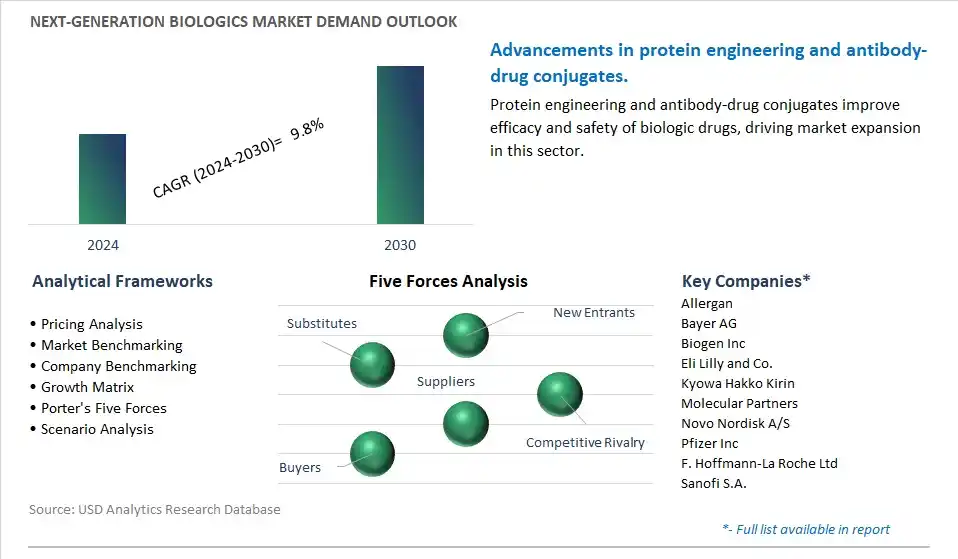
Next-Generation Biologics Market is estimated to increase at a growth rate of 9.8% CAGR over the forecast period from 2024 to 2030.
The global Next-Generation Biologics Market Study analyzes and forecasts the market size across 6 regions and 24 countries for diverse segments including By Type (Antibodies, Regenerative medicine, Insulins, Growth hormones, Other), By Application (Medical, Scientific Research, Others).
An Introduction to Next-Generation Biologics Market in 2024
The Next-Generation Biologics Market is poised for remarkable growth and innovation in 2024, fueled by the increasing demand for sophisticated biopharmaceuticals capable of addressing complex diseases with higher precision and efficacy. Building upon the success of monoclonal antibodies, next-generation biologics encompass a diverse range of modalities, including antibody-drug conjugates, bispecific antibodies, and fusion proteins, among others. These advanced therapeutics offer novel mechanisms of action, improved targeting capabilities, and enhanced therapeutic profiles, paving the way for breakthrough treatments across various therapeutic areas such as oncology, autoimmune disorders, and infectious diseases. Furthermore, advancements in recombinant DNA technology, protein engineering, and bioinformatics are driving the development and commercialization of next-generation biologics, underscoring their immense potential to revolutionize modern medicine.
Next-Generation Biologics Market Competitive Landscape
The global Next-Generation Biologics Industry is highly competitive with a large number of companies focusing on niche market segments. Amidst intense competitive conditions, Next-Generation Biologics Companies are investing in new product launches and strengthening distribution channels. Key companies operating in the Next-Generation Biologics Industry include- Allergan, Bayer AG, Biogen Inc, Eli Lilly and Co., Kyowa Hakko Kirin, Molecular Partners, Novo Nordisk A/S, Pfizer Inc, F. Hoffmann-La Roche Ltd, Sanofi S.A..
Next Generation Biologics Market Trend: Advancements in Biologics Engineering and Design
In the Next Generation Biologics market, a prominent trend is the advancements in biologics engineering and design. Traditional biologic therapeutics, such as monoclonal antibodies and recombinant proteins, have revolutionized the treatment of various diseases. However, ongoing research and technological innovations have led to the development of next-generation biologics with enhanced properties, including improved target specificity, prolonged half-life, reduced immunogenicity, and enhanced tissue penetration. These advancements, facilitated by techniques such as protein engineering, glycoengineering, and novel drug conjugation strategies, offer opportunities to address unmet medical needs and expand the therapeutic potential of biologic drugs across diverse therapeutic areas.
Next Generation Biologics Market Driver: Demand for Precision Medicine and Personalized Therapies
The primary market driver for Next Generation Biologics is the demand for precision medicine and personalized therapies. With the growing understanding of disease heterogeneity and molecular pathways, there is increasing recognition of the importance of tailored treatment approaches that address individual patient characteristics and disease mechanisms. Next-generation biologics, including antibody-drug conjugates, bispecific antibodies, and engineered cell therapies, enable precise targeting of disease-specific antigens, modulation of immune responses, and customization of therapeutic effects. The demand for next-generation biologics is driven by the need to improve treatment outcomes, minimize off-target effects, and optimize patient responses in oncology, autoimmune disorders, and other therapeutic areas.
Next Generation Biologics Market Opportunity: Expansion of Therapeutic Applications and Market Access
An emerging opportunity in the Next Generation Biologics market lies in the expansion of therapeutic applications and market access. While next-generation biologics have demonstrated significant clinical benefits in certain disease settings, there remains untapped potential for their utilization across a broader range of indications and patient populations. Collaborative efforts between biopharmaceutical companies, academic researchers, healthcare providers, and regulatory agencies can facilitate the development of next-generation biologics for novel therapeutic indications, rare diseases, and unmet medical needs. Additionally, initiatives to enhance market access, affordability, and reimbursement for next-generation biologic therapies can broaden patient access and uptake, driving market growth and improving patient outcomes globally. By leveraging strategic partnerships and regulatory pathways, stakeholders can capitalize on the expanding opportunities in the next-generation biologics market and address evolving healthcare challenges with innovative therapeutic solutions.
Next Generation Biologics Market Share Analysis: Regenerative Medicine is the fastest growing market segment over the forecast period to 2030
Among the various types of next-generation biologics, the segment experiencing notable growth is regenerative medicine. Regenerative medicine focuses on harnessing the body's natural healing processes to repair, replace, or regenerate damaged tissues and organs. This innovative approach holds immense promise for addressing a wide range of medical conditions, including musculoskeletal injuries, cardiovascular diseases, neurological disorders, and even organ failure. Regenerative medicine biologics encompass a variety of therapeutic modalities such as stem cell therapies, tissue-engineered constructs, growth factors, and gene therapies, all aimed at restoring tissue function and promoting healing. The rapid growth of regenerative medicine is fueled by advancements in stem cell research, tissue engineering techniques, and biomaterial science, which have enabled the development of more sophisticated and effective biologic therapies. Additionally, the increasing prevalence of chronic diseases and age-related conditions, coupled with the limitations of conventional treatments, has spurred interest and investment in regenerative medicine approaches. Furthermore, regulatory approvals and clinical successes in regenerative medicine therapies have bolstered confidence in their efficacy and safety, driving further adoption in medical practice and scientific research. As the field of regenerative medicine continues to evolve and mature, it holds tremendous potential to revolutionize healthcare by providing innovative solutions for previously untreatable conditions.
Next-Generation Biologics Market Segmentation
By Type
Antibodies
Regenerative medicine
Insulins
Growth hormones
Other
By Application
Medical
Scientific Research
Others
Geographical Analysis
North America (United States, Canada, Mexico)
Europe (Germany, France, United Kingdom, Spain, Italy, Rest of Europe)
Asia Pacific (China, India, Japan, South Korea, Rest of Asia Pacific)
South America (Brazil, Argentina, Rest of South America)
Middle East and Africa (Saudi Arabia, UAE, Rest of Middle East, South Africa, Egypt, Rest of Africa)
Next-Generation Biologics Companies
Allergan
Bayer AG
Biogen Inc
Eli Lilly and Co.
Kyowa Hakko Kirin
Molecular Partners
Novo Nordisk A/S
Pfizer Inc
F. Hoffmann-La Roche Ltd
Sanofi S.A.
* List not Exhaustive
Reasons to Buy the Next-Generation Biologics Market Study
• Deepen your industry insights and navigate uncertainties for strategy formulation, CAPEX, and Operational decisions
• Gain access to detailed insights on the Next-Generation Biologics Market, encompassing current market size, growth trends, and forecasts till 2030.
• Access detailed competitor analysis, enabling competitive advantage through a thorough understanding of market players, strategies, and potential differentiation opportunities
• Stay ahead of the curve with insights on technological advancements, innovations, and upcoming trends
• Identify lucrative investment avenues and expansion opportunities within the Next-Generation Biologics Industry, guided by robust, data-backed analysis.
• Understand regional and global markets through country-wise analysis, regional market potential, regulatory nuances, and dynamics
• Execute strategies with confidence and speed through information, analytics, and insights on the industry value chain
• Corporate leaders, strategists, financial experts, shareholders, asset managers, and governmental representatives can make long-term planning scenarios and build an integrated and timely understanding of market dynamics
• Benefit from tailored solutions and expert consultation based on report insights, providing personalized strategies aligned with specific business needs.
TABLE OF CONTENTS
1 Introduction to 2024 Next-Generation Biologics Market
1.1 Market Overview
1.2 Quick Facts
1.3 Scope/Objective of the Study
1.4 Market Definition
1.5 Countries and Regions Analyzed
1.6 Units, Currency, and Conversions
1.7 Industry Value Chain
2 Research Methodology
2.1 Market Size Estimation
2.2 Sources and Research Methodology
2.3 Data Triangulation
2.4 Assumptions and Limitations
3 Executive Summary
3.1 Global Next-Generation Biologics Market Size Outlook, $ Million, 2021 to 2030
3.2 Next-Generation Biologics Market Outlook by Type, $ Million, 2021 to 2030
3.3 Next-Generation Biologics Market Outlook by Product, $ Million, 2021 to 2030
3.4 Next-Generation Biologics Market Outlook by Application, $ Million, 2021 to 2030
3.5 Next-Generation Biologics Market Outlook by Key Countries, $ Million, 2021 to 2030
4 Market Dynamics
4.1 Key Driving Forces of Next-Generation Biologics Industry
4.2 Key Market Trends in Next-Generation Biologics Industry
4.3 Potential Opportunities in Next-Generation Biologics Industry
4.4 Key Challenges in Next-Generation Biologics Industry
5 Market Factor Analysis
5.1 Value Chain Analysis
5.2 Competitive Landscape
5.2.1 Global Next-Generation Biologics Market Share by Company (%), 2023
5.2.2 Product Offerings by Company
5.3 Porter’s Five Forces Analysis
5.4 Pricing Analysis and Outlook
6 Growth Outlook Across Scenarios
6.1 Growth Analysis-Case Scenario Definitions
6.2 Low Growth Scenario Forecasts
6.3 Reference Growth Scenario Forecasts
6.4 High Growth Scenario Forecasts
7 Global Next-Generation Biologics Market Outlook by Segments
7.1 Next-Generation Biologics Market Outlook by Segments, $ Million, 2021- 2030
By Type
Antibodies
Regenerative medicine
Insulins
Growth hormones
Other
By Application
Medical
Scientific Research
Others
8 North America Next-Generation Biologics Market Analysis and Outlook To 2030
8.1 Introduction to North America Next-Generation Biologics Markets in 2024
8.2 North America Next-Generation Biologics Market Size Outlook by Country, 2021-2030
8.2.1 United States
8.2.2 Canada
8.2.3 Mexico
8.3 North America Next-Generation Biologics Market size Outlook by Segments, 2021-2030
By Type
Antibodies
Regenerative medicine
Insulins
Growth hormones
Other
By Application
Medical
Scientific Research
Others
9 Europe Next-Generation Biologics Market Analysis and Outlook To 2030
9.1 Introduction to Europe Next-Generation Biologics Markets in 2024
9.2 Europe Next-Generation Biologics Market Size Outlook by Country, 2021-2030
9.2.1 Germany
9.2.2 France
9.2.3 Spain
9.2.4 United Kingdom
9.2.4 Italy
9.2.5 Russia
9.2.6 Norway
9.2.7 Rest of Europe
9.3 Europe Next-Generation Biologics Market Size Outlook by Segments, 2021-2030
By Type
Antibodies
Regenerative medicine
Insulins
Growth hormones
Other
By Application
Medical
Scientific Research
Others
10 Asia Pacific Next-Generation Biologics Market Analysis and Outlook To 2030
10.1 Introduction to Asia Pacific Next-Generation Biologics Markets in 2024
10.2 Asia Pacific Next-Generation Biologics Market Size Outlook by Country, 2021-2030
10.2.1 China
10.2.2 India
10.2.3 Japan
10.2.4 South Korea
10.2.5 Indonesia
10.2.6 Malaysia
10.2.7 Australia
10.2.8 Rest of Asia Pacific
10.3 Asia Pacific Next-Generation Biologics Market size Outlook by Segments, 2021-2030
By Type
Antibodies
Regenerative medicine
Insulins
Growth hormones
Other
By Application
Medical
Scientific Research
Others
11 South America Next-Generation Biologics Market Analysis and Outlook To 2030
11.1 Introduction to South America Next-Generation Biologics Markets in 2024
11.2 South America Next-Generation Biologics Market Size Outlook by Country, 2021-2030
11.2.1 Brazil
11.2.2 Argentina
11.2.3 Rest of South America
11.3 South America Next-Generation Biologics Market size Outlook by Segments, 2021-2030
By Type
Antibodies
Regenerative medicine
Insulins
Growth hormones
Other
By Application
Medical
Scientific Research
Others
12 Middle East and Africa Next-Generation Biologics Market Analysis and Outlook To 2030
12.1 Introduction to Middle East and Africa Next-Generation Biologics Markets in 2024
12.2 Middle East and Africa Next-Generation Biologics Market Size Outlook by Country, 2021-2030
12.2.1 Saudi Arabia
12.2.2 UAE
12.2.3 Oman
12.2.4 Rest of Middle East
12.2.5 Egypt
12.2.6 Nigeria
12.2.7 South Africa
12.2.8 Rest of Africa
12.3 Middle East and Africa Next-Generation Biologics Market size Outlook by Segments, 2021-2030
By Type
Antibodies
Regenerative medicine
Insulins
Growth hormones
Other
By Application
Medical
Scientific Research
Others
13 Company Profiles
13.1 Company Snapshot
13.2 SWOT Profiles
13.3 Products and Services
13.4 Recent Developments
13.5 Financial Profile
List of Companies
Allergan
Bayer AG
Biogen Inc
Eli Lilly and Co.
Kyowa Hakko Kirin
Molecular Partners
Novo Nordisk A/S
Pfizer Inc
F. Hoffmann-La Roche Ltd
Sanofi S.A.
14 Appendix
14.1 Customization Offerings
14.2 Subscription Services
14.3 Related Reports
14.4 Publisher Expertise
