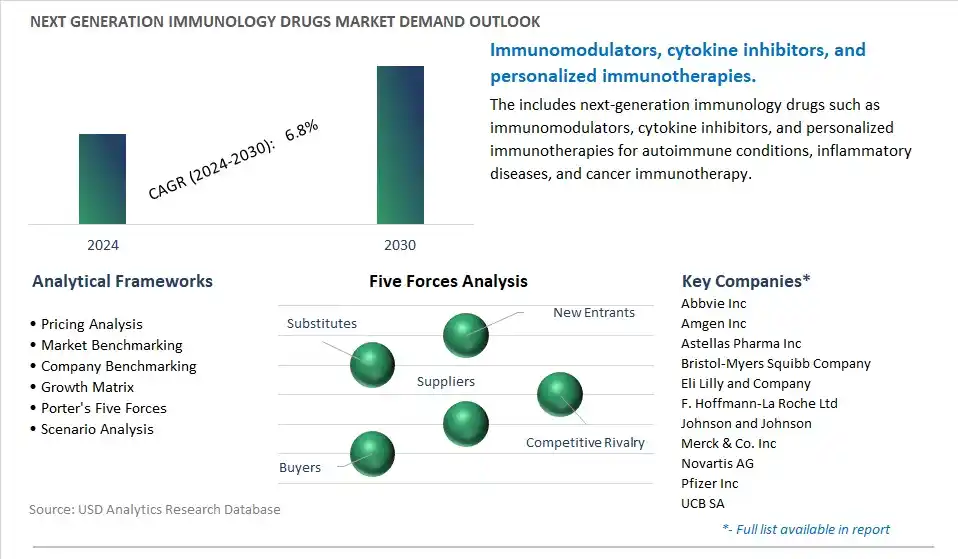
Next Generation Immunology Drugs Market is estimated to increase at a Compounded Annual Growth Rate of 6.8% CAGR over the forecast period from 2024 to 2030
The Next Generation Immunology Drugs Market study analyzes and forecasts the market size across 6 regions and 24 countries for diverse segments- By Drug Class (Small Molecules, Antibodies, Cell Based Therapies, Others), By Therapeutic Area (Cancer, Autoimmune Diseases, Infectious Diseases, Inflammatory Diseases, Others).
An Introduction to Next Generation Immunology Drugs Market in 2024
In 2024, the market for next-generation immunology drugs continues to evolve, driven by advancements in biotechnology, immunotherapy, and precision medicine for the treatment of autoimmune diseases, inflammatory disorders, and cancer. Next-generation immunology drugs encompass a diverse array of biologic agents, small molecules, and cellular therapies designed to modulate the immune system's function and responses selectively. These drugs target specific immune cells, cytokines, signaling pathways, and molecular targets implicated in immune dysregulation, inflammation, and tissue damage, offering novel approaches to managing complex and refractory immunological conditions. Technological advancements in next-generation immunology drugs include the development of bi-specific antibodies, immune checkpoint inhibitors, cell-based therapies such as chimeric antigen receptor (CAR) T-cell therapy, and gene-editing techniques like CRISPR-Cas9, which enable precise targeting of pathological immune responses and manipulation of immune cell function. Moreover, the integration of biomarker-driven treatment strategies, pharmacogenomics, and patient stratification approaches enhances the efficacy, safety, and personalized therapeutic outcomes of next-generation immunology drugs across diverse patient populations. With the increasing prevalence of autoimmune diseases, chronic inflammatory conditions, and cancer-related immune dysregulation, the market for next-generation immunology drugs is poised for continued growth and innovation, offering promising avenues for improving patient outcomes and quality of life.
Market Trend: Precision Medicine and Personalized Immunotherapy
A prominent trend in the next-generation immunology drugs market is the shift towards precision medicine and personalized immunotherapy approaches. Traditional immunology drugs have demonstrated efficacy in treating a wide range of autoimmune diseases and inflammatory conditions, but variability in patient responses and adverse effects pose challenges to optimal treatment outcomes. The trend towards precision medicine involves leveraging advances in immunogenomics, biomarker identification, and patient stratification strategies to tailor immunotherapy interventions to individual patient characteristics, including genetic makeup, immune profile, and disease subtype. This trend is characterized by the development of targeted biologics, small molecules, and cell-based therapies that selectively modulate specific immune pathways, cytokines, or cell types implicated in disease pathogenesis. As pharmaceutical companies and biotechnology firms invest in biomarker-driven drug discovery and companion diagnostic technologies, the market for next-generation immunology drugs is expected to witness significant growth and innovation, driven by the imperative to improve treatment response rates, minimize adverse effects, and optimize therapeutic outcomes for patients with immune-mediated disorders.
Market Driver: Rising Prevalence of Autoimmune Diseases and Chronic Inflammatory Conditions
The primary driver propelling the next-generation immunology drugs market is the rising prevalence of autoimmune diseases, chronic inflammatory conditions, and immune-related disorders worldwide, driving the demand for innovative treatments that address the underlying pathophysiology and unmet clinical needs. Autoimmune diseases, including rheumatoid arthritis, psoriasis, inflammatory bowel disease, multiple sclerosis, and lupus, affect millions of individuals and represent leading causes of disability, morbidity, and healthcare costs globally. The socioeconomic burden of autoimmune diseases encompasses direct medical costs, productivity losses, and impaired quality of life for patients and their families. This driver is further fueled by demographic trends such as population aging, increasing urbanization, and changes in lifestyle factors, which contribute to the growing incidence and prevalence of autoimmune and inflammatory disorders. Additionally, advancements in molecular biology, immunology, and translational research have deepened our understanding of disease mechanisms, immune dysregulation, and therapeutic targets, leading to the development of novel immunology drugs with improved efficacy, safety, and tolerability profiles. As healthcare systems prioritize early detection, intervention, and management of autoimmune diseases, the market for next-generation immunology drugs is expected to experience sustained growth and investment, driven by the imperative to improve patient outcomes and reduce the burden of immune-mediated disorders on individuals, families, and society.
Market Opportunity: Expansion into Novel Therapeutic Modalities
An opportunity within the next-generation immunology drugs market lies in the expansion into novel therapeutic modalities that offer targeted, durable, and personalized treatments for autoimmune diseases, inflammatory conditions, and immune-mediated disorders. Opportunities exist for pharmaceutical companies to explore innovative approaches such as bi-specific antibodies, engineered cytokines, gene therapies, and cell-based immunotherapies that modulate immune responses, restore immune tolerance, and promote tissue repair. Additionally, advancements in drug delivery technologies, including nanoparticles, liposomes, and polymer conjugates, enable targeted delivery of immunology drugs to specific tissues or cells, minimizing off-target effects and enhancing therapeutic efficacy. Collaborations between industry, academia, and regulatory agencies can drive innovation and development of next-generation immunology drugs that address unmet clinical needs and overcome challenges such as treatment resistance and disease heterogeneity. As the field of immunology evolves towards precision medicine and personalized care, the market presents opportunities for differentiation, market expansion, and leadership in delivering transformative immunotherapy solutions that improve patient outcomes and quality of life for individuals with immune-mediated disorders.
Next-Generation Immunology Drugs Market Share Analysis: Cell-Based Therapies
The fast-growing segment within the next-generation immunology drugs market is cell-based therapies. This growth is propelled by several key factors. Firstly, cell-based therapies, including chimeric antigen receptor (CAR) T-cell therapies, adoptive cell transfer (ACT) therapies, and stem cell therapies, represent innovative approaches to modulating the immune system and targeting a wide range of diseases, including cancer, autoimmune diseases, infectious diseases, and inflammatory diseases. These therapies involve the isolation, modification, and reinfusion of patient-derived immune cells or stem cells, either autologous or allogeneic, with the aim of enhancing their anti-tumor or immunomodulatory properties and promoting durable responses against disease. Secondly, cell-based therapies offer the potential for precise and personalized treatment strategies tailored to individual patients' immune profiles and disease characteristics, thereby maximizing therapeutic efficacy while minimizing off-target effects and systemic toxicity associated with conventional therapies. CAR T-cell therapies, in particular, have demonstrated remarkable clinical success in the treatment of hematological malignancies, such as B-cell acute lymphoblastic leukemia (B-ALL) and diffuse large B-cell lymphoma (DLBCL), leading to durable remissions and even cures in some patients. Additionally, advancements in cell engineering, gene editing, and manufacturing technologies have facilitated the development and commercialization of next-generation cell-based therapies with improved potency, persistence, and safety profiles, driving the expansion of the cell therapy market across various therapeutic areas. Furthermore, strategic collaborations between pharmaceutical companies, biotechnology firms, academic research centers, and regulatory agencies accelerate the translation of preclinical discoveries into clinical applications and foster the development of innovative cell-based therapies for unmet medical needs. Moreover, the growing investment in regenerative medicine and cellular immunotherapy, coupled with the increasing prevalence of cancer, autoimmune diseases, and infectious diseases worldwide, underscores the significance of cell-based therapies as a promising therapeutic modality to address complex diseases and improve patient outcomes. Overall, the combination of scientific innovation, clinical efficacy, and market demand positions cell-based therapies as the fast-growing segment within the next-generation immunology drugs market.
Next Generation Immunology Drugs Competitive Analysis
The market research study provides in-depth insights into leading companies including the SWOT analyses, product profile, financial details, and recent developments acrossAbbvie Inc, Amgen Inc, Astellas Pharma Inc, Bristol-Myers Squibb Company, Eli Lilly and Company, F. Hoffmann-La Roche Ltd, Johnson and Johnson, Merck & Co. Inc, Novartis AG, Pfizer Inc, UCB SA
Next Generation Immunology Drugs Market Segmentation
By Drug Class
Small Molecules
Antibodies
Cell Based Therapies
Others
By Therapeutic Area
Cancer
Autoimmune Diseases
Infectious Diseases
Inflammatory Diseases
Others
Geographical Analysis
North America (United States, Canada, Mexico)
Europe (Germany, France, United Kingdom, Spain, Italy, Rest of Europe)
Asia Pacific (China, India, Japan, South Korea, Rest of Asia Pacific)
South America (Brazil, Argentina, Rest of South America)
Middle East and Africa (Saudi Arabia, UAE, Rest of Middle East, South Africa, Egypt, Rest of Africa)
Next Generation Immunology Drugs Market Companies
Abbvie Inc
Amgen Inc
Astellas Pharma Inc
Bristol-Myers Squibb Company
Eli Lilly and Company
F. Hoffmann-La Roche Ltd
Johnson and Johnson
Merck & Co. Inc
Novartis AG
Pfizer Inc
UCB SA
Reasons to Buy the Next Generation Immunology Drugs Market Study
• Deepen your industry insights and navigate uncertainties for strategy formulation, CAPEX, and Operational decisions
• Gain access to detailed insights on the Next Generation Immunology Drugs Market, encompassing current market size, growth trends, and forecasts till 2030.
• Access detailed competitor analysis, enabling competitive advantage through a thorough understanding of market players, strategies, and potential differentiation opportunities
• Stay ahead of the curve with insights on technological advancements, innovations, and upcoming trends
• Identify lucrative investment avenues and expansion opportunities within the Next Generation Immunology Drugs Market industry, guided by robust, data-backed analysis.
• Understand regional and global markets through country-wise analysis, regional market potential, regulatory nuances, and dynamics
• Execute strategies with confidence and speed through information, analytics, and insights on the industry value chain
• Corporate leaders, strategists, financial experts, shareholders, asset managers, and governmental representatives can make long-term planning scenarios and build an integrated and timely understanding of market dynamics
• Benefit from tailored solutions and expert consultation based on report insights, providing personalized strategies aligned with specific business needs.
TABLE OF CONTENTS
1 Introduction to 2024 Next Generation Immunology Drugs Market
1.1 Market Overview
1.2 Quick Facts
1.3 Scope/Objective of the Study
1.4 Market Definition
1.5 Countries and Regions Covered
1.6 Units, Currency, and Conversions
1.7 Industry Value Chain
2 Research Methodology
2.1 Market Size Estimation
2.2 Sources and Research Methodology
2.3 Data Triangulation
2.4 Assumptions and Limitations
3 Executive Summary
3.1 Global Next Generation Immunology Drugs Market Size Outlook, $ Million, 2021 to 2030
3.2 Next Generation Immunology Drugs Market Outlook by Type, $ Million, 2021 to 2030
3.3 Next Generation Immunology Drugs Market Outlook by Product, $ Million, 2021 to 2030
3.4 Next Generation Immunology Drugs Market Outlook by Application, $ Million, 2021 to 2030
3.5 Next Generation Immunology Drugs Market Outlook by Key Countries, $ Million, 2021 to 2030
4 Market Dynamics
4.1 Key Driving Forces of Next Generation Immunology Drugs Industry
4.2 Key Market Trends in Next Generation Immunology Drugs Industry
4.3 Potential Opportunities in Next Generation Immunology Drugs Industry
4.4 Key Challenges in Next Generation Immunology Drugs Industry
5 Market Factor Analysis
5.1 Value Chain Analysis
5.2 Competitive Landscape
5.2.1 Global Next Generation Immunology Drugs Market Share by Company (%), 2023
5.2.2 Product Offerings by Company
5.3 Porter’s Five Forces Analysis
5.4 Pricing Analysis and Outlook
6 Growth Outlook Across Scenarios
6.1 Growth Analysis-Case Scenario Definitions
6.2 Low Growth Scenario Forecasts
6.3 Reference Growth Scenario Forecasts
6.4 High Growth Scenario Forecasts
7 Global Next Generation Immunology Drugs Market Outlook by Segments
7.1 Next Generation Immunology Drugs Market Outlook by Segments, $ Million, 2021- 2030
By Drug Class
Small Molecules
Antibodies
Cell Based Therapies
Others
By Therapeutic Area
Cancer
Autoimmune Diseases
Infectious Diseases
Inflammatory Diseases
Others
8 North America Next Generation Immunology Drugs Market Analysis and Outlook To 2030
8.1 Introduction to North America Next Generation Immunology Drugs Markets in 2024
8.2 North America Next Generation Immunology Drugs Market Size Outlook by Country, 2021-2030
8.2.1 United States
8.2.2 Canada
8.2.3 Mexico
8.3 North America Next Generation Immunology Drugs Market size Outlook by Segments, 2021-2030
By Drug Class
Small Molecules
Antibodies
Cell Based Therapies
Others
By Therapeutic Area
Cancer
Autoimmune Diseases
Infectious Diseases
Inflammatory Diseases
Others
9 Europe Next Generation Immunology Drugs Market Analysis and Outlook To 2030
9.1 Introduction to Europe Next Generation Immunology Drugs Markets in 2024
9.2 Europe Next Generation Immunology Drugs Market Size Outlook by Country, 2021-2030
9.2.1 Germany
9.2.2 France
9.2.3 Spain
9.2.4 United Kingdom
9.2.4 Italy
9.2.5 Russia
9.2.6 Norway
9.2.7 Rest of Europe
9.3 Europe Next Generation Immunology Drugs Market Size Outlook by Segments, 2021-2030
By Drug Class
Small Molecules
Antibodies
Cell Based Therapies
Others
By Therapeutic Area
Cancer
Autoimmune Diseases
Infectious Diseases
Inflammatory Diseases
Others
10 Asia Pacific Next Generation Immunology Drugs Market Analysis and Outlook To 2030
10.1 Introduction to Asia Pacific Next Generation Immunology Drugs Markets in 2024
10.2 Asia Pacific Next Generation Immunology Drugs Market Size Outlook by Country, 2021-2030
10.2.1 China
10.2.2 India
10.2.3 Japan
10.2.4 South Korea
10.2.5 Indonesia
10.2.6 Malaysia
10.2.7 Australia
10.2.8 Rest of Asia Pacific
10.3 Asia Pacific Next Generation Immunology Drugs Market size Outlook by Segments, 2021-2030
By Drug Class
Small Molecules
Antibodies
Cell Based Therapies
Others
By Therapeutic Area
Cancer
Autoimmune Diseases
Infectious Diseases
Inflammatory Diseases
Others
11 South America Next Generation Immunology Drugs Market Analysis and Outlook To 2030
11.1 Introduction to South America Next Generation Immunology Drugs Markets in 2024
11.2 South America Next Generation Immunology Drugs Market Size Outlook by Country, 2021-2030
11.2.1 Brazil
11.2.2 Argentina
11.2.3 Rest of South America
11.3 South America Next Generation Immunology Drugs Market size Outlook by Segments, 2021-2030
By Drug Class
Small Molecules
Antibodies
Cell Based Therapies
Others
By Therapeutic Area
Cancer
Autoimmune Diseases
Infectious Diseases
Inflammatory Diseases
Others
12 Middle East and Africa Next Generation Immunology Drugs Market Analysis and Outlook To 2030
12.1 Introduction to Middle East and Africa Next Generation Immunology Drugs Markets in 2024
12.2 Middle East and Africa Next Generation Immunology Drugs Market Size Outlook by Country, 2021-2030
12.2.1 Saudi Arabia
12.2.2 UAE
12.2.3 Oman
12.2.4 Rest of Middle East
12.2.5 Egypt
12.2.6 Nigeria
12.2.7 South Africa
12.2.8 Rest of Africa
12.3 Middle East and Africa Next Generation Immunology Drugs Market size Outlook by Segments, 2021-2030
By Drug Class
Small Molecules
Antibodies
Cell Based Therapies
Others
By Therapeutic Area
Cancer
Autoimmune Diseases
Infectious Diseases
Inflammatory Diseases
Others
13 Company Profiles
13.1 Company Snapshot
13.2 SWOT Profiles
13.3 Products and Services
13.4 Recent Developments
13.5 Financial Profile
List of Companies
Abbvie Inc
Amgen Inc
Astellas Pharma Inc
Bristol-Myers Squibb Company
Eli Lilly and Company
F. Hoffmann-La Roche Ltd
Johnson and Johnson
Merck & Co. Inc
Novartis AG
Pfizer Inc
UCB SA
14 Appendix
14.1 Customization Offerings
14.2 Subscription Services
14.3 Related Reports
14.4 Publisher Expertise
