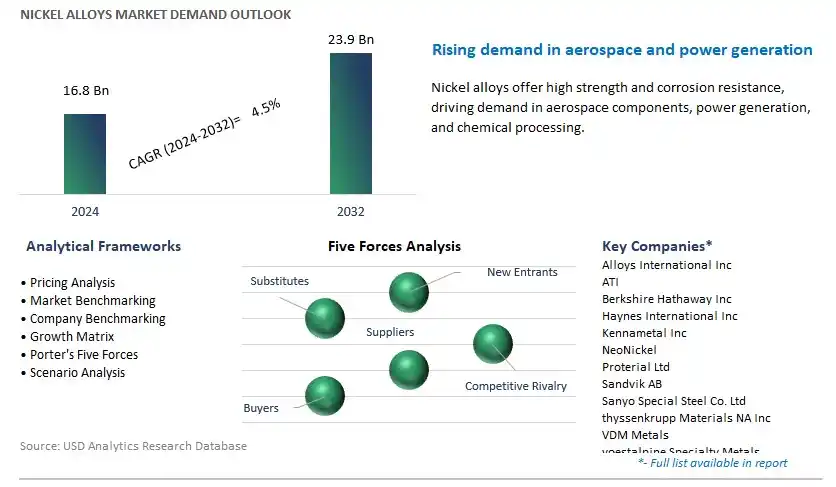
Global Nickel Alloys Market Size is valued at $16.8 Billion in 2024 and is forecast to register a growth rate (CAGR) of 4.5% to reach $23.9 Billion by 2032.
The global Nickel Alloys Market Study analyzes and forecasts the market size across 6 regions and 24 countries for diverse segments -By Type (Heat-Resistant Nickel Alloys, Corrosion-Resistant Nickel Alloys, Electrical-Resistant Nickel Alloys, Low-Expansion Nickel Alloys, Others), By End-User (Aerospace, Electrical and Electronics, Oil and Gas, Chemical Processing, Automotive, Others).
An Introduction to Nickel Alloys Market in 2024
Nickel alloys are a diverse group of materials composed primarily of nickel along with other elements such as chromium, iron, and molybdenum, offering exceptional mechanical, thermal, and corrosion-resistant properties. In 2024, the market for nickel alloys remains robust, driven by their extensive use in industries such as aerospace, chemical processing, power generation, and marine engineering. Nickel alloys exhibit high strength, temperature resistance, and resistance to corrosion and oxidation, making them suitable for demanding applications in aggressive environments. Common nickel alloys include Inconel, Hastelloy, Monel, and Nimonic, each engineered to provide specific performance characteristics tailored to the requirements of different applications. The demand for nickel alloys is influenced by factors such as infrastructure development, technological advancements in materials science, and the increasing demand for high-performance materials in critical industries. Market trends include the development of advanced alloy compositions for improved properties and cost-effectiveness, the adoption of additive manufacturing techniques for complex component fabrication, and the exploration of nickel alloys for emerging applications in additive manufacturing, renewable energy, and medical devices.
Nickel Alloys Market Competitive Landscape
The market report analyses the leading companies in the industry including Alloys International Inc, ATI, Berkshire Hathaway Inc, Haynes International Inc, Kennametal Inc, NeoNickel, Proterial Ltd, Sandvik AB, Sanyo Special Steel Co. Ltd, thyssenkrupp Materials NA Inc, VDM Metals, voestalpine Specialty Metals, and others.
Nickel Alloys Market Dynamics
Market Trend: Growing Demand for High-Performance Materials in Harsh Environments
A prominent market trend in nickel alloys is the growing demand for high-performance materials capable of withstanding harsh operating conditions across industries such as aerospace, oil and gas, chemical processing, and power generation. Nickel alloys, renowned for their exceptional corrosion resistance, high-temperature strength, and mechanical properties, are increasingly sought after for applications where traditional materials may not suffice. As industries push the boundaries of performance and efficiency, there is a rising need for nickel alloys to enable the design and manufacturing of components that can withstand extreme temperatures, pressures, and corrosive environments, thus driving market growth.
Market Driver: Increasing Adoption in Aerospace and Defense Applications
A key driver for the nickel alloys market is the increasing adoption of these materials in aerospace and defense applications. With the aerospace industry striving for lighter, more fuel-efficient aircraft and the defense sector requiring materials capable of withstanding demanding operational conditions, nickel alloys play a critical role in the production of aircraft engines, gas turbines, landing gear, and missile components. The superior strength-to-weight ratio, fatigue resistance, and thermal stability of nickel alloys make them indispensable for aerospace and defense applications, driving demand for these materials. Additionally, ongoing investments in military modernization programs and commercial aerospace expansion further fuel the growth of the nickel alloys market.
Market Opportunity: Expansion in Renewable Energy and Power Generation
A significant market opportunity for nickel alloys lies in their expansion into renewable energy and power generation applications. With the global shift towards sustainable energy sources and the increasing demand for clean power generation technologies, there is a growing opportunity for nickel alloys to support the development of renewable energy infrastructure. Nickel-based superalloys are utilized in gas turbines for power generation from natural gas, while nickel-containing alloys are used in components for wind turbines, hydroelectric generators, and nuclear reactors. As the renewable energy sector continues to expand, driven by environmental concerns and energy security, the demand for nickel alloys is expected to increase, presenting opportunities for manufacturers to supply high-performance materials for critical components in clean energy systems. Collaborations with renewable energy developers, engineering firms, and government agencies can facilitate market penetration and technology advancement, positioning nickel alloy suppliers for long-term growth in the evolving energy landscape.
Nickel Alloys Market Share Analysis: Corrosion-Resistant Nickel Alloys segment generated the highest revenue in 2024
Among the types in the Nickel Alloys Market, the Corrosion-Resistant Nickel Alloys segment is the largest. The large revenue share is driven by corrosion-resistant nickel alloys essential in various industries. Corrosion-resistant nickel alloys, such as Inconel and Hastelloy, are widely used in environments where exposure to corrosive elements such as acids, alkalis, and seawater is prevalent. These alloys offer exceptional resistance to corrosion, oxidation, and high-temperature environments, making them ideal for critical applications in chemical processing, oil and gas, aerospace, and marine industries. Additionally, corrosion-resistant nickel alloys are favored for their versatility, strength, and durability, allowing them to withstand harsh operating conditions and extend equipment lifespan. As industries continue to prioritize asset integrity, safety, and performance, the demand for corrosion-resistant nickel alloys remains robust, solidifying the Corrosion-Resistant Nickel Alloys segment as the largest in the Nickel Alloys Market.
Nickel Alloys Market Share Analysis: Aerospace segment generated the highest revenue in 2024
Within the Nickel Alloys Market, the Aerospace segment is experiencing rapid growth, outpacing other end-user industries. This accelerated growth is driven by the demand for nickel alloys in the aerospace sector. Nickel alloys offer exceptional mechanical properties, high-temperature resistance, and corrosion resistance, making them indispensable materials for aerospace applications. Components such as turbine blades, engine parts, and structural elements in aircraft engines and airframes require materials that can withstand extreme temperatures, pressures, and corrosive environments encountered during flight. Nickel alloys fulfill these stringent requirements, enabling the development of lightweight, fuel-efficient, and durable aircraft components. Additionally, the growing demand for air travel, coupled with increasing investments in aerospace research and development, is driving the need for advanced materials with superior performance characteristics. As aerospace manufacturers continue to innovate and push the boundaries of technology, the demand for nickel alloys in the Aerospace segment is expected to maintain its rapid growth trajectory, driving innovation and market expansion in the Nickel Alloys Market.
Nickel Alloys Market
By Type
Heat-Resistant Nickel Alloys
Corrosion-Resistant Nickel Alloys
Electrical-Resistant Nickel Alloys
Low-Expansion Nickel Alloys
Others
By End-User
Aerospace
Electrical and Electronics
Oil and Gas
Chemical Processing
Automotive
Others
Countries Analyzed
North America (US, Canada, Mexico)
Europe (Germany, UK, France, Spain, Italy, Russia, Rest of Europe)
Asia Pacific (China, India, Japan, South Korea, Australia, South East Asia, Rest of Asia)
South America (Brazil, Argentina, Rest of South America)
Middle East and Africa (Saudi Arabia, UAE, Rest of Middle East, South Africa, Egypt, Rest of Africa)
Nickel Alloys Companies Profiled in the Study
Alloys International Inc
ATI
Berkshire Hathaway Inc
Haynes International Inc
Kennametal Inc
NeoNickel
Proterial Ltd
Sandvik AB
Sanyo Special Steel Co. Ltd
thyssenkrupp Materials NA Inc
VDM Metals
voestalpine Specialty Metals
*- List Not Exhaustive
TABLE OF CONTENTS
1 Introduction to 2024 Nickel Alloys Market
1.1 Market Overview
1.2 Quick Facts
1.3 Scope/Objective of the Study
1.4 Market Definition
1.5 Countries and Regions Covered
1.6 Units, Currency, and Conversions
1.7 Industry Value Chain
2 Research Methodology
2.1 Market Size Estimation
2.2 Sources and Research Methodology
2.3 Data Triangulation
2.4 Assumptions and Limitations
3 Executive Summary
3.1 Global Nickel Alloys Market Size Outlook, $ Million, 2021 to 2032
3.2 Nickel Alloys Market Outlook by Type, $ Million, 2021 to 2032
3.3 Nickel Alloys Market Outlook by Product, $ Million, 2021 to 2032
3.4 Nickel Alloys Market Outlook by Application, $ Million, 2021 to 2032
3.5 Nickel Alloys Market Outlook by Key Countries, $ Million, 2021 to 2032
4 Market Dynamics
4.1 Key Driving Forces of Nickel Alloys Industry
4.2 Key Market Trends in Nickel Alloys Industry
4.3 Potential Opportunities in Nickel Alloys Industry
4.4 Key Challenges in Nickel Alloys Industry
5 Market Factor Analysis
5.1 Value Chain Analysis
5.2 Competitive Landscape
5.2.1 Global Nickel Alloys Market Share by Company (%), 2023
5.2.2 Product Offerings by Company
5.3 Porter’s Five Forces Analysis
5.4 Pricing Analysis and Outlook
6 Growth Outlook Across Scenarios
6.1 Growth Analysis-Case Scenario Definitions
6.2 Low Growth Scenario Forecasts
6.3 Reference Growth Scenario Forecasts
6.4 High Growth Scenario Forecasts
7 Global Nickel Alloys Market Outlook by Segments
7.1 Nickel Alloys Market Outlook by Segments, $ Million, 2021- 2032
By Type
Heat-Resistant Nickel Alloys
Corrosion-Resistant Nickel Alloys
Electrical-Resistant Nickel Alloys
Low-Expansion Nickel Alloys
Others
By End-User
Aerospace
Electrical and Electronics
Oil and Gas
Chemical Processing
Automotive
Others
8 North America Nickel Alloys Market Analysis and Outlook To 2032
8.1 Introduction to North America Nickel Alloys Markets in 2024
8.2 North America Nickel Alloys Market Size Outlook by Country, 2021-2032
8.2.1 United States
8.2.2 Canada
8.2.3 Mexico
8.3 North America Nickel Alloys Market size Outlook by Segments, 2021-2032
By Type
Heat-Resistant Nickel Alloys
Corrosion-Resistant Nickel Alloys
Electrical-Resistant Nickel Alloys
Low-Expansion Nickel Alloys
Others
By End-User
Aerospace
Electrical and Electronics
Oil and Gas
Chemical Processing
Automotive
Others
9 Europe Nickel Alloys Market Analysis and Outlook To 2032
9.1 Introduction to Europe Nickel Alloys Markets in 2024
9.2 Europe Nickel Alloys Market Size Outlook by Country, 2021-2032
9.2.1 Germany
9.2.2 France
9.2.3 Spain
9.2.4 United Kingdom
9.2.4 Italy
9.2.5 Russia
9.2.6 Norway
9.2.7 Rest of Europe
9.3 Europe Nickel Alloys Market Size Outlook by Segments, 2021-2032
By Type
Heat-Resistant Nickel Alloys
Corrosion-Resistant Nickel Alloys
Electrical-Resistant Nickel Alloys
Low-Expansion Nickel Alloys
Others
By End-User
Aerospace
Electrical and Electronics
Oil and Gas
Chemical Processing
Automotive
Others
10 Asia Pacific Nickel Alloys Market Analysis and Outlook To 2032
10.1 Introduction to Asia Pacific Nickel Alloys Markets in 2024
10.2 Asia Pacific Nickel Alloys Market Size Outlook by Country, 2021-2032
10.2.1 China
10.2.2 India
10.2.3 Japan
10.2.4 South Korea
10.2.5 Indonesia
10.2.6 Malaysia
10.2.7 Australia
10.2.8 Rest of Asia Pacific
10.3 Asia Pacific Nickel Alloys Market size Outlook by Segments, 2021-2032
By Type
Heat-Resistant Nickel Alloys
Corrosion-Resistant Nickel Alloys
Electrical-Resistant Nickel Alloys
Low-Expansion Nickel Alloys
Others
By End-User
Aerospace
Electrical and Electronics
Oil and Gas
Chemical Processing
Automotive
Others
11 South America Nickel Alloys Market Analysis and Outlook To 2032
11.1 Introduction to South America Nickel Alloys Markets in 2024
11.2 South America Nickel Alloys Market Size Outlook by Country, 2021-2032
11.2.1 Brazil
11.2.2 Argentina
11.2.3 Rest of South America
11.3 South America Nickel Alloys Market size Outlook by Segments, 2021-2032
By Type
Heat-Resistant Nickel Alloys
Corrosion-Resistant Nickel Alloys
Electrical-Resistant Nickel Alloys
Low-Expansion Nickel Alloys
Others
By End-User
Aerospace
Electrical and Electronics
Oil and Gas
Chemical Processing
Automotive
Others
12 Middle East and Africa Nickel Alloys Market Analysis and Outlook To 2032
12.1 Introduction to Middle East and Africa Nickel Alloys Markets in 2024
12.2 Middle East and Africa Nickel Alloys Market Size Outlook by Country, 2021-2032
12.2.1 Saudi Arabia
12.2.2 UAE
12.2.3 Oman
12.2.4 Rest of Middle East
12.2.5 Egypt
12.2.6 Nigeria
12.2.7 South Africa
12.2.8 Rest of Africa
12.3 Middle East and Africa Nickel Alloys Market size Outlook by Segments, 2021-2032
By Type
Heat-Resistant Nickel Alloys
Corrosion-Resistant Nickel Alloys
Electrical-Resistant Nickel Alloys
Low-Expansion Nickel Alloys
Others
By End-User
Aerospace
Electrical and Electronics
Oil and Gas
Chemical Processing
Automotive
Others
13 Company Profiles
13.1 Company Snapshot
13.2 SWOT Profiles
13.3 Products and Services
13.4 Recent Developments
13.5 Financial Profile
Alloys International Inc
ATI
Berkshire Hathaway Inc
Haynes International Inc
Kennametal Inc
NeoNickel
Proterial Ltd
Sandvik AB
Sanyo Special Steel Co. Ltd
thyssenkrupp Materials NA Inc
VDM Metals
voestalpine Specialty Metals
14 Appendix
14.1 Customization Offerings
14.2 Subscription Services
14.3 Related Reports
14.4 Publisher Expertise
By Type
Heat-Resistant Nickel Alloys
Corrosion-Resistant Nickel Alloys
Electrical-Resistant Nickel Alloys
Low-Expansion Nickel Alloys
Others
By End-User
Aerospace
Electrical and Electronics
Oil and Gas
Chemical Processing
Automotive
Others
Countries Analyzed
North America (US, Canada, Mexico)
Europe (Germany, UK, France, Spain, Italy, Russia, Rest of Europe)
Asia Pacific (China, India, Japan, South Korea, Australia, South East Asia, Rest of Asia)
South America (Brazil, Argentina, Rest of South America)
Middle East and Africa (Saudi Arabia, UAE, Rest of Middle East, South Africa, Egypt, Rest of Africa)
