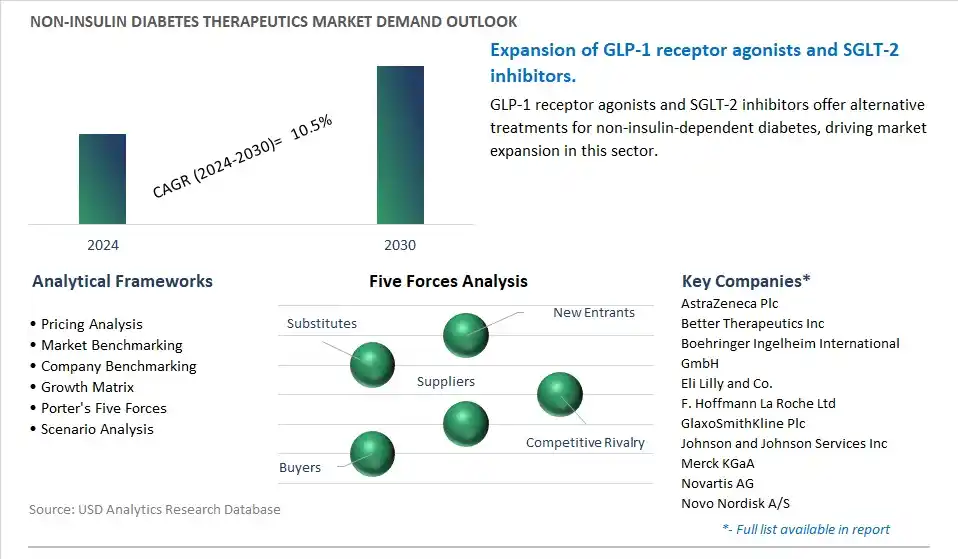
Non-insulin Diabetes Therapeutics Market is estimated to increase at a growth rate of 10.5% CAGR over the forecast period from 2024 to 2030.
The global Non-insulin Diabetes Therapeutics Market Study analyzes and forecasts the market size across 6 regions and 24 countries for diverse segments including By Type (DPP4 inhibitors, GLP-1 receptor agonists, SGLT2 inhibitors, Others), By Distribution Channel (Offline, Online).
An Introduction to Non-insulin Diabetes Therapeutics Market in 2024
The Non-insulin Diabetes Therapeutics Market is undergoing a paradigm shift in 2024, driven by advancements in pharmacotherapy and a growing emphasis on personalized diabetes management. With the escalating prevalence of diabetes mellitus worldwide, there is a pressing need for innovative therapeutics capable of achieving glycemic control while minimizing the risk of hypoglycemia and adverse effects associated with conventional insulin therapy. The market is witnessing a surge in the development of oral antidiabetic agents, injectable glucagon-like peptide-1 (GLP-1) receptor agonists, and sodium-glucose cotransporter-2 (SGLT-2) inhibitors, offering diverse treatment options tailored to individual patient needs and preferences. Additionally, there is increasing recognition of the importance of comprehensive diabetes care, including lifestyle interventions, dietary counseling, and patient education, in optimizing treatment outcomes and reducing the burden of diabetes-related complications, underscoring the holistic approach embraced by stakeholders in the evolving diabetes therapeutics landscape.
Non-insulin Diabetes Therapeutics Market Competitive Landscape
The global Non-insulin Diabetes Therapeutics Industry is highly competitive with a large number of companies focusing on niche market segments. Amidst intense competitive conditions, Non-insulin Diabetes Therapeutics Companies are investing in new product launches and strengthening distribution channels. Key companies operating in the Non-insulin Diabetes Therapeutics Industry include- AstraZeneca Plc, Better Therapeutics Inc, Boehringer Ingelheim International GmbH, Eli Lilly and Co., F. Hoffmann La Roche Ltd, GlaxoSmithKline Plc, Johnson and Johnson Services Inc, Merck KGaA, Novartis AG, Novo Nordisk A/S, Pfizer Inc, Sanofi S.A., Takeda Pharmaceutical Co. Ltd, The Cleveland Clinic Foundation.
Non-insulin Diabetes Therapeutics Market Trend: Shift Towards Personalized Medicine
In the Non-insulin Diabetes Therapeutics market, a prominent trend is the shift towards personalized medicine. With advancements in understanding the heterogeneity of diabetes and its underlying mechanisms, there is increasing recognition of the need for tailored treatment approaches that address individual patient characteristics, including genetic factors, metabolic profiles, and lifestyle factors. Personalized medicine in diabetes therapeutics involves the use of biomarkers, genetic testing, and patient-specific interventions to optimize treatment efficacy, minimize adverse effects, and improve patient outcomes. This trend reflects a paradigm shift towards precision medicine in diabetes management, driving innovation and shaping the development of novel therapeutics tailored to specific patient subpopulations.
Non-insulin Diabetes Therapeutics Market Driver: Rising Global Diabetes Epidemic
The primary market driver for Non-insulin Diabetes Therapeutics is the rising global diabetes epidemic. Diabetes mellitus, characterized by hyperglycemia and impaired insulin function, is a major public health concern worldwide, with an increasing prevalence across all age groups and geographic regions. Factors such as sedentary lifestyles, unhealthy dietary habits, obesity, and aging populations contribute to the growing burden of diabetes and its associated complications, including cardiovascular disease, kidney disease, and neuropathy. The escalating diabetes epidemic drives the demand for effective therapeutics that control blood glucose levels, improve insulin sensitivity, and reduce the risk of diabetes-related complications, fueling research, development, and market growth in the Non-insulin Diabetes Therapeutics segment.
Non-insulin Diabetes Therapeutics Market Opportunity: Development of Novel Oral Antidiabetic Agents
An emerging opportunity in the Non-insulin Diabetes Therapeutics market lies in the development of novel oral antidiabetic agents. While insulin and oral hypoglycemic agents remain the cornerstone of diabetes management, there is a need for innovative therapeutics that offer improved efficacy, safety, and patient adherence. Novel oral antidiabetic agents, including glucagon-like peptide-1 (GLP-1) receptor agonists, sodium-glucose co-transporter-2 (SGLT-2) inhibitors, and dipeptidyl peptidase-4 (DPP-4) inhibitors, represent promising treatment options that target distinct pathways involved in glucose metabolism and insulin regulation. Collaborative efforts between pharmaceutical companies, academic researchers, and regulatory agencies are essential for advancing the development and regulatory approval of novel oral antidiabetic agents, addressing unmet medical needs and improving patient care in the management of non-insulin-dependent diabetes.
Non insulin Diabetes Therapeutics Market Share Analysis: GLP-1 Receptor Agonists is the fastest growing market segment over the forecast period to 2030
Among the various types of Non-insulin Diabetes Therapeutics, GLP-1 receptor agonists emerge as the fastest-growing segment. This growth is driven by several factors, including their potent glucose-lowering effects, weight loss benefits, and cardiovascular advantages. GLP-1 receptor agonists mimic the action of glucagon-like peptide-1 (GLP-1), a hormone that stimulates insulin secretion, inhibits glucagon release, slows gastric emptying, and promotes satiety. These mechanisms not only help in achieving glycemic control but also contribute to weight reduction, making GLP-1 receptor agonists particularly appealing for individuals with diabetes who are overweight or obese. Furthermore, clinical trials have demonstrated the cardiovascular benefits of GLP-1 receptor agonists, including reductions in major adverse cardiovascular events, making them a preferred choice in patients with established cardiovascular disease. The increasing recognition of these therapeutic benefits by healthcare providers, coupled with favorable reimbursement policies and patient demand for convenient and effective treatments, is fueling the rapid growth of GLP-1 receptor agonists in the diabetes therapeutics market. Additionally, the availability of GLP-1 receptor agonists through both offline distribution channels, such as hospital pharmacies, and online platforms further enhances their accessibility to patients, contributing to their expanding market share and dominance in the treatment landscape of non-insulin-dependent diabetes.
Non-insulin Diabetes Therapeutics Market Segmentation
By Type
DPP4 inhibitors
GLP-1 receptor agonists
SGLT2 inhibitors
Others
By Distribution Channel
Offline
Online
Geographical Analysis
North America (United States, Canada, Mexico)
Europe (Germany, France, United Kingdom, Spain, Italy, Rest of Europe)
Asia Pacific (China, India, Japan, South Korea, Rest of Asia Pacific)
South America (Brazil, Argentina, Rest of South America)
Middle East and Africa (Saudi Arabia, UAE, Rest of Middle East, South Africa, Egypt, Rest of Africa)
Non-insulin Diabetes Therapeutics Companies
AstraZeneca Plc
Better Therapeutics Inc
Boehringer Ingelheim International GmbH
Eli Lilly and Co.
F. Hoffmann La Roche Ltd
GlaxoSmithKline Plc
Johnson and Johnson Services Inc
Merck KGaA
Novartis AG
Novo Nordisk A/S
Pfizer Inc
Sanofi S.A.
Takeda Pharmaceutical Co. Ltd
The Cleveland Clinic Foundation
* List not Exhaustive
Reasons to Buy the Non-insulin Diabetes Therapeutics Market Study
• Deepen your industry insights and navigate uncertainties for strategy formulation, CAPEX, and Operational decisions
• Gain access to detailed insights on the Non-insulin Diabetes Therapeutics Market, encompassing current market size, growth trends, and forecasts till 2030.
• Access detailed competitor analysis, enabling competitive advantage through a thorough understanding of market players, strategies, and potential differentiation opportunities
• Stay ahead of the curve with insights on technological advancements, innovations, and upcoming trends
• Identify lucrative investment avenues and expansion opportunities within the Non-insulin Diabetes Therapeutics Industry, guided by robust, data-backed analysis.
• Understand regional and global markets through country-wise analysis, regional market potential, regulatory nuances, and dynamics
• Execute strategies with confidence and speed through information, analytics, and insights on the industry value chain
• Corporate leaders, strategists, financial experts, shareholders, asset managers, and governmental representatives can make long-term planning scenarios and build an integrated and timely understanding of market dynamics
• Benefit from tailored solutions and expert consultation based on report insights, providing personalized strategies aligned with specific business needs.
TABLE OF CONTENTS
1 Introduction to 2024 Non-insulin Diabetes Therapeutics Market
1.1 Market Overview
1.2 Quick Facts
1.3 Scope/Objective of the Study
1.4 Market Definition
1.5 Countries and Regions Analyzed
1.6 Units, Currency, and Conversions
1.7 Industry Value Chain
2 Research Methodology
2.1 Market Size Estimation
2.2 Sources and Research Methodology
2.3 Data Triangulation
2.4 Assumptions and Limitations
3 Executive Summary
3.1 Global Non-insulin Diabetes Therapeutics Market Size Outlook, $ Million, 2021 to 2030
3.2 Non-insulin Diabetes Therapeutics Market Outlook by Type, $ Million, 2021 to 2030
3.3 Non-insulin Diabetes Therapeutics Market Outlook by Product, $ Million, 2021 to 2030
3.4 Non-insulin Diabetes Therapeutics Market Outlook by Application, $ Million, 2021 to 2030
3.5 Non-insulin Diabetes Therapeutics Market Outlook by Key Countries, $ Million, 2021 to 2030
4 Market Dynamics
4.1 Key Driving Forces of Non-insulin Diabetes Therapeutics Industry
4.2 Key Market Trends in Non-insulin Diabetes Therapeutics Industry
4.3 Potential Opportunities in Non-insulin Diabetes Therapeutics Industry
4.4 Key Challenges in Non-insulin Diabetes Therapeutics Industry
5 Market Factor Analysis
5.1 Value Chain Analysis
5.2 Competitive Landscape
5.2.1 Global Non-insulin Diabetes Therapeutics Market Share by Company (%), 2023
5.2.2 Product Offerings by Company
5.3 Porter’s Five Forces Analysis
5.4 Pricing Analysis and Outlook
6 Growth Outlook Across Scenarios
6.1 Growth Analysis-Case Scenario Definitions
6.2 Low Growth Scenario Forecasts
6.3 Reference Growth Scenario Forecasts
6.4 High Growth Scenario Forecasts
7 Global Non-insulin Diabetes Therapeutics Market Outlook by Segments
7.1 Non-insulin Diabetes Therapeutics Market Outlook by Segments, $ Million, 2021- 2030
By Type
DPP4 inhibitors
GLP-1 receptor agonists
SGLT2 inhibitors
Others
By Distribution Channel
Offline
Online
8 North America Non-insulin Diabetes Therapeutics Market Analysis and Outlook To 2030
8.1 Introduction to North America Non-insulin Diabetes Therapeutics Markets in 2024
8.2 North America Non-insulin Diabetes Therapeutics Market Size Outlook by Country, 2021-2030
8.2.1 United States
8.2.2 Canada
8.2.3 Mexico
8.3 North America Non-insulin Diabetes Therapeutics Market size Outlook by Segments, 2021-2030
By Type
DPP4 inhibitors
GLP-1 receptor agonists
SGLT2 inhibitors
Others
By Distribution Channel
Offline
Online
9 Europe Non-insulin Diabetes Therapeutics Market Analysis and Outlook To 2030
9.1 Introduction to Europe Non-insulin Diabetes Therapeutics Markets in 2024
9.2 Europe Non-insulin Diabetes Therapeutics Market Size Outlook by Country, 2021-2030
9.2.1 Germany
9.2.2 France
9.2.3 Spain
9.2.4 United Kingdom
9.2.4 Italy
9.2.5 Russia
9.2.6 Norway
9.2.7 Rest of Europe
9.3 Europe Non-insulin Diabetes Therapeutics Market Size Outlook by Segments, 2021-2030
By Type
DPP4 inhibitors
GLP-1 receptor agonists
SGLT2 inhibitors
Others
By Distribution Channel
Offline
Online
10 Asia Pacific Non-insulin Diabetes Therapeutics Market Analysis and Outlook To 2030
10.1 Introduction to Asia Pacific Non-insulin Diabetes Therapeutics Markets in 2024
10.2 Asia Pacific Non-insulin Diabetes Therapeutics Market Size Outlook by Country, 2021-2030
10.2.1 China
10.2.2 India
10.2.3 Japan
10.2.4 South Korea
10.2.5 Indonesia
10.2.6 Malaysia
10.2.7 Australia
10.2.8 Rest of Asia Pacific
10.3 Asia Pacific Non-insulin Diabetes Therapeutics Market size Outlook by Segments, 2021-2030
By Type
DPP4 inhibitors
GLP-1 receptor agonists
SGLT2 inhibitors
Others
By Distribution Channel
Offline
Online
11 South America Non-insulin Diabetes Therapeutics Market Analysis and Outlook To 2030
11.1 Introduction to South America Non-insulin Diabetes Therapeutics Markets in 2024
11.2 South America Non-insulin Diabetes Therapeutics Market Size Outlook by Country, 2021-2030
11.2.1 Brazil
11.2.2 Argentina
11.2.3 Rest of South America
11.3 South America Non-insulin Diabetes Therapeutics Market size Outlook by Segments, 2021-2030
By Type
DPP4 inhibitors
GLP-1 receptor agonists
SGLT2 inhibitors
Others
By Distribution Channel
Offline
Online
12 Middle East and Africa Non-insulin Diabetes Therapeutics Market Analysis and Outlook To 2030
12.1 Introduction to Middle East and Africa Non-insulin Diabetes Therapeutics Markets in 2024
12.2 Middle East and Africa Non-insulin Diabetes Therapeutics Market Size Outlook by Country, 2021-2030
12.2.1 Saudi Arabia
12.2.2 UAE
12.2.3 Oman
12.2.4 Rest of Middle East
12.2.5 Egypt
12.2.6 Nigeria
12.2.7 South Africa
12.2.8 Rest of Africa
12.3 Middle East and Africa Non-insulin Diabetes Therapeutics Market size Outlook by Segments, 2021-2030
By Type
DPP4 inhibitors
GLP-1 receptor agonists
SGLT2 inhibitors
Others
By Distribution Channel
Offline
Online
13 Company Profiles
13.1 Company Snapshot
13.2 SWOT Profiles
13.3 Products and Services
13.4 Recent Developments
13.5 Financial Profile
List of Companies
AstraZeneca Plc
Better Therapeutics Inc
Boehringer Ingelheim International GmbH
Eli Lilly and Co.
F. Hoffmann La Roche Ltd
GlaxoSmithKline Plc
Johnson and Johnson Services Inc
Merck KGaA
Novartis AG
Novo Nordisk A/S
Pfizer Inc
Sanofi S.A.
Takeda Pharmaceutical Co. Ltd
The Cleveland Clinic Foundation
14 Appendix
14.1 Customization Offerings
14.2 Subscription Services
14.3 Related Reports
14.4 Publisher Expertise
