The global Non-resilient Flooring Market is poised to register a 5.2% CAGR from $291.3 Billion in 2024 to $394.9 Billion in 2030.
The global Non-resilient Flooring Market Study analyzes and forecasts the market size across 6 regions and 24 countries for diverse segments -By Product (Ceramic Tiles, Stone), By Application (Residential, Commercial, Industrial).
An Introduction to Global Non resilient Flooring Market in 2024
The market for non-resilient flooring is witnessing growth driven by the increasing demand for durable, low-maintenance flooring solutions in commercial, industrial, and institutional settings. One key trend shaping the future of the industry is the adoption of non-resilient flooring materials such as ceramic tile, porcelain tile, natural stone, and concrete in applications such as retail spaces, healthcare facilities, educational institutions, and hospitality venues. Non-resilient flooring offers several advantages such as high durability, resistance to wear and tear, ease of maintenance, and aesthetic versatility, making it suitable for high-traffic areas and demanding environments where hygiene, safety, and aesthetics are paramount. This trend is driving investments in manufacturing technologies, surface treatments, and installation methods to enhance the performance, appearance, and sustainability of non-resilient flooring products while meeting the evolving needs and preferences of end-users. Moreover, the growing focus on environmental sustainability and green building practices is driving the adoption of eco-friendly non-resilient flooring materials such as recycled ceramic tile, reclaimed stone, and low-emission concrete, supporting LEED certification and sustainable building initiatives in the construction industry. Additionally, the expansion of the commercial and institutional construction sectors, particularly in emerging economies, is driving market growth for non-resilient flooring solutions, driven by urbanization, infrastructure development, and renovation projects. Furthermore, the integration of advanced technologies such as digital printing, 3D modeling, and surface finishing techniques is driving innovation in non-resilient flooring design and customization, enabling the creation of unique, visually striking floor designs that enhance interior aesthetics and brand identity in commercial and retail environments.
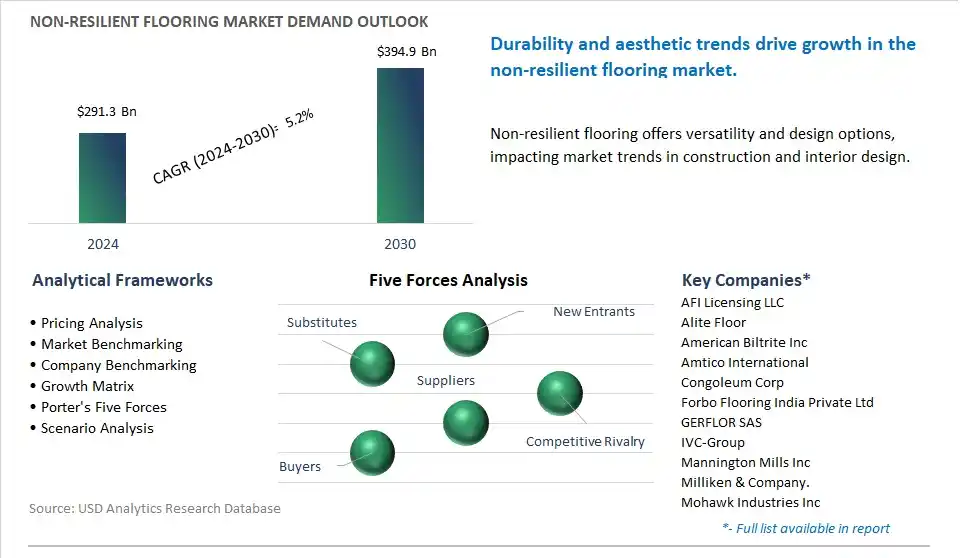
Non-resilient Flooring Market Competitive Landscape
The market report analyses the leading companies in the industry including AFI Licensing LLC, Alite Floor, American Biltrite Inc, Amtico International, Congoleum Corp, Forbo Flooring India Private Ltd, GERFLOR SAS, IVC-Group, Mannington Mills Inc, Milliken & Company., Mohawk Industries Inc, Novalis Innovative Flooring, PERGO, Polyflor Ltd, Shaw Industries Group Inc, Shaw Industries Group Inc.
Non-resilient Flooring Market Dynamics
Non resilient Flooring Market Trend: Growing Demand for Sustainable and Low-Maintenance Flooring Solutions
A prominent trend in the non-resilient flooring market is the growing demand for sustainable and low-maintenance flooring solutions driven by increased awareness of environmental concerns and a shift towards eco-friendly building materials. Non-resilient flooring, which includes materials like ceramic tile, porcelain tile, laminate, and vinyl flooring, is valued for its durability, ease of maintenance, and resistance to moisture and stains. With consumers and businesses seeking flooring options that offer longevity, aesthetics, and environmental benefits, there is a rising interest in non-resilient flooring materials that are made from recycled content, have low VOC emissions, and require minimal upkeep. This trend reflects the emphasis on sustainable construction practices and the preference for flooring solutions that contribute to healthier indoor environments, driving market growth and innovation in non-resilient flooring products.
Non resilient Flooring Market Driver: Expansion of the Construction and Renovation Sector
A key driver propelling the non-resilient flooring market is the expansion of the construction and renovation sector driven by urbanization, population growth, and infrastructure development projects worldwide. Non-resilient flooring materials are widely used in residential, commercial, and institutional buildings for their durability, versatility, and aesthetic appeal. With increasing construction activities in emerging economies, rising disposable incomes, and a growing demand for modern living and working spaces, there is a corresponding need for flooring solutions that can withstand heavy foot traffic, resist wear and tear, and complement interior design themes. Additionally, renovation and remodeling projects in both residential and commercial sectors contribute to the demand for non-resilient flooring materials as homeowners and businesses seek to update their spaces with durable and visually appealing flooring options. The expansion of the construction and renovation sector acts as a significant driver for market growth and penetration of non-resilient flooring products in diverse applications and end-user segments.
Non resilient Flooring Market Opportunity: Innovation in Sustainable and Design-forward Flooring Solutions
An opportunity for market expansion lies in the innovation and development of sustainable and design-forward flooring solutions that offer enhanced performance, aesthetics, and environmental benefits. Manufacturers and suppliers in the non-resilient flooring market can capitalize on the growing demand for eco-friendly and stylish flooring options by investing in research and development of new materials, designs, and production processes. This includes exploring alternative raw materials, such as recycled content or bio-based materials, to reduce environmental impact and enhance sustainability credentials. Additionally, incorporating advanced technologies, such as digital printing and embossing techniques, can enable the creation of customizable and visually appealing flooring designs that mimic natural materials like wood, stone, and marble. By offering a diverse range of sustainable and design-forward flooring solutions, companies can cater to the evolving needs and preferences of consumers, architects, and interior designers, unlocking new opportunities for growth and market differentiation in the non-resilient flooring segment.
Non-resilient Flooring Market Share Analysis: Ceramic Tiles segment generated the highest revenue in the industry
The Ceramic Tiles segment is the largest segment in the Non-resilient Flooring Market due to diverse key factors contributing to its dominance. Ceramic tiles are widely favored for their durability, versatility, and aesthetic appeal, making them a popular choice for flooring applications in both residential and commercial settings. One of the primary reasons for the dominance of ceramic tiles is their exceptional durability and resistance to wear and tear. Ceramic tiles are highly resistant to scratches, stains, moisture, and fading, making them suitable for high-traffic areas such as kitchens, bathrooms, and entryways. This durability ensures that ceramic tile flooring maintains its appearance and performance over time, resulting in long-lasting and cost-effective flooring solutions. In addition, ceramic tiles offer a diverse range of design options, including various colors, patterns, sizes, and finishes, allowing for customization to suit different design preferences and architectural styles. This versatility makes ceramic tiles suitable for a wide range of interior design themes, from traditional to contemporary, and enables architects, designers, and homeowners to create unique and visually appealing spaces. Additionally, ceramic tiles are relatively easy to clean and maintain, requiring simple routine care to retain their beauty and functionality. Their non-porous surface prevents the absorption of liquids and stains, simplifying maintenance and contributing to a hygienic and healthy indoor environment.
Non-resilient Flooring Market Share Analysis: Residential Segment is poised to register the fastest growth rate (CAGR) over the forecast period to 2030
The Residential segment is the fastest growing segment in the Non-resilient Flooring Market due to diverse key factors driving its rapid expansion. In recent years, there has been a surge in residential construction and renovation activities worldwide, fueled by factors such as urbanization, population growth, and changing lifestyle preferences. As homeowners increasingly prioritize comfort, aesthetics, and durability in their living spaces, there is a growing demand for high-quality flooring solutions that enhance the Over the forecast period look and feel of residential interiors. Non-resilient flooring options such as ceramic tiles, hardwood, and natural stone offer homeowners a wide range of design possibilities, from timeless elegance to modern sophistication. In addition, advancements in manufacturing technologies have led to the development of innovative and affordable non-resilient flooring products that mimic the look and texture of natural materials while offering superior performance and durability. Additionally, the growing trend towards sustainable and eco-friendly building materials drives the adoption of non-resilient flooring options made from renewable or recycled materials, appealing to environmentally conscious consumers. With the increasing focus on creating comfortable, stylish, and sustainable living environments, the Residential segment experiences significant growth in the Non-resilient Flooring Market, propelled by the rising demand for premium flooring solutions in residential settings.
Non-resilient Flooring Market Report Segmentation
By Product
Ceramic Tiles
Stone
By Application
Residential
Commercial
Industrial
Regions Included
North America (US, Canada, Mexico)
Europe (Germany, UK, France, Spain, Italy, Russia, Rest of Europe)
Asia Pacific (China, India, Japan, South Korea, Australia, South East Asia, Rest of Asia)
South America (Brazil, Argentina, Rest of South America)
Middle East and Africa (Saudi Arabia, UAE, Rest of Middle East, South Africa, Egypt, Rest of Africa)
Non-resilient Flooring Companies Profiled in the Market Study
AFI Licensing LLC
Alite Floor
American Biltrite Inc
Amtico International
Congoleum Corp
Forbo Flooring India Private Ltd
GERFLOR SAS
IVC-Group
Mannington Mills Inc
Milliken & Company.
Mohawk Industries Inc
Novalis Innovative Flooring
PERGO
Polyflor Ltd
Shaw Industries Group Inc
Shaw Industries Group Inc
*- List Not Exhaustive
TABLE OF CONTENTS
1 Introduction to 2024 Non-resilient Flooring Market
1.1 Market Overview
1.2 Quick Facts
1.3 Scope/Objective of the Study
1.4 Market Definition
1.5 Countries and Regions Covered
1.6 Units, Currency, and Conversions
1.7 Industry Value Chain
2 Research Methodology
2.1 Market Size Estimation
2.2 Sources and Research Methodology
2.3 Data Triangulation
2.4 Assumptions and Limitations
3 Executive Summary
3.1 Global Non-resilient Flooring Market Size Outlook, $ Million, 2021 to 2030
3.2 Non-resilient Flooring Market Outlook by Type, $ Million, 2021 to 2030
3.3 Non-resilient Flooring Market Outlook by Product, $ Million, 2021 to 2030
3.4 Non-resilient Flooring Market Outlook by Application, $ Million, 2021 to 2030
3.5 Non-resilient Flooring Market Outlook by Key Countries, $ Million, 2021 to 2030
4 Market Dynamics
4.1 Key Driving Forces of Non-resilient Flooring Industry
4.2 Key Market Trends in Non-resilient Flooring Industry
4.3 Potential Opportunities in Non-resilient Flooring Industry
4.4 Key Challenges in Non-resilient Flooring Industry
5 Market Factor Analysis
5.1 Value Chain Analysis
5.2 Competitive Landscape
5.2.1 Global Non-resilient Flooring Market Share by Company (%), 2023
5.2.2 Product Offerings by Company
5.3 Porter’s Five Forces Analysis
5.4 Pricing Analysis and Outlook
6 Growth Outlook Across Scenarios
6.1 Growth Analysis-Case Scenario Definitions
6.2 Low Growth Scenario Forecasts
6.3 Reference Growth Scenario Forecasts
6.4 High Growth Scenario Forecasts
7 Global Non-resilient Flooring Market Outlook by Segments
7.1 Non-resilient Flooring Market Outlook by Segments, $ Million, 2021- 2030
By Product
Ceramic Tiles
Stone
By Application
Residential
Commercial
Industrial
8 North America Non-resilient Flooring Market Analysis and Outlook To 2030
8.1 Introduction to North America Non-resilient Flooring Markets in 2024
8.2 North America Non-resilient Flooring Market Size Outlook by Country, 2021-2030
8.2.1 United States
8.2.2 Canada
8.2.3 Mexico
8.3 North America Non-resilient Flooring Market size Outlook by Segments, 2021-2030
By Product
Ceramic Tiles
Stone
By Application
Residential
Commercial
Industrial
9 Europe Non-resilient Flooring Market Analysis and Outlook To 2030
9.1 Introduction to Europe Non-resilient Flooring Markets in 2024
9.2 Europe Non-resilient Flooring Market Size Outlook by Country, 2021-2030
9.2.1 Germany
9.2.2 France
9.2.3 Spain
9.2.4 United Kingdom
9.2.4 Italy
9.2.5 Russia
9.2.6 Norway
9.2.7 Rest of Europe
9.3 Europe Non-resilient Flooring Market Size Outlook by Segments, 2021-2030
By Product
Ceramic Tiles
Stone
By Application
Residential
Commercial
Industrial
10 Asia Pacific Non-resilient Flooring Market Analysis and Outlook To 2030
10.1 Introduction to Asia Pacific Non-resilient Flooring Markets in 2024
10.2 Asia Pacific Non-resilient Flooring Market Size Outlook by Country, 2021-2030
10.2.1 China
10.2.2 India
10.2.3 Japan
10.2.4 South Korea
10.2.5 Indonesia
10.2.6 Malaysia
10.2.7 Australia
10.2.8 Rest of Asia Pacific
10.3 Asia Pacific Non-resilient Flooring Market size Outlook by Segments, 2021-2030
By Product
Ceramic Tiles
Stone
By Application
Residential
Commercial
Industrial
11 South America Non-resilient Flooring Market Analysis and Outlook To 2030
11.1 Introduction to South America Non-resilient Flooring Markets in 2024
11.2 South America Non-resilient Flooring Market Size Outlook by Country, 2021-2030
11.2.1 Brazil
11.2.2 Argentina
11.2.3 Rest of South America
11.3 South America Non-resilient Flooring Market size Outlook by Segments, 2021-2030
By Product
Ceramic Tiles
Stone
By Application
Residential
Commercial
Industrial
12 Middle East and Africa Non-resilient Flooring Market Analysis and Outlook To 2030
12.1 Introduction to Middle East and Africa Non-resilient Flooring Markets in 2024
12.2 Middle East and Africa Non-resilient Flooring Market Size Outlook by Country, 2021-2030
12.2.1 Saudi Arabia
12.2.2 UAE
12.2.3 Oman
12.2.4 Rest of Middle East
12.2.5 Egypt
12.2.6 Nigeria
12.2.7 South Africa
12.2.8 Rest of Africa
12.3 Middle East and Africa Non-resilient Flooring Market size Outlook by Segments, 2021-2030
By Product
Ceramic Tiles
Stone
By Application
Residential
Commercial
Industrial
13 Company Profiles
13.1 Company Snapshot
13.2 SWOT Profiles
13.3 Products and Services
13.4 Recent Developments
13.5 Financial Profile
AFI Licensing LLC
Alite Floor
American Biltrite Inc
Amtico International
Congoleum Corp
Forbo Flooring India Private Ltd
GERFLOR SAS
IVC-Group
Mannington Mills Inc
Milliken & Company.
Mohawk Industries Inc
Novalis Innovative Flooring
PERGO
Polyflor Ltd
Shaw Industries Group Inc
Shaw Industries Group Inc
14 Appendix
14.1 Customization Offerings
14.2 Subscription Services
14.3 Related Reports
14.4 Publisher Expertise
By Product
Ceramic Tiles
Stone
By Application
Residential
Commercial
Industrial
Countries Analyzed
North America (US, Canada, Mexico)
Europe (Germany, UK, France, Spain, Italy, Russia, Rest of Europe)
Asia Pacific (China, India, Japan, South Korea, Australia, South East Asia, Rest of Asia)
South America (Brazil, Argentina, Rest of South America)
Middle East and Africa (Saudi Arabia, UAE, Rest of Middle East, South Africa, Egypt, Rest of Africa)
