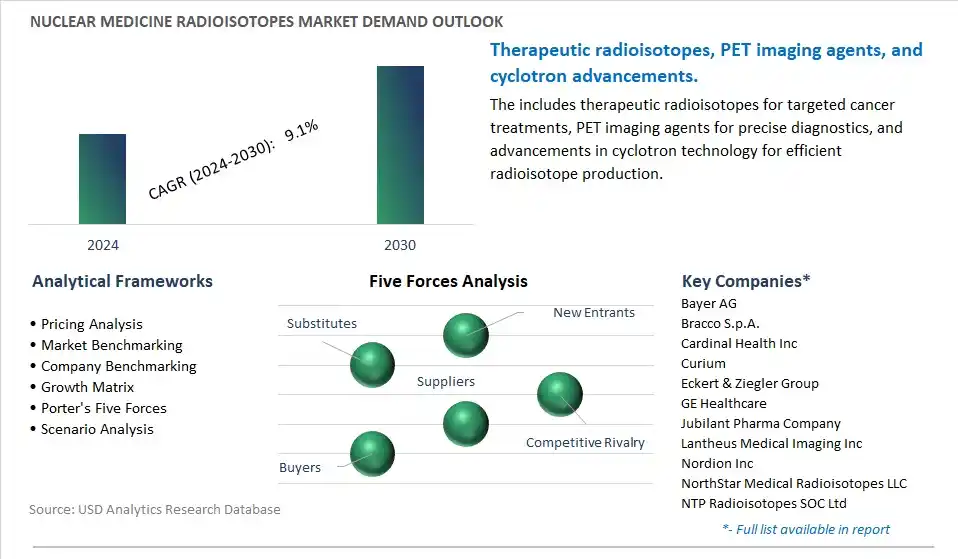
Nuclear Medicine Radioisotopes Market is estimated to increase at a Compounded Annual Growth Rate of 9.1% CAGR over the forecast period from 2024 to 2030
The Nuclear Medicine Radioisotopes Market study analyzes and forecasts the market size across 6 regions and 24 countries for diverse segments- By Type (Technetium-99m (Tc-99m), Thallium-201 (Tl-201), Iodine (I-123), Fluorine-18, Rubidium-82 (Rb-82), Iodine-131 (I-131), Lutetium-177 (Lu-177), Radium-223 (Ra-223) and Alpharadin, Actinium-225 (Ac-225), Others), By Application (Oncology, Cardiology, Thyroid, Neurology, Others).
An Introduction to Nuclear Medicine Radioisotopes Market in 2024
The market for nuclear medicine radioisotopes is expanding in 2024, driven by the increasing utilization of nuclear imaging techniques for diagnosis, staging, and treatment monitoring of various diseases. Radioisotopes, such as technetium-99m, iodine-131, and gallium-68, serve as essential tracers in positron emission tomography (PET) and single-photon emission computed tomography (SPECT) imaging modalities, enabling visualization of physiological processes and molecular targets in vivo. With advancements in radioisotope production, purification, and labeling techniques, the market offers a diverse portfolio of radiopharmaceuticals for oncology, cardiology, neurology, and other medical specialties. Moreover, the emergence of theranostic approaches, combining diagnostic imaging with targeted radiotherapy using radiolabeled pharmaceuticals, holds promise for personalized medicine and precision oncology initiatives. As nuclear medicine continues to play a pivotal role in modern healthcare, the market for radioisotopes is poised for further growth, driven by the demand for innovative imaging and therapeutic solutions across clinical and research applications.
Market Trend: Shift Towards Therapeutic Applications and Targeted Radiopharmaceuticals
A significant trend in the nuclear medicine radioisotopes market is the shift towards therapeutic applications and the development of targeted radiopharmaceuticals. Traditionally, nuclear medicine primarily focused on diagnostic imaging using radioisotopes for procedures such as PET (Positron Emission Tomography) and SPECT (Single Photon Emission Computed Tomography). However, there is a growing recognition of the therapeutic potential of radioisotopes in the treatment of various cancers and other medical conditions. Advances in radiochemistry and molecular targeting techniques have enabled the development of radiopharmaceuticals that specifically target diseased cells while sparing healthy tissues, leading to more effective and personalized treatment approaches. This trend towards therapeutic nuclear medicine opens up new avenues for innovation and market growth, as pharmaceutical companies and research institutions continue to explore novel radioisotope-based therapies.
Market Driver: Increasing Incidence of Cancer and Chronic Diseases
A primary driver fueling the nuclear medicine radioisotopes market is the increasing incidence of cancer and chronic diseases globally. Cancer remains one of the leading causes of mortality worldwide, with a rising prevalence due to aging populations, lifestyle factors, and improved detection methods. Additionally, chronic diseases such as cardiovascular disorders and neurological conditions contribute to the growing demand for nuclear medicine procedures for both diagnosis and treatment. Radioisotopes play a crucial role in oncology, cardiology, neurology, and other medical specialties, providing valuable diagnostic information and therapeutic options for patients. As the burden of cancer and chronic diseases continues to rise, there is a corresponding increase in the utilization of nuclear medicine technologies, driving the demand for radioisotopes and related products and services.
Market Opportunity: Expansion of Nuclear Medicine Infrastructure in Emerging Markets
An opportunity within the nuclear medicine radioisotopes market lies in the expansion of nuclear medicine infrastructure in emerging markets. While developed countries have well-established nuclear medicine departments and widespread access to radioisotope-based technologies, many emerging economies are still in the early stages of adopting these medical modalities. There is a growing recognition of the value of nuclear medicine in disease diagnosis, management, and treatment planning, prompting investment in healthcare infrastructure and technology upgrades in regions such as Asia, Latin America, and the Middle East. By targeting these emerging markets and collaborating with local healthcare providers and government agencies, radioisotope manufacturers and distributors can capitalize on the growing demand for nuclear medicine solutions. Moreover, initiatives aimed at improving access to radioisotopes, training healthcare professionals, and raising awareness about the benefits of nuclear medicine can further stimulate market growth and expansion opportunities in emerging markets.
Nuclear Medicine Radioisotopes Market Share Analysis: Lutetium-177 (Lu-177)
In the Nuclear Medicine Radioisotopes market, Lutetium-177 (Lu-177) stands out as a segment with significant growth potential. Lu-177 is increasingly utilized in targeted radionuclide therapy, particularly in the treatment of neuroendocrine tumors and prostate cancer metastases to bones. Its beta-emitting properties make it suitable for therapeutic applications, delivering localized radiation to cancerous cells while minimizing damage to surrounding healthy tissue. This targeted approach enhances treatment efficacy and reduces side effects compared to traditional therapies. Additionally, advancements in radiopharmaceutical development and production techniques have expanded the clinical utility of Lu-177, leading to its adoption in a broader range of oncological indications. The rising incidence of cancer worldwide, coupled with the growing demand for personalized and precision medicine, further drives the market for Lu-177-based therapies. Moreover, ongoing research and clinical trials exploring new therapeutic applications and combination treatments involving Lu-177 contribute to the segment's rapid growth trajectory. As healthcare providers increasingly embrace molecular imaging and targeted radionuclide therapy as integral components of cancer care, the demand for Lu-177 and related radiopharmaceuticals is expected to soar, fostering innovation and market expansion in the nuclear medicine sector.
Nuclear Medicine Radioisotopes Competitive Analysis
The market research study provides in-depth insights into leading companies including the SWOT analyses, product profile, financial details, and recent developments acrossBayer AG, Bracco S.p.A., Cardinal Health Inc, Curium, Eckert & Ziegler Group, GE Healthcare, Jubilant Pharma Company, Lantheus Medical Imaging Inc, Nordion Inc, NorthStar Medical Radioisotopes LLC, NTP Radioisotopes SOC Ltd
Nuclear Medicine Radioisotopes Market Segmentation
By Type
Technetium-99m (Tc-99m)
Thallium-201 (Tl-201)
Iodine (I-123)
Fluorine-18
Rubidium-82 (Rb-82)
Iodine-131 (I-131)
Lutetium-177 (Lu-177)
Radium-223 (Ra-223) and Alpharadin
Actinium-225 (Ac-225)
Others
By Application
Oncology
Cardiology
Thyroid
Neurology
Others
Geographical Analysis
North America (United States, Canada, Mexico)
Europe (Germany, France, United Kingdom, Spain, Italy, Rest of Europe)
Asia Pacific (China, India, Japan, South Korea, Rest of Asia Pacific)
South America (Brazil, Argentina, Rest of South America)
Middle East and Africa (Saudi Arabia, UAE, Rest of Middle East, South Africa, Egypt, Rest of Africa)
Nuclear Medicine Radioisotopes Market Companies
Bayer AG
Bracco S.p.A.
Cardinal Health Inc
Curium
Eckert & Ziegler Group
GE Healthcare
Jubilant Pharma Company
Lantheus Medical Imaging Inc
Nordion Inc
NorthStar Medical Radioisotopes LLC
NTP Radioisotopes SOC Ltd
Reasons to Buy the Nuclear Medicine Radioisotopes Market Study
• Deepen your industry insights and navigate uncertainties for strategy formulation, CAPEX, and Operational decisions
• Gain access to detailed insights on the Nuclear Medicine Radioisotopes Market, encompassing current market size, growth trends, and forecasts till 2030.
• Access detailed competitor analysis, enabling competitive advantage through a thorough understanding of market players, strategies, and potential differentiation opportunities
• Stay ahead of the curve with insights on technological advancements, innovations, and upcoming trends
• Identify lucrative investment avenues and expansion opportunities within the Nuclear Medicine Radioisotopes Market industry, guided by robust, data-backed analysis.
• Understand regional and global markets through country-wise analysis, regional market potential, regulatory nuances, and dynamics
• Execute strategies with confidence and speed through information, analytics, and insights on the industry value chain
• Corporate leaders, strategists, financial experts, shareholders, asset managers, and governmental representatives can make long-term planning scenarios and build an integrated and timely understanding of market dynamics
• Benefit from tailored solutions and expert consultation based on report insights, providing personalized strategies aligned with specific business needs.
TABLE OF CONTENTS
1 Introduction to 2024 Nuclear Medicine Radioisotopes Market
1.1 Market Overview
1.2 Quick Facts
1.3 Scope/Objective of the Study
1.4 Market Definition
1.5 Countries and Regions Covered
1.6 Units, Currency, and Conversions
1.7 Industry Value Chain
2 Research Methodology
2.1 Market Size Estimation
2.2 Sources and Research Methodology
2.3 Data Triangulation
2.4 Assumptions and Limitations
3 Executive Summary
3.1 Global Nuclear Medicine Radioisotopes Market Size Outlook, $ Million, 2021 to 2030
3.2 Nuclear Medicine Radioisotopes Market Outlook by Type, $ Million, 2021 to 2030
3.3 Nuclear Medicine Radioisotopes Market Outlook by Product, $ Million, 2021 to 2030
3.4 Nuclear Medicine Radioisotopes Market Outlook by Application, $ Million, 2021 to 2030
3.5 Nuclear Medicine Radioisotopes Market Outlook by Key Countries, $ Million, 2021 to 2030
4 Market Dynamics
4.1 Key Driving Forces of Nuclear Medicine Radioisotopes Industry
4.2 Key Market Trends in Nuclear Medicine Radioisotopes Industry
4.3 Potential Opportunities in Nuclear Medicine Radioisotopes Industry
4.4 Key Challenges in Nuclear Medicine Radioisotopes Industry
5 Market Factor Analysis
5.1 Value Chain Analysis
5.2 Competitive Landscape
5.2.1 Global Nuclear Medicine Radioisotopes Market Share by Company (%), 2023
5.2.2 Product Offerings by Company
5.3 Porter’s Five Forces Analysis
5.4 Pricing Analysis and Outlook
6 Growth Outlook Across Scenarios
6.1 Growth Analysis-Case Scenario Definitions
6.2 Low Growth Scenario Forecasts
6.3 Reference Growth Scenario Forecasts
6.4 High Growth Scenario Forecasts
7 Global Nuclear Medicine Radioisotopes Market Outlook by Segments
7.1 Nuclear Medicine Radioisotopes Market Outlook by Segments, $ Million, 2021- 2030
By Type
Technetium-99m (Tc-99m)
Thallium-201 (Tl-201)
Iodine (I-123)
Fluorine-18
Rubidium-82 (Rb-82)
Iodine-131 (I-131)
Lutetium-177 (Lu-177)
Radium-223 (Ra-223) and Alpharadin
Actinium-225 (Ac-225)
Others
By Application
Oncology
Cardiology
Thyroid
Neurology
Others
8 North America Nuclear Medicine Radioisotopes Market Analysis and Outlook To 2030
8.1 Introduction to North America Nuclear Medicine Radioisotopes Markets in 2024
8.2 North America Nuclear Medicine Radioisotopes Market Size Outlook by Country, 2021-2030
8.2.1 United States
8.2.2 Canada
8.2.3 Mexico
8.3 North America Nuclear Medicine Radioisotopes Market size Outlook by Segments, 2021-2030
By Type
Technetium-99m (Tc-99m)
Thallium-201 (Tl-201)
Iodine (I-123)
Fluorine-18
Rubidium-82 (Rb-82)
Iodine-131 (I-131)
Lutetium-177 (Lu-177)
Radium-223 (Ra-223) and Alpharadin
Actinium-225 (Ac-225)
Others
By Application
Oncology
Cardiology
Thyroid
Neurology
Others
9 Europe Nuclear Medicine Radioisotopes Market Analysis and Outlook To 2030
9.1 Introduction to Europe Nuclear Medicine Radioisotopes Markets in 2024
9.2 Europe Nuclear Medicine Radioisotopes Market Size Outlook by Country, 2021-2030
9.2.1 Germany
9.2.2 France
9.2.3 Spain
9.2.4 United Kingdom
9.2.4 Italy
9.2.5 Russia
9.2.6 Norway
9.2.7 Rest of Europe
9.3 Europe Nuclear Medicine Radioisotopes Market Size Outlook by Segments, 2021-2030
By Type
Technetium-99m (Tc-99m)
Thallium-201 (Tl-201)
Iodine (I-123)
Fluorine-18
Rubidium-82 (Rb-82)
Iodine-131 (I-131)
Lutetium-177 (Lu-177)
Radium-223 (Ra-223) and Alpharadin
Actinium-225 (Ac-225)
Others
By Application
Oncology
Cardiology
Thyroid
Neurology
Others
10 Asia Pacific Nuclear Medicine Radioisotopes Market Analysis and Outlook To 2030
10.1 Introduction to Asia Pacific Nuclear Medicine Radioisotopes Markets in 2024
10.2 Asia Pacific Nuclear Medicine Radioisotopes Market Size Outlook by Country, 2021-2030
10.2.1 China
10.2.2 India
10.2.3 Japan
10.2.4 South Korea
10.2.5 Indonesia
10.2.6 Malaysia
10.2.7 Australia
10.2.8 Rest of Asia Pacific
10.3 Asia Pacific Nuclear Medicine Radioisotopes Market size Outlook by Segments, 2021-2030
By Type
Technetium-99m (Tc-99m)
Thallium-201 (Tl-201)
Iodine (I-123)
Fluorine-18
Rubidium-82 (Rb-82)
Iodine-131 (I-131)
Lutetium-177 (Lu-177)
Radium-223 (Ra-223) and Alpharadin
Actinium-225 (Ac-225)
Others
By Application
Oncology
Cardiology
Thyroid
Neurology
Others
11 South America Nuclear Medicine Radioisotopes Market Analysis and Outlook To 2030
11.1 Introduction to South America Nuclear Medicine Radioisotopes Markets in 2024
11.2 South America Nuclear Medicine Radioisotopes Market Size Outlook by Country, 2021-2030
11.2.1 Brazil
11.2.2 Argentina
11.2.3 Rest of South America
11.3 South America Nuclear Medicine Radioisotopes Market size Outlook by Segments, 2021-2030
By Type
Technetium-99m (Tc-99m)
Thallium-201 (Tl-201)
Iodine (I-123)
Fluorine-18
Rubidium-82 (Rb-82)
Iodine-131 (I-131)
Lutetium-177 (Lu-177)
Radium-223 (Ra-223) and Alpharadin
Actinium-225 (Ac-225)
Others
By Application
Oncology
Cardiology
Thyroid
Neurology
Others
12 Middle East and Africa Nuclear Medicine Radioisotopes Market Analysis and Outlook To 2030
12.1 Introduction to Middle East and Africa Nuclear Medicine Radioisotopes Markets in 2024
12.2 Middle East and Africa Nuclear Medicine Radioisotopes Market Size Outlook by Country, 2021-2030
12.2.1 Saudi Arabia
12.2.2 UAE
12.2.3 Oman
12.2.4 Rest of Middle East
12.2.5 Egypt
12.2.6 Nigeria
12.2.7 South Africa
12.2.8 Rest of Africa
12.3 Middle East and Africa Nuclear Medicine Radioisotopes Market size Outlook by Segments, 2021-2030
By Type
Technetium-99m (Tc-99m)
Thallium-201 (Tl-201)
Iodine (I-123)
Fluorine-18
Rubidium-82 (Rb-82)
Iodine-131 (I-131)
Lutetium-177 (Lu-177)
Radium-223 (Ra-223) and Alpharadin
Actinium-225 (Ac-225)
Others
By Application
Oncology
Cardiology
Thyroid
Neurology
Others
13 Company Profiles
13.1 Company Snapshot
13.2 SWOT Profiles
13.3 Products and Services
13.4 Recent Developments
13.5 Financial Profile
List of Companies
Bayer AG
Bracco S.p.A.
Cardinal Health Inc
Curium
Eckert & Ziegler Group
GE Healthcare
Jubilant Pharma Company
Lantheus Medical Imaging Inc
Nordion Inc
NorthStar Medical Radioisotopes LLC
NTP Radioisotopes SOC Ltd
14 Appendix
14.1 Customization Offerings
14.2 Subscription Services
14.3 Related Reports
14.4 Publisher Expertise
By Type
Technetium-99m (Tc-99m)
Thallium-201 (Tl-201)
Iodine (I-123)
Fluorine-18
Rubidium-82 (Rb-82)
Iodine-131 (I-131)
Lutetium-177 (Lu-177)
Radium-223 (Ra-223) and Alpharadin
Actinium-225 (Ac-225)
Others
By Application
Oncology
Cardiology
Thyroid
Neurology
Others
Countries Analyzed
North America (United States, Canada, Mexico)
Europe (Germany, France, United Kingdom, Spain, Italy, Rest of Europe)
Asia Pacific (China, India, Japan, South Korea, Rest of Asia Pacific)
South America (Brazil, Argentina, Rest of South America)
Middle East and Africa (Saudi Arabia, UAE, Rest of Middle East, South Africa, Egypt, Rest of Africa)
