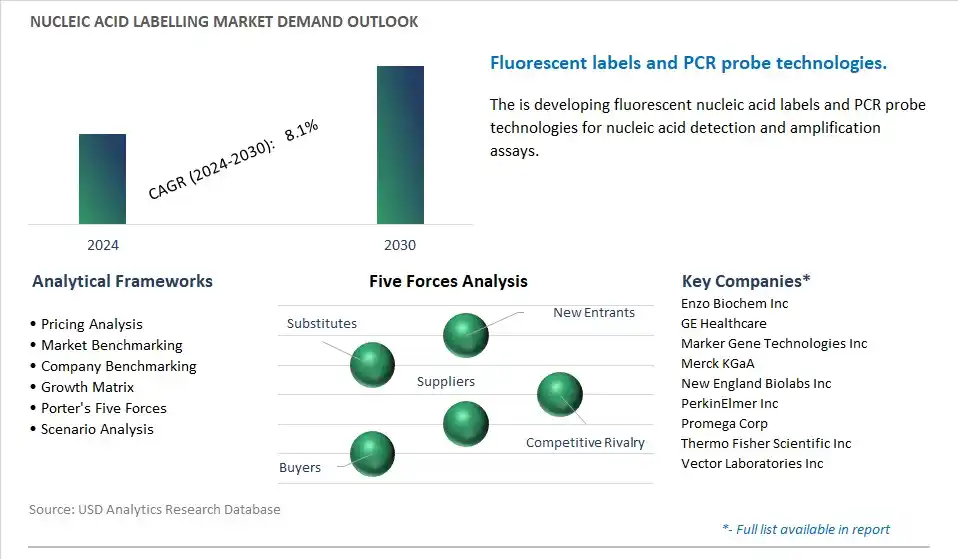
Nucleic Acid Labeling Market is estimated to increase at a Compounded Annual Growth Rate of 8.1% CAGR over the forecast period from 2024 to 2030
The Nucleic Acid Labeling Market study analyzes and forecasts the market size across 6 regions and 24 countries for diverse segments- By Label (Biotin-based, Fluorescent, Radioactive, Others), By Application (Microarray, DNA Sequencing, In situ Hybridization, Polymerase Chain Reaction, Others), By End-User (Hospitals/Clinics, Diagnostic Centers, Others).
An Introduction to Nucleic Acid Labeling Market in 2024
Nucleic Acid Labeling techniques play a critical role in molecular biology research, enabling the detection, visualization, and manipulation of DNA and RNA molecules for various applications. Whether for in situ hybridization, nucleic acid amplification assays, or protein-nucleic acid interaction studies, labeled nucleic acid probes serve as indispensable tools for elucidating cellular processes and disease mechanisms. Fluorescent dyes, radioisotopes, biotin, and digoxigenin are among the commonly used labels, offering flexibility in experimental design and detection sensitivity. With advancements in labeling chemistries, conjugation methods, and detection technologies, nucleic acid labeling continues to evolve, empowering researchers with increasingly sophisticated tools for unraveling the complexities of the genome and transcriptome.
Market Trend: Adoption of Fluorescent Probes for Nucleic Acid Labeling
A significant trend in the nucleic acid labeling market is the increasing adoption of fluorescent probes for nucleic acid labeling applications. Fluorescent labeling enables the visualization and detection of nucleic acids in various research and diagnostic applications, including fluorescence in situ hybridization (FISH), polymerase chain reaction (PCR), and DNA sequencing. Recent advancements in fluorescent labeling technologies, such as fluorophore conjugation chemistry and signal amplification strategies, have improved the sensitivity, specificity, and multiplexing capabilities of nucleic acid labeling assays. This trend reflects a growing demand for fluorescent probes that offer bright, photostable signals and compatibility with a wide range of detection platforms, driving market growth and innovation in nucleic acid labeling reagents and kits.
Market Driver: Growing Demand for Molecular Diagnostics and Genomic Research
A key driver for the nucleic acid labeling market is the growing demand for molecular diagnostics and genomic research applications. Nucleic acid labeling plays a critical role in molecular biology techniques used for the detection, quantification, and characterization of nucleic acids in biological samples. With the increasing prevalence of infectious diseases, genetic disorders, and cancer, there is a rising demand for nucleic acid-based diagnostic tests that enable rapid and accurate detection of pathogens, genetic mutations, and biomarkers associated with disease states. Additionally, advancements in genomic research and personalized medicine drive the need for nucleic acid labeling reagents that support high-throughput sequencing, gene expression analysis, and functional genomics studies. This driver fuels market growth and investment in nucleic acid labeling technologies to meet the evolving needs of molecular diagnostics laboratories, academic research institutions, and biotechnology companies.
Market Opportunity: Development of Novel Labeling Technologies for Single-Molecule Analysis
An emerging opportunity within the nucleic acid labeling market lies in the development of novel labeling technologies for single-molecule analysis. Single-molecule techniques enable the study of individual nucleic acid molecules with unprecedented sensitivity and resolution, offering insights into molecular interactions, structure-function relationships, and dynamic processes in biological systems. Nucleic acid labeling technologies that enable precise labeling and detection of single molecules hold immense potential for applications such as single-molecule fluorescence microscopy, nanopore sequencing, and single-cell genomics. By developing innovative labeling probes, detection methods, and data analysis algorithms tailored for single-molecule analysis, manufacturers can capitalize on the growing demand for high-resolution molecular imaging and single-cell sequencing technologies. This presents an opportunity for collaboration between nucleic acid labeling companies, microscopy equipment manufacturers, and academic researchers to advance single-molecule analysis techniques and drive discoveries in fields such as molecular biology, biophysics, and biomedical research.
Nucleic Acid Labeling Market Share Analysis: Fluorescent labeling is the fastest growing segment over the forecast period to 2030
The fastest-growing segment in the Nucleic Acid Labeling Market is Fluorescent labeling, driven by its versatile applications across various molecular biology techniques and diagnostic methods. Fluorescent labels offer high sensitivity, multiplexing capabilities, and compatibility with a range of detection systems, making them highly suitable for applications such as Microarray analysis, DNA Sequencing, In situ Hybridization, Polymerase Chain Reaction (PCR), and other molecular assays. The increasing demand for precise and reliable nucleic acid labeling methods in research, clinical diagnostics, and biotechnology industries fuels the growth of fluorescent labeling within the Nucleic Acid Labeling Market. Moreover, the adoption of fluorescent labels in hospitals/clinics, diagnostic centers, and other end-user segments further contributes to its rapid expansion.
Nucleic Acid Labeling Competitive Analysis
The market research study provides in-depth insights into leading companies including the SWOT analyses, product profile, financial details, and recent developments acrossEnzo Biochem Inc, GE Healthcare, Marker Gene Technologies Inc, Merck KGaA, New England Biolabs Inc, PerkinElmer Inc, Promega Corp, Thermo Fisher Scientific Inc, Vector Laboratories Inc
Nucleic Acid Labeling Market Segmentation
By Label
Biotin-based
Fluorescent
Radioactive
Others
By Application
Microarray
DNA Sequencing
In situ Hybridization
Polymerase Chain Reaction
Others
By End-User
Hospitals/Clinics
Diagnostic Centers
Others
Geographical Analysis
North America (United States, Canada, Mexico)
Europe (Germany, France, United Kingdom, Spain, Italy, Rest of Europe)
Asia Pacific (China, India, Japan, South Korea, Rest of Asia Pacific)
South America (Brazil, Argentina, Rest of South America)
Middle East and Africa (Saudi Arabia, UAE, Rest of Middle East, South Africa, Egypt, Rest of Africa)
Nucleic Acid Labeling Market Companies
Enzo Biochem Inc
GE Healthcare
Marker Gene Technologies Inc
Merck KGaA
New England Biolabs Inc
PerkinElmer Inc
Promega Corp
Thermo Fisher Scientific Inc
Vector Laboratories Inc
Reasons to Buy the Nucleic Acid Labeling Market Study
• Deepen your industry insights and navigate uncertainties for strategy formulation, CAPEX, and Operational decisions
• Gain access to detailed insights on the Nucleic Acid Labeling Market, encompassing current market size, growth trends, and forecasts till 2030.
• Access detailed competitor analysis, enabling competitive advantage through a thorough understanding of market players, strategies, and potential differentiation opportunities
• Stay ahead of the curve with insights on technological advancements, innovations, and upcoming trends
• Identify lucrative investment avenues and expansion opportunities within the Nucleic Acid Labeling Market industry, guided by robust, data-backed analysis.
• Understand regional and global markets through country-wise analysis, regional market potential, regulatory nuances, and dynamics
• Execute strategies with confidence and speed through information, analytics, and insights on the industry value chain
• Corporate leaders, strategists, financial experts, shareholders, asset managers, and governmental representatives can make long-term planning scenarios and build an integrated and timely understanding of market dynamics
• Benefit from tailored solutions and expert consultation based on report insights, providing personalized strategies aligned with specific business needs.
TABLE OF CONTENTS
1 Introduction to 2024 Nucleic Acid Labeling Market
1.1 Market Overview
1.2 Quick Facts
1.3 Scope/Objective of the Study
1.4 Market Definition
1.5 Countries and Regions Covered
1.6 Units, Currency, and Conversions
1.7 Industry Value Chain
2 Research Methodology
2.1 Market Size Estimation
2.2 Sources and Research Methodology
2.3 Data Triangulation
2.4 Assumptions and Limitations
3 Executive Summary
3.1 Global Nucleic Acid Labeling Market Size Outlook, $ Million, 2021 to 2030
3.2 Nucleic Acid Labeling Market Outlook by Type, $ Million, 2021 to 2030
3.3 Nucleic Acid Labeling Market Outlook by Product, $ Million, 2021 to 2030
3.4 Nucleic Acid Labeling Market Outlook by Application, $ Million, 2021 to 2030
3.5 Nucleic Acid Labeling Market Outlook by Key Countries, $ Million, 2021 to 2030
4 Market Dynamics
4.1 Key Driving Forces of Nucleic Acid Labeling Industry
4.2 Key Market Trends in Nucleic Acid Labeling Industry
4.3 Potential Opportunities in Nucleic Acid Labeling Industry
4.4 Key Challenges in Nucleic Acid Labeling Industry
5 Market Factor Analysis
5.1 Value Chain Analysis
5.2 Competitive Landscape
5.2.1 Global Nucleic Acid Labeling Market Share by Company (%), 2023
5.2.2 Product Offerings by Company
5.3 Porter’s Five Forces Analysis
5.4 Pricing Analysis and Outlook
6 Growth Outlook Across Scenarios
6.1 Growth Analysis-Case Scenario Definitions
6.2 Low Growth Scenario Forecasts
6.3 Reference Growth Scenario Forecasts
6.4 High Growth Scenario Forecasts
7 Global Nucleic Acid Labeling Market Outlook by Segments
7.1 Nucleic Acid Labeling Market Outlook by Segments, $ Million, 2021- 2030
By Label
Biotin-based
Fluorescent
Radioactive
Others
By Application
Microarray
DNA Sequencing
In situ Hybridization
Polymerase Chain Reaction
Others
By End-User
Hospitals/Clinics
Diagnostic Centers
Others
8 North America Nucleic Acid Labeling Market Analysis and Outlook To 2030
8.1 Introduction to North America Nucleic Acid Labeling Markets in 2024
8.2 North America Nucleic Acid Labeling Market Size Outlook by Country, 2021-2030
8.2.1 United States
8.2.2 Canada
8.2.3 Mexico
8.3 North America Nucleic Acid Labeling Market size Outlook by Segments, 2021-2030
By Label
Biotin-based
Fluorescent
Radioactive
Others
By Application
Microarray
DNA Sequencing
In situ Hybridization
Polymerase Chain Reaction
Others
By End-User
Hospitals/Clinics
Diagnostic Centers
Others
9 Europe Nucleic Acid Labeling Market Analysis and Outlook To 2030
9.1 Introduction to Europe Nucleic Acid Labeling Markets in 2024
9.2 Europe Nucleic Acid Labeling Market Size Outlook by Country, 2021-2030
9.2.1 Germany
9.2.2 France
9.2.3 Spain
9.2.4 United Kingdom
9.2.4 Italy
9.2.5 Russia
9.2.6 Norway
9.2.7 Rest of Europe
9.3 Europe Nucleic Acid Labeling Market Size Outlook by Segments, 2021-2030
By Label
Biotin-based
Fluorescent
Radioactive
Others
By Application
Microarray
DNA Sequencing
In situ Hybridization
Polymerase Chain Reaction
Others
By End-User
Hospitals/Clinics
Diagnostic Centers
Others
10 Asia Pacific Nucleic Acid Labeling Market Analysis and Outlook To 2030
10.1 Introduction to Asia Pacific Nucleic Acid Labeling Markets in 2024
10.2 Asia Pacific Nucleic Acid Labeling Market Size Outlook by Country, 2021-2030
10.2.1 China
10.2.2 India
10.2.3 Japan
10.2.4 South Korea
10.2.5 Indonesia
10.2.6 Malaysia
10.2.7 Australia
10.2.8 Rest of Asia Pacific
10.3 Asia Pacific Nucleic Acid Labeling Market size Outlook by Segments, 2021-2030
By Label
Biotin-based
Fluorescent
Radioactive
Others
By Application
Microarray
DNA Sequencing
In situ Hybridization
Polymerase Chain Reaction
Others
By End-User
Hospitals/Clinics
Diagnostic Centers
Others
11 South America Nucleic Acid Labeling Market Analysis and Outlook To 2030
11.1 Introduction to South America Nucleic Acid Labeling Markets in 2024
11.2 South America Nucleic Acid Labeling Market Size Outlook by Country, 2021-2030
11.2.1 Brazil
11.2.2 Argentina
11.2.3 Rest of South America
11.3 South America Nucleic Acid Labeling Market size Outlook by Segments, 2021-2030
By Label
Biotin-based
Fluorescent
Radioactive
Others
By Application
Microarray
DNA Sequencing
In situ Hybridization
Polymerase Chain Reaction
Others
By End-User
Hospitals/Clinics
Diagnostic Centers
Others
12 Middle East and Africa Nucleic Acid Labeling Market Analysis and Outlook To 2030
12.1 Introduction to Middle East and Africa Nucleic Acid Labeling Markets in 2024
12.2 Middle East and Africa Nucleic Acid Labeling Market Size Outlook by Country, 2021-2030
12.2.1 Saudi Arabia
12.2.2 UAE
12.2.3 Oman
12.2.4 Rest of Middle East
12.2.5 Egypt
12.2.6 Nigeria
12.2.7 South Africa
12.2.8 Rest of Africa
12.3 Middle East and Africa Nucleic Acid Labeling Market size Outlook by Segments, 2021-2030
By Label
Biotin-based
Fluorescent
Radioactive
Others
By Application
Microarray
DNA Sequencing
In situ Hybridization
Polymerase Chain Reaction
Others
By End-User
Hospitals/Clinics
Diagnostic Centers
Others
13 Company Profiles
13.1 Company Snapshot
13.2 SWOT Profiles
13.3 Products and Services
13.4 Recent Developments
13.5 Financial Profile
List of Companies
Enzo Biochem Inc
GE Healthcare
Marker Gene Technologies Inc
Merck KGaA
New England Biolabs Inc
PerkinElmer Inc
Promega Corp
Thermo Fisher Scientific Inc
Vector Laboratories Inc
14 Appendix
14.1 Customization Offerings
14.2 Subscription Services
14.3 Related Reports
14.4 Publisher Expertise
By Label
Biotin-based
Fluorescent
Radioactive
Others
By Application
Microarray
DNA Sequencing
In situ Hybridization
Polymerase Chain Reaction
Others
By End-User
Hospitals/Clinics
Diagnostic Centers
Others
Countries Analyzed
North America (United States, Canada, Mexico)
Europe (Germany, France, United Kingdom, Spain, Italy, Rest of Europe)
Asia Pacific (China, India, Japan, South Korea, Rest of Asia Pacific)
South America (Brazil, Argentina, Rest of South America)
Middle East and Africa (Saudi Arabia, UAE, Rest of Middle East, South Africa, Egypt, Rest of Africa)
