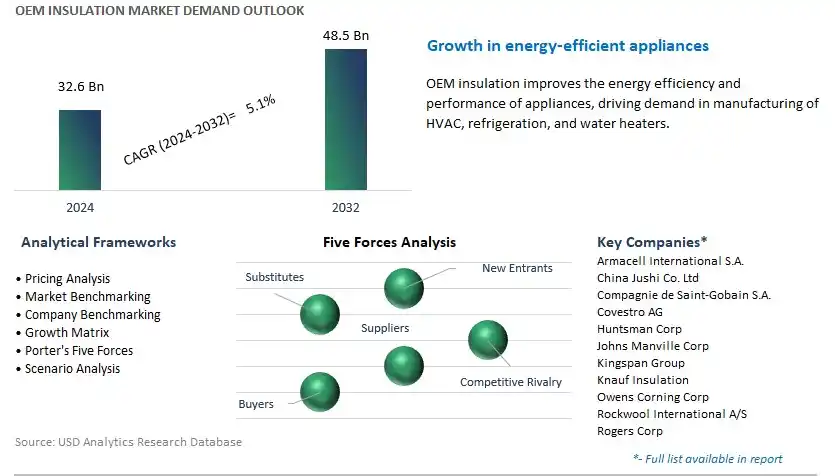
Global OEM Insulation Market Size is valued at $32.6 Billion in 2024 and is forecast to register a growth rate (CAGR) of 5.1% to reach $48.5 Billion by 2032.
The global OEM Insulation Market Study analyzes and forecasts the market size across 6 regions and 24 countries for diverse segments -By Material (Mineral Wool, Polyurethane Foam (PUF), Flexible Elastomeric Foam (FEF), Others), By End-User (Building & Construction, Industrial, Transportation, Consumer).
An Introduction to OEM Insulation Market in 2024
Original equipment manufacturer (OEM) insulation refers to thermal and acoustic insulation materials integrated into various products during their manufacturing process to improve energy efficiency, comfort, and noise control. In 2024, the market for OEM insulation experiences steady growth as industries such as automotive, HVAC (heating, ventilation, and air conditioning), appliances, and construction prioritize energy conservation and comfort in their products. OEM insulation materials include foams, fibers, films, and coatings engineered to provide effective thermal insulation, sound absorption, and vibration damping properties while meeting space, weight, and performance requirements. These materials are tailored to specific applications such as engine compartments, interior panels, pipes, and building envelopes, ensuring optimal thermal comfort and noise levels in finished products. The demand for OEM insulation is driven by factors such as regulatory mandates for energy efficiency, consumer preferences for quiet and comfortable environments, and advancements in insulation technologies. Market trends include the development of lightweight and high-performance insulation materials, the integration of sustainable and recyclable materials for eco-friendly solutions, and the customization of insulation solutions to meet the evolving needs of OEM manufacturers in different industries.
OEM Insulation Market Competitive Landscape
The market report analyses the leading companies in the industry including Armacell International S.A., China Jushi Co. Ltd, Compagnie de Saint-Gobain S.A., Covestro AG, Huntsman Corp, Johns Manville Corp, Kingspan Group, Knauf Insulation, Owens Corning Corp, Rockwool International A/S, Rogers Corp, and others.
OEM Insulation Market Dynamics
Market Trend: Rising Demand for Energy-Efficient Solutions in Buildings and Appliances
A prominent market trend in OEM insulation is the rising demand for energy-efficient solutions in buildings and appliances across residential, commercial, and industrial sectors. With increasing awareness of energy conservation, climate change concerns, and regulatory mandates for building energy codes, there is a growing emphasis on improving thermal insulation to reduce energy consumption and greenhouse gas emissions. OEM insulation materials, such as foam, fiberglass, and mineral wool, play a crucial role in enhancing the thermal efficiency of buildings, HVAC (Heating, Ventilation, and Air Conditioning) systems, appliances, and industrial equipment. This trend towards energy efficiency is driving the adoption of advanced insulation solutions that offer superior thermal performance, durability, and environmental sustainability.
Market Driver: Stringent Building Codes and Energy Efficiency Regulations
A key driver for the OEM insulation market is the implementation of stringent building codes and energy efficiency regulations aimed at reducing carbon footprint and promoting sustainable construction practices. Governments and regulatory bodies worldwide are enforcing mandates for minimum insulation requirements, energy performance standards, and green building certifications to mitigate climate change and enhance energy security. OEM manufacturers are compelled to comply with these regulations by incorporating high-performance insulation materials into their products to achieve desired thermal resistance (R-value) and U-factor ratings. The need to meet building code requirements, obtain energy efficiency certifications, and satisfy consumer preferences for environmentally friendly products drives the demand for OEM insulation solutions that deliver superior thermal insulation and energy savings.
Market Opportunity: Expansion into Emerging Applications and Retrofit Projects
A significant market opportunity for OEM insulation lies in its expansion into emerging applications and retrofit projects, such as building renovations, industrial upgrades, and transportation infrastructure. With aging infrastructure, urbanization, and growing population, there is a need to improve the thermal performance of existing buildings, equipment, and transportation systems to enhance energy efficiency and occupant comfort. OEM insulation manufacturers can capitalize on this opportunity by offering retrofit solutions tailored to the specific needs of retrofit projects, such as flexible insulation materials, retrofit kits, and innovative installation techniques. Additionally, the expansion of insulation applications beyond traditional buildings to include industrial equipment, vehicles, and infrastructure presents opportunities for OEM insulation suppliers to diversify their product offerings, penetrate new markets, and address evolving customer demands for energy-efficient solutions. By leveraging the opportunity presented by emerging applications and retrofit projects, OEM insulation manufacturers can drive growth, innovation, and market leadership in the dynamic field of thermal insulation.
OEM Insulation Market Share Analysis: Mineral Wool segment generated the highest revenue in 2024
Among the materials in the OEM Insulation Market, the Mineral Wool segment is the largest. The large revenue share is driven by the preference for mineral wool insulation in various OEM applications. Mineral wool, including both glass wool and rock wool variants, offers excellent thermal and acoustic insulation properties, making it suitable for a wide range of industrial and commercial applications. In OEM settings, such as manufacturing facilities, industrial equipment, and automotive components, insulation is crucial for maintaining optimal operating temperatures, reducing energy consumption, and mitigating noise levels. Mineral wool insulation is known for its high thermal resistance, fire resistance, and sound absorption capabilities, providing effective insulation in challenging environments. Additionally, mineral wool insulation is non-combustible and resistant to moisture, mold, and pests, ensuring long-term durability and performance. Moreover, as sustainability and energy efficiency become increasingly important considerations, mineral wool insulation's recyclability and low environmental impact contribute to its popularity among OEM manufacturers. Over the forecast period, the Mineral Wool segment of the OEM Insulation Market is expected to maintain its leadership position due to its superior performance characteristics and versatility across a wide range of OEM applications.
OEM Insulation Market Share Analysis: Industrial segment generated the highest revenue in 2024
Among the end-users in the OEM Insulation Market, the Industrial segment is experiencing rapid growth, outpacing other segments. This accelerated growth is driven by the demand for insulation in industrial OEM applications. In industrial settings, insulation plays a critical role in maintaining process efficiency, protecting equipment, and ensuring workplace safety. Industrial facilities, including manufacturing plants, refineries, power plants, and chemical processing facilities, require insulation solutions to control temperature fluctuations, prevent heat loss or gain, and minimize energy consumption. As industries strive to optimize operational efficiency, reduce emissions, and comply with stringent regulations, the demand for high-performance insulation materials in OEM applications is increasing. Additionally, with the growing emphasis on sustainability and energy conservation, industrial OEM manufacturers are adopting advanced insulation materials that offer superior thermal resistance, durability, and environmental benefits. Moreover, the ongoing investments in infrastructure development and industrial expansion projects further drive the demand for insulation solutions in the industrial sector. As a result, the Industrial segment of the OEM Insulation Market is expected to continue its rapid growth trajectory, fuelled by the increasing demand for insulation materials in various industrial OEM applications.
OEM Insulation Market
By Material
Mineral Wool
-Fiberglass
-Stone wool
Polyurethane Foam (PUF)
Flexible Elastomeric Foam (FEF)
Others
By End-User
Building & Construction
Industrial
-Refrigeration
-Oil & Petrochemical
-Food Processing
-Power Generation & others
Transportation
-Aerospace & Defense
-Automotive
-Others
Consumer
-Consumer goods
-LightingCountries Analyzed
North America (US, Canada, Mexico)
Europe (Germany, UK, France, Spain, Italy, Russia, Rest of Europe)
Asia Pacific (China, India, Japan, South Korea, Australia, South East Asia, Rest of Asia)
South America (Brazil, Argentina, Rest of South America)
Middle East and Africa (Saudi Arabia, UAE, Rest of Middle East, South Africa, Egypt, Rest of Africa)
OEM Insulation Companies Profiled in the Study
Armacell International S.A.
China Jushi Co. Ltd
Compagnie de Saint-Gobain S.A.
Covestro AG
Huntsman Corp
Johns Manville Corp
Kingspan Group
Knauf Insulation
Owens Corning Corp
Rockwool International A/S
Rogers Corp
*- List Not Exhaustive
TABLE OF CONTENTS
1 Introduction to 2024 OEM Insulation Market
1.1 Market Overview
1.2 Quick Facts
1.3 Scope/Objective of the Study
1.4 Market Definition
1.5 Countries and Regions Covered
1.6 Units, Currency, and Conversions
1.7 Industry Value Chain
2 Research Methodology
2.1 Market Size Estimation
2.2 Sources and Research Methodology
2.3 Data Triangulation
2.4 Assumptions and Limitations
3 Executive Summary
3.1 Global OEM Insulation Market Size Outlook, $ Million, 2021 to 2032
3.2 OEM Insulation Market Outlook by Type, $ Million, 2021 to 2032
3.3 OEM Insulation Market Outlook by Product, $ Million, 2021 to 2032
3.4 OEM Insulation Market Outlook by Application, $ Million, 2021 to 2032
3.5 OEM Insulation Market Outlook by Key Countries, $ Million, 2021 to 2032
4 Market Dynamics
4.1 Key Driving Forces of OEM Insulation Industry
4.2 Key Market Trends in OEM Insulation Industry
4.3 Potential Opportunities in OEM Insulation Industry
4.4 Key Challenges in OEM Insulation Industry
5 Market Factor Analysis
5.1 Value Chain Analysis
5.2 Competitive Landscape
5.2.1 Global OEM Insulation Market Share by Company (%), 2023
5.2.2 Product Offerings by Company
5.3 Porter’s Five Forces Analysis
5.4 Pricing Analysis and Outlook
6 Growth Outlook Across Scenarios
6.1 Growth Analysis-Case Scenario Definitions
6.2 Low Growth Scenario Forecasts
6.3 Reference Growth Scenario Forecasts
6.4 High Growth Scenario Forecasts
7 Global OEM Insulation Market Outlook by Segments
7.1 OEM Insulation Market Outlook by Segments, $ Million, 2021- 2032
By Material
Mineral Wool
-Fiberglass
-Stone wool
Polyurethane Foam (PUF)
Flexible Elastomeric Foam (FEF)
Others
By End-User
Building & Construction
Industrial
-Refrigeration
-Oil & Petrochemical
-Food Processing
-Power Generation & others
Transportation
-Aerospace & Defense
-Automotive
-Others
Consumer
-Consumer goods
-Lighting
8 North America OEM Insulation Market Analysis and Outlook To 2032
8.1 Introduction to North America OEM Insulation Markets in 2024
8.2 North America OEM Insulation Market Size Outlook by Country, 2021-2032
8.2.1 United States
8.2.2 Canada
8.2.3 Mexico
8.3 North America OEM Insulation Market size Outlook by Segments, 2021-2032
By Material
Mineral Wool
-Fiberglass
-Stone wool
Polyurethane Foam (PUF)
Flexible Elastomeric Foam (FEF)
Others
By End-User
Building & Construction
Industrial
-Refrigeration
-Oil & Petrochemical
-Food Processing
-Power Generation & others
Transportation
-Aerospace & Defense
-Automotive
-Others
Consumer
-Consumer goods
-Lighting
9 Europe OEM Insulation Market Analysis and Outlook To 2032
9.1 Introduction to Europe OEM Insulation Markets in 2024
9.2 Europe OEM Insulation Market Size Outlook by Country, 2021-2032
9.2.1 Germany
9.2.2 France
9.2.3 Spain
9.2.4 United Kingdom
9.2.4 Italy
9.2.5 Russia
9.2.6 Norway
9.2.7 Rest of Europe
9.3 Europe OEM Insulation Market Size Outlook by Segments, 2021-2032
By Material
Mineral Wool
-Fiberglass
-Stone wool
Polyurethane Foam (PUF)
Flexible Elastomeric Foam (FEF)
Others
By End-User
Building & Construction
Industrial
-Refrigeration
-Oil & Petrochemical
-Food Processing
-Power Generation & others
Transportation
-Aerospace & Defense
-Automotive
-Others
Consumer
-Consumer goods
-Lighting
10 Asia Pacific OEM Insulation Market Analysis and Outlook To 2032
10.1 Introduction to Asia Pacific OEM Insulation Markets in 2024
10.2 Asia Pacific OEM Insulation Market Size Outlook by Country, 2021-2032
10.2.1 China
10.2.2 India
10.2.3 Japan
10.2.4 South Korea
10.2.5 Indonesia
10.2.6 Malaysia
10.2.7 Australia
10.2.8 Rest of Asia Pacific
10.3 Asia Pacific OEM Insulation Market size Outlook by Segments, 2021-2032
By Material
Mineral Wool
-Fiberglass
-Stone wool
Polyurethane Foam (PUF)
Flexible Elastomeric Foam (FEF)
Others
By End-User
Building & Construction
Industrial
-Refrigeration
-Oil & Petrochemical
-Food Processing
-Power Generation & others
Transportation
-Aerospace & Defense
-Automotive
-Others
Consumer
-Consumer goods
-Lighting
11 South America OEM Insulation Market Analysis and Outlook To 2032
11.1 Introduction to South America OEM Insulation Markets in 2024
11.2 South America OEM Insulation Market Size Outlook by Country, 2021-2032
11.2.1 Brazil
11.2.2 Argentina
11.2.3 Rest of South America
11.3 South America OEM Insulation Market size Outlook by Segments, 2021-2032
By Material
Mineral Wool
-Fiberglass
-Stone wool
Polyurethane Foam (PUF)
Flexible Elastomeric Foam (FEF)
Others
By End-User
Building & Construction
Industrial
-Refrigeration
-Oil & Petrochemical
-Food Processing
-Power Generation & others
Transportation
-Aerospace & Defense
-Automotive
-Others
Consumer
-Consumer goods
-Lighting
12 Middle East and Africa OEM Insulation Market Analysis and Outlook To 2032
12.1 Introduction to Middle East and Africa OEM Insulation Markets in 2024
12.2 Middle East and Africa OEM Insulation Market Size Outlook by Country, 2021-2032
12.2.1 Saudi Arabia
12.2.2 UAE
12.2.3 Oman
12.2.4 Rest of Middle East
12.2.5 Egypt
12.2.6 Nigeria
12.2.7 South Africa
12.2.8 Rest of Africa
12.3 Middle East and Africa OEM Insulation Market size Outlook by Segments, 2021-2032
By Material
Mineral Wool
-Fiberglass
-Stone wool
Polyurethane Foam (PUF)
Flexible Elastomeric Foam (FEF)
Others
By End-User
Building & Construction
Industrial
-Refrigeration
-Oil & Petrochemical
-Food Processing
-Power Generation & others
Transportation
-Aerospace & Defense
-Automotive
-Others
Consumer
-Consumer goods
-Lighting
13 Company Profiles
13.1 Company Snapshot
13.2 SWOT Profiles
13.3 Products and Services
13.4 Recent Developments
13.5 Financial Profile
Armacell International S.A.
China Jushi Co. Ltd
Compagnie de Saint-Gobain S.A.
Covestro AG
Huntsman Corp
Johns Manville Corp
Kingspan Group
Knauf Insulation
Owens Corning Corp
Rockwool International A/S
Rogers Corp
14 Appendix
14.1 Customization Offerings
14.2 Subscription Services
14.3 Related Reports
14.4 Publisher Expertise
By Material
Mineral Wool
-Fiberglass
-Stone wool
Polyurethane Foam (PUF)
Flexible Elastomeric Foam (FEF)
Others
By End-User
Building & Construction
Industrial
-Refrigeration
-Oil & Petrochemical
-Food Processing
-Power Generation & others
Transportation
-Aerospace & Defense
-Automotive
-Others
Consumer
-Consumer goods
-Lighting
Countries Analyzed
North America (US, Canada, Mexico)
Europe (Germany, UK, France, Spain, Italy, Russia, Rest of Europe)
Asia Pacific (China, India, Japan, South Korea, Australia, South East Asia, Rest of Asia)
South America (Brazil, Argentina, Rest of South America)
Middle East and Africa (Saudi Arabia, UAE, Rest of Middle East, South Africa, Egypt, Rest of Africa)
