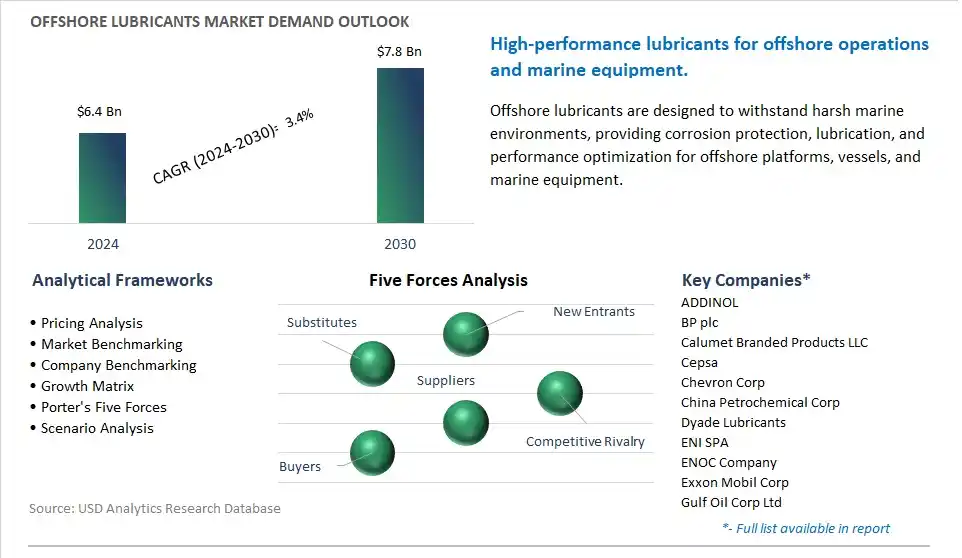
The global Offshore Lubricants Market is poised to register a 3.4% CAGR from $6.4 Billion in 2024 to $7.8 Billion in 2030.
The global Offshore Lubricants Market Study analyzes and forecasts the market size across 6 regions and 24 countries for diverse segments -By Application (Engine Oil, Hydraulic Oil, Gear Oil, Grease, Others), By End-User (Offshore Rigs, FPSOs (Floating, Production, Storage & Offloading Vessels), OSVs (Offshore Support Vessels)).
An Introduction to Global Offshore Lubricants Market in 2024
The market for offshore lubricants is witnessing robust growth driven by the expanding offshore oil and gas exploration and production activities, as well as the increasing demand for reliable lubrication solutions in offshore wind energy, marine transportation, and aquaculture industries. Key trends shaping the future of this market include the rising adoption of specialized lubricants such as marine-grade oils, greases, and hydraulic fluids formulated to withstand extreme operating conditions, high pressures, and corrosive environments encountered in offshore operations. Additionally, the growing emphasis on equipment reliability, safety, and regulatory compliance is driving market expansion, as offshore operators and asset owners prioritize preventive maintenance, asset integrity, and environmental protection measures to ensure safe and sustainable operations. With advancements in lubricant formulation, performance testing, and condition monitoring technologies, manufacturers are developing innovative products that offer superior protection against wear, corrosion, and contamination while enhancing equipment efficiency and longevity. Furthermore, the increasing demand for environmentally friendly and biodegradable lubricants in offshore applications is fueling market growth, as industries strive to minimize environmental impact and comply with stringent regulations governing offshore operations in ecologically sensitive areas. As offshore activities continue to expand globally, driven by the need for energy security and transition to renewable sources, the market for offshore lubricants is poised for sustained growth, offering opportunities for technology development, market expansion, and collaboration across the lubricants value chain.
Offshore Lubricants Market Competitive Landscape
The market report analyses the leading companies in the industry including ADDINOL, BP plc, Calumet Branded Products LLC, Cepsa, Chevron Corp, China Petrochemical Corp, Dyade Lubricants, ENI SPA, ENOC Company, Exxon Mobil Corp, Gulf Oil Corp Ltd, Idemitsu Kosan Co. Ltd, Indian Oil Corp Ltd, JX Nippon oil & Energy Corp, Liqui Molly GmbH, LUKOIL PJSC, Morris Lubricants, Penrite Oil, PetroChina Company Ltd, Petroliam Nasional Berhad (Petronas), Royal Dutch Shell plc, SK Inc, TotalEnergies SE, Valvoline Inc.
Offshore Lubricants Market Dynamics
Offshore Lubricants Market Trend: Growing Offshore Exploration and Production Activities
A prominent trend in the offshore lubricants market is the growing offshore exploration and production activities. With the increasing demand for energy resources and the depletion of onshore oil and gas reserves, there is a shift towards offshore drilling and production operations to access untapped offshore hydrocarbon reserves. Offshore lubricants play a critical role in ensuring the efficient and reliable operation of offshore equipment such as drilling rigs, production platforms, subsea equipment, and support vessels. As offshore exploration and production activities expand globally, there is a rising demand for high-performance lubricants that can withstand the challenging offshore environment, including extreme temperatures, high pressures, and corrosive seawater conditions.
Offshore Lubricants Market Driver: Need for Equipment Reliability and Performance in Harsh Offshore Conditions
A significant driver propelling the offshore lubricants market is the need for equipment reliability and performance in harsh offshore conditions. Offshore oil and gas operations are conducted in some of the harshest and most challenging environments on Earth, including deepwater, Arctic, and tropical offshore regions. Offshore equipment is exposed to harsh elements such as saltwater corrosion, abrasive sand, high humidity, and temperature variations, which can accelerate equipment wear and lead to premature failure if not adequately lubricated and protected. High-quality offshore lubricants are essential to ensure the smooth operation, longevity, and safety of offshore equipment, thereby reducing downtime, maintenance costs, and operational risks for offshore operators.
Offshore Lubricants Market Opportunity: Development of Environmentally Friendly Lubricants for Offshore Applications
An opportunity for the offshore lubricants market lies in the development of environmentally friendly lubricants for offshore applications. With increasing environmental awareness and regulatory pressure to minimize the environmental impact of offshore oil and gas activities, there is a growing demand for eco-friendly lubricants that meet stringent environmental standards. Environmentally friendly offshore lubricants are formulated to be biodegradable, non-toxic, and low in toxicity to marine organisms, minimizing the risk of environmental contamination in case of spills or leaks. By investing in the research and development of sustainable lubricant formulations, lubricant manufacturers can capitalize on the growing demand for environmentally responsible solutions in the offshore industry, differentiate themselves in the market, and enhance their competitive advantage.
Offshore Lubricants Market Share Analysis: Hydraulic Oil generated the highest revenue in 2024
Hydraulic oil is the largest segment in the Offshore Lubricants market. offshore operations, including oil and gas exploration, drilling, and production, rely heavily on hydraulic systems to power critical equipment such as cranes, winches, and hydraulic cylinders. Hydraulic oil plays a crucial role in lubricating and protecting these hydraulic systems, ensuring smooth operation and preventing equipment failures in harsh offshore environments characterized by saltwater exposure, high pressures, and extreme temperatures. Additionally, the complexity and scale of offshore operations require large quantities of hydraulic oil to support the extensive hydraulic machinery and equipment deployed on offshore platforms and vessels. Further, the stringent safety and environmental regulations governing offshore operations necessitate the use of high-quality hydraulic oils that meet industry standards for performance, reliability, and environmental compliance. The versatility, reliability, and performance of hydraulic oil make it the preferred choice for lubricating hydraulic systems in offshore applications, establishing hydraulic oil as the largest segment in the Offshore Lubricants market.
Offshore Lubricants Market Share Analysis: FPSOs (Floating, Production, Storage & Offloading Vessels) segment is poised to register the fastest growth rate (CAGR) over the forecast period to 2030
FPSOs (Floating, Production, Storage & Offloading Vessels) emerge as the fastest-growing segment in the Offshore Lubricants market. FPSOs play a critical role in offshore oil and gas production, serving as versatile floating facilities capable of extracting, processing, storing, and offloading hydrocarbons from offshore fields. As the offshore oil and gas industry continues to expand into deeper waters and remote regions, the demand for FPSOs as a cost-effective and flexible production solution is on the rise. The complexity and scale of FPSO operations necessitate the deployment of sophisticated machinery and equipment, including hydraulic systems, engines, gears, and turbines, which require high-performance lubricants to ensure reliable operation and maximize productivity. Additionally, FPSOs operate in challenging marine environments characterized by harsh weather conditions, saltwater exposure, and high operating pressures, posing unique challenges for lubrication. Therefore, the growing deployment of FPSOs and the increasing demand for specialized lubricants tailored to the unique requirements of FPSO operations drive the rapid growth of the FPSO segment in the Offshore Lubricants market.
Offshore Lubricants Market Report Segmentation
By Application
Engine Oil
Hydraulic Oil
Gear Oil
Grease
Others
By End-User
Offshore Rigs
FPSOs (Floating, Production, Storage & Offloading Vessels)
OSVs (Offshore Support Vessels)
Regions Included
North America (US, Canada, Mexico)
Europe (Germany, UK, France, Spain, Italy, Russia, Rest of Europe)
Asia Pacific (China, India, Japan, South Korea, Australia, South East Asia, Rest of Asia)
South America (Brazil, Argentina, Rest of South America)
Middle East and Africa (Saudi Arabia, UAE, Rest of Middle East, South Africa, Egypt, Rest of Africa)
Offshore Lubricants Companies Profiled in the Market Study
ADDINOL
BP plc
Calumet Branded Products LLC
Cepsa
Chevron Corp
China Petrochemical Corp
Dyade Lubricants
ENI SPA
ENOC Company
Exxon Mobil Corp
Gulf Oil Corp Ltd
Idemitsu Kosan Co. Ltd
Indian Oil Corp Ltd
JX Nippon oil & Energy Corp
Liqui Molly GmbH
LUKOIL PJSC
Morris Lubricants
Penrite Oil
PetroChina Company Ltd
Petroliam Nasional Berhad (Petronas)
Royal Dutch Shell plc
SK Inc
TotalEnergies SE
Valvoline Inc
*- List Not Exhaustive
TABLE OF CONTENTS
1 Introduction to 2024 Offshore Lubricants Market
1.1 Market Overview
1.2 Quick Facts
1.3 Scope/Objective of the Study
1.4 Market Definition
1.5 Countries and Regions Covered
1.6 Units, Currency, and Conversions
1.7 Industry Value Chain
2 Research Methodology
2.1 Market Size Estimation
2.2 Sources and Research Methodology
2.3 Data Triangulation
2.4 Assumptions and Limitations
3 Executive Summary
3.1 Global Offshore Lubricants Market Size Outlook, $ Million, 2021 to 2030
3.2 Offshore Lubricants Market Outlook by Type, $ Million, 2021 to 2030
3.3 Offshore Lubricants Market Outlook by Product, $ Million, 2021 to 2030
3.4 Offshore Lubricants Market Outlook by Application, $ Million, 2021 to 2030
3.5 Offshore Lubricants Market Outlook by Key Countries, $ Million, 2021 to 2030
4 Market Dynamics
4.1 Key Driving Forces of Offshore Lubricants Industry
4.2 Key Market Trends in Offshore Lubricants Industry
4.3 Potential Opportunities in Offshore Lubricants Industry
4.4 Key Challenges in Offshore Lubricants Industry
5 Market Factor Analysis
5.1 Value Chain Analysis
5.2 Competitive Landscape
5.2.1 Global Offshore Lubricants Market Share by Company (%), 2023
5.2.2 Product Offerings by Company
5.3 Porter’s Five Forces Analysis
5.4 Pricing Analysis and Outlook
6 Growth Outlook Across Scenarios
6.1 Growth Analysis-Case Scenario Definitions
6.2 Low Growth Scenario Forecasts
6.3 Reference Growth Scenario Forecasts
6.4 High Growth Scenario Forecasts
7 Global Offshore Lubricants Market Outlook by Segments
7.1 Offshore Lubricants Market Outlook by Segments, $ Million, 2021- 2030
By Application
Engine Oil
Hydraulic Oil
Gear Oil
Grease
Others
By End-User
Offshore Rigs
FPSOs (Floating, Production, Storage & Offloading Vessels)
OSVs (Offshore Support Vessels)
8 North America Offshore Lubricants Market Analysis and Outlook To 2030
8.1 Introduction to North America Offshore Lubricants Markets in 2024
8.2 North America Offshore Lubricants Market Size Outlook by Country, 2021-2030
8.2.1 United States
8.2.2 Canada
8.2.3 Mexico
8.3 North America Offshore Lubricants Market size Outlook by Segments, 2021-2030
By Application
Engine Oil
Hydraulic Oil
Gear Oil
Grease
Others
By End-User
Offshore Rigs
FPSOs (Floating, Production, Storage & Offloading Vessels)
OSVs (Offshore Support Vessels)
9 Europe Offshore Lubricants Market Analysis and Outlook To 2030
9.1 Introduction to Europe Offshore Lubricants Markets in 2024
9.2 Europe Offshore Lubricants Market Size Outlook by Country, 2021-2030
9.2.1 Germany
9.2.2 France
9.2.3 Spain
9.2.4 United Kingdom
9.2.4 Italy
9.2.5 Russia
9.2.6 Norway
9.2.7 Rest of Europe
9.3 Europe Offshore Lubricants Market Size Outlook by Segments, 2021-2030
By Application
Engine Oil
Hydraulic Oil
Gear Oil
Grease
Others
By End-User
Offshore Rigs
FPSOs (Floating, Production, Storage & Offloading Vessels)
OSVs (Offshore Support Vessels)
10 Asia Pacific Offshore Lubricants Market Analysis and Outlook To 2030
10.1 Introduction to Asia Pacific Offshore Lubricants Markets in 2024
10.2 Asia Pacific Offshore Lubricants Market Size Outlook by Country, 2021-2030
10.2.1 China
10.2.2 India
10.2.3 Japan
10.2.4 South Korea
10.2.5 Indonesia
10.2.6 Malaysia
10.2.7 Australia
10.2.8 Rest of Asia Pacific
10.3 Asia Pacific Offshore Lubricants Market size Outlook by Segments, 2021-2030
By Application
Engine Oil
Hydraulic Oil
Gear Oil
Grease
Others
By End-User
Offshore Rigs
FPSOs (Floating, Production, Storage & Offloading Vessels)
OSVs (Offshore Support Vessels)
11 South America Offshore Lubricants Market Analysis and Outlook To 2030
11.1 Introduction to South America Offshore Lubricants Markets in 2024
11.2 South America Offshore Lubricants Market Size Outlook by Country, 2021-2030
11.2.1 Brazil
11.2.2 Argentina
11.2.3 Rest of South America
11.3 South America Offshore Lubricants Market size Outlook by Segments, 2021-2030
By Application
Engine Oil
Hydraulic Oil
Gear Oil
Grease
Others
By End-User
Offshore Rigs
FPSOs (Floating, Production, Storage & Offloading Vessels)
OSVs (Offshore Support Vessels)
12 Middle East and Africa Offshore Lubricants Market Analysis and Outlook To 2030
12.1 Introduction to Middle East and Africa Offshore Lubricants Markets in 2024
12.2 Middle East and Africa Offshore Lubricants Market Size Outlook by Country, 2021-2030
12.2.1 Saudi Arabia
12.2.2 UAE
12.2.3 Oman
12.2.4 Rest of Middle East
12.2.5 Egypt
12.2.6 Nigeria
12.2.7 South Africa
12.2.8 Rest of Africa
12.3 Middle East and Africa Offshore Lubricants Market size Outlook by Segments, 2021-2030
By Application
Engine Oil
Hydraulic Oil
Gear Oil
Grease
Others
By End-User
Offshore Rigs
FPSOs (Floating, Production, Storage & Offloading Vessels)
OSVs (Offshore Support Vessels)
13 Company Profiles
13.1 Company Snapshot
13.2 SWOT Profiles
13.3 Products and Services
13.4 Recent Developments
13.5 Financial Profile
ADDINOL
BP plc
Calumet Branded Products LLC
Cepsa
Chevron Corp
China Petrochemical Corp
Dyade Lubricants
ENI SPA
ENOC Company
Exxon Mobil Corp
Gulf Oil Corp Ltd
Idemitsu Kosan Co. Ltd
Indian Oil Corp Ltd
JX Nippon oil & Energy Corp
Liqui Molly GmbH
LUKOIL PJSC
Morris Lubricants
Penrite Oil
PetroChina Company Ltd
Petroliam Nasional Berhad (Petronas)
Royal Dutch Shell plc
SK Inc
TotalEnergies SE
Valvoline Inc
14 Appendix
14.1 Customization Offerings
14.2 Subscription Services
14.3 Related Reports
14.4 Publisher Expertise
By Application
Engine Oil
Hydraulic Oil
Gear Oil
Grease
Others
By End-User
Offshore Rigs
FPSOs (Floating, Production, Storage & Offloading Vessels)
OSVs (Offshore Support Vessels)
Countries Analyzed
North America (US, Canada, Mexico)
Europe (Germany, UK, France, Spain, Italy, Russia, Rest of Europe)
Asia Pacific (China, India, Japan, South Korea, Australia, South East Asia, Rest of Asia)
South America (Brazil, Argentina, Rest of South America)
Middle East and Africa (Saudi Arabia, UAE, Rest of Middle East, South Africa, Egypt, Rest of Africa)
