The global Oil and Gas Pipeline Leak Detection Market is poised to register a 7.2% CAGR from $3.9 Billion in 2024 to $5.9 Billion in 2030.
The global Oil and Gas Pipeline Leak Detection Market Study analyzes and forecasts the market size across 6 regions and 24 countries for diverse segments -By Location (Onshore, Offshore), By Technology (Acoustic Sensors, Flowmeters, Cable Sensors, Vapour Sensors, Others).
An Introduction to Global Oil and Gas Pipeline Leak Detection Market in 2024
The key trend shaping the future of the oil and gas pipeline leak detection industry is the increasing adoption of advanced monitoring technologies and analytics to enhance pipeline safety, integrity management, and regulatory compliance. With the growing concern over pipeline leaks, spills, and environmental impacts, operators are investing in sophisticated leak detection systems that utilize sensors, remote monitoring, and data analytics to detect and locate leaks quickly and accurately. Additionally, the integration of artificial intelligence (AI) and machine learning algorithms is enabling predictive analytics and anomaly detection capabilities, allowing operators to identify potential leaks and integrity threats before they escalate into critical incidents. Furthermore, the deployment of unmanned aerial vehicles (UAVs) and satellite imaging technologies is enabling remote inspection and surveillance of pipeline networks, improving monitoring coverage and response times. As pipeline operators strive to ensure the safe and reliable operation of their infrastructure, the demand for advanced leak detection solutions capable of providing real-time insights and proactive risk management is expected to drive market growth and innovation in the coming years.
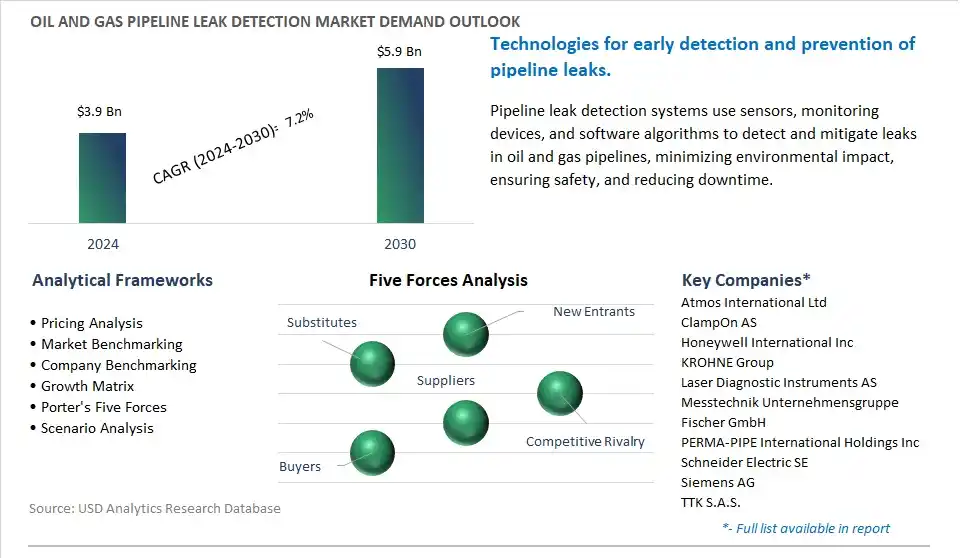
Oil and Gas Pipeline Leak Detection Market Competitive Landscape
The market report analyses the leading companies in the industry including Atmos International Ltd, ClampOn AS, Honeywell International Inc, KROHNE Group, Laser Diagnostic Instruments AS, Messtechnik Unternehmensgruppe Fischer GmbH, PERMA-PIPE International Holdings Inc, Schneider Electric SE, Siemens AG, TTK S.A.S..
Oil and Gas Pipeline Leak Detection Market Dynamics
Oil and Gas Pipeline Leak Detection Market Trend: Adoption of Advanced Leak Detection Technologies
A prominent trend in the oil and gas pipeline leak detection market is the increasing adoption of advanced leak detection technologies. With the growing emphasis on pipeline safety, environmental protection, and regulatory compliance, oil and gas companies are investing in sophisticated leak detection systems to monitor pipelines for leaks and potential integrity threats. Advanced technologies such as fiber optic sensing, acoustic monitoring, infrared cameras, and real-time data analytics are being deployed to enhance the sensitivity, accuracy, and reliability of leak detection systems. The demand for advanced technologies in oil and gas pipeline supports preventing and mitigating pipeline leaks, minimizing environmental impact, and ensuring the safe and efficient operation of oil and gas infrastructure.
Oil and Gas Pipeline Leak Detection Market Driver: Regulatory Mandates and Environmental Concerns
A significant driver propelling the oil and gas pipeline leak detection market is regulatory mandates and environmental concerns. Governments and regulatory agencies worldwide impose stringent regulations and standards on oil and gas operators to prevent pipeline leaks, protect public safety, and minimize environmental damage. Compliance with regulatory requirements for leak detection and prevention is essential for oil and gas companies to obtain permits, maintain operational licenses, and avoid costly fines and penalties. Additionally, growing public awareness and concern about the environmental impact of pipeline leaks, spills, and accidents further drive the demand for effective leak detection systems. Accordingly, oil and gas operators prioritize investments in leak detection technologies to comply with regulations, minimize risks, and safeguard the environment.
Oil and Gas Pipeline Leak Detection Market Opportunity: Integration of Artificial Intelligence and Remote Sensing Technologies
An opportunity for the oil and gas pipeline leak detection market lies in the integration of artificial intelligence (AI) and remote sensing technologies. With advancements in AI algorithms, machine learning, and remote sensing capabilities, there is potential to enhance the effectiveness and efficiency of pipeline leak detection systems. AI-driven algorithms can analyze sensor data, identify abnormal patterns, and detect potential leaks in real-time, allowing for proactive intervention and rapid response to mitigate leak incidents. Additionally, remote sensing technologies such as satellite imagery, drones, and aerial surveillance can complement traditional leak detection methods by providing continuous monitoring and coverage of large pipeline networks, including remote and inaccessible areas. By integrating AI and remote sensing technologies into leak detection systems, oil and gas companies can improve detection accuracy, reduce false alarms, and enhance overall pipeline safety and environmental protection measures.
Oil and Gas Pipeline Leak Detection Market Share Analysis: onshore generated the highest revenue in 2024
the onshore segment is the largest in the Oil and Gas Pipeline Leak Detection Market. This is primarily because onshore pipelines constitute a significant portion of the overall pipeline network in the oil and gas industry. Onshore pipelines are used to transport crude oil, natural gas, and refined products over vast distances, connecting production sites, refineries, distribution centers, and end-users. Due to their extensive coverage and proximity to populated areas, onshore pipelines are subject to stringent safety and environmental regulations, making leak detection systems essential for early detection and mitigation of leaks. Additionally, onshore pipelines traverse various terrains, including urban areas, farmland, forests, and environmentally sensitive regions, increasing the need for reliable leak detection solutions to prevent environmental contamination and minimize safety risks. The prevalence and importance of onshore pipelines in the oil and gas industry contribute to the dominance of the onshore segment as the largest in the Oil and Gas Pipeline Leak Detection Market.
Oil and Gas Pipeline Leak Detection Market Share Analysis: The Oil and Gas Pipeline Leak Detection segment is poised to register the fastest growth rate (CAGR) over the forecast period to 2030
The fastest-growing segment in the Oil and Gas Pipeline Leak Detection Market is the acoustic sensors segment. Acoustic sensors utilize sound waves to detect pipeline leaks by listening for changes in the acoustic signature of the pipeline. Diverse factors contribute to the rapid growth of acoustic sensors in leak detection applications. acoustic sensors offer high sensitivity and accuracy in detecting leaks, even in challenging environments with background noise or varying operating conditions. Additionally, acoustic sensors can detect leaks in real-time, allowing operators to quickly identify and respond to leaks, minimizing potential environmental damage and safety risks. Furthermore, advancements in sensor technology, including the development of intelligent algorithms and data analytics, enhance the performance and reliability of acoustic sensors, further driving their adoption in pipeline leak detection systems. As oil and gas companies prioritize safety, environmental protection, and regulatory compliance, the demand for advanced leak detection technologies such as acoustic sensors is expected to surge, making it the fastest-growing segment in the Oil and Gas Pipeline Leak Detection Market.
Oil and Gas Pipeline Leak Detection Market Report Segmentation
By Location
Onshore
Offshore
By Technology
Acoustic Sensors
Flowmeters
Cable Sensors
Vapour Sensors
Others
Regions Included
North America (US, Canada, Mexico)
Europe (Germany, UK, France, Spain, Italy, Russia, Rest of Europe)
Asia Pacific (China, India, Japan, South Korea, Australia, South East Asia, Rest of Asia)
South America (Brazil, Argentina, Rest of South America)
Middle East and Africa (Saudi Arabia, UAE, Rest of Middle East, South Africa, Egypt, Rest of Africa)
Oil and Gas Pipeline Leak Detection Companies Profiled in the Market Study
Atmos International Ltd
ClampOn AS
Honeywell International Inc
KROHNE Group
Laser Diagnostic Instruments AS
Messtechnik Unternehmensgruppe Fischer GmbH
PERMA-PIPE International Holdings Inc
Schneider Electric SE
Siemens AG
TTK S.A.S.
*- List Not Exhaustive
TABLE OF CONTENTS
1 Introduction to 2024 Oil and Gas Pipeline Leak Detection Market
1.1 Market Overview
1.2 Quick Facts
1.3 Scope/Objective of the Study
1.4 Market Definition
1.5 Countries and Regions Covered
1.6 Units, Currency, and Conversions
1.7 Industry Value Chain
2 Research Methodology
2.1 Market Size Estimation
2.2 Sources and Research Methodology
2.3 Data Triangulation
2.4 Assumptions and Limitations
3 Executive Summary
3.1 Global Oil and Gas Pipeline Leak Detection Market Size Outlook, $ Million, 2021 to 2030
3.2 Oil and Gas Pipeline Leak Detection Market Outlook by Type, $ Million, 2021 to 2030
3.3 Oil and Gas Pipeline Leak Detection Market Outlook by Product, $ Million, 2021 to 2030
3.4 Oil and Gas Pipeline Leak Detection Market Outlook by Application, $ Million, 2021 to 2030
3.5 Oil and Gas Pipeline Leak Detection Market Outlook by Key Countries, $ Million, 2021 to 2030
4 Market Dynamics
4.1 Key Driving Forces of Oil and Gas Pipeline Leak Detection Industry
4.2 Key Market Trends in Oil and Gas Pipeline Leak Detection Industry
4.3 Potential Opportunities in Oil and Gas Pipeline Leak Detection Industry
4.4 Key Challenges in Oil and Gas Pipeline Leak Detection Industry
5 Market Factor Analysis
5.1 Value Chain Analysis
5.2 Competitive Landscape
5.2.1 Global Oil and Gas Pipeline Leak Detection Market Share by Company (%), 2023
5.2.2 Product Offerings by Company
5.3 Porter’s Five Forces Analysis
5.4 Pricing Analysis and Outlook
6 Growth Outlook Across Scenarios
6.1 Growth Analysis-Case Scenario Definitions
6.2 Low Growth Scenario Forecasts
6.3 Reference Growth Scenario Forecasts
6.4 High Growth Scenario Forecasts
7 Global Oil and Gas Pipeline Leak Detection Market Outlook by Segments
7.1 Oil and Gas Pipeline Leak Detection Market Outlook by Segments, $ Million, 2021- 2030
By Location
Onshore
Offshore
By Technology
Acoustic Sensors
Flowmeters
Cable Sensors
Vapour Sensors
Others
8 North America Oil and Gas Pipeline Leak Detection Market Analysis and Outlook To 2030
8.1 Introduction to North America Oil and Gas Pipeline Leak Detection Markets in 2024
8.2 North America Oil and Gas Pipeline Leak Detection Market Size Outlook by Country, 2021-2030
8.2.1 United States
8.2.2 Canada
8.2.3 Mexico
8.3 North America Oil and Gas Pipeline Leak Detection Market size Outlook by Segments, 2021-2030
By Location
Onshore
Offshore
By Technology
Acoustic Sensors
Flowmeters
Cable Sensors
Vapour Sensors
Others
9 Europe Oil and Gas Pipeline Leak Detection Market Analysis and Outlook To 2030
9.1 Introduction to Europe Oil and Gas Pipeline Leak Detection Markets in 2024
9.2 Europe Oil and Gas Pipeline Leak Detection Market Size Outlook by Country, 2021-2030
9.2.1 Germany
9.2.2 France
9.2.3 Spain
9.2.4 United Kingdom
9.2.4 Italy
9.2.5 Russia
9.2.6 Norway
9.2.7 Rest of Europe
9.3 Europe Oil and Gas Pipeline Leak Detection Market Size Outlook by Segments, 2021-2030
By Location
Onshore
Offshore
By Technology
Acoustic Sensors
Flowmeters
Cable Sensors
Vapour Sensors
Others
10 Asia Pacific Oil and Gas Pipeline Leak Detection Market Analysis and Outlook To 2030
10.1 Introduction to Asia Pacific Oil and Gas Pipeline Leak Detection Markets in 2024
10.2 Asia Pacific Oil and Gas Pipeline Leak Detection Market Size Outlook by Country, 2021-2030
10.2.1 China
10.2.2 India
10.2.3 Japan
10.2.4 South Korea
10.2.5 Indonesia
10.2.6 Malaysia
10.2.7 Australia
10.2.8 Rest of Asia Pacific
10.3 Asia Pacific Oil and Gas Pipeline Leak Detection Market size Outlook by Segments, 2021-2030
By Location
Onshore
Offshore
By Technology
Acoustic Sensors
Flowmeters
Cable Sensors
Vapour Sensors
Others
11 South America Oil and Gas Pipeline Leak Detection Market Analysis and Outlook To 2030
11.1 Introduction to South America Oil and Gas Pipeline Leak Detection Markets in 2024
11.2 South America Oil and Gas Pipeline Leak Detection Market Size Outlook by Country, 2021-2030
11.2.1 Brazil
11.2.2 Argentina
11.2.3 Rest of South America
11.3 South America Oil and Gas Pipeline Leak Detection Market size Outlook by Segments, 2021-2030
By Location
Onshore
Offshore
By Technology
Acoustic Sensors
Flowmeters
Cable Sensors
Vapour Sensors
Others
12 Middle East and Africa Oil and Gas Pipeline Leak Detection Market Analysis and Outlook To 2030
12.1 Introduction to Middle East and Africa Oil and Gas Pipeline Leak Detection Markets in 2024
12.2 Middle East and Africa Oil and Gas Pipeline Leak Detection Market Size Outlook by Country, 2021-2030
12.2.1 Saudi Arabia
12.2.2 UAE
12.2.3 Oman
12.2.4 Rest of Middle East
12.2.5 Egypt
12.2.6 Nigeria
12.2.7 South Africa
12.2.8 Rest of Africa
12.3 Middle East and Africa Oil and Gas Pipeline Leak Detection Market size Outlook by Segments, 2021-2030
By Location
Onshore
Offshore
By Technology
Acoustic Sensors
Flowmeters
Cable Sensors
Vapour Sensors
Others
13 Company Profiles
13.1 Company Snapshot
13.2 SWOT Profiles
13.3 Products and Services
13.4 Recent Developments
13.5 Financial Profile
Atmos International Ltd
ClampOn AS
Honeywell International Inc
KROHNE Group
Laser Diagnostic Instruments AS
Messtechnik Unternehmensgruppe Fischer GmbH
PERMA-PIPE International Holdings Inc
Schneider Electric SE
Siemens AG
TTK S.A.S.
14 Appendix
14.1 Customization Offerings
14.2 Subscription Services
14.3 Related Reports
14.4 Publisher Expertise
By Location
Onshore
Offshore
By Technology
Acoustic Sensors
Flowmeters
Cable Sensors
Vapour Sensors
Others
Countries Analyzed
North America (US, Canada, Mexico)
Europe (Germany, UK, France, Spain, Italy, Russia, Rest of Europe)
Asia Pacific (China, India, Japan, South Korea, Australia, South East Asia, Rest of Asia)
South America (Brazil, Argentina, Rest of South America)
Middle East and Africa (Saudi Arabia, UAE, Rest of Middle East, South Africa, Egypt, Rest of Africa)
