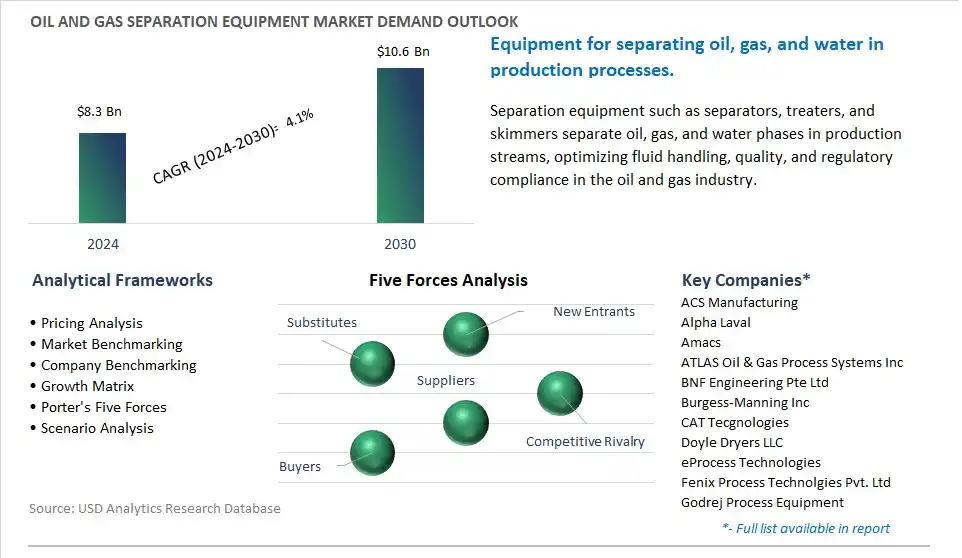
The global Oil and Gas Separation Equipment Market is poised to register a 4.1% CAGR from $8.3 Billion in 2024 to $10.6 Billion in 2030.
The global Oil and Gas Separation Equipment Market Study analyzes and forecasts the market size across 6 regions and 24 countries for diverse segments -By Product (Two Phase Separators, Three Phase Separators, Degasser, Scrubber, Deliquilizer, Heat Treaters, Others), By Technology (Gravitational Separation, Centrifugal Separation, Others), By Application (Onshore, Offshore, Refineries, Others).
An Introduction to Global Oil and Gas Separation Equipment Market in 2024
The key trend shaping the future of the oil and gas separation equipment industry is the increasing focus on maximizing production efficiency, reducing environmental footprint, and complying with stringent regulatory standards. With the growing complexity of hydrocarbon processing operations, operators are investing in advanced separation technologies such as cyclonic separators, gravity separators, and membrane systems to efficiently separate oil, gas, and water phases in production streams. Additionally, the adoption of modular and compact separation units is enabling operators to optimize footprint, minimize installation costs, and accelerate project timelines for both onshore and offshore applications. Furthermore, the integration of automation, control systems, and remote monitoring capabilities is enhancing operational visibility and control, enabling operators to optimize separation processes, reduce downtime, and improve overall production performance. As the oil and gas industry continues to evolve, driven by technological advancements and market dynamics, the demand for efficient and reliable separation equipment capable of meeting the challenges of complex production environments is expected to drive innovation and market growth in the coming years.
Oil and Gas Separation Equipment Market Competitive Landscape
The market report analyses the leading companies in the industry including ACS Manufacturing, Alpha Laval, Amacs, ATLAS Oil & Gas Process Systems Inc, BNF Engineering Pte Ltd, Burgess-Manning Inc, CAT Tecgnologies, Doyle Dryers LLC, eProcess Technologies, Fenix Process Technolgies Pvt. Ltd, Godrej Process Equipment, HAT International, Honeywell, Valerus, Worhtington.
Oil and Gas Separation Equipment Market Dynamics
Oil And Gas Separation Equipment Market Trend: Increasing Demand for Modular and Compact Separation Solutions
A prominent trend in the oil and gas separation equipment market is the increasing demand for modular and compact separation solutions. With the growing complexity of oil and gas production operations, there is a need for separation equipment that can efficiently separate oil, gas, and water from well fluids in a compact and cost-effective manner. Modular separation systems, consisting of skid-mounted units with integrated separation technologies such as cyclonic separators, hydrocyclones, and gravity separators, are gaining popularity due to their flexibility, scalability, and ease of deployment in remote or offshore locations. The trend towards modular and compact separation solutions supports companies investments in optimizing production efficiency, minimizing footprint, and reducing capital and operating costs.
Oil And Gas Separation Equipment Market Driver: Expansion of Unconventional Oil and Gas Production
A significant driver propelling the oil and gas separation equipment market is the expansion of unconventional oil and gas production activities. Unconventional resources such as shale oil and gas, tight gas, and coalbed methane require specialized separation equipment to extract hydrocarbons from complex reservoirs and well fluids. Hydraulic fracturing (fracking) and horizontal drilling techniques used in unconventional reservoirs generate large volumes of produced water, which must be effectively separated and treated to meet regulatory requirements and minimize environmental impact. As the development of unconventional resources continues to expand globally, driven by advancements in drilling technologies and economic incentives, the demand for separation equipment tailored to unconventional production methods is expected to increase.
Oil And Gas Separation Equipment Market Opportunity: Integration of Advanced Automation and Control Systems
An opportunity for the oil and gas separation equipment market lies in the integration of advanced automation and control systems. With advancements in process automation, instrumentation, and digitalization, there is potential to enhance the efficiency, reliability, and safety of separation equipment through advanced control and monitoring capabilities. Automated control systems can optimize separation processes, adjust operating parameters in real-time, and ensure optimal performance under varying operating conditions. Additionally, integration with data analytics and predictive maintenance tools enables proactive monitoring of equipment health, predictive failure analysis, and optimization of maintenance schedules to minimize downtime and maximize equipment uptime. By offering separation equipment with advanced automation and control features, manufacturers can address the evolving needs of oil and gas operators, improve operational efficiency, and create value-added solutions for the market.
Oil and Gas Separation Equipment Market Share Analysis: three-phase separators generated the highest revenue in 2024
three-phase separators are the largest segment in the Oil and Gas Separation Equipment Market. Three-phase separators are widely used in the oil and gas industry to separate crude oil, natural gas, and water from production streams. These separators utilize gravity and centrifugal force to separate the three phases based on their density and immiscibility. Crude oil, being lighter than water and gas, rises to the top of the separator, while water settles at the bottom, and natural gas accumulates in the middle. Three-phase separators are essential for efficiently separating and processing multiphase production streams from oil and gas wells, ensuring the quality and purity of each component for further processing or transportation. Additionally, three-phase separators offer versatility and adaptability to varying operating conditions and production requirements, making them suitable for a wide range of applications in both onshore and offshore oil and gas facilities. The widespread use and importance of three-phase separators in oil and gas production contribute to their dominance as the largest segment in the Oil and Gas Separation Equipment Market.
Oil and Gas Separation Equipment Market Share Analysis: centrifugal separation segment is poised to register the fastest growth rate (CAGR) over the forecast period to 2030
The centrifugal separation segment is the fastest-growing segment in the Oil and Gas Separation Equipment Market. Centrifugal separation technology utilizes centrifugal force to separate different components of oil and gas production streams based on their density and molecular weight. Multiple factors contribute to the rapid growth of centrifugal separation technology in the oil and gas industry. centrifugal separators offer high efficiency and throughput, allowing for the rapid separation of oil, gas, and water phases from production streams. This results in improved production rates and higher yields of valuable hydrocarbons. Additionally, centrifugal separators are compact and versatile, making them suitable for both onshore and offshore applications with limited space and weight constraints. Furthermore, advancements in centrifugal separation technology, including the development of innovative designs and materials, enhance the performance and reliability of centrifugal separators, further driving their adoption in oil and gas separation processes. As oil and gas companies seek to optimize production efficiency, reduce operating costs, and comply with stringent environmental regulations, the demand for centrifugal separation technology is expected to surge, making it the fastest-growing segment in the Oil and Gas Separation Equipment Market.
Oil and Gas Separation Equipment Market Share Analysis: The offshore segment is poised to register the fastest growth rate (CAGR) over the forecast period to 2030
The offshore segment is the fastest-growing segment in the Oil and Gas Separation Equipment Market. Offshore oil and gas production activities are increasing as energy companies explore deeper waters and more remote offshore regions to access untapped reserves. Offshore production platforms and facilities require efficient separation equipment to separate oil, gas, and water from production streams before transportation to onshore facilities. The offshore environment presents unique challenges compared to onshore operations, including harsh weather conditions, limited space, and remote locations, requiring specialized separation equipment that can withstand these challenges. Additionally, as offshore drilling technologies advance and exploration moves into deeper waters, the complexity of separation processes increases, driving the demand for advanced and innovative separation equipment tailored to offshore applications. Furthermore, stringent environmental regulations and the need to minimize environmental impact drive the adoption of efficient separation equipment to ensure compliance and reduce emissions in offshore operations. As offshore oil and gas production continues to expand globally, the demand for separation equipment in the offshore segment is expected to experience rapid growth, making it the fastest-growing segment in the Oil and Gas Separation Equipment Market.
Oil and Gas Separation Equipment Market Report Segmentation
By Product
Two Phase Separators
Three Phase Separators
Degasser
Scrubber
Deliquilizer
Heat Treaters
Others
By Technology
Gravitational Separation
Centrifugal Separation
Others
By Application
Onshore
Offshore
Refineries
Others
Regions Included
North America (US, Canada, Mexico)
Europe (Germany, UK, France, Spain, Italy, Russia, Rest of Europe)
Asia Pacific (China, India, Japan, South Korea, Australia, South East Asia, Rest of Asia)
South America (Brazil, Argentina, Rest of South America)
Middle East and Africa (Saudi Arabia, UAE, Rest of Middle East, South Africa, Egypt, Rest of Africa)
Oil and Gas Separation Equipment Companies Profiled in the Market Study
ACS Manufacturing
Alpha Laval
Amacs
ATLAS Oil & Gas Process Systems Inc
BNF Engineering Pte Ltd
Burgess-Manning Inc
CAT Tecgnologies
Doyle Dryers LLC
eProcess Technologies
Fenix Process Technolgies Pvt. Ltd
Godrej Process Equipment
HAT International
Honeywell
Valerus
Worhtington
*- List Not Exhaustive
TABLE OF CONTENTS
1 Introduction to 2024 Oil and Gas Separation Equipment Market
1.1 Market Overview
1.2 Quick Facts
1.3 Scope/Objective of the Study
1.4 Market Definition
1.5 Countries and Regions Covered
1.6 Units, Currency, and Conversions
1.7 Industry Value Chain
2 Research Methodology
2.1 Market Size Estimation
2.2 Sources and Research Methodology
2.3 Data Triangulation
2.4 Assumptions and Limitations
3 Executive Summary
3.1 Global Oil and Gas Separation Equipment Market Size Outlook, $ Million, 2021 to 2030
3.2 Oil and Gas Separation Equipment Market Outlook by Type, $ Million, 2021 to 2030
3.3 Oil and Gas Separation Equipment Market Outlook by Product, $ Million, 2021 to 2030
3.4 Oil and Gas Separation Equipment Market Outlook by Application, $ Million, 2021 to 2030
3.5 Oil and Gas Separation Equipment Market Outlook by Key Countries, $ Million, 2021 to 2030
4 Market Dynamics
4.1 Key Driving Forces of Oil and Gas Separation Equipment Industry
4.2 Key Market Trends in Oil and Gas Separation Equipment Industry
4.3 Potential Opportunities in Oil and Gas Separation Equipment Industry
4.4 Key Challenges in Oil and Gas Separation Equipment Industry
5 Market Factor Analysis
5.1 Value Chain Analysis
5.2 Competitive Landscape
5.2.1 Global Oil and Gas Separation Equipment Market Share by Company (%), 2023
5.2.2 Product Offerings by Company
5.3 Porter’s Five Forces Analysis
5.4 Pricing Analysis and Outlook
6 Growth Outlook Across Scenarios
6.1 Growth Analysis-Case Scenario Definitions
6.2 Low Growth Scenario Forecasts
6.3 Reference Growth Scenario Forecasts
6.4 High Growth Scenario Forecasts
7 Global Oil and Gas Separation Equipment Market Outlook by Segments
7.1 Oil and Gas Separation Equipment Market Outlook by Segments, $ Million, 2021- 2030
By Product
Two Phase Separators
Three Phase Separators
Degasser
Scrubber
Deliquilizer
Heat Treaters
Others
By Technology
Gravitational Separation
Centrifugal Separation
Others
By Application
Onshore
Offshore
Refineries
Others
8 North America Oil and Gas Separation Equipment Market Analysis and Outlook To 2030
8.1 Introduction to North America Oil and Gas Separation Equipment Markets in 2024
8.2 North America Oil and Gas Separation Equipment Market Size Outlook by Country, 2021-2030
8.2.1 United States
8.2.2 Canada
8.2.3 Mexico
8.3 North America Oil and Gas Separation Equipment Market size Outlook by Segments, 2021-2030
By Product
Two Phase Separators
Three Phase Separators
Degasser
Scrubber
Deliquilizer
Heat Treaters
Others
By Technology
Gravitational Separation
Centrifugal Separation
Others
By Application
Onshore
Offshore
Refineries
Others
9 Europe Oil and Gas Separation Equipment Market Analysis and Outlook To 2030
9.1 Introduction to Europe Oil and Gas Separation Equipment Markets in 2024
9.2 Europe Oil and Gas Separation Equipment Market Size Outlook by Country, 2021-2030
9.2.1 Germany
9.2.2 France
9.2.3 Spain
9.2.4 United Kingdom
9.2.4 Italy
9.2.5 Russia
9.2.6 Norway
9.2.7 Rest of Europe
9.3 Europe Oil and Gas Separation Equipment Market Size Outlook by Segments, 2021-2030
By Product
Two Phase Separators
Three Phase Separators
Degasser
Scrubber
Deliquilizer
Heat Treaters
Others
By Technology
Gravitational Separation
Centrifugal Separation
Others
By Application
Onshore
Offshore
Refineries
Others
10 Asia Pacific Oil and Gas Separation Equipment Market Analysis and Outlook To 2030
10.1 Introduction to Asia Pacific Oil and Gas Separation Equipment Markets in 2024
10.2 Asia Pacific Oil and Gas Separation Equipment Market Size Outlook by Country, 2021-2030
10.2.1 China
10.2.2 India
10.2.3 Japan
10.2.4 South Korea
10.2.5 Indonesia
10.2.6 Malaysia
10.2.7 Australia
10.2.8 Rest of Asia Pacific
10.3 Asia Pacific Oil and Gas Separation Equipment Market size Outlook by Segments, 2021-2030
By Product
Two Phase Separators
Three Phase Separators
Degasser
Scrubber
Deliquilizer
Heat Treaters
Others
By Technology
Gravitational Separation
Centrifugal Separation
Others
By Application
Onshore
Offshore
Refineries
Others
11 South America Oil and Gas Separation Equipment Market Analysis and Outlook To 2030
11.1 Introduction to South America Oil and Gas Separation Equipment Markets in 2024
11.2 South America Oil and Gas Separation Equipment Market Size Outlook by Country, 2021-2030
11.2.1 Brazil
11.2.2 Argentina
11.2.3 Rest of South America
11.3 South America Oil and Gas Separation Equipment Market size Outlook by Segments, 2021-2030
By Product
Two Phase Separators
Three Phase Separators
Degasser
Scrubber
Deliquilizer
Heat Treaters
Others
By Technology
Gravitational Separation
Centrifugal Separation
Others
By Application
Onshore
Offshore
Refineries
Others
12 Middle East and Africa Oil and Gas Separation Equipment Market Analysis and Outlook To 2030
12.1 Introduction to Middle East and Africa Oil and Gas Separation Equipment Markets in 2024
12.2 Middle East and Africa Oil and Gas Separation Equipment Market Size Outlook by Country, 2021-2030
12.2.1 Saudi Arabia
12.2.2 UAE
12.2.3 Oman
12.2.4 Rest of Middle East
12.2.5 Egypt
12.2.6 Nigeria
12.2.7 South Africa
12.2.8 Rest of Africa
12.3 Middle East and Africa Oil and Gas Separation Equipment Market size Outlook by Segments, 2021-2030
By Product
Two Phase Separators
Three Phase Separators
Degasser
Scrubber
Deliquilizer
Heat Treaters
Others
By Technology
Gravitational Separation
Centrifugal Separation
Others
By Application
Onshore
Offshore
Refineries
Others
13 Company Profiles
13.1 Company Snapshot
13.2 SWOT Profiles
13.3 Products and Services
13.4 Recent Developments
13.5 Financial Profile
ACS Manufacturing
Alpha Laval
Amacs
ATLAS Oil & Gas Process Systems Inc
BNF Engineering Pte Ltd
Burgess-Manning Inc
CAT Tecgnologies
Doyle Dryers LLC
eProcess Technologies
Fenix Process Technolgies Pvt. Ltd
Godrej Process Equipment
HAT International
Honeywell
Valerus
Worhtington
14 Appendix
14.1 Customization Offerings
14.2 Subscription Services
14.3 Related Reports
14.4 Publisher Expertise
By Product
Two Phase Separators
Three Phase Separators
Degasser
Scrubber
Deliquilizer
Heat Treaters
Others
By Technology
Gravitational Separation
Centrifugal Separation
Others
By Application
Onshore
Offshore
Refineries
Others
Countries Analyzed
North America (US, Canada, Mexico)
Europe (Germany, UK, France, Spain, Italy, Russia, Rest of Europe)
Asia Pacific (China, India, Japan, South Korea, Australia, South East Asia, Rest of Asia)
South America (Brazil, Argentina, Rest of South America)
Middle East and Africa (Saudi Arabia, UAE, Rest of Middle East, South Africa, Egypt, Rest of Africa)
