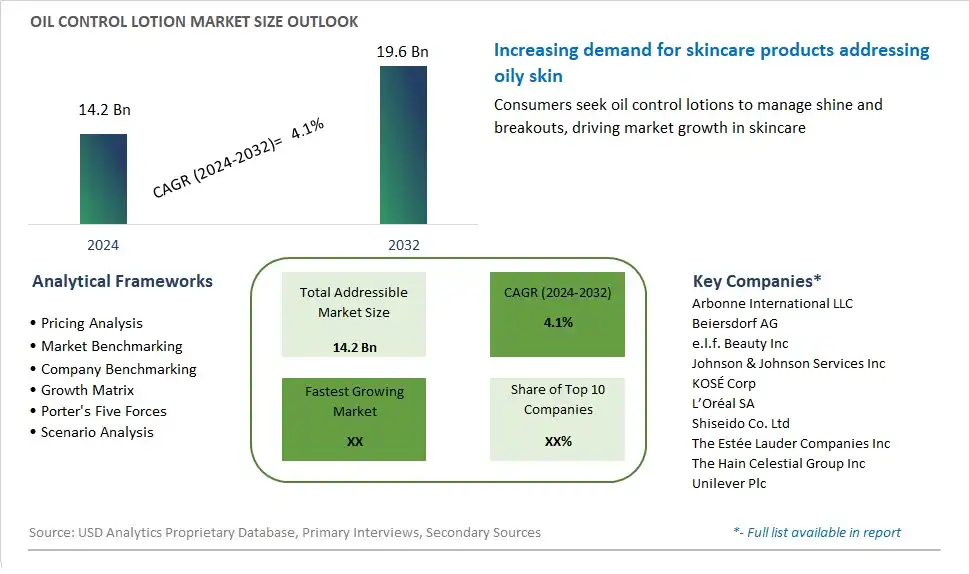
Global Oil Control Lotion Market Size is valued at $14.2 Billion in 2024 and is forecast to register a growth rate (CAGR) of 4.1% to reach $19.6 Billion by 2032.
The global Oil Control Lotion Market Comprehensive Study analyzes and forecasts the market size across 6 regions and 24 countries for diverse segments -By End-User (Women, Men), By Distribution Channel (Supermarkets/Hypermarkets, Convenience Stores, Specialty Stores, Online Channels, Others)
An Introduction to Oil Control Lotion Market
In 2024, the market for oil control lotion is thriving as consumers seek effective solutions for managing excess oil production and preventing shine in their skincare routines. Oil control lotions are specially formulated to absorb excess sebum, mattify the skin, and minimize the appearance of pores, providing a matte, shine-free finish that lasts throughout the day. With oily or combination skin types prone to breakouts, enlarged pores, and uneven texture, oil control lotions offer a lightweight and non-greasy option for balancing oil production and maintaining a fresh, matte complexion. Moreover, advancements in skincare technology have led to the development of oil control lotions enriched with ingredients such as niacinamide, salicylic acid, and antioxidants that help regulate oil production, clarify pores, and reduce inflammation for clearer, smoother skin over time. As consumer demand for oil control solutions continues to grow, expect to see further innovation in oil control lotion formulations, including oil-free, non-comedogenic, and dermatologist-tested options that cater to diverse skin concerns and preferences, reflecting a broader trend towards customizable and efficacious skincare solutions that empower individuals to achieve their skin goals with confidence.
Oil Control Lotion Competitive Landscape
The market report analyses the leading companies in the industry including Arbonne International LLC, Beiersdorf AG, e.l.f. Beauty Inc, Johnson & Johnson Services Inc, KOSÉ Corp, L’Oréal SA, Shiseido Co. Ltd, The Estée Lauder Companies Inc, The Hain Celestial Group Inc, Unilever Plc, and Others.
Oil Control Lotion Market Dynamics
Oil Control Lotion Market Trend: Growing Demand for Mattifying and Oil-Controlling Skincare Products
A significant trend in the oil control lotion market is the growing demand for mattifying and oil-controlling skincare products among consumers with oily or combination skin types. With increasing concerns about excess oiliness, shine, and enlarged pores, particularly in humid climates, consumers are seeking lightweight, non-greasy lotions formulated to absorb excess oil, minimize shine, and mattify the skin's appearance. This trend is driven by a desire for a balanced and matte complexion, improved makeup longevity, and enhanced skin comfort throughout the day. Additionally, the popularity of social media platforms and beauty influencers showcasing oil control products and techniques has further fueled consumer interest in incorporating oil control lotions into their skincare routines, driving demand for innovative formulations and solutions.
Market Driver: Rising Prevalence of Oily and Combination Skin Concerns
A key driver for the oil control lotion market is the rising prevalence of oily and combination skin concerns among consumers worldwide. Factors such as hormonal fluctuations, genetics, environmental factors, and lifestyle habits contribute to the overproduction of sebum, leading to oily skin, enlarged pores, and acne breakouts. As a result, consumers are increasingly seeking targeted skincare solutions designed to address these specific concerns and achieve a matte, shine-free complexion. This driver is reinforced by the growing awareness of the detrimental effects of excess oil production on skin health, such as clogged pores, acne, and skin inflammation, driving demand for oil control lotions as a preventive and corrective measure to maintain skin balance and clarity.
Market Opportunity: Innovation in Multi-Functional Formulations and Ingredients
An opportunity for the oil control lotion market lies in innovation in multi-functional formulations and ingredients that offer comprehensive oil control benefits while addressing other skincare needs and concerns. Companies can capitalize on this opportunity by developing oil control lotions enriched with ingredients such as niacinamide, salicylic acid, witch hazel extract, and mattifying powders that help regulate sebum production, minimize pore size, and soothe irritated skin. Moreover, there's potential to incorporate additional skincare benefits such as hydration, antioxidant protection, and anti-aging properties into oil control lotion formulations to appeal to consumers seeking multi-tasking skincare solutions. Additionally, there's an opportunity to cater to niche market segments such as men's skincare, active lifestyle skincare, and clean beauty enthusiasts by offering oil control lotions formulated with natural and organic ingredients, free from harsh chemicals and artificial fragrances. By innovating with multi-functional formulations and addressing diverse consumer needs, companies can differentiate their oil control lotion products, capture market share, and drive growth in the segment.
Oil Control Lotion Market Share Analysis: Women held the dominant market share in 2024
In the Oil Control Lotion Market segmented by end-users, women stand out as the largest segment, driven by several key factors. Historically, skincare products have predominantly targeted women, reflecting societal norms and cultural perceptions of beauty and grooming. Women are often more invested in skincare regimens and are more to seek out products tailored to their specific needs, including oil control lotions to combat shine and manage oily skin. Additionally, the beauty industry has witnessed a surge in demand for skincare products among women, driven by evolving beauty standards, increased disposable income, and the growing influence of social media and beauty influencers. Furthermore, the rise of inclusive beauty campaigns and gender-neutral product formulations has broadened the appeal of oil control lotions to a diverse range of consumers. As women continue to prioritize skincare as part of their self-care routines and seek effective solutions for oil control, the segment is expected to maintain its dominance in the oil control lotion market.
Oil Control Lotion Market Share Analysis: Online Channels market is poised to register the fastest growth rae over the forecast period to 2032
Among the distribution channels in the Oil Control Lotion Market, online channels emerge as the fastest-growing segment, driven by several compelling factors. The exponential growth of e-commerce platforms and the increasing preference for online shopping have revolutionized the way consumers purchase skincare products, including oil control lotions. Online channels offer unparalleled convenience, allowing consumers to browse a wide range of products, compare prices, and read reviews from the comfort of their homes. Further, the COVID-19 pandemic has accelerated the shift towards online shopping as consumers prioritize safety and social distancing measures. Additionally, the accessibility of online channels eliminates geographical barriers, enabling brands to reach a broader audience and cater to diverse consumer preferences. Furthermore, the rise of digital marketing strategies and influencer collaborations has further boosted the visibility and popularity of oil control lotions among online consumers. As the online retail landscape continues to evolve and technological advancements enhance the shopping experience, the online channel is poised to remain at the forefront of the oil control lotion market's growth trajectory.
Oil Control Lotion Market Segmentation
By End-User
Women
Men
By Distribution Channel
Supermarkets/Hypermarkets
Convenience Stores
Specialty Stores
Online Channels
Others
Countries Analyzed
North America (US, Canada, Mexico)
Europe (Germany, UK, France, Spain, Italy, Russia, Rest of Europe)
Asia Pacific (China, India, Japan, South Korea, Australia, South East Asia, Rest of Asia)
South America (Brazil, Argentina, Rest of South America)
Middle East and Africa (Saudi Arabia, UAE, Rest of Middle East, South Africa, Egypt, Rest of Africa)
Oil Control Lotion Companies Profiled in the Study
Arbonne International LLC
Beiersdorf AG
e.l.f. Beauty Inc
Johnson & Johnson Services Inc
KOSÉ Corp
L’Oréal SA
Shiseido Co. Ltd
The Estée Lauder Companies Inc
The Hain Celestial Group Inc
Unilever Plc
*- List Not Exhaustive
Chapter 1. TABLE OF CONTENTS
Chapter 2. Introduction to Oil Control Lotion Market
2.1. Market Overview
2.2. Key Statistics and Report Highlights
2.3. Scope of the Comprehensive Study
2.3.1. Market Definition
2.3.2 Countries and Regions Covered
2.3.3 Research Objective
2.3.4 Units, Currency, and Conversions
2.3.5 Industry Value Chain
2.4. Key Market Segments
2.5. Key Companies
2.6. Study Period
Chapter 3. Strategic Analysis Review
3.1. Oil Control Lotion Pricing Analysis and Forecast
3.2. Porter’s Five Forces
3.3. Market Ecosystem
3.4. SWOT Analysis
3.5. Regulatory Scenario
3.3. Effects of Inflation, Russia-Ukraine War, moderating economic growth, and other macroeconomic factors
Chapter 4. Competitive Landscape
4.1. Market Share Analysis
4.1.1. Global Oil Control Lotion Market Share by Company, 2023
4.1.2. Product Offerings of Leading Oil Control Lotion Companies
4.2. Market Entropy
4.2.1. New Product Launches in the Industry
4.2.2. Mergers, Acquisitions, Joint ventures, and Partnerships
4.3. Key Strategies and Best Practices
Chapter 5. Global Market Projections: Best, Reference, and Low Case Scenarios
5.1. Growth Analysis- Case Scenario Definitions
5.2. Low Growth Case Scenario Forecasts
5.3. Reference Growth Case Scenario Forecasts
5.4. High Growth Case Scenario Forecasts
Chapter 6. Market Dynamics
6.1. Oil Control Lotion Market Drivers
6.2. Oil Control Lotion Market Challenges
6.6. Oil Control Lotion Market Opportunities
6.4. Oil Control Lotion Market Trends
Chapter 7. Global Oil Control Lotion Market Outlook Trends
7.1. Global Oil Control Lotion Revenue (USD Million) and CAGR (%) by Type (2021-2032)
7.2. Global Oil Control Lotion Revenue (USD Million) and CAGR (%) by Application (2021-2032)
7.3. Global Oil Control Lotion Revenue (USD Million) and CAGR (%) by Product (2021-2032)
By End-User
Women
Men
By Distribution Channel
Supermarkets/Hypermarkets
Convenience Stores
Specialty Stores
Online Channels
Others
Chapter 8. Global Oil Control Lotion Regional Analysis and Outlook
8.1. Global Oil Control Lotion Revenue (USD Million) By Regions (2021- 2032)
8.2. North America Oil Control Lotion Revenue (USD Million) by Country (2021-2032)
8.2.1. United States Oil Control Lotion Regional Analysis and Outlook
8.2.2. Canada Oil Control Lotion Regional Analysis and Outlook
8.2.3. Mexico Oil Control Lotion Regional Analysis and Outlook
8.3. Europe Oil Control Lotion Revenue (USD Million), by Country (2021-2032)
8.3.1. Germany Oil Control Lotion Regional Analysis and Outlook
8.3.2. France Oil Control Lotion Regional Analysis and Outlook
8.3.3. United Kingdom Oil Control Lotion Regional Analysis and Outlook
8.3.4. Spain Oil Control Lotion Regional Analysis and Outlook
8.3.5. Italy Oil Control Lotion Regional Analysis and Outlook
8.3.6. Russia Oil Control Lotion Regional Analysis and Outlook
8.3.7. Rest of Europe Oil Control Lotion Regional Analysis and Outlook
8.4. Asia Pacific Oil Control Lotion Revenue (USD Million) by Country (2021-2032)
8.4.1. China Oil Control Lotion Regional Analysis and Outlook
8.4.2. Japan Oil Control Lotion Regional Analysis and Outlook
8.4.3. India Oil Control Lotion Regional Analysis and Outlook
8.4.4. South Korea Oil Control Lotion Regional Analysis and Outlook
8.4.5. Australia Oil Control Lotion Regional Analysis and Outlook
8.4.6. South East Asia Oil Control Lotion Regional Analysis and Outlook
8.4.7. Rest of Asia Pacific Oil Control Lotion Regional Analysis and Outlook
8.5. South America Oil Control Lotion Revenue (USD Million), by Country (2021-2032)
8.5.1. Brazil Oil Control Lotion Regional Analysis and Outlook
8.5.2. Argentina Oil Control Lotion Regional Analysis and Outlook
8.5.3. Rest of South America Oil Control Lotion Regional Analysis and Outlook
8.6. Middle East and Africa Oil Control Lotion Revenue (USD Million) by Country (2021-2032)
8.6.1. Middle East Oil Control Lotion Regional Analysis and Outlook
8.6.2. Africa Oil Control Lotion Regional Analysis and Outlook
Chapter 9. North America Oil Control Lotion Analysis and Outlook
9.1. North America Oil Control Lotion Revenue (USD Million) by Segments (2021-2032)
9.1.1. North America Oil Control Lotion Revenue (USD Million) by Type (2021-2032)
9.1.2. North America Oil Control Lotion Revenue (USD Million) by Application (2021-2032)
9.1.3. North America Oil Control Lotion Revenue (USD Million) by Product (2021-2032)
By End-User
Women
Men
By Distribution Channel
Supermarkets/Hypermarkets
Convenience Stores
Specialty Stores
Online Channels
Others
Chapter 10. Europe Oil Control Lotion Analysis and Outlook
10.1. Europe Oil Control Lotion Revenue (USD Million), by Segments (USD Million) (2021-2032)
10.1.1. Europe Oil Control Lotion Revenue (USD Million) by Type (2021-2032)
10.1.2. Europe Oil Control Lotion Revenue (USD Million) by Application (2021-2032)
10.1.3. Europe Oil Control Lotion Revenue (USD Million) by Product (2021-2032)
By End-User
Women
Men
By Distribution Channel
Supermarkets/Hypermarkets
Convenience Stores
Specialty Stores
Online Channels
Others
Chapter 11. Asia Pacific Oil Control Lotion Analysis and Outlook
11.1. Asia Pacific Oil Control Lotion Revenue (USD Million), and Revenue (USD Million) by Segments (2021-2032)
11.1.1. Asia Pacific Oil Control Lotion Revenue (USD Million) by Type (2021-2032)
11.1.2. Asia Pacific Oil Control Lotion Revenue (USD Million) by Application (2021-2032)
11.1.3. Asia Pacific Oil Control Lotion Revenue (USD Million) by Product (2021-2032)
By End-User
Women
Men
By Distribution Channel
Supermarkets/Hypermarkets
Convenience Stores
Specialty Stores
Online Channels
Others
Chapter 12. South America Oil Control Lotion Analysis and Outlook
12.1. South America Oil Control Lotion Revenue (USD Million), by Segments (2021-2032)
12.1.1. South America Oil Control Lotion Revenue (USD Million) by Type (2021-2032)
12.1.2. South America Oil Control Lotion Revenue (USD Million) by Application (2021-2032)
12.1.3. South America Oil Control Lotion Revenue (USD Million) by Product (2021-2032)
By End-User
Women
Men
By Distribution Channel
Supermarkets/Hypermarkets
Convenience Stores
Specialty Stores
Online Channels
Others
Chapter 13. Middle East and Africa Oil Control Lotion Analysis and Outlook
13.1. Middle East and Africa Oil Control Lotion Revenue (USD Million), by Segments (2021-2032)
13.1.1. Middle East and Africa Oil Control Lotion Revenue (USD Million) by Type (2021-2032)
13.1.2. Middle East and Africa Oil Control Lotion Revenue (USD Million) by Application (2021-2032)
13.1.3. Middle East and Africa Oil Control Lotion Revenue (USD Million) by Product (2021-2032)
By End-User
Women
Men
By Distribution Channel
Supermarkets/Hypermarkets
Convenience Stores
Specialty Stores
Online Channels
Others
Chapter 14. Oil Control Lotion Company Profiles
14.1 Business Overview
14.2 Product Profiles
14.3 SWOT Profiles
14.5 Recent Developments
14.6 Financial Profile
List of Companies
Arbonne International LLC
Beiersdorf AG
e.l.f. Beauty Inc
Johnson & Johnson Services Inc
KOSÉ Corp
L’Oréal SA
Shiseido Co. Ltd
The Estée Lauder Companies Inc
The Hain Celestial Group Inc
Unilever Plc
15. Methodology and Data Sources
15.1 Customization Offerings
15.2 Subscription Services
15.3 Related Reports
15.4 Publisher Expertise
LIST OF TABLES
Table 1 Market Segmentation Analysis
Table 2 Global Oil Control Lotion Market Share of Leading Companies, 2023
Table 3 Product Offerings of Leading Companies
Table 4 Low Growth Scenario Forecasts
Table 5 Reference Case Growth Scenario
Table 6 High Growth Case Scenario
Table 7 Global Oil Control Lotion Revenue (USD Million) And CAGR (%) By Type (2021-2032)
Table 8 Global Oil Control Lotion Revenue (USD Million) And CAGR (%) By Application (2021-2032)
Table 9 Global Oil Control Lotion Revenue (USD Million) And CAGR (%) By Product (2021-2032)
Table 10 Global Oil Control Lotion Market Revenue (USD Million) By Regions (2021-2032)
Table 11 Global Oil Control Lotion Market Share (%) By Regions (2021-2032)
Table 12 North America Oil Control Lotion Revenue (USD Million) By Country (2021-2032)
Table 13 Europe Oil Control Lotion Revenue (USD Million) By Country (2021-2032)
Table 14 Asia Pacific Oil Control Lotion Revenue (USD Million) By Country (2021-2032)
Table 15 South America Oil Control Lotion Revenue (USD Million) By Country (2021-2032)
Table 16 Middle East and Africa Oil Control Lotion Revenue (USD Million) By Region (2021-2032)
Table 17 North America Oil Control Lotion Revenue (USD Million) By Type (2021-2032)
Table 18 North America Oil Control Lotion Revenue (USD Million) By Application (2021-2032)
Table 19 North America Oil Control Lotion Revenue (USD Million) By Product (2021-2032)
Table 20 Europe Oil Control Lotion Revenue (USD Million) By Type (2021-2032)
Table 21 Europe Oil Control Lotion Revenue (USD Million) By Application (2021-2032)
Table 22 Europe Oil Control Lotion Revenue (USD Million) By Product (2021-2032)
Table 23 Asia Pacific Oil Control Lotion Revenue (USD Million) By Type (2021-2032)
Table 24 Asia Pacific Oil Control Lotion Revenue (USD Million) By Application (2021-2032)
Table 25 Asia Pacific Oil Control Lotion Revenue (USD Million) By Product (2021-2032)
Table 26 South America Oil Control Lotion Revenue (USD Million) By Type (2021-2032)
Table 27 South America Oil Control Lotion Revenue (USD Million) By Application (2021-2032)
Table 28 South America Oil Control Lotion Revenue (USD Million) By Product (2021-2032)
Table 29 Middle East and Africa Oil Control Lotion Revenue (USD Million) By Type (2021-2032)
Table 30 Middle East and Africa Oil Control Lotion Revenue (USD Million) By Application (2021-2032)
Table 31 Middle East and Africa Oil Control Lotion Revenue (USD Million) By Product (2021-2032)
LIST OF FIGURES
Figure 1. Market Scope
Figure 2. Pricing Forecasts Per Unit, 2023- 2032
Figure 3. Porter’s Five Forces
Figure 4. Global Oil Control Lotion Market Revenue (USD Million) By Regions (2021-2032)
Figure 5. Global Oil Control Lotion Market Share (%) By Regions (2023)
Figure 6. North America Oil Control Lotion Revenue (USD Million) By Country (2021-2032)
Figure 7. United States Oil Control Lotion Revenue (USD Million) By Country (2021-2032)
Figure 8. Canada Oil Control Lotion Revenue (USD Million) By Country (2021-2032)
Figure 9. Mexico Oil Control Lotion Revenue (USD Million) By Country (2021-2032)
Figure 10. Europe Oil Control Lotion Revenue (USD Million) By Country (2021-2032)
Figure 11. Germany Oil Control Lotion Revenue (USD Million) By Country (2021-2032)
Figure 12. France Oil Control Lotion Revenue (USD Million) By Country (2021-2032)
Figure 13. United Kingdom Oil Control Lotion Revenue (USD Million) By Country (2021-2032)
Figure 14. Spain Oil Control Lotion Revenue (USD Million) By Country (2021-2032)
Figure 15. Italy Oil Control Lotion Revenue (USD Million) By Country (2021-2032)
Figure 16. Russia Oil Control Lotion Revenue (USD Million) By Country (2021-2032)
Figure 17. Rest of Europe Oil Control Lotion Revenue (USD Million) By Country (2021-2032)
Figure 11. Asia Pacific Oil Control Lotion Revenue (USD Million) By Country (2021-2032)
Figure 12. China Oil Control Lotion Revenue (USD Million) By Country (2021-2032)
Figure 13. Japan Oil Control Lotion Revenue (USD Million) By Country (2021-2032)
Figure 14. India Oil Control Lotion Revenue (USD Million) By Country (2021-2032)
Figure 15. South Korea Oil Control Lotion Revenue (USD Million) By Country (2021-2032)
Figure 16. Australia Oil Control Lotion Revenue (USD Million) By Country (2021-2032)
Figure 17. South East Asia Oil Control Lotion Revenue (USD Million) By Country (2021-2032)
Figure 18. South America Oil Control Lotion Revenue (USD Million) By Country (2021-2032)
Figure 19. Brazil Oil Control Lotion Revenue (USD Million) By Country (2021-2032)
Figure 20. Argentina Oil Control Lotion Revenue (USD Million) By Country (2021-2032)
Figure 21. Rest of Asia Pacific Oil Control Lotion Revenue (USD Million) By Country (2021-2032)
Figure 22. Middle East and Africa Oil Control Lotion Revenue (USD Million) By Region (2021-2032)
Figure 23. Saudi Arabia Oil Control Lotion Revenue (USD Million) By Region (2021-2032)
Figure 24. The UAE Oil Control Lotion Revenue (USD Million) By Region (2021-2032)
Figure 25. Rest of Middle East Oil Control Lotion Revenue (USD Million) By Region (2021-2032)
Figure 26. South Africa Oil Control Lotion Revenue (USD Million) By Region (2021-2032)
Figure 27. Africa Oil Control Lotion Revenue (USD Million) By Region (2021-2032)
Figure 28. North America Oil Control Lotion Revenue (USD Million) By Type (2021-2032)
Figure 29. North America Oil Control Lotion Revenue (USD Million) By Application (2021-2032)
Figure 30. North America Oil Control Lotion Revenue (USD Million) By Product (2021-2032)
Figure 31. Europe Oil Control Lotion Revenue (USD Million) By Type (2021-2032)
Figure 32. Europe Oil Control Lotion Revenue (USD Million) By Application (2021-2032)
Figure 33. Europe Oil Control Lotion Revenue (USD Million) By Product (2021-2032)
Figure 34. Asia Pacific Oil Control Lotion Revenue (USD Million) By Type (2021-2032)
Figure 35. Asia Pacific Oil Control Lotion Revenue (USD Million) By Application (2021-2032)
Figure 36. Asia Pacific Oil Control Lotion Revenue (USD Million) By Product (2021-2032)
Figure 37. South America Oil Control Lotion Revenue (USD Million) By Type (2021-2032)
Figure 38. South America Oil Control Lotion Revenue (USD Million) By Application (2021-2032)
Figure 39. South America Oil Control Lotion Revenue (USD Million) By Product (2021-2032)
Figure 40. Middle East and Africa Oil Control Lotion Revenue (USD Million) By Type (2021-2032)
Figure 41. Middle East and Africa Oil Control Lotion Revenue (USD Million) By Application (2021-2032)
Figure 42. Middle East and Africa Oil Control Lotion Revenue (USD Million) By Product (2021-2032)
By End-User
Women
Men
By Distribution Channel
Supermarkets/Hypermarkets
Convenience Stores
Specialty Stores
Online Channels
Others
Countries Analyzed
North America (US, Canada, Mexico)
Europe (Germany, UK, France, Spain, Italy, Russia, Rest of Europe)
Asia Pacific (China, India, Japan, South Korea, Australia, South East Asia, Rest of Asia)
South America (Brazil, Argentina, Rest of South America)
Middle East and Africa (Saudi Arabia, UAE, Rest of Middle East, South Africa, Egypt, Rest of Africa)
