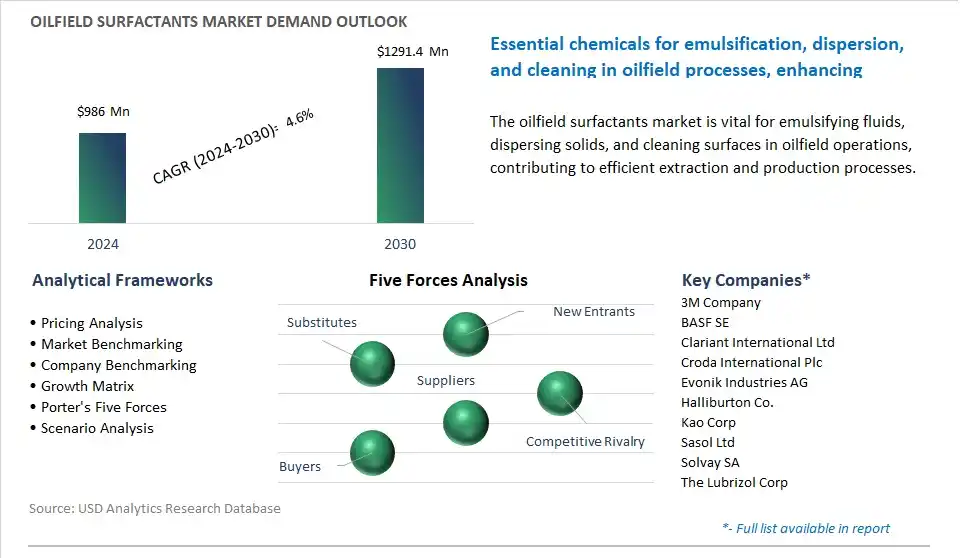
The global Oilfield Surfactants Market is poised to register a 4.6% CAGR from $986 Million in 2024 to $1291.4 Million in 2030.
The global Oilfield Surfactants Market Study analyzes and forecasts the market size across 6 regions and 24 countries for diverse segments -By Product (Anionic, Non-Ionic, Cationic, Amphoteric, Silicone, Others), By Source (Synthetic, Bio-Based, Others), By Application (Stimulation Flow back, EOR, Foamers, Drilling Surfactants, Rig Wash Solutions, Wetting Agents, Surface Active Materials, Emulsion Breakers, Non-Emulsifiers, Spacers, Others).
An Introduction to Global Oilfield Surfactants Market in 2024
The future of oilfield surfactants is influenced by several key trends, including increasing demand for surfactant-based solutions in enhanced oil recovery (EOR), advancements in surfactant chemistry and formulation techniques, and growing emphasis on reservoir performance, environmental impact, and economic viability in the oil and gas industry. Oilfield surfactants are surface-active agents used to alter interfacial tensions between oil, water, and rock surfaces, enhancing the mobilization and displacement of trapped hydrocarbons in reservoir formations during secondary and tertiary recovery operations. With the rise of unconventional reservoirs, mature fields, and water flooding techniques, there's a growing need for surfactants that offer improved reservoir sweep efficiency, oil recovery rates, and cost-effectiveness while minimizing environmental footprint and operational risks. Moreover, advancements in surfactant synthesis, such as bio-based surfactants, fluorosurfactants, and nanoparticle-stabilized emulsions, are driving the development of tailored surfactant formulations with enhanced stability, thermal resistance, and chemical compatibility for challenging reservoir conditions and production environments. Additionally, the integration of surfactant flooding techniques such as alkali-surfactant-polymer (ASP) flooding, microemulsion flooding, and foam flooding is enabling the optimization of EOR processes, reservoir performance, and project economics in mature and marginal oilfields. Collaboration between surfactant manufacturers, oilfield service companies, research institutions, and regulatory agencies is essential to drive innovation, ensure surfactant performance, and address market demands in the oilfield surfactants industry.
Oilfield Surfactants Market Competitive Landscape
The market report analyses the leading companies in the industry including 3M Company, BASF SE, Clariant International Ltd, Croda International Plc, Evonik Industries AG, Halliburton Co., Kao Corp, Sasol Ltd, Solvay SA, The Lubrizol Corp.
Oilfield Surfactants Market Dynamics
Oilfield Surfactants Market Trend: Increasing Demand for Enhanced Oil Recovery Techniques
A significant trend in the oilfield surfactants market is the increasing demand for enhanced oil recovery (EOR) techniques. As conventional oil reserves become depleted and global energy demand continues to rise, there's a growing emphasis on maximizing the recovery of hydrocarbon resources from existing reservoirs. Surfactants play a crucial role in EOR processes by reducing interfacial tension, improving oil mobility, and enhancing sweep efficiency within reservoirs. This trend is driven by the need for oilfield operators to maintain production levels, increase ultimate recovery factors, and optimize reservoir management strategies. With advancements in surfactant chemistry, formulation technologies, and reservoir modeling, there's a growing interest in deploying surfactant-based EOR techniques such as surfactant flooding, micellar-polymer flooding, and alkaline-surfactant-polymer flooding to extract more oil from mature and unconventional reservoirs. As companies seek to unlock untapped reserves and extend the economic life of oilfields, the demand for surfactants for EOR applications is expected to continue growing.
Oilfield Surfactants Market Driver: Expansion of Unconventional Oil and Gas Exploration
A major driver of the oilfield surfactants market is the expansion of unconventional oil and gas exploration and production activities. With the depletion of conventional reserves and advancements in drilling technologies, there's been a surge in the development of unconventional resources such as shale oil and gas, tight oil, and heavy oil deposits. Surfactants play a vital role in unconventional oil and gas recovery by improving reservoir fluid flow, reducing viscosity, and enhancing well productivity. The driver behind this demand is the growing global demand for energy, coupled with technological advancements in hydraulic fracturing (fracking), horizontal drilling, and reservoir stimulation techniques. As oilfield operators continue to invest in unlocking unconventional resources and optimizing production from challenging reservoirs, the demand for surfactants to support these operations is expected to increase.
Oilfield Surfactants Market Opportunity: Innovation in Green and Environmentally Friendly Surfactant Formulations
An opportunity within the oilfield surfactants market lies in innovation in green and environmentally friendly surfactant formulations. With increasing environmental regulations, stakeholder pressure, and corporate sustainability goals, there's a growing demand for surfactants that are biodegradable, non-toxic, and eco-friendly. Oilfield operators are seeking surfactant solutions that minimize environmental impact, reduce health and safety risks, and comply with regulatory requirements. Opportunities exist for the development of bio-based surfactants derived from renewable feedstocks, green chemistry approaches that minimize waste and emissions, and surfactant formulations with low environmental persistence. By investing in research and development, collaboration with academic institutions and research organizations, and leveraging advances in sustainable chemistry, companies can capitalize on opportunities to provide green surfactant solutions that meet the evolving needs of environmentally conscious oilfield operators. Additionally, there's an opportunity to differentiate in the market by offering comprehensive surfactant management services, including chemical monitoring, recycling, and disposal solutions, to support environmental stewardship and compliance initiatives in the oil and gas industry.
Oilfield Surfactants Market Share Analysis: The Anionic Segment generated the highest revenue in 2024
The Anionic segment is the largest in the Oilfield Surfactants Market, primarily due to its widespread use and effectiveness in various oilfield applications. Anionic surfactants, characterized by their negatively charged hydrophilic head groups, exhibit excellent oil-solubilizing and emulsifying properties, making them indispensable in oilfield operations such as drilling, production, and enhanced oil recovery (EOR). These surfactants effectively reduce interfacial tension between oil and water, improving oil recovery rates, enhancing wellbore cleaning, and facilitating fluid mobility in reservoirs. Further, anionic surfactants are versatile and compatible with a wide range of reservoir conditions, including high salinity, temperature, and pressure, ensuring their applicability in diverse oilfield environments. Additionally, advancements in surfactant chemistry and formulation technologies continually enhance the performance and efficiency of anionic surfactants, further reinforcing their dominance in the Oilfield Surfactants Market. Furthermore, the increasing adoption of advanced oilfield techniques, such as unconventional oil and gas production and chemical enhanced oil recovery (CEOR), amplifies the demand for specialized anionic surfactants tailored to specific reservoir challenges. As oil and gas operators prioritize efficiency, productivity, and reservoir optimization, the demand for anionic surfactants in the Oilfield Surfactants Market is expected to remain robust, solidifying the Anionic segment as the largest segment in the market.
Oilfield Surfactants Market Share Analysis: The Bio-Based segment is poised to register the fastest growth rate (CAGR) over the forecast period to 2030
The Bio-Based segment is the fastest-growing segment in the Oilfield Surfactants Market. With increasing environmental concerns and regulations surrounding the oil and gas industry, there is a growing demand for sustainable and eco-friendly solutions. Bio-based surfactants, derived from renewable sources such as plant oils, sugars, and fatty acids, offer a viable alternative to traditional synthetic surfactants derived from petrochemicals. These bio-based surfactants exhibit comparable or superior performance to their synthetic counterparts while offering environmental benefits such as biodegradability, reduced toxicity, and lower carbon footprint. Further, advancements in biotechnology and green chemistry have enabled the development of innovative bio-based surfactants with tailored properties and functionalities, further driving their adoption in oilfield applications. Additionally, the shift towards sustainable practices and corporate responsibility initiatives among oil and gas companies contribute to the increasing demand for bio-based surfactants. Furthermore, favorable government regulations, incentives, and consumer preferences for environmentally friendly products propel the growth of the Bio-Based segment in the Oilfield Surfactants Market. As the industry continues to prioritize sustainability and environmental stewardship, the demand for bio-based surfactants is expected to experience sustained acceleration, positioning the Bio-Based segment as a key driver of growth in the market.
Oilfield Surfactants Market Share Analysis: The Enhanced Oil Recovery (EOR) segment is poised to register the fastest growth rate (CAGR) over the forecast period to 2030
The Enhanced Oil Recovery (EOR) segment is the fastest-growing segment in the Oilfield Surfactants Market. Enhanced Oil Recovery techniques, including chemical, thermal, and microbial methods, are increasingly employed to extract additional hydrocarbons from reservoirs beyond primary and secondary recovery stages. Surfactants play a crucial role in chemical EOR processes by altering fluid properties, reducing interfacial tension, and improving sweep efficiency in reservoirs, thereby enhancing oil recovery rates. Surfactants used in EOR applications effectively mobilize trapped oil and increase displacement efficiency, leading to higher ultimate oil recovery from reservoirs. Further, the growing emphasis on maximizing hydrocarbon production and extending asset lifespan drives the demand for specialized surfactants tailored to EOR applications. Additionally, advancements in surfactant chemistry and formulation technologies enable the development of customized surfactant solutions to address reservoir-specific challenges effectively. Furthermore, favorable government incentives, technological advancements, and increasing investments in mature oilfields further accelerate the adoption of surfactants for EOR applications. As oil and gas operators seek innovative solutions to enhance oil recovery rates and maximize hydrocarbon reserves, the demand for surfactants in EOR applications is expected to experience sustained acceleration, positioning the EOR segment as a key driver of growth in the Oilfield Surfactants Market.
Oilfield Surfactants Market Report Segmentation
By Product
Anionic
Non-Ionic
Cationic
Amphoteric
Silicone
Others
By Source
Synthetic
Bio-Based
Others
By Application
Stimulation Flow back
EOR
Foamers
Drilling Surfactants
Rig Wash Solutions
Wetting Agents
Surface Active Materials
Emulsion Breakers
Non-Emulsifiers
Spacers
Others
Regions Included
North America (US, Canada, Mexico)
Europe (Germany, UK, France, Spain, Italy, Russia, Rest of Europe)
Asia Pacific (China, India, Japan, South Korea, Australia, South East Asia, Rest of Asia)
South America (Brazil, Argentina, Rest of South America)
Middle East and Africa (Saudi Arabia, UAE, Rest of Middle East, South Africa, Egypt, Rest of Africa)
Oilfield Surfactants Companies Profiled in the Market Study
3M Company
BASF SE
Clariant International Ltd
Croda International Plc
Evonik Industries AG
Halliburton Co.
Kao Corp
Sasol Ltd
Solvay SA
The Lubrizol Corp
*- List Not Exhaustive
TABLE OF CONTENTS
1 Introduction to 2024 Oilfield Surfactants Market
1.1 Market Overview
1.2 Quick Facts
1.3 Scope/Objective of the Study
1.4 Market Definition
1.5 Countries and Regions Covered
1.6 Units, Currency, and Conversions
1.7 Industry Value Chain
2 Research Methodology
2.1 Market Size Estimation
2.2 Sources and Research Methodology
2.3 Data Triangulation
2.4 Assumptions and Limitations
3 Executive Summary
3.1 Global Oilfield Surfactants Market Size Outlook, $ Million, 2021 to 2030
3.2 Oilfield Surfactants Market Outlook by Type, $ Million, 2021 to 2030
3.3 Oilfield Surfactants Market Outlook by Product, $ Million, 2021 to 2030
3.4 Oilfield Surfactants Market Outlook by Application, $ Million, 2021 to 2030
3.5 Oilfield Surfactants Market Outlook by Key Countries, $ Million, 2021 to 2030
4 Market Dynamics
4.1 Key Driving Forces of Oilfield Surfactants Industry
4.2 Key Market Trends in Oilfield Surfactants Industry
4.3 Potential Opportunities in Oilfield Surfactants Industry
4.4 Key Challenges in Oilfield Surfactants Industry
5 Market Factor Analysis
5.1 Value Chain Analysis
5.2 Competitive Landscape
5.2.1 Global Oilfield Surfactants Market Share by Company (%), 2023
5.2.2 Product Offerings by Company
5.3 Porter’s Five Forces Analysis
5.4 Pricing Analysis and Outlook
6 Growth Outlook Across Scenarios
6.1 Growth Analysis-Case Scenario Definitions
6.2 Low Growth Scenario Forecasts
6.3 Reference Growth Scenario Forecasts
6.4 High Growth Scenario Forecasts
7 Global Oilfield Surfactants Market Outlook by Segments
7.1 Oilfield Surfactants Market Outlook by Segments, $ Million, 2021- 2030
By Product
Anionic
Non-Ionic
Cationic
Amphoteric
Silicone
Others
By Source
Synthetic
Bio-Based
Others
By Application
Stimulation Flow back
EOR
Foamers
Drilling Surfactants
Rig Wash Solutions
Wetting Agents
Surface Active Materials
Emulsion Breakers
Non-Emulsifiers
Spacers
Others
8 North America Oilfield Surfactants Market Analysis and Outlook To 2030
8.1 Introduction to North America Oilfield Surfactants Markets in 2024
8.2 North America Oilfield Surfactants Market Size Outlook by Country, 2021-2030
8.2.1 United States
8.2.2 Canada
8.2.3 Mexico
8.3 North America Oilfield Surfactants Market size Outlook by Segments, 2021-2030
By Product
Anionic
Non-Ionic
Cationic
Amphoteric
Silicone
Others
By Source
Synthetic
Bio-Based
Others
By Application
Stimulation Flow back
EOR
Foamers
Drilling Surfactants
Rig Wash Solutions
Wetting Agents
Surface Active Materials
Emulsion Breakers
Non-Emulsifiers
Spacers
Others
9 Europe Oilfield Surfactants Market Analysis and Outlook To 2030
9.1 Introduction to Europe Oilfield Surfactants Markets in 2024
9.2 Europe Oilfield Surfactants Market Size Outlook by Country, 2021-2030
9.2.1 Germany
9.2.2 France
9.2.3 Spain
9.2.4 United Kingdom
9.2.4 Italy
9.2.5 Russia
9.2.6 Norway
9.2.7 Rest of Europe
9.3 Europe Oilfield Surfactants Market Size Outlook by Segments, 2021-2030
By Product
Anionic
Non-Ionic
Cationic
Amphoteric
Silicone
Others
By Source
Synthetic
Bio-Based
Others
By Application
Stimulation Flow back
EOR
Foamers
Drilling Surfactants
Rig Wash Solutions
Wetting Agents
Surface Active Materials
Emulsion Breakers
Non-Emulsifiers
Spacers
Others
10 Asia Pacific Oilfield Surfactants Market Analysis and Outlook To 2030
10.1 Introduction to Asia Pacific Oilfield Surfactants Markets in 2024
10.2 Asia Pacific Oilfield Surfactants Market Size Outlook by Country, 2021-2030
10.2.1 China
10.2.2 India
10.2.3 Japan
10.2.4 South Korea
10.2.5 Indonesia
10.2.6 Malaysia
10.2.7 Australia
10.2.8 Rest of Asia Pacific
10.3 Asia Pacific Oilfield Surfactants Market size Outlook by Segments, 2021-2030
By Product
Anionic
Non-Ionic
Cationic
Amphoteric
Silicone
Others
By Source
Synthetic
Bio-Based
Others
By Application
Stimulation Flow back
EOR
Foamers
Drilling Surfactants
Rig Wash Solutions
Wetting Agents
Surface Active Materials
Emulsion Breakers
Non-Emulsifiers
Spacers
Others
11 South America Oilfield Surfactants Market Analysis and Outlook To 2030
11.1 Introduction to South America Oilfield Surfactants Markets in 2024
11.2 South America Oilfield Surfactants Market Size Outlook by Country, 2021-2030
11.2.1 Brazil
11.2.2 Argentina
11.2.3 Rest of South America
11.3 South America Oilfield Surfactants Market size Outlook by Segments, 2021-2030
By Product
Anionic
Non-Ionic
Cationic
Amphoteric
Silicone
Others
By Source
Synthetic
Bio-Based
Others
By Application
Stimulation Flow back
EOR
Foamers
Drilling Surfactants
Rig Wash Solutions
Wetting Agents
Surface Active Materials
Emulsion Breakers
Non-Emulsifiers
Spacers
Others
12 Middle East and Africa Oilfield Surfactants Market Analysis and Outlook To 2030
12.1 Introduction to Middle East and Africa Oilfield Surfactants Markets in 2024
12.2 Middle East and Africa Oilfield Surfactants Market Size Outlook by Country, 2021-2030
12.2.1 Saudi Arabia
12.2.2 UAE
12.2.3 Oman
12.2.4 Rest of Middle East
12.2.5 Egypt
12.2.6 Nigeria
12.2.7 South Africa
12.2.8 Rest of Africa
12.3 Middle East and Africa Oilfield Surfactants Market size Outlook by Segments, 2021-2030
By Product
Anionic
Non-Ionic
Cationic
Amphoteric
Silicone
Others
By Source
Synthetic
Bio-Based
Others
By Application
Stimulation Flow back
EOR
Foamers
Drilling Surfactants
Rig Wash Solutions
Wetting Agents
Surface Active Materials
Emulsion Breakers
Non-Emulsifiers
Spacers
Others
13 Company Profiles
13.1 Company Snapshot
13.2 SWOT Profiles
13.3 Products and Services
13.4 Recent Developments
13.5 Financial Profile
3M Company
BASF SE
Clariant International Ltd
Croda International Plc
Evonik Industries AG
Halliburton Co.
Kao Corp
Sasol Ltd
Solvay SA
The Lubrizol Corp
14 Appendix
14.1 Customization Offerings
14.2 Subscription Services
14.3 Related Reports
14.4 Publisher Expertise
By Product
Anionic
Non-Ionic
Cationic
Amphoteric
Silicone
Others
By Source
Synthetic
Bio-Based
Others
By Application
Stimulation Flow back
EOR
Foamers
Drilling Surfactants
Rig Wash Solutions
Wetting Agents
Surface Active Materials
Emulsion Breakers
Non-Emulsifiers
Spacers
Others
Countries Analyzed
North America (US, Canada, Mexico)
Europe (Germany, UK, France, Spain, Italy, Russia, Rest of Europe)
Asia Pacific (China, India, Japan, South Korea, Australia, South East Asia, Rest of Asia)
South America (Brazil, Argentina, Rest of South America)
Middle East and Africa (Saudi Arabia, UAE, Rest of Middle East, South Africa, Egypt, Rest of Africa)
