
The global On-highway Vehicle Market study analyzes and forecasts the market size across 6 regions and 24 countries for diverse segments including By Lighting (High-Intensity Discharge (HID), Incandescent, Halogen, Light-Emitting Diode (LED), LASER, Organic Light-Emitting Diode (OLED), Xenon), By Vehicle (Bus, Motorcycle, Passenger Car, Electric Vehicle), By Transmission (Manual Transmission, Automatic Transmission, Automated Manual Transmission), By Fuel (Diesel, Gas Powered, Electricity, Others).
The on-highway vehicle market in 2024 encompasses a broad range of vehicles designed primarily for use on public roads and highways, catering to both personal and commercial transportation needs. This market segment includes passenger cars, trucks, buses, and motorcycles, each serving distinct purposes and catering to different demographics and industries. With ongoing advancements in vehicle technology, safety features, and fuel efficiency, on-highway vehicles offer consumers and businesses enhanced performance, comfort, and convenience. Moreover, as governments worldwide implement regulations to address emissions and promote road safety, the on-highway vehicle market witnesses significant innovation in electric and hybrid propulsion systems, autonomous driving technology, and connectivity features. With the increasing demand for sustainable transportation solutions and seamless mobility experiences, the on-highway vehicle market continues to evolve, offering diverse options to meet the evolving needs and preferences of motorists and fleet operators.
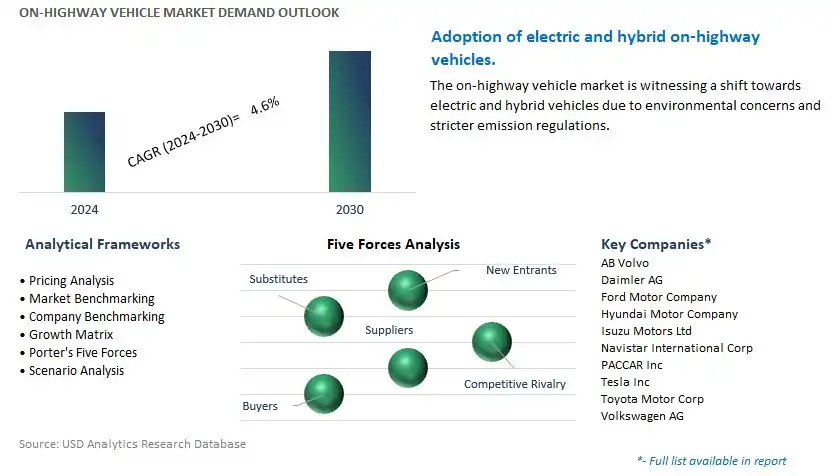
The global On-highway Vehicle market is highly competitive with a large number of companies focusing on niche market segments. Amidst intense competitive conditions, On-highway Vehicle Companies are investing in new product launches and strengthening distribution channels. Key companies operating in the On-highway Vehicle Market Industry include- AB Volvo, Daimler AG, Ford Motor Company, Hyundai Motor Company, Isuzu Motors Ltd, Navistar International Corp, PACCAR Inc, Tesla Inc, Toyota Motor Corp, Volkswagen AG.
One prominent trend in the On-Highway Vehicle Market is the electrification of vehicles. With increasing concerns about carbon emissions, air pollution, and the need for sustainable transportation, there is a significant shift towards electric propulsion systems in on-highway vehicles. This trend is driven by advancements in battery technology, regulatory pressures to reduce emissions, and growing consumer interest in environmentally friendly transportation options. Manufacturers are investing heavily in electric vehicle (EV) technology, developing electric trucks, buses, and vans to meet the evolving demands of the market and address sustainability goals.
A significant driver propelling the On-Highway Vehicle Market is government regulations and emission standards. Governments worldwide are implementing stringent regulations to curb greenhouse gas emissions and improve air quality, prompting automakers to accelerate the development and adoption of cleaner and more fuel-efficient vehicles. Stringent emission standards, such as Euro 6 in Europe and EPA regulations in the United States, incentivize the adoption of alternative fuel vehicles, including electric, hybrid, and hydrogen-powered vehicles. Compliance with these regulations drives innovation in vehicle technology and fuels the demand for on-highway vehicles that meet or exceed environmental standards.
An emerging Market Opportunity in the On-Highway Vehicle Market is the development of autonomous vehicles (AVs). With rapid advancements in artificial intelligence, sensor technology, and connectivity, autonomous driving technology holds the potential to revolutionize the transportation industry, offering improved safety, efficiency, and mobility solutions. AVs have the potential to enhance productivity, reduce traffic congestion, and lower transportation costs by enabling driverless operation in various on-highway applications, including long-haul trucking, public transportation, and ride-sharing services. As the technology matures and regulatory frameworks evolve, there are opportunities for automakers, technology companies, and transportation providers to capitalize on the growth of autonomous on-highway vehicles and shape the future of mobility.
By Lighting
High-Intensity Discharge (HID)
Incandescent
Halogen
Light-Emitting Diode (LED)
LASER
Organic Light-Emitting Diode (OLED)
Xenon
By Vehicle
Bus
Motorcycle
Passenger Car
Electric Vehicle
By Transmission
Manual Transmission
Automatic Transmission
Automated Manual Transmission
By Fuel
Diesel
Gas Powered
Electricity
OthersGeographical Analysis
North America (United States, Canada, Mexico)
Europe (Germany, France, United Kingdom, Spain, Italy, Rest of Europe)
Asia Pacific (China, India, Japan, South Korea, Rest of Asia Pacific)
South America (Brazil, Argentina, Rest of South America)
Middle East and Africa (Saudi Arabia, UAE, Rest of Middle East, South Africa, Egypt, Rest of Africa
AB Volvo
Daimler AG
Ford Motor Company
Hyundai Motor Company
Isuzu Motors Ltd
Navistar International Corp
PACCAR Inc
Tesla Inc
Toyota Motor Corp
Volkswagen AG
*- List not Exhaustive
TABLE OF CONTENTS
1 Introduction to 2024 On-highway Vehicle Market
1.1 Market Overview
1.2 Quick Facts
1.3 Scope/Objective of the Study
1.4 Market Definition
1.5 Countries and Regions Analyzed
1.6 Units, Currency, and Conversions
1.7 Industry Value Chain
2 Research Methodology
2.1 Market Size Estimation
2.2 Sources and Research Methodology
2.3 Data Triangulation
2.4 Assumptions and Limitations
3 Executive Summary
3.1 Global On-highway Vehicle Market Size Outlook, $ Million, 2021 to 2030
3.2 On-highway Vehicle Market Outlook by Type, $ Million, 2021 to 2030
3.3 On-highway Vehicle Market Outlook by Product, $ Million, 2021 to 2030
3.4 On-highway Vehicle Market Outlook by Application, $ Million, 2021 to 2030
3.5 On-highway Vehicle Market Outlook by Key Countries, $ Million, 2021 to 2030
4 Market Dynamics
4.1 Key Driving Forces of On-highway Vehicle Industry
4.2 Key Market Trends in On-highway Vehicle Industry
4.3 Potential Opportunities in On-highway Vehicle Industry
4.4 Key Challenges in On-highway Vehicle Industry
5 Market Factor Analysis
5.1 Value Chain Analysis
5.2 Competitive Landscape
5.2.1 Global On-highway Vehicle Market Share by Company (%), 2023
5.2.2 Product Offerings by Company
5.3 Porter’s Five Forces Analysis
5.4 Pricing Analysis and Outlook
6 Growth Outlook Across Scenarios
6.1 Growth Analysis-Case Scenario Definitions
6.2 Low Growth Scenario Forecasts
6.3 Reference Growth Scenario Forecasts
6.4 High Growth Scenario Forecasts
7 Global On-highway Vehicle Market Outlook by Segments
7.1 On-highway Vehicle Market Outlook by Segments, $ Million, 2021- 2030
By Lighting
High-Intensity Discharge (HID)
Incandescent
Halogen
Light-Emitting Diode (LED)
LASER
Organic Light-Emitting Diode (OLED)
Xenon
By Vehicle
Bus
Motorcycle
Passenger Car
Electric Vehicle
By Transmission
Manual Transmission
Automatic Transmission
Automated Manual Transmission
By Fuel
Diesel
Gas Powered
Electricity
Others
8 North America On-highway Vehicle Market Analysis and Outlook To 2030
8.1 Introduction to North America On-highway Vehicle Markets in 2024
8.2 North America On-highway Vehicle Market Size Outlook by Country, 2021-2030
8.2.1 United States
8.2.2 Canada
8.2.3 Mexico
8.3 North America On-highway Vehicle Market size Outlook by Segments, 2021-2030
By Lighting
High-Intensity Discharge (HID)
Incandescent
Halogen
Light-Emitting Diode (LED)
LASER
Organic Light-Emitting Diode (OLED)
Xenon
By Vehicle
Bus
Motorcycle
Passenger Car
Electric Vehicle
By Transmission
Manual Transmission
Automatic Transmission
Automated Manual Transmission
By Fuel
Diesel
Gas Powered
Electricity
Others
9 Europe On-highway Vehicle Market Analysis and Outlook To 2030
9.1 Introduction to Europe On-highway Vehicle Markets in 2024
9.2 Europe On-highway Vehicle Market Size Outlook by Country, 2021-2030
9.2.1 Germany
9.2.2 France
9.2.3 Spain
9.2.4 United Kingdom
9.2.4 Italy
9.2.5 Russia
9.2.6 Norway
9.2.7 Rest of Europe
9.3 Europe On-highway Vehicle Market Size Outlook by Segments, 2021-2030
By Lighting
High-Intensity Discharge (HID)
Incandescent
Halogen
Light-Emitting Diode (LED)
LASER
Organic Light-Emitting Diode (OLED)
Xenon
By Vehicle
Bus
Motorcycle
Passenger Car
Electric Vehicle
By Transmission
Manual Transmission
Automatic Transmission
Automated Manual Transmission
By Fuel
Diesel
Gas Powered
Electricity
Others
10 Asia Pacific On-highway Vehicle Market Analysis and Outlook To 2030
10.1 Introduction to Asia Pacific On-highway Vehicle Markets in 2024
10.2 Asia Pacific On-highway Vehicle Market Size Outlook by Country, 2021-2030
10.2.1 China
10.2.2 India
10.2.3 Japan
10.2.4 South Korea
10.2.5 Indonesia
10.2.6 Malaysia
10.2.7 Australia
10.2.8 Rest of Asia Pacific
10.3 Asia Pacific On-highway Vehicle Market size Outlook by Segments, 2021-2030
By Lighting
High-Intensity Discharge (HID)
Incandescent
Halogen
Light-Emitting Diode (LED)
LASER
Organic Light-Emitting Diode (OLED)
Xenon
By Vehicle
Bus
Motorcycle
Passenger Car
Electric Vehicle
By Transmission
Manual Transmission
Automatic Transmission
Automated Manual Transmission
By Fuel
Diesel
Gas Powered
Electricity
Others
11 South America On-highway Vehicle Market Analysis and Outlook To 2030
11.1 Introduction to South America On-highway Vehicle Markets in 2024
11.2 South America On-highway Vehicle Market Size Outlook by Country, 2021-2030
11.2.1 Brazil
11.2.2 Argentina
11.2.3 Rest of South America
11.3 South America On-highway Vehicle Market size Outlook by Segments, 2021-2030
By Lighting
High-Intensity Discharge (HID)
Incandescent
Halogen
Light-Emitting Diode (LED)
LASER
Organic Light-Emitting Diode (OLED)
Xenon
By Vehicle
Bus
Motorcycle
Passenger Car
Electric Vehicle
By Transmission
Manual Transmission
Automatic Transmission
Automated Manual Transmission
By Fuel
Diesel
Gas Powered
Electricity
Others
12 Middle East and Africa On-highway Vehicle Market Analysis and Outlook To 2030
12.1 Introduction to Middle East and Africa On-highway Vehicle Markets in 2024
12.2 Middle East and Africa On-highway Vehicle Market Size Outlook by Country, 2021-2030
12.2.1 Saudi Arabia
12.2.2 UAE
12.2.3 Oman
12.2.4 Rest of Middle East
12.2.5 Egypt
12.2.6 Nigeria
12.2.7 South Africa
12.2.8 Rest of Africa
12.3 Middle East and Africa On-highway Vehicle Market size Outlook by Segments, 2021-2030
By Lighting
High-Intensity Discharge (HID)
Incandescent
Halogen
Light-Emitting Diode (LED)
LASER
Organic Light-Emitting Diode (OLED)
Xenon
By Vehicle
Bus
Motorcycle
Passenger Car
Electric Vehicle
By Transmission
Manual Transmission
Automatic Transmission
Automated Manual Transmission
By Fuel
Diesel
Gas Powered
Electricity
Others
13 Company Profiles
13.1 Company Snapshot
13.2 SWOT Profiles
13.3 Products and Services
13.4 Recent Developments
13.5 Financial Profile
List of Companies
AB Volvo
Daimler AG
Ford Motor Company
Hyundai Motor Company
Isuzu Motors Ltd
Navistar International Corp
PACCAR Inc
Tesla Inc
Toyota Motor Corp
Volkswagen AG
14 Appendix
14.1 Customization Offerings
14.2 Subscription Services
14.3 Related Reports
14.4 Publisher Expertise
By Lighting
High-Intensity Discharge (HID)
Incandescent
Halogen
Light-Emitting Diode (LED)
LASER
Organic Light-Emitting Diode (OLED)
Xenon
By Vehicle
Bus
Motorcycle
Passenger Car
Electric Vehicle
By Transmission
Manual Transmission
Automatic Transmission
Automated Manual Transmission
By Fuel
Diesel
Gas Powered
Electricity
Others
The global On-highway Vehicle Market is one of the lucrative growth markets, poised to register a 4.6% growth (CAGR) between 2024 and 2030.
Emerging Markets across Asia Pacific, Europe, and Americas present robust growth prospects.
AB Volvo, Daimler AG, Ford Motor Company, Hyundai Motor Company, Isuzu Motors Ltd, Navistar International Corp, PACCAR Inc, Tesla Inc, Toyota Motor Corp, Volkswagen AG
Base Year- 2023; Estimated Year- 2024; Historic Period- 2018-2023; Forecast period- 2024 to 2030; Currency: USD; Volume