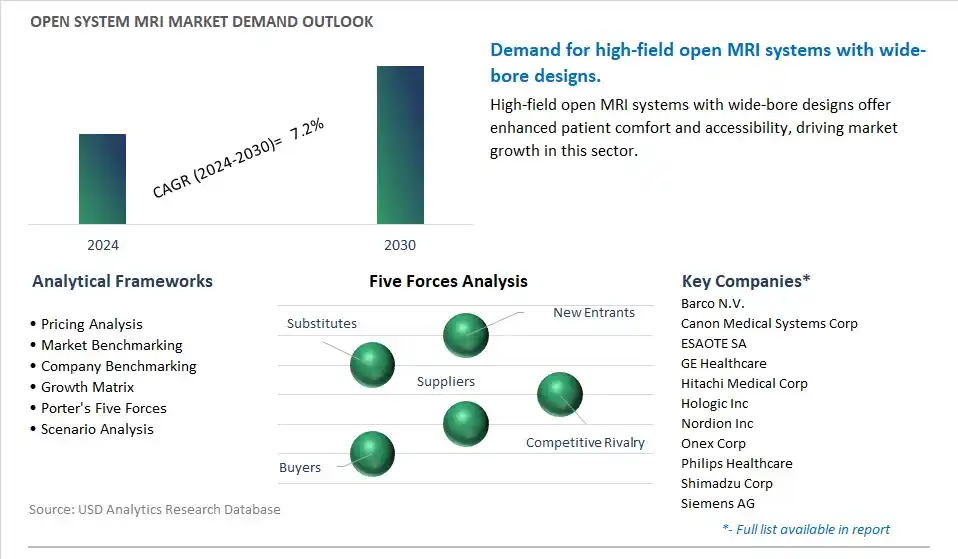
Open System MRI Market is estimated to increase at a growth rate of 7.2% CAGR over the forecast period from 2024 to 2030.
The global Open System MRI Market Study analyzes and forecasts the market size across 6 regions and 24 countries for diverse segments including By Resolution (Low- Field Scanner, Mid-field Scanner, High-Field Scanner), By Application (Neurology, Gastroenterology, Cardiology, Oncology, Others).
An Introduction to Open System MRI Market in 2024
The Open System MRI Market is experiencing rapid growth and adoption in 2024, driven by increasing demand for versatile and patient-friendly magnetic resonance imaging (MRI) solutions across diverse clinical settings. Unlike traditional closed-bore MRI systems, open MRI systems offer a more spacious and accessible imaging environment, making them ideal for claustrophobic patients, pediatric populations, and individuals with mobility issues. The market is characterized by advancements in magnet design, gradient technology, and image reconstruction algorithms, enabling high-resolution imaging with improved patient comfort and diagnostic accuracy. Moreover, there is growing adoption of open MRI systems in outpatient imaging centers, ambulatory care facilities, and rural healthcare settings, facilitating broader access to advanced diagnostic capabilities and reducing wait times for MRI scans. As healthcare providers prioritize patient-centered care and imaging quality, the Open System MRI Market holds promise for continued innovation and market expansion, driving improvements in diagnostic imaging outcomes and patient satisfaction.
Open System MRI Market Competitive Landscape
The global Open System MRI Industry is highly competitive with a large number of companies focusing on niche market segments. Amidst intense competitive conditions, Open System MRI Companies are investing in new product launches and strengthening distribution channels. Key companies operating in the Open System MRI Industry include- Barco N.V., Canon Medical Systems Corp, ESAOTE SA, GE Healthcare, Hitachi Medical Corp, Hologic Inc, Nordion Inc, Onex Corp, Philips Healthcare, Shimadzu Corp, Siemens AG, Toshiba Corp.
Open System MRI Market Trend: Demand for Patient-Centric Imaging Solutions
In the Open System MRI market, a prominent trend is the increasing demand for patient-centric imaging solutions. Open MRI systems, characterized by their open-sided design and wider bore, offer a more comfortable and less claustrophobic imaging experience for patients compared to traditional closed-bore MRI scanners. This trend is driven by a growing emphasis on patient satisfaction, particularly among pediatric, claustrophobic, and obese patients who may experience anxiety or discomfort during MRI examinations. Additionally, open MRI systems accommodate patients with physical disabilities, such as those requiring wheelchair access or larger body sizes, enhancing inclusivity and accessibility in medical imaging. As healthcare providers prioritize patient-centered care and strive to improve the overall imaging experience, the adoption of open system MRI technology is expected to continue growing, driving market expansion and innovation in patient-friendly MRI solutions.
Open System MRI Market Driver: Diverse Clinical Applications and Imaging Capabilities
The primary market driver for Open System MRI is the diverse clinical applications and imaging capabilities offered by these systems. Open MRI technology has evolved significantly since its inception, with modern systems offering high-field strength magnets, advanced imaging sequences, and specialized coils for comprehensive diagnostic imaging across various anatomical regions and clinical indications. Open system MRI is utilized in a wide range of medical specialties, including neurology, orthopedics, oncology, cardiology, and pediatric imaging, enabling clinicians to visualize and evaluate anatomical structures, soft tissue abnormalities, and disease processes with exceptional detail and precision. Furthermore, advancements in imaging techniques, such as functional MRI (fMRI), diffusion-weighted imaging (DWI), and magnetic resonance spectroscopy (MRS), expand the diagnostic capabilities of open MRI systems, allowing for non-invasive assessment of brain function, tissue microstructure, and metabolic activity. As healthcare providers seek versatile and reliable imaging solutions to support diagnosis, treatment planning, and patient management across diverse clinical scenarios, open system MRI technology continues to be a vital tool in modern medical practice, driving market demand and investment in advanced MRI platforms.
Open System MRI Market Opportunity: Integration of Artificial Intelligence (AI) and Image Reconstruction Techniques
An emerging opportunity in the Open System MRI market lies in the integration of artificial intelligence (AI) and image reconstruction techniques to enhance diagnostic accuracy, efficiency, and workflow optimization. AI-driven algorithms offer the potential to automate image reconstruction, noise reduction, artifact correction, and image interpretation tasks, improving the quality and consistency of MRI scans while reducing the burden on radiologists and technologists. By leveraging machine learning and deep learning techniques, open system MRI manufacturers can develop AI-powered software solutions that optimize scan protocols, enhance image quality, and enable real-time image analysis for rapid diagnosis and treatment planning. Additionally, AI-enabled decision support tools can assist radiologists in detecting subtle abnormalities, quantifying disease severity, and predicting patient outcomes based on imaging findings, facilitating more informed clinical decisions and personalized patient care. Collaborative partnerships between MRI vendors, AI developers, healthcare institutions, and regulatory agencies are essential for advancing the integration of AI into open system MRI platforms, ensuring regulatory compliance, clinical validation, and widespread adoption of AI-enhanced imaging solutions in routine clinical practice.
Open System MRI Market Share Analysis: High-Field Scanner for Neurology is the fastest growing market segment over the forecast period to 2030
Among the different resolutions of open system MRI, the High-Field Scanner segment for Neurology applications is experiencing the fastest growth. This growth is propelled by advancements in imaging technology and the increasing demand for high-resolution MRI scans for neurological conditions. High-field MRI scanners, typically operating at 1.5 Tesla (T) or higher, offer superior image quality and spatial resolution compared to low- and mid-field scanners, making them well-suited for detailed visualization of anatomical structures and pathological changes in the brain and nervous system. In neurology, high-field MRI is essential for diagnosing and monitoring a wide range of neurological disorders, including stroke, multiple sclerosis, brain tumors, epilepsy, and neurodegenerative diseases such as Alzheimer's and Parkinson's. The high-resolution images produced by these scanners enable clinicians to accurately identify lesions, assess disease progression, and plan optimal treatment strategies for patients. Additionally, ongoing advancements in high-field MRI technology, such as improved coil designs, parallel imaging techniques, and advanced image reconstruction algorithms, are further enhancing image quality and reducing scan times, thereby increasing the clinical utility and accessibility of high-field MRI in neurology. As the demand for precise and comprehensive imaging in neurological practice continues to grow, the adoption of high-field MRI scanners for neurology applications is expected to accelerate, driving innovation and improving patient care in the field of neuroimaging.
Open System MRI Market Segmentation
By Resolution
Low- Field Scanner
Mid-field Scanner
High-Field Scanner
By Application
Neurology
Gastroenterology
Cardiology
Oncology
Others
Geographical Analysis
North America (United States, Canada, Mexico)
Europe (Germany, France, United Kingdom, Spain, Italy, Rest of Europe)
Asia Pacific (China, India, Japan, South Korea, Rest of Asia Pacific)
South America (Brazil, Argentina, Rest of South America)
Middle East and Africa (Saudi Arabia, UAE, Rest of Middle East, South Africa, Egypt, Rest of Africa)
Open System MRI Companies
Barco N.V.
Canon Medical Systems Corp
ESAOTE SA
GE Healthcare
Hitachi Medical Corp
Hologic Inc
Nordion Inc
Onex Corp
Philips Healthcare
Shimadzu Corp
Siemens AG
Toshiba Corp
* List not Exhaustive
Reasons to Buy the Open System MRI Market Study
• Deepen your industry insights and navigate uncertainties for strategy formulation, CAPEX, and Operational decisions
• Gain access to detailed insights on the Open System MRI Market, encompassing current market size, growth trends, and forecasts till 2030.
• Access detailed competitor analysis, enabling competitive advantage through a thorough understanding of market players, strategies, and potential differentiation opportunities
• Stay ahead of the curve with insights on technological advancements, innovations, and upcoming trends
• Identify lucrative investment avenues and expansion opportunities within the Open System MRI Industry, guided by robust, data-backed analysis.
• Understand regional and global markets through country-wise analysis, regional market potential, regulatory nuances, and dynamics
• Execute strategies with confidence and speed through information, analytics, and insights on the industry value chain
• Corporate leaders, strategists, financial experts, shareholders, asset managers, and governmental representatives can make long-term planning scenarios and build an integrated and timely understanding of market dynamics
• Benefit from tailored solutions and expert consultation based on report insights, providing personalized strategies aligned with specific business needs.
TABLE OF CONTENTS
1 Introduction to 2024 Open System MRI Market
1.1 Market Overview
1.2 Quick Facts
1.3 Scope/Objective of the Study
1.4 Market Definition
1.5 Countries and Regions Analyzed
1.6 Units, Currency, and Conversions
1.7 Industry Value Chain
2 Research Methodology
2.1 Market Size Estimation
2.2 Sources and Research Methodology
2.3 Data Triangulation
2.4 Assumptions and Limitations
3 Executive Summary
3.1 Global Open System MRI Market Size Outlook, $ Million, 2021 to 2030
3.2 Open System MRI Market Outlook by Type, $ Million, 2021 to 2030
3.3 Open System MRI Market Outlook by Product, $ Million, 2021 to 2030
3.4 Open System MRI Market Outlook by Application, $ Million, 2021 to 2030
3.5 Open System MRI Market Outlook by Key Countries, $ Million, 2021 to 2030
4 Market Dynamics
4.1 Key Driving Forces of Open System MRI Industry
4.2 Key Market Trends in Open System MRI Industry
4.3 Potential Opportunities in Open System MRI Industry
4.4 Key Challenges in Open System MRI Industry
5 Market Factor Analysis
5.1 Value Chain Analysis
5.2 Competitive Landscape
5.2.1 Global Open System MRI Market Share by Company (%), 2023
5.2.2 Product Offerings by Company
5.3 Porter’s Five Forces Analysis
5.4 Pricing Analysis and Outlook
6 Growth Outlook Across Scenarios
6.1 Growth Analysis-Case Scenario Definitions
6.2 Low Growth Scenario Forecasts
6.3 Reference Growth Scenario Forecasts
6.4 High Growth Scenario Forecasts
7 Global Open System MRI Market Outlook by Segments
7.1 Open System MRI Market Outlook by Segments, $ Million, 2021- 2030
By Resolution
Low- Field Scanner
Mid-field Scanner
High-Field Scanner
By Application
Neurology
Gastroenterology
Cardiology
Oncology
Others
8 North America Open System MRI Market Analysis and Outlook To 2030
8.1 Introduction to North America Open System MRI Markets in 2024
8.2 North America Open System MRI Market Size Outlook by Country, 2021-2030
8.2.1 United States
8.2.2 Canada
8.2.3 Mexico
8.3 North America Open System MRI Market size Outlook by Segments, 2021-2030
By Resolution
Low- Field Scanner
Mid-field Scanner
High-Field Scanner
By Application
Neurology
Gastroenterology
Cardiology
Oncology
Others
9 Europe Open System MRI Market Analysis and Outlook To 2030
9.1 Introduction to Europe Open System MRI Markets in 2024
9.2 Europe Open System MRI Market Size Outlook by Country, 2021-2030
9.2.1 Germany
9.2.2 France
9.2.3 Spain
9.2.4 United Kingdom
9.2.4 Italy
9.2.5 Russia
9.2.6 Norway
9.2.7 Rest of Europe
9.3 Europe Open System MRI Market Size Outlook by Segments, 2021-2030
By Resolution
Low- Field Scanner
Mid-field Scanner
High-Field Scanner
By Application
Neurology
Gastroenterology
Cardiology
Oncology
Others
10 Asia Pacific Open System MRI Market Analysis and Outlook To 2030
10.1 Introduction to Asia Pacific Open System MRI Markets in 2024
10.2 Asia Pacific Open System MRI Market Size Outlook by Country, 2021-2030
10.2.1 China
10.2.2 India
10.2.3 Japan
10.2.4 South Korea
10.2.5 Indonesia
10.2.6 Malaysia
10.2.7 Australia
10.2.8 Rest of Asia Pacific
10.3 Asia Pacific Open System MRI Market size Outlook by Segments, 2021-2030
By Resolution
Low- Field Scanner
Mid-field Scanner
High-Field Scanner
By Application
Neurology
Gastroenterology
Cardiology
Oncology
Others
11 South America Open System MRI Market Analysis and Outlook To 2030
11.1 Introduction to South America Open System MRI Markets in 2024
11.2 South America Open System MRI Market Size Outlook by Country, 2021-2030
11.2.1 Brazil
11.2.2 Argentina
11.2.3 Rest of South America
11.3 South America Open System MRI Market size Outlook by Segments, 2021-2030
By Resolution
Low- Field Scanner
Mid-field Scanner
High-Field Scanner
By Application
Neurology
Gastroenterology
Cardiology
Oncology
Others
12 Middle East and Africa Open System MRI Market Analysis and Outlook To 2030
12.1 Introduction to Middle East and Africa Open System MRI Markets in 2024
12.2 Middle East and Africa Open System MRI Market Size Outlook by Country, 2021-2030
12.2.1 Saudi Arabia
12.2.2 UAE
12.2.3 Oman
12.2.4 Rest of Middle East
12.2.5 Egypt
12.2.6 Nigeria
12.2.7 South Africa
12.2.8 Rest of Africa
12.3 Middle East and Africa Open System MRI Market size Outlook by Segments, 2021-2030
By Resolution
Low- Field Scanner
Mid-field Scanner
High-Field Scanner
By Application
Neurology
Gastroenterology
Cardiology
Oncology
Others
13 Company Profiles
13.1 Company Snapshot
13.2 SWOT Profiles
13.3 Products and Services
13.4 Recent Developments
13.5 Financial Profile
List of Companies
Barco N.V.
Canon Medical Systems Corp
ESAOTE SA
GE Healthcare
Hitachi Medical Corp
Hologic Inc
Nordion Inc
Onex Corp
Philips Healthcare
Shimadzu Corp
Siemens AG
Toshiba Corp
14 Appendix
14.1 Customization Offerings
14.2 Subscription Services
14.3 Related Reports
14.4 Publisher Expertise
